

AI search systems prioritize content that signals real expertise, clear citations, and extractable answer blocks. Google AI Overviews, ChatGPT, and Perplexity all follow a version of the same logic: retrieve candidate pages, score passages for information quality, then lift and attribute the best-matched excerpt. If your content lacks a named author, sourced data, or a clean answer capsule, it gets passed over regardless of how well it ranks organically.
The core signals AI systems check before citing your content:
- Named author with credentials, title, affiliation, and a sameAs link (LinkedIn or institutional profile)
- Visible publication and last-updated timestamps in both the page markup and the visible text
- Citable statistics or case metrics with inline source links
- Answer-first capsules of 40–80 words placed directly under a question heading
- Stacked schema: Article + FAQPage (or HowTo) in JSON-LD
- Domain and entity signals: consistent mentions on trusted third-party sites
Three tests to run on any page right now:
- Add a 40–80 word direct answer under your top question heading and check whether a retrieval tool can extract it cleanly.
- Attach Article + Person schema with the author's credentials and a sameAs link to their LinkedIn or institutional profile.
- Add at least one sourced statistic with an inline citation link, replacing any qualitative claim you cannot back with a number.
For business owners in Tyler, Texas, start by auditing your highest-traffic pages against these three tests before touching anything else.
Table of Contents
- How do AI search systems actually evaluate content quality?
- What does E-E-A-T actually mean for AI citation eligibility?
- Why does long-form content win, and when does it not?
- What structural signals make your content extractable by AI?
- How do specific data and case studies become citation magnets?
- How do freshness signals affect your chances of being cited?
- What does the AI citation optimization checklist look like in practice?
- How does a done-for-you authority system implement this checklist?
- What this shift means for marketers and content teams
- Executive Edge Authority Engine: built for teams ready to earn AI citations
- Useful sources and resources to read next
- FAQ
How do AI search systems actually evaluate content quality?
AI citation is a three-stage process, and most content fails at stage two.
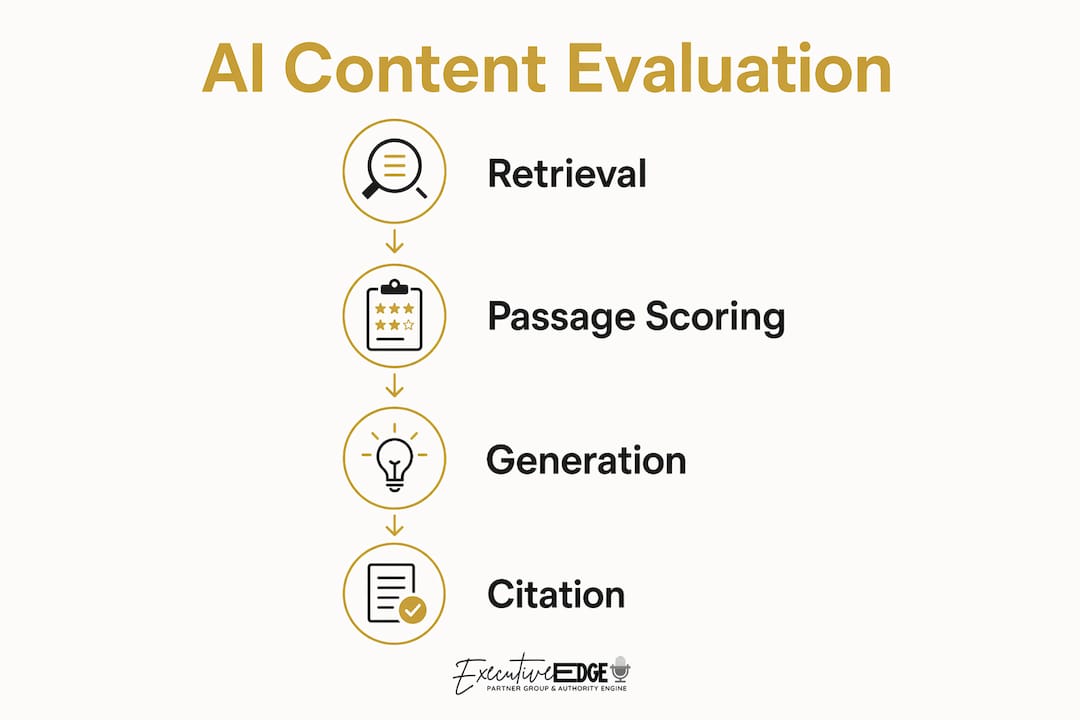
Stage 1: Retrieval. The AI platform queries its index and pulls candidate pages. Google AI Overviews cite top-10 organic results a majority of the time, which means classic SEO still matters as a gate. If you are not in the top 10 for a query, most platforms will never consider your content for citation.
Stage 2: Passage scoring. This is where most expert content loses. The model scores discrete passages using embedding similarity to the query and information gain. A page that answers the query plus three related sub-questions creates more extractable matches than a page that covers only the primary question. Earned mentions on trusted sites also factor in here: consistent entity signals across LinkedIn, review platforms, and industry publications correlate more strongly with citation presence than raw backlink counts.
Stage 3: Generation and citation. The model lifts a passage, attributes it, and includes it in the answer. The unit of citation is almost always a self-contained block of roughly 40–80 words. Perplexity tends to pull from recent, well-sourced pages. ChatGPT draws on its training data plus browsing. Google AI Overviews weight freshness heavily for time-sensitive queries. The platform differences matter less than the shared requirement: a clean, extractable passage backed by verifiable signals.
Understanding how AI search discovery works at the passage level changes how you write every section of a page.

What does E-E-A-T actually mean for AI citation eligibility?
Google's E-E-A-T framework (Experience, Expertise, Authoritativeness, Trustworthiness) was designed for human quality raters, but AI systems operationalize the same signals through pattern matching. Each dimension maps to concrete, checkable page elements.
Experience means first-hand evidence. AI engines look for named practitioners, specific case outcomes, and language that reflects direct involvement rather than summarized research. A quote from a named professional with their title and organization attached carries more weight than a generic claim.
Expertise is largely about the author record. Named, credentialed authors with visible affiliations are a primary eligibility signal for generative engines. The author bio should include: full name, professional title, credentials or certifications, organizational affiliation, and a link to a verifiable profile page.
Authoritativeness comes from outside your site. Third-party mentions, citations in other publications, and consistent presence on review platforms all contribute. This is why PR and earned media are not optional extras in a GEO strategy.
Trustworthiness is the most mechanical of the four. Clear sourcing, visible timestamps, and correction logs are all checkable. A page with no update date and no inline citations scores poorly on this dimension regardless of how good the content is.
Practical author-block checklist:
- Full name and professional title visible near the top of the page
- Credentials and organizational affiliation in plain text
- Link to LinkedIn or institutional profile page (sameAs in schema)
- Publication date and last-updated date visible in the page body
- Article + Person schema in JSON-LD, with the author's sameAs property populated
Pro Tip: Make the author block machine-friendly by placing Article + Person schema in JSON-LD and positioning the author byline near the top of long-form content. A schema validator like Google's Rich Results Test will confirm the engine can read it.
Executives who want to understand how this plays out in practice can read more about how executives use AI content tools to build verifiable author signals.
Why does long-form content win, and when does it not?
Word count is a proxy, not a cause. The real mechanism is passage-retrieval coverage.
AI models match query embeddings to discrete passages across a page. A page that answers the primary question and four related sub-questions gives the model five potential citation candidates. A page that answers only the primary question gives it one. Pages covering a topic end-to-end are cited significantly more often than thin pages, and topical completeness across three to five sub-questions is one of the strongest predictors of citation odds.
Length thresholds matter too, but only as a floor. Pages under 800 words on complex B2B topics rarely get cited by Claude or Perplexity on multi-part queries. Medium-length content tends to maximize passage-retrieval coverage for professional topics without padding.
| Depth element | Estimated citation lift | Notes |
|---|---|---|
| Topical completeness (3–5 sub-questions covered) | ~2.4x vs. thin pages | Presenc.ai research |
| Adding primary statistics and authoritative citations | Up to ~40% lift | Aggarwal et al. / Alice Labs synthesis |
| Answer-first capsule (40–80 words) | High extractability | Soku GEO guidance |
| Pages under 800 words (complex B2B) | Substantially lower | Presenc.ai research |
What to expand vs. what to cut:
- Expand: edge cases, counter-arguments, sourced data, practitioner examples
- Cut: repetitive summaries, generic lists that restate the heading, padding that adds sentences without adding information
A good 40–80 word answer capsule looks like this: "AI search systems favor content with named authors, sourced statistics, and self-contained answer blocks. Pages that cover a primary question plus three to five sub-questions are cited ~2.4x more often than thin pages. The fastest fix is adding a direct answer under each question heading before expanding into detail." A bloated paragraph that buries the same point in five sentences of context will be skipped by the retrieval pipeline entirely.
What structural signals make your content extractable by AI?
Structure is not decoration. It is the mechanism by which a retrieval model finds and lifts your best passage.

The answer-first pattern is the single most reliable structural tactic. Place a 40–80 word direct answer immediately under a question heading, then expand with detail. GEO guidance from Soku identifies this capsule format as the primary unit of extractability for AI answers. The capsule should stand alone: a reader who sees only that block should get a complete, usable answer.
Schema types that improve citation eligibility:
- Article with author, datePublished, and dateModified properties
- FAQPage with Question and Answer pairs matching your heading structure
- HowTo for step-by-step content with named steps and descriptions
- Person linked from Article's author property, with sameAs to LinkedIn or an institutional profile
Stacked schema (Article + FAQPage in the same JSON-LD block) helps AI systems parse extractable Q&A units from your page. Multiple practical guides confirm this raises citation eligibility, though the lift varies by platform and query type.
On the technical side: allow GPTBot and PerplexityBot in your robots.txt. Consider adding an llms.txt file at your domain root to signal content permissions to AI crawlers. Keep your HTML clean enough that a chunking algorithm can identify paragraph boundaries without guessing.
Pro Tip: Put the short answer capsule before any narrative introduction. Passage extraction finds the first strong candidate and often stops there. If your best answer is buried in paragraph four, it may never surface.
How do specific data and case studies become citation magnets?
AI engines prefer passages with verifiable numbers and explicit sourcing. A qualitative claim ("our clients see strong results") is nearly invisible to a retrieval model. A specific, attributed figure ("clients in this category saw a 34% reduction in time-to-close, per internal tracking across 12 accounts") is a high-weight retrieval anchor.
Content with attributed figures is consistently preferred by AI systems over qualitative claims, and GEO experiments attribute notable visibility lifts to adding primary statistics and authoritative citations. That is not a marginal improvement.
How to format citable data for maximum extraction:
- State the result in one sentence with the metric and the scope (who, how many, over what period).
- Add a brief method note (survey, internal tracking, third-party audit) so the claim is verifiable in principle.
- Link the source inline on the key figure, not on the word "source."
- Keep the whole data callout under 60 words so it fits the capsule format.
For case studies, the extractable structure is: one-sentence result, the metric, brief method note, source or attribution. A case study buried in narrative prose is not citable. The same information formatted as a labeled data callout with a source link is.
When you have real client work, convert it into citable case data with the client's permission. Anonymized aggregate metrics ("across 8 service-based clients over 6 months") are more citable than vague references to "past projects."
How do freshness signals affect your chances of being cited?
Recency matters differently across platforms. Perplexity weights it heavily for any query with a time dimension. Google AI Overviews prioritize recent updates for news-adjacent and data-driven topics. ChatGPT's browsing mode pulls from recently indexed pages when the query implies current information.
Freshness signals AI platforms check:
dateModifiedin Article schema, matching a visible "last updated" date in the page bodylastReviewedandnextReviewDueproperties for health, legal, or compliance content- A visible update changelog near the top of the page (one line per update is enough)
- Content-level changes that reflect current data, not just a metadata timestamp update
A metadata-only update (changing the date without changing the content) is detectable and does not reliably improve citation odds. The update needs to be substantive: a new statistic, a corrected figure, a new sub-question answered.
For evergreen content like explainers and how-to guides, a quarterly review cycle is usually sufficient. Data-driven reports and industry benchmarks should be reviewed whenever the underlying data changes, or at minimum every six months. A simple update log at the top of the page ("Updated March 2026: revised citation-lift figures from Presenc.ai research") signals both freshness and editorial rigor.
What does the AI citation optimization checklist look like in practice?
Prioritize by time-to-impact. Some fixes show results in days; others take months.
| Task | Priority | Expected time-to-impact |
|---|---|---|
| Add 40–80 word answer capsule under question headings | Quick win | Days |
| Add/update visible timestamps and update changelog | Quick win | Days |
| Attach Article + Person schema with sameAs | Technical fix | 2–4 weeks |
| Add llms.txt and allow AI crawlers in robots.txt | Technical fix | 2–4 weeks |
| Add sourced statistics with inline citation links | Content upgrade | 2–6 weeks |
| Expand thin pages to cover 3–5 sub-questions | Content upgrade | 4–8 weeks |
| Earned mentions: PR, guest posts, industry directories | PR and entity | 3–6 months |
| Consistent entity descriptions across LinkedIn, review sites | PR and entity | 3–6 months |
Measurement: how to track AI visibility
- Run manual prompt audits in Perplexity and ChatGPT monthly: search your target queries and check whether your brand or content appears in the answer.
- Monitor Google AI Overviews for your top 20 queries using Google Search Console impression data as a proxy.
- Track organic rank as a retrieval gate: if you fall below position 10, citation probability drops sharply.
- Watch downstream engagement: leads or conversions from pages you have optimized for AI citation, not just traffic.
For a deeper look at how to get found on AI search, the full tactical breakdown covers measurement setup in detail.
How does a done-for-you authority system implement this checklist?
The checklist above is straightforward on paper. Executing it consistently across a full content library while running a business is a different problem. The Executive Edge Authority Engine workflow maps directly to each checklist stage.
The implementation sequence:
- Audit: Identify high-intent pages missing answer capsules, author schema, or sourced data.
- Answer-capsule creation: Write 40–80 word extractable answers for each target question heading.
- Schema injection: Add Article + Person + FAQPage JSON-LD with author credentials and sameAs links.
- Data and case collection: Gather client metrics and format them as citable data callouts with method notes.
- Earned-mention PR: Pitch industry publications, directories, and partner sites to build third-party entity signals.
- Monitoring: Run monthly prompt audits across Perplexity, ChatGPT, and Google AI Overviews; adjust based on citation frequency.
David Domm and the Executive Edge Authority Engine team execute this sequence as a managed workflow, not a one-time project. The system is built for service-based businesses, consultants, and executives who want consistent AI citation presence without rebuilding their content operation from scratch.
Author credentials and verification links are displayed via Article + Person schema on every published piece. For deeper reading on the content side of this workflow, the educational content marketing guide covers how expertise-driven content is structured for natural citability.
What this shift means for marketers and content teams
The KPI that matters most is changing. Organic traffic is still worth tracking, but citation share in AI answers is becoming the primary brand visibility metric for professional services, B2B, and high-consideration categories. A page that earns consistent AI citations can drive qualified leads even when its organic rank fluctuates.
That shift has real resource implications. Editorial, data, and PR cannot operate in separate silos anymore. A content team that writes well but never collects primary data will lose citation share to a competitor who publishes even modest proprietary metrics. A PR team that earns mentions but never connects them to schema-optimized pages is leaving retrieval signals on the table.
Google's own guidance is clear that foundational content quality remains the most reliable long-term approach. GEO tactics layer on top of that foundation; they do not replace it. The teams that win are the ones that treat citation-readiness as a production standard, not a post-publication checklist item.
For many business owners in Tyler and East Texas, this means the content you have already built around your real expertise is closer to citation-ready than you think. The gap is usually structural: missing author schema, no answer capsules, no sourced figures. Those are fixable in weeks, not months.
Executive Edge Authority Engine: built for teams ready to earn AI citations
The fastest path from "we have expertise" to "AI systems cite us" is a system that handles the structural work while you focus on the expertise itself. Executive Edge Partner Group converts your real-world knowledge into citable, extractable content across formats: long-form articles with answer capsules, schema-injected pages, sourced data callouts, and earned-mention campaigns that build the third-party signals AI engines weight most heavily.
The service covers every layer of the checklist: answer-capsule writing, Article + Person + FAQPage schema, citation monitoring across Perplexity and Google AI Overviews, and a PR workflow designed to generate the kind of entity mentions that AI search optimization research consistently links to citation presence. You get a done-for-you system, not a course or a template. Request an audit or sample workflow at Executive Edge Partner Group and see exactly which pages on your site are closest to citation-ready.
Useful sources and resources to read next
The following sources back the claims in this article and offer implementation detail for teams ready to go deeper:
- Google's AI Optimization Guide — Google Search Central's official guidance on optimizing for generative AI features; the authoritative source on people-first content and what Google actually recommends.
- Presenc.ai: Content Depth and AI Visibility Research — The citation-lift data behind the 2.4x topical-completeness finding and the word-count thresholds; good for research citations in your own content.
- OptimizeGEO: Generative AI SEO Strategy Guide — Covers E-E-A-T signals, the 76.1% top-10 citation stat, and practical schema recommendations; strong implementation reference.
- Alice Labs: AI Search Optimization Complete Guide — Synthesizes GEO research including the Aggarwal et al. experiments; useful for the statistics-as-citation-magnets section and the GEO-as-SEO-layer framing.
- Soku: Generative Engine Optimization Guide — Practical GEO tactics including the 40–80 word capsule format, earned-mention signals, and llms.txt guidance; best for implementation.
Use the Presenc.ai and Alice Labs pieces as citation sources when you publish your own case data. The Soku and OptimizeGEO guides are the most practical for schema snippets and llms.txt examples.
FAQ
How does AI search favor experts over other content?
AI systems favor expert content by checking for named authors with credentials, sourced statistics, and self-contained answer capsules that can be extracted and attributed. Pages with these signals are cited significantly more often than anonymous or unsourced content.
What is the fastest structural fix to improve AI citation odds?
Add a 40–80 word direct answer immediately under each question heading on your highest-traffic pages. This capsule format is the primary unit of extractability for AI answers, and it can show results within days of implementation.
Does organic search rank still matter for AI citations?
Yes. Google AI Overviews cite top-10 organic results a majority of the time, so classic SEO remains a retrieval gate. Ranking is a prerequisite for most platforms, but ranking alone does not guarantee citation.
Which schema types matter most for AI extractability?
Article, FAQPage, HowTo, and Person are the most relevant. Stacking Article + FAQPage in a single JSON-LD block helps AI systems identify and extract answerable units from your page.
How long does it take to see results from GEO optimization?
Quick structural fixes like answer capsules and timestamps can show results in days. Schema and technical changes typically take 2–6 weeks to register. Earned mentions and entity-building campaigns take 3–6 months to compound into measurable citation share.