

AI content tools are defined as software systems that draft, format, schedule, and repurpose written or spoken content using large language models trained on human communication patterns. Understanding how executives use AI content tools is the difference between amplifying your leadership voice and drowning it in generic output. The most effective executive approach treats AI as a drafting assistant, not a decision maker. Your judgment, your stance, and your market perspective are the assets AI cannot replicate. For business leaders in Tyler, East Texas, and across the country, this distinction is what separates credible thought leadership from forgettable filler.
How executives use AI content tools: the core framework
Executives use AI content tools by supplying their point of view, then letting AI handle the drafting and formatting before reviewing the output for voice accuracy. This is the fundamental workflow. The executive remains the source of judgment; the AI handles the production labor.
The industry term for this approach is "AI-assisted executive communication." It sits within the broader practice of Generative Engine Optimization (GEO) and Answer Engine Optimization (AEO), both of which reward content that demonstrates genuine authority and specific expertise. Generic AI output fails these tests. Executive-guided AI output passes them.
AI amplifies content volume across every channel simultaneously. That scale makes your unique market perspective more valuable, not less, because it becomes the only differentiator in a sea of AI-generated content.
What are the main AI content tools executives use?
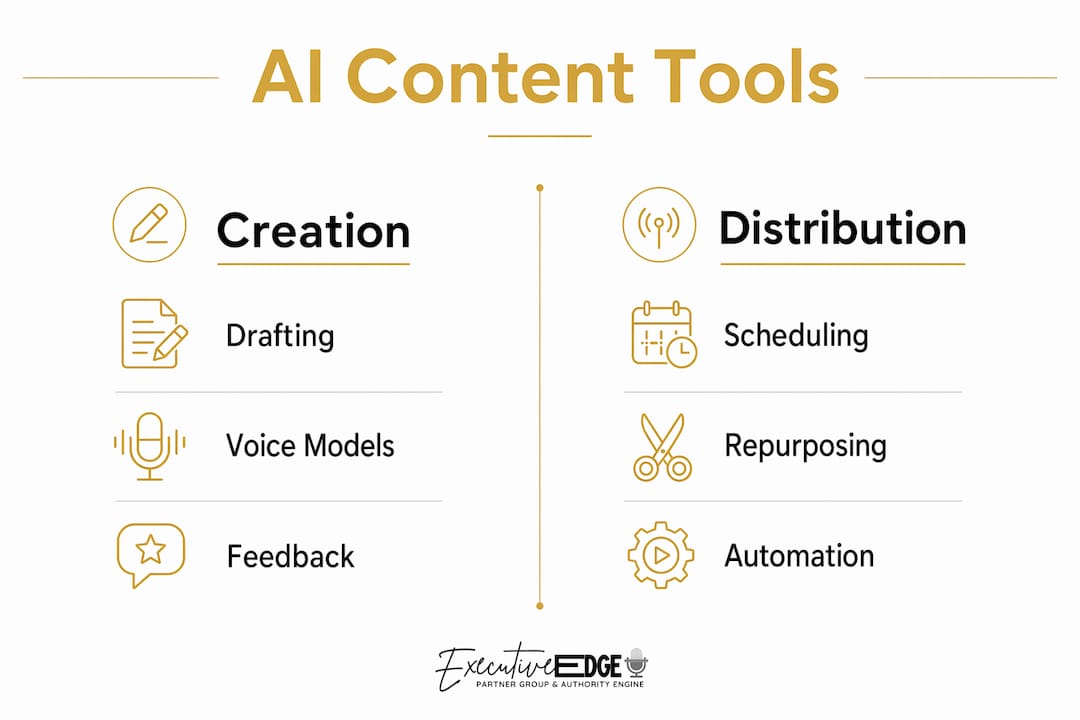
Executives draw on four categories of AI tools: drafting assistants, voice-matching models, scheduling automation, and content repurposing engines. Each serves a distinct function in the production chain.
Drafting assistants generate first-draft articles, LinkedIn posts, email newsletters, and internal memos from bullet points or voice notes the executive provides. The executive supplies the raw idea; the tool structures it into publishable prose.

Voice-matching models, often called CEO digital twins, are AI systems trained on an executive's historical speeches, emails, and articles. A well-built digital twin captures rhythm, vocabulary, personal stories, and a list of forbidden phrases that do not fit the executive's style. The result is output that sounds like the executive wrote it, not like a generic AI.
Scheduling automation handles multi-platform publishing. A single approved article can be automatically distributed as a LinkedIn post, a short-form video script, an email newsletter excerpt, and a podcast intro without the executive touching each format manually.
Content repurposing engines take one long-form piece and extract clips, quotes, and summaries for use across platforms. One 1,500-word article becomes eight to twelve pieces of supporting content.
Pro Tip: Select tools that allow you to upload structured style documents defining your vocabulary, metaphors, and tone boundaries. Tools that accept this kind of input produce far more accurate output than tools that rely on a single prompt.
Real-time feedback tools also belong in this stack. AI-powered media training platforms can score clarity and delivery across speaking and written communication, giving executives objective data on where their messaging loses precision. This depersonalizes performance improvement, which makes it easier to act on.
How do executives maintain authenticity while using AI?
Authenticity in AI-assisted content comes from one rule: the executive provides the stance, and the AI drafts the structure. Reversing that order produces content that sophisticated audiences detect as hollow within seconds.
The outsourcing of stance to AI is the most common failure mode in executive content programs. When an AI decides what the executive believes about a market trend, the resulting post reads as cautious, balanced, and forgettable. Audiences follow executives for their specific, sometimes uncomfortable, point of view.
A practical workflow that preserves authenticity follows four steps:
- Capture the raw input. The executive records a two-minute voice note, drops a few bullet points into a Slack thread, or reacts to a curated article with a brief written comment. This is the source material.
- Feed it to the AI with a style document. The AI drafts using the executive's vocabulary list, tone boundaries, and forbidden phrases as constraints. A structured style document defines positivity and negativity tolerance, preferred metaphors, and phrases the executive never uses.
- Review for voice accuracy, not grammar. The executive reads the draft asking one question: "Does this sound like me?" Grammar is the AI's job. Voice accuracy is the executive's job.
- Approve or return with a single note. A well-trained system needs one round of feedback, not five. If the draft requires major rewriting, the style document needs updating, not the draft.
Pro Tip: Build a "negative boundaries" list before you start any AI content program. Write down ten phrases you would never say, five topics you will not comment on publicly, and three tonal registers that feel wrong for your brand. Feed this list to every tool you use.
High-quality source data is what separates a useful AI voice model from a generic one. Feeding the system 10–20 pieces of authentic executive communication, such as past speeches, recorded interviews, and written articles, produces dramatically better output than asking the AI to "write like me" from a blank prompt.
What practical strategies help executives integrate AI tools into their workflow?
The executives who get the most from AI content tools treat thought leadership as a capture-and-leverage system, not a writing task. The writing is delegated. The thinking is not.
Practical integration follows a set of workflow principles that compress executive time without reducing output quality:
- Use asynchronous input methods. Voice notes recorded during a commute, Slack reactions to industry articles, and short bullet-point brain dumps all serve as raw material. The executive never sits down to write a post from scratch.
- Set an approval gate with a time limit. Block fifteen minutes per week for content review. If a draft cannot be approved or returned with one note in that window, the brief was too vague. Fix the brief, not the schedule.
- Repurpose before you create. Every approved long-form piece should generate at least five short-form assets before any new content is commissioned. This multiplies output without multiplying executive time.
- Measure with meaningful metrics. Track inbound inquiries, speaking invitations, and partnership conversations attributed to content, not just likes and impressions. Vanity metrics do not reflect authority growth.
- Build a content cadence and protect it. Consistency matters more than volume. Publishing twice per week for six months outperforms publishing daily for three weeks and then stopping.
An executive content strategy built around these principles produces compounding returns. Each piece of content trains the audience to expect a specific perspective from the executive, which builds the trust that converts readers into clients, partners, and advocates.
Pro Tip: The highest-performing executive content clusters around three buckets: opinionated stance on industry trends, personal leadership lessons, and specific business context only you can provide. Generic how-to posts underperform all three.
What are common pitfalls executives face with AI content tools?
The risks in AI-assisted executive content are predictable. Knowing them in advance prevents the most costly mistakes.
| Pitfall | What it looks like | How to prevent it |
|---|---|---|
| Generic AI output | Posts that could have been written by anyone in your industry | Train the AI on 10–20 pieces of your authentic communication before publishing |
| Voice drift | Content that gradually sounds less like you over time | Review style documents quarterly and update forbidden phrases as your communication evolves |
| Outsourced stance | AI decides your opinion on a trend; you approve without adding your real view | Always supply your actual position before the AI drafts, never after |
| Weak source data | AI trained on press releases and bios instead of real communication | Use transcripts, recorded interviews, and handwritten notes as training material |
| Over-reliance on AI | Executive stops engaging with content entirely; approval becomes rubber-stamping | Keep the fifteen-minute weekly review non-negotiable; read every draft before approving |
The loss of audience trust from outsourced stance is the hardest damage to repair. Readers who sense that an executive's content is AI-generated without genuine input stop engaging, and they rarely return. The fix is not better AI. The fix is more executive input at the source.
Understanding how AI content tools work at a mechanical level also helps executives set realistic expectations. AI drafts from patterns in its training data. Without your specific market context, it defaults to the average of everything it has seen, which is precisely the kind of content that fails to build authority.
What I've learned about AI and executive voice after years in the field
AI is the best production assistant I have ever seen. It is also the worst strategist I have ever encountered. That distinction matters more than most executives realize when they first start building AI-assisted content programs.
The executives who thrive with these tools share one habit: they treat their own judgment as the product. The AI is the packaging. When that relationship flips, and the AI starts generating the opinions while the executive just edits grammar, the content becomes indistinguishable from every other AI-generated post in the feed. The audience feels it before they can name it.
What I see consistently, including with leaders across East Texas who are building their authority online, is that the executives who invest thirty minutes per week capturing their genuine perspective outperform those who spend three hours editing AI drafts they did not seed with real input. Volume without voice is noise.
The discipline required is not technical. It is editorial. You have to decide what you actually believe about your market, your industry, and your clients, and then say it clearly. AI handles the rest. That is the only version of this that builds lasting authority.
— David Domm
How Executive Edge Partner Group helps leaders build AI-powered authority
Building an AI-assisted content program that actually sounds like you requires more than picking the right tools. It requires a system.

Executive Edge Partner Group runs a done-for-you authority-building system designed for executives who want consistent, credible content without becoming full-time content creators. The system captures your voice, builds your digital content profile, and publishes across search, AI discovery platforms, and social channels on a consistent cadence. Every piece of content reflects your actual perspective, not a generic AI approximation of it. If you are ready to build executive authority online without sacrificing your time or your voice, Executive Edge Partner Group is built for exactly that.
FAQ
What does it mean for an executive to "use" an AI content tool?
An executive uses an AI content tool by supplying their point of view and approving AI-generated drafts for voice accuracy, rather than writing content from scratch. The executive remains the source of judgment; the AI handles drafting and formatting.
How do executives keep AI content from sounding generic?
Executives prevent generic output by training AI on authentic communication such as speeches, interviews, and past articles, and by providing structured style documents that define vocabulary, tone, and forbidden phrases before any content is drafted.
What is a CEO digital twin?
A CEO digital twin is an AI model trained on an executive's historical content to replicate their voice, rhythm, and vocabulary. It uses structured style documents and negative boundaries to produce output that matches the executive's communication style.
How much time does an executive need to spend on AI-assisted content?
A well-built AI content system requires approximately fifteen minutes per week for executive review and approval. Asynchronous input methods like voice notes and Slack threads handle the raw material capture without requiring scheduled writing time.
What is the biggest risk of using AI for executive thought leadership?
The biggest risk is outsourcing your stance to the AI, meaning letting the AI decide your opinion rather than drafting around a position you have already defined. Sophisticated audiences detect this quickly, and the resulting loss of trust is difficult to rebuild.