

AI search discovery is the process by which AI-powered engines analyze a user query by breaking it into multiple sub-questions, retrieving precise content passages, and synthesizing the best responses into one relevant, cited answer. This is not traditional keyword matching. Systems like Google Gemini and ChatGPT use a combination of query fan-out and Retrieval-Augmented Generation (RAG) to understand meaning, not just words. The practical result is that ranking #1 on a single keyword no longer guarantees visibility. For business owners in Tyler and East Texas, and for digital marketers everywhere, understanding this AI discovery process is the difference between being cited and being invisible.
How AI search discovery works: query fan-out explained
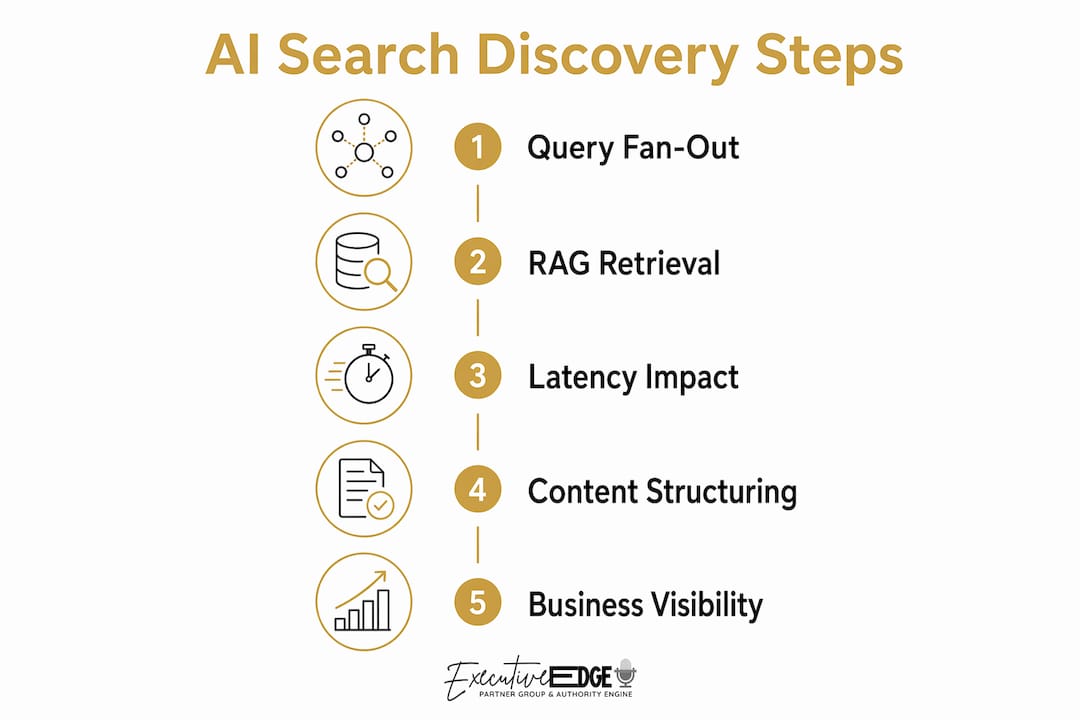
Query fan-out is the mechanism AI search engines use to decompose one user question into multiple related sub-queries, all running simultaneously before synthesis. Think of it as a research team instead of a single analyst. You ask one question, and the system dispatches 8–16 specialized investigators to answer different angles of it at the same time.
Here is how the process works step by step:
- Query intake. The AI receives the user's original question and identifies its core intent.
- Sub-query generation. The system generates 8–16 sub-queries for a standard search, each targeting a distinct angle of the original question.
- Parallel retrieval. Each sub-query runs independently against a vector database, pulling the most relevant content passages.
- Reranking. Retrieved passages are scored for quality, authority, and relevance to each sub-query.
- Synthesis. The AI combines the highest-scoring passages into a single, coherent, cited response.
For intensive research modes, the number of sub-queries can reach into the hundreds. That scale matters because it means the AI is not looking for one authoritative page. It is looking for many authoritative passages across many pages.
The critical shift here is this: ranking #1 on a head keyword does not guarantee citation. The AI prioritizes sub-query relevance and coverage breadth over traditional rank position. A page that answers five related sub-intents clearly will outperform a page that dominates one keyword but ignores the surrounding questions.

Pro Tip: Map your content to sub-query variants, not just the primary keyword. Ask yourself what five related questions a user might have after reading your headline, then answer all five within the same piece.
How does RAG make AI search more accurate?
Retrieval-Augmented Generation, or RAG, is the technical framework that gives AI search engines their ability to pull real, sourced information instead of generating answers from memory alone. The process runs in three stages: retrieve, rerank, and generate.
AI engines run a three-step pipeline against a vector database that matches meaning rather than keywords. A vector database stores content as numerical representations of meaning, called embeddings. When a sub-query arrives, the system finds passages whose embeddings are mathematically close to the query's embedding, regardless of whether the exact words match.
Key components of RAG-based discovery include:
- Semantic search. The AI finds content based on conceptual similarity, not literal word overlap.
- Hybrid retrieval. Combining keyword matching with dense semantic vector similarity improves both recall and precision. Methods like Reciprocal Rank Fusion merge exact-term results with conceptual matches.
- Passage-level retrieval. The AI rarely cites an entire page. It extracts specific chunks that directly answer a sub-query.
- Reranking as gatekeeper. Retrieval and reranking determine which content the model ever sees. Strong pages that fail retrieval or reranking never reach the generation stage.
The passage-level competition point deserves emphasis. Only 12.9% of AI Overview citations match the top 10 organic results. That number reveals how far traditional SEO rankings and AI citation patterns have diverged. You can hold a top-three organic position and still be completely absent from AI-generated answers.
AI search engines operate as dynamic reasoning systems that understand semantic queries, retrieve relevant knowledge, and generate grounded responses. The implication for marketers is that content must be structured to survive retrieval, survive reranking, and then answer a specific sub-question clearly enough to be extracted.
RAG also reduces hallucination. By grounding responses in retrieved passages, the system has real text to cite rather than generating plausible-sounding but fabricated answers. That is why content authority and source credibility directly affect whether your content gets used.
Why latency engineering shapes what gets ranked
Latency is not just a user experience concern. It is a hard constraint on which AI relevance signals can actually be applied at scale. Every millisecond of additional processing time multiplied across millions of queries becomes a real infrastructure cost. This forces AI search teams to make deliberate tradeoffs between model accuracy and inference speed.
Etsy's approach illustrates this tradeoff clearly. The company uses a teacher-student LLM setup to improve search relevance while keeping latency under control. A larger, more expensive LLM acts as the teacher, generating high-quality relevance judgments on training data. A smaller, faster distilled model learns from those judgments and handles real-time inference. The result is less than 10ms of additional delay in the live search stack.
This architecture matters for marketers for one specific reason. The distilled model that runs at inference time is trained on LLM-generated relevance labels, not human labels. Large-scale human labeling is replaced by LLM relevance judgments to reduce cost and maximize training coverage. The AI is essentially teaching itself what good relevance looks like, at scale, using its own outputs as ground truth.
For your content strategy, this means relevance signals must be clear enough for a model to recognize them quickly. Ambiguous content, buried answers, and unfocused pages fail not because the AI dislikes them but because they do not score well under fast inference conditions.
Pro Tip: Treat the first 100 words of every page as your relevance signal. If the AI cannot identify what your page answers within the first passage, it will not wait for the third paragraph to find out.
How should marketers structure content for AI discovery?
Content structure is the single most controllable variable in AI search optimization. The AI discovery process rewards pages that surface answers early, cover related sub-intents, and organize information into retrievable chunks.
| Content Approach | Traditional SEO Impact | AI Search Discovery Impact |
|---|---|---|
| Keyword-dense intro | High | Low |
| Direct answer in first paragraph | Medium | Very High |
| FAQ sections covering sub-intents | Low | Very High |
| Long narrative without headers | Medium | Low |
| Structured data markup | Medium | High |
| Broad topic coverage with H2/H3 structure | Medium | Very High |
The table above shows where the two systems diverge most sharply. Traditional SEO rewarded keyword density and backlink authority. AI discovery rewards passage clarity and sub-intent coverage.
Specific practices that improve AI discoverability:
- Lead with the answer. Concise, well-structured content with answers early is more likely to be extracted than long, unfocused pages. Put the direct answer in sentence one of every section.
- Cover sub-intent variants. Content must cover variants of user intent to match the sub-question forms AI generates during fan-out. One page should address the main question and at least four to six related angles.
- Use FAQ-style formatting. Question-based headings align directly with how AI systems generate sub-queries. A heading phrased as a question is a retrievable passage waiting to happen.
- Apply structured data. Schema markup helps AI systems understand the type and context of your content, improving retrieval accuracy.
- Avoid burying key information. If your most important claim appears in paragraph eight, the AI may never retrieve it. The unit of competition is the passage, not the page.
Understanding how content marketing works in the context of AI discovery also means thinking about content depth. Shallow pages that cover one angle of a topic lose to pages that address the full question ecosystem around a subject.
How does AI search discovery affect business visibility?
AI search discovery changes the competitive landscape for every business with an online presence. The old model rewarded whoever had the most backlinks pointing to a single optimized page. The new model rewards whoever has the most relevant, clearly structured content across the broadest range of related sub-intents.
For local service businesses, this shift creates both a risk and an opportunity. The risk is that businesses relying entirely on traditional SEO rankings may find themselves absent from AI-generated answers even while holding strong organic positions. The opportunity is that smaller, well-structured local content can now compete with larger national sites if it answers specific sub-queries more clearly.
AI-powered search also drives personalized and context-aware results. A query about "best HVAC contractor" in Tyler, Texas generates different sub-queries than the same query in Dallas. The AI factors in location, search history, and contextual signals to generate sub-queries specific to the user's situation. Local businesses that structure their content around specific local sub-intents, such as service area pages, local FAQ content, and location-specific case studies, gain a real advantage in this environment.
Ongoing monitoring matters here. AI search algorithms update continuously, and citation patterns shift as models are retrained. Tracking which of your pages appear in AI-generated answers, and which do not, gives you the feedback loop needed to adjust content structure and topic coverage over time. Tools like Perplexity, Google AI Overviews, and ChatGPT search can be used manually to test how your content surfaces across different query types.
What i've learned about AI discovery that most marketers miss
Most marketers approach AI search optimization the same way they approached Google optimization in 2015. They focus on the primary keyword, build a few links, and wait. That approach is not wrong. It is just incomplete.
What I have seen consistently is that the businesses gaining the most AI search visibility are not the ones with the most backlinks. They are the ones with the most answerable content. Every page they publish is structured around a specific question, with the answer in the first paragraph and related sub-questions addressed throughout. They write long-form content that covers a topic ecosystem, not just a single keyword.
The counterintuitive part is that this approach also tends to improve traditional SEO performance. When you structure content to survive AI retrieval and reranking, you are also making it clearer, more organized, and more useful for human readers. The two goals reinforce each other.
The mistake I see most often is treating AI search as a threat to existing rankings rather than a parallel discovery channel with its own rules. Businesses that adapt their content structure now, before AI-generated answers become the dominant click destination, will hold a significant advantage over those who wait. The window to build that advantage is open. It will not stay open indefinitely.
— David Domm
How executive edge partner group helps you win in ai-powered search
Understanding the mechanics of AI search discovery is one thing. Building a content system that executes on them consistently is another challenge entirely.

Executive Edge Partner Group works with business owners, consultants, and local brands to build authority-driven content strategies designed specifically for AI-powered discovery platforms. The system covers everything from long-form blog content and FAQ architecture to structured data implementation and multi-platform publishing. Every piece of content is built to survive retrieval, pass reranking, and answer the sub-queries your ideal customers are actually generating. If you are ready to stop guessing and start showing up in AI-generated answers, explore the Executive Edge system and see how it applies to your market.
FAQ
What is query fan-out in AI search?
Query fan-out is the process where an AI search engine breaks one user question into 8–16 related sub-queries that run simultaneously. Each sub-query retrieves content independently before the AI synthesizes a single unified response.
Why doesn't ranking #1 guarantee AI citation?
AI search prioritizes sub-query relevance and passage-level clarity over traditional rank position. Only 12.9% of AI Overview citations match the top 10 organic results, meaning strong organic rankings and AI citations are largely separate outcomes.
What is RAG and why does it matter for marketers?
RAG stands for Retrieval-Augmented Generation. It is the framework AI search engines use to retrieve real content passages before generating an answer, which grounds responses in actual sources and reduces fabricated outputs.
How should i format content for AI discovery?
Lead every section with a direct answer, use question-based headings that mirror sub-query forms, and cover related sub-intents within a single piece. The AI extracts passages, not pages, so clarity and early placement of key answers are critical.
Does local content perform differently in AI search?
Yes. AI search factors in location and context when generating sub-queries, which means locally specific content, such as service area pages and location-based FAQs, can outperform broader national content for geographically relevant queries.