

Content marketing is the practice of creating and distributing valuable, relevant content to attract a defined audience and drive profitable customer action through trust rather than direct selling. Unlike paid advertising, which interrupts people, content marketing earns attention by answering real questions and solving real problems. The Content Marketing Institute defines this approach as one that changes consumer behavior through consistent, audience-focused publishing rather than promotional messaging. For business owners in Tyler and East Texas, understanding how content marketing works is the difference between being found online and being invisible. This guide breaks down the full system, from strategy to measurement to execution.
How content marketing works: the core components
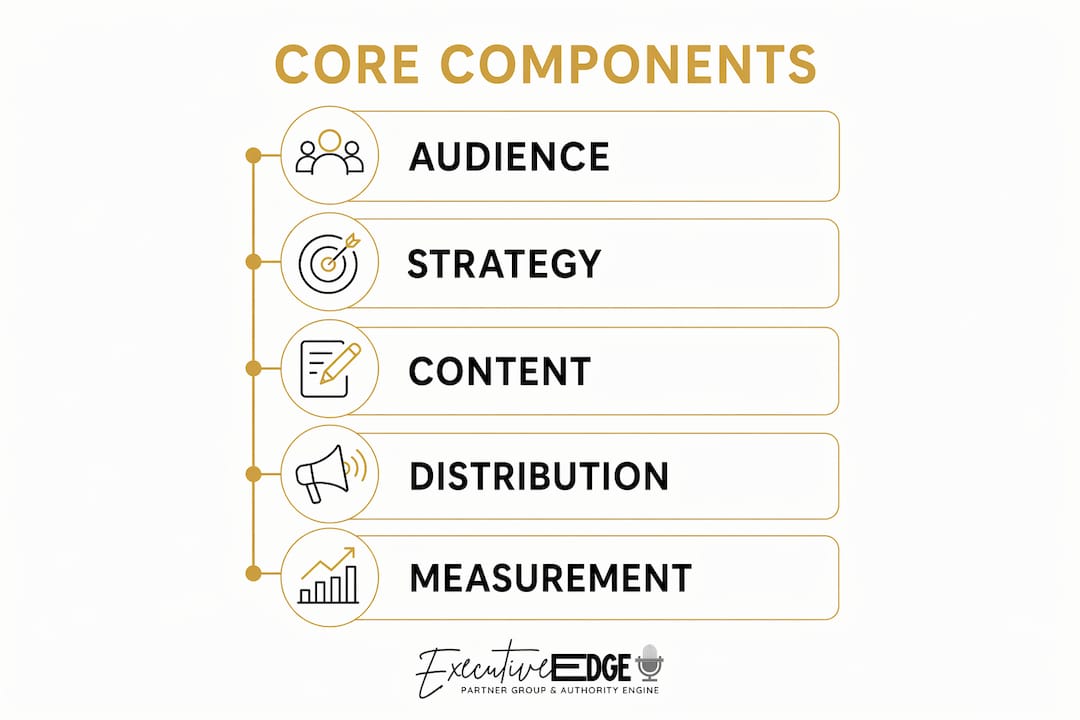
Content marketing works through five interconnected components. Miss one, and the whole system underperforms. Get all five aligned, and you build a compounding asset that generates visibility and leads long after the content is published.
1. Audience research and persona development
Every effective content strategy begins with a precise understanding of who you are trying to reach. This means building audience personas that go beyond demographics to capture the specific questions, frustrations, and goals your prospective customers carry. A law firm targeting small business owners needs different content than one targeting individuals in personal injury cases. The more specific your persona, the more directly your content speaks to the reader's situation.

2. A documented content strategy with SMART goals
A content strategy is the written plan that connects your content output to measurable business outcomes. SMART goals with timeframes and monthly performance reviews are the standard for effective content programs. This means setting targets like "increase organic blog traffic by 30% in 90 days" rather than vague intentions like "publish more content." Without a documented strategy, most businesses default to reactive, ad-hoc publishing that produces noise rather than results.
3. Varied content formats and repurposing
Blogs, videos, podcasts, social media posts, case studies, and email newsletters each serve different audience segments and discovery channels. The most efficient content programs repurpose a single core idea across multiple formats. A 2,000-word blog post becomes a YouTube video script, three LinkedIn posts, and a podcast episode. This multiplies reach without multiplying the production effort.
4. Multi-channel distribution
Creating content without a distribution plan is like printing a brochure and leaving it in a warehouse. Owned channels include your website, email list, and social profiles. Earned channels include media coverage, backlinks, and shares. Paid channels amplify content to new audiences through targeted promotion. A strong content marketing strategy uses all three in proportion to the business's goals and budget.
5. Performance measurement tied to business outcomes
Leading indicators measure reach and engagement; lagging indicators measure conversions and revenue. Both matter. Tracking only vanity metrics like page views tells you nothing about whether your content is generating leads or clients. The measurement framework must connect content activity directly to pipeline and revenue.
Pro Tip: Set a 90-day content calendar before you publish a single piece. Pre-planning at least four to six weeks ahead keeps your team focused and prevents the reactive publishing cycle that kills most content programs.
How content maps to the customer journey
Content assets map directly to the three stages of the customer journey: awareness, consideration, and decision. Each stage requires a different type of content because the buyer's intent and questions change as they move closer to a purchase.
| Journey stage | Buyer intent | Most effective content types |
|---|---|---|
| Awareness | "I have a problem. What is it?" | Blog posts, short videos, social media, podcasts |
| Consideration | "What are my options?" | Comparison guides, webinars, case studies, email sequences |
| Decision | "Should I trust this provider?" | Testimonials, detailed service pages, free consultations, demos |
Consider a practical scenario. A business owner searches "why is my website not showing up on Google." That is an awareness-stage query. A well-written blog post answering that question introduces your brand at exactly the right moment. Two weeks later, the same person searches "SEO services vs. content marketing." That is a consideration-stage query. A comparison guide you published positions you as a knowledgeable resource. When they are ready to hire someone, your testimonials and case studies close the gap between interest and commitment.
This funnel mapping is not theoretical. It is the architecture that determines which content you produce, when you publish it, and how you distribute it. Businesses that skip this mapping end up creating content that attracts the wrong audience or speaks to people who are not ready to buy.
The practical implication is that your content library needs representation at all three stages. Most businesses over-invest in awareness content and neglect the consideration and decision stages. That is where leads stall and conversions drop.
What modern measurement looks like in 2026
Measurement in content marketing has grown more complex. Brands must now track both traditional Google rankings and AI platform citations to get a complete picture of their visibility. This is called the dual surface model, and it reflects how people now discover information through tools like ChatGPT, Perplexity, and Google's AI Overviews alongside standard search results.
| Metric category | What to track | Why it matters |
|---|---|---|
| Traditional SEO | Organic traffic, keyword rankings, backlinks | Measures Google visibility and search authority |
| Engagement | Time on page, scroll depth, email open rates | Signals content quality and audience relevance |
| Conversion | Lead form submissions, calls, sales attributed to content | Connects content to revenue |
| AI visibility | LLM citation frequency, AI Overview appearances | Measures discoverability on AI-driven platforms |
Traditional SEO metrics and AI citation frequency do not always correlate. A piece of content can rank on page two of Google and still be cited regularly by AI platforms because it answers a specific question with authority and clarity. This means optimizing for both surfaces requires intentional content structure, not just keyword placement.
Content decay is the other measurement challenge most businesses ignore. Formal content audits every six months protect domain authority by identifying articles that have lost traffic, become outdated, or no longer reflect your current positioning. Refreshing a declining post is almost always faster and more effective than writing a new one from scratch.
Pro Tip: Build a simple content audit spreadsheet tracking each published URL, its current organic traffic, last updated date, and conversion performance. Review it every six months and flag anything that has dropped more than 20% in traffic over the prior period.
Performance reviews should happen monthly, with strategic adjustments based on 60 to 90 day trends rather than week-to-week fluctuations. Content marketing compounds over time. Reacting to a single slow week by abandoning a strategy is one of the most common and costly mistakes business owners make.
How to implement a content marketing plan that actually holds
Most content programs fail not because of bad ideas but because of poor execution systems. Here is a practical framework for building a plan that sustains itself beyond the initial enthusiasm.
-
Define your core topics. Choose three to five topic pillars that reflect your expertise and match what your audience searches for. Every piece of content you produce should connect to one of these pillars. This builds topical authority, which both Google and AI platforms reward with higher visibility.
-
Build a 90-day content calendar. Map out specific titles, formats, and publish dates for the next 90 days. Include decision points at the 30-day and 60-day marks to review performance and adjust. Pre-planning four to six weeks ahead is the standard that separates consistent programs from reactive ones.
-
Assign clear roles and approval workflows. Every piece of content needs an owner, a reviewer, and a publisher. Without defined roles, content sits in draft indefinitely. Even a solo operator benefits from a simple checklist that covers writing, editing, SEO review, and scheduling.
-
Plan distribution at the same time as creation. Before you write a single word, decide where the content will be published, how it will be promoted, and what repurposed formats will come from it. Distribution is not an afterthought. It is half the work.
-
Mix formats deliberately. Rotate between long-form articles, short social posts, video content, and email newsletters. Each format reaches a different segment of your audience and performs differently across platforms. A consulting firm might find that YouTube videos drive awareness while detailed blog posts drive conversions.
-
Audit and refresh on a schedule. Build the six-month content audit into your calendar from day one. Content decay silently reduces ROI when old posts lose relevance and traffic without anyone noticing. Scheduled audits prevent this from compounding into a larger authority problem.
The 90-day rollout with clear workflows is not just a planning tool. It is a burnout prevention system. When your team knows what is coming, who owns it, and when it publishes, the cognitive load of content production drops significantly.
What I have learned about content marketing that most guides skip
I have worked with enough business owners to know that the biggest obstacle to content marketing success is not strategy. It is the belief that publishing more will fix the problem. It will not.
The businesses that see real results from content are the ones that commit to genuine topical authority. That means writing about what you actually know at a depth that a generalist content mill cannot replicate. A Tyler, Texas contractor who writes a detailed post about the specific foundation challenges in East Texas clay soil will outperform a generic "how to fix foundation problems" article every time. Specificity is authority.
The dual measurement model matters more than most people realize. I have seen businesses with strong Google rankings that are completely absent from AI-generated answers. As more buyers use tools like Perplexity and ChatGPT to research vendors, that absence is a real competitive disadvantage. You need content structured to answer questions directly, not just content optimized for keyword density.
The discipline of planning also separates the businesses that build lasting visibility from those that publish in bursts and then go quiet for months. Consistency signals authority to search engines and trust to readers. A 90-day calendar is not a bureaucratic exercise. It is the mechanism that keeps the system running when motivation dips.
Finally, content marketing is not a short-term play. The businesses I have seen get the most from it are the ones who treat it as building a media asset, not running a campaign. That shift in perspective changes everything about how you plan, measure, and sustain the work.
— David Domm
Build your content authority with Executive Edge Partner Group

Understanding the principles behind content marketing is the first step. Executing them consistently, across the right channels, with the right structure for both Google and AI platforms, is where most businesses need support. Executive Edge Partner Group helps business owners and professionals turn their expertise into a content authority system that builds visibility and trust over time. From strategic content planning and SEO-optimized articles to AI-enhanced distribution and local market positioning, the system is built for businesses that want results without becoming full-time content creators. If you are ready to stop guessing and start building, visit Executive Edge Partner Group to learn how the Authority Engine works.
FAQ
What is content marketing in simple terms?
Content marketing is the practice of publishing valuable, relevant content to attract and engage a specific audience, with the goal of driving profitable customer action over time rather than through direct advertising.
How long does content marketing take to show results?
Most content marketing programs show measurable organic traffic growth within three to six months, with compounding results building over 12 to 18 months as topical authority and backlinks accumulate.
What are the main benefits of content marketing for small businesses?
Content marketing builds long-term search visibility, establishes credibility with prospective clients, and generates leads at a lower cost per acquisition than paid advertising, particularly for service-based businesses.
How do I measure whether my content marketing is working?
Track both traditional metrics like organic traffic, keyword rankings, and lead conversions alongside AI visibility indicators such as citation frequency in tools like ChatGPT and Perplexity, since the two surfaces do not always correlate.
How often should I publish content to see results?
Consistency matters more than volume. Publishing one well-researched, audience-focused piece per week outperforms publishing five thin posts. A documented content calendar reviewed on 60 to 90 day cycles keeps the program on track without burning out your team.