

An executive LinkedIn content strategy is the deliberate planning and execution of authentic, opinionated, and educational posts designed to build your professional authority and influence. The industry term for this practice is "executive thought leadership content," and it operates on a specific content mix model called the 80-10-10 rule: 80% educational content, 10% personal stories, and 10% promotional posts. LinkedIn's 2026 algorithm rewards depth and consistency over volume, which means executives who post with purpose outperform those who post at random. For professionals in Tyler, Texas and across the country, this approach is the difference between a dormant profile and a genuine business development asset.
What types of content should executives post on LinkedIn?
The 80-10-10 content mix is the most effective framework for executive LinkedIn content in 2026. It divides your posting calendar into three clear categories, each serving a distinct purpose in building trust and driving engagement.
80% educational and thought leadership content forms the foundation. This category includes posts that explain a decision you made, break down an industry trend, or share a lesson from a real project. Educational content builds trust over time because it gives your audience something useful without asking for anything in return. Executives who post about decisions, tradeoffs, and lessons from real work develop stronger authority than those who post generic summaries or trend roundups.

10% personal stories humanize your brand. A post about a hiring mistake you corrected, a client relationship that changed your thinking, or a leadership lesson from a difficult quarter generates more comments than any polished announcement. Personal content creates the emotional connection that makes your audience want to follow your career, not just your company.
10% promotional content closes the loop. This includes announcements, service highlights, and calls to action. The limit exists for good reason. Too much promotion alienates the audience you spent months building.
| Content type | Primary purpose | Example post idea |
|---|---|---|
| Educational (80%) | Build trust and authority | "3 things I learned from a failed product launch" |
| Personal story (10%) | Create emotional connection | "The conversation that changed how I hire" |
| Promotional (10%) | Drive business outcomes | "We just opened enrollment for our Q3 program" |
LinkedIn's algorithm also favors specific formats for retention. Document posts (PDF carousels), text-only insight posts, and substantive comments on other executives' content all score well for depth. Short, reactive posts with no clear point of view score poorly.
Pro Tip: Write your educational posts from the perspective of someone who has already made the mistake. "Here's what I got wrong about X" outperforms "Here are 5 tips about X" in both reach and comment volume.
How to systematize executive content creation without burning out
Thought leadership burnout results from executives trying to be full-time content creators instead of drawing on the intellectual assets they already generate every day. The fix is a capture-and-leverage system, not more writing time.
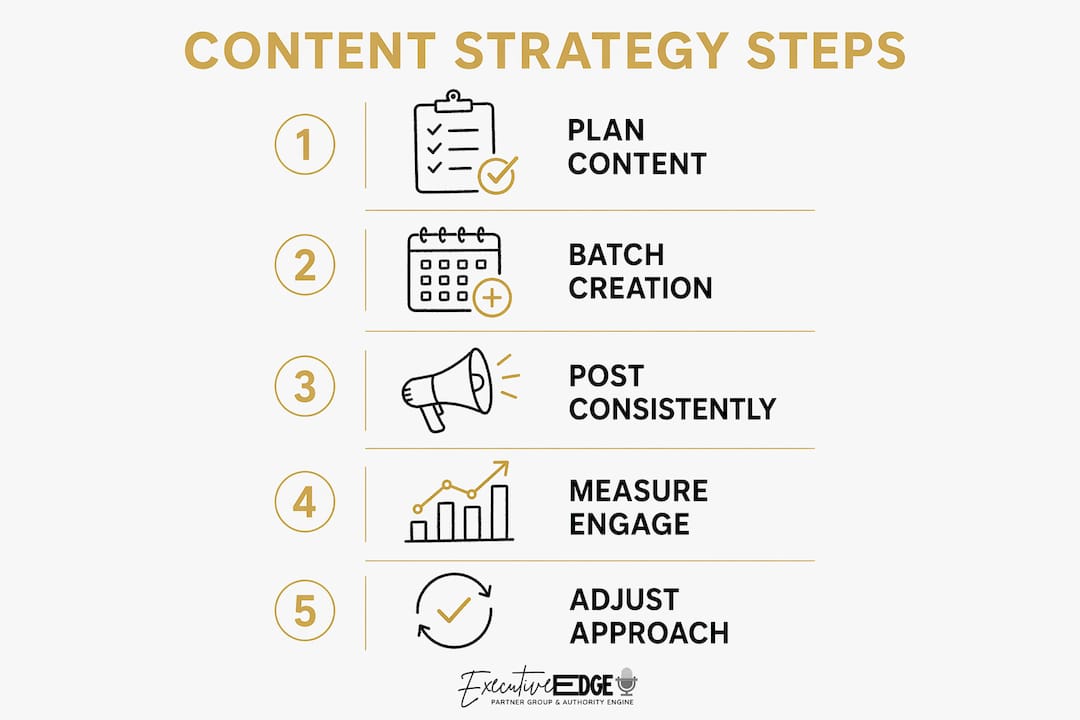
The best executive content originates from real-time extraction of professional insights during meetings, calls, and decision-making processes. You already have the raw material. The system just needs to collect it.
Here is a practical workflow:
- Capture raw ideas daily. Keep a note in Notion or a plain notes app on your phone. After any meeting, call, or decision, write one sentence about what you observed, decided, or learned. No editing required at this stage.
- Batch your drafts once a week. Set aside 30 minutes each week to review your raw notes and turn the strongest two or three into post drafts. You are not writing from scratch. You are expanding a thought you already had.
- Hand off to an editorial layer. An AI-assisted drafting system or a content editor formats your raw drafts into polished posts while preserving your voice. AI and editorial systems that learn your brand voice increase consistency and reduce your time commitment significantly.
- Review and approve, never skip. You do not need to write every word. You do need to read every post before it goes live. Your approval is what keeps the content authentic and on-brand.
- Schedule in advance. Use a scheduling tool to queue posts for the week. This removes the daily pressure of deciding what to post and prevents the erratic bursts that hurt algorithmic performance.
Batching content creation reduces time pressure and makes long-term consistency achievable. Executives who batch weekly spend less than 90 minutes per week on LinkedIn content while maintaining a consistent presence.
Pro Tip: Record a 2-minute voice memo after your most important meeting each week. That audio contains your most authentic thinking. A good editor or AI tool can turn it into a post draft in minutes.
What posting frequency actually builds LinkedIn authority?
LinkedIn's 2026 algorithm evaluates each post's Depth Score over a 24–48 hour window after it goes live. The platform measures how long people read, whether they comment with substance, and whether the post generates saves. Consistent, on-topic posting trains the algorithm to classify you as an expert in your field.
Two focused posts per week over a rolling 90-day window builds a stronger authority signal than posting five times one week and going silent for three. The algorithm rewards predictability. It interprets consistent posting as a signal of genuine expertise, not just a burst of promotional energy.
| Posting approach | Frequency | Outcome |
|---|---|---|
| Sprint posting | 5+ posts in one week, then silence | Algorithm de-prioritizes; reach drops |
| Inconsistent posting | 1 post every few weeks | Weak authority signal; low classification |
| Consistent cadence | 2 focused posts per week | Strong Depth Score; growing reach |
Posting volume without substance trains the algorithm to de-prioritize your content. Two strong, focused posts weekly build a cleaner authority signal than five generic ones. Quality and regularity work together. Neither alone is enough.
Pro Tip: Post on Tuesday or Wednesday mornings when your audience is most active at their desks. Avoid posting on Friday afternoons or weekends unless your audience data shows otherwise.
How do you measure success and fix what is not working?
Vanity metrics like total likes tell you almost nothing about whether your LinkedIn content strategy is working. The metrics that matter are engagement type, comment quality, profile views from new connections, and inbound messages from qualified prospects.
Signs your current approach needs adjustment:
- Posts get likes but no comments. This means your content is pleasant but not opinionated enough. Add a clear point of view or a direct question at the end.
- Reach is flat or declining. This usually signals inconsistency or topic drift. Return to your core subject matter and post on a fixed schedule for 30 days.
- You are running out of ideas. This is the classic symptom of trying to create content from scratch instead of capturing it from your real work. Return to the capture system described above.
- Engagement comes only from colleagues, not prospects. Your content may be too internal. Shift toward posts that address the problems your clients face, not the internal language of your industry.
Regular content audits solve most of these problems. Every 90 days, review your top five posts by comment volume and your bottom five by reach. The pattern tells you exactly what your audience values and what they ignore. Adjust your next quarter's themes accordingly. Executive content guides recommend reviewing both format and topic performance together, since a great topic in the wrong format still underperforms.
What tools support an executive LinkedIn content strategy?
The right tools reduce friction without replacing your voice. Every executive needs a simple stack that covers four functions: idea capture, drafting, scheduling, and analytics.
| Tool category | Function | Best for |
|---|---|---|
| Note-taking app (Notion, plain notes) | Capture raw ideas daily | Executives who think on the go |
| AI-assisted drafting platform | Turn raw notes into post drafts | Reducing writing time |
| Scheduling tool | Queue posts in advance | Maintaining consistent cadence |
| LinkedIn native analytics | Track Depth Score and post reach | Identifying top-performing content |
Centralized, simple systems like Notion or a plain notes app work best for idea capture because they remove the barrier to entry. The goal is to record a thought in under 30 seconds, not to organize it perfectly.
Content calendars add another layer of structure. The 4-pillar content calendar framework organizes posts by strategic purpose rather than format or topic. The four pillars are authority builder, community catalyst, value delivery, and human connection. Mapping your posts to these pillars each quarter prevents topic drift and keeps your content mix balanced.
Treating LinkedIn as a distribution channel for existing intellectual assets is more sustainable than creating content from nothing. Your speaking notes, client presentations, and internal memos are all raw material. A good editorial workflow extracts and formats them for LinkedIn without requiring you to start from a blank screen.
Pro Tip: Use LinkedIn's native analytics to check which posts drove profile views, not just impressions. Profile views from new connections are the clearest signal that your content is reaching the right audience.
What I have learned about authenticity and efficiency in executive content
Working with executives on their LinkedIn presence, I have seen the same mistake repeated constantly. The executive hands off their LinkedIn entirely to a marketing team, the team produces polished but generic posts, and the profile flatlines within 60 days. The audience can tell when a post does not sound like the person it is attributed to.
The fix is not for executives to write every word. It is for executives to own every idea. Your voice, your point of view, and your real opinions are what make the content worth reading. A good editorial system captures those things and formats them. It does not invent them.
The executives I have seen build real authority on LinkedIn share one habit: they treat content as a byproduct of their work, not a separate task. After a difficult client conversation, they write one sentence about what they learned. After a hiring decision, they note the tradeoff they weighed. That raw material becomes the post. The blank screen never appears.
For business owners and executives in East Texas, this approach is especially relevant. Local markets reward personal reputation more than polished marketing. A post that shows how you think builds more trust with a local prospect than any advertisement. The platform is free. The only cost is consistency and honesty.
The executives who win on LinkedIn in 2026 are not the ones with the biggest budgets. They are the ones who show up with a real point of view, on a regular schedule, about the work they actually do.
— David Domm
How Executive Edge Partner Group supports your LinkedIn authority
Building a consistent LinkedIn presence takes more than good intentions. It takes a system that captures your thinking, formats it for the platform, and publishes it on a schedule you can sustain.
Executive Edge Partner Group offers a done-for-you authority-building system designed specifically for executives and professionals who want to grow their LinkedIn presence without becoming full-time content creators. The system combines AI-assisted content capture, editorial formatting, and multi-platform publishing to keep your profile active and authoritative. From executive branding strategy to content calendar planning, the team handles the workflow while you retain full control of your voice and message. If you are ready to build the kind of LinkedIn presence that generates real business, Executive Edge Partner Group is built for exactly that.
FAQ
What is the 80-10-10 rule for executive LinkedIn content?
The 80-10-10 rule divides your LinkedIn posts into 80% educational or thought leadership content, 10% personal stories, and 10% promotional content. This mix builds trust while keeping your audience engaged without feeling sold to.
How often should executives post on LinkedIn?
Two focused, substantive posts per week over a consistent 90-day period builds the strongest authority signal with LinkedIn's algorithm. Posting more frequently with low-quality content actively reduces your reach.
What is LinkedIn's Depth Score?
LinkedIn's Depth Score measures how deeply users engage with a post during the 24–48 hours after it is published. The algorithm uses this score to classify your expertise and determine how widely to distribute future posts.
How do executives avoid thought leadership burnout?
Burnout happens when executives try to create content from scratch instead of capturing insights from their real work. A simple daily note-taking habit combined with an AI-assisted editorial workflow eliminates the blank-screen problem entirely.
What content format performs best on LinkedIn for executives?
Document posts (PDF carousels), text-only insight posts with a clear point of view, and substantive comments on other leaders' content consistently score the highest Depth Scores. Short reactive posts with no original perspective perform poorly.