

Educational content marketing is the practice of creating and sharing informative content that teaches your audience about your industry, products, or services to build credibility and drive engagement before asking for a sale. The industry term for this approach is "content marketing," but the educational variant goes further. It prioritizes genuine teaching over promotion. Brands like Grammarly, HubSpot, and Canva have built massive audiences by answering real questions their customers ask every day. For business owners and marketing professionals in Tyler, Texas and across East Texas, this strategy is one of the most cost-effective ways to build lasting online visibility in 2026's AI-driven search environment.
What is educational content marketing and why does it work?
Educational content marketing aims to provide value to your audience by educating them on specific topics, establishing credibility with the intended audience. That definition separates it from traditional advertising, which interrupts. Educational content attracts. A business that publishes a detailed guide on how to choose a contractor earns trust before a prospect ever picks up the phone.
The core mechanic is simple. You give away useful knowledge. Your audience associates that knowledge with your brand. When they are ready to buy, they come to you first. HubSpot built a nine-figure business almost entirely on this model, publishing free marketing guides, templates, and courses that trained an entire generation of marketers.

This approach also works because it aligns with how people actually search. Most buyers research before they buy. They type questions into Google, YouTube, and now AI tools like ChatGPT and Perplexity. A business with educational content already published on those topics shows up at the exact moment a prospect is looking for answers.
Educational vs. promotional content
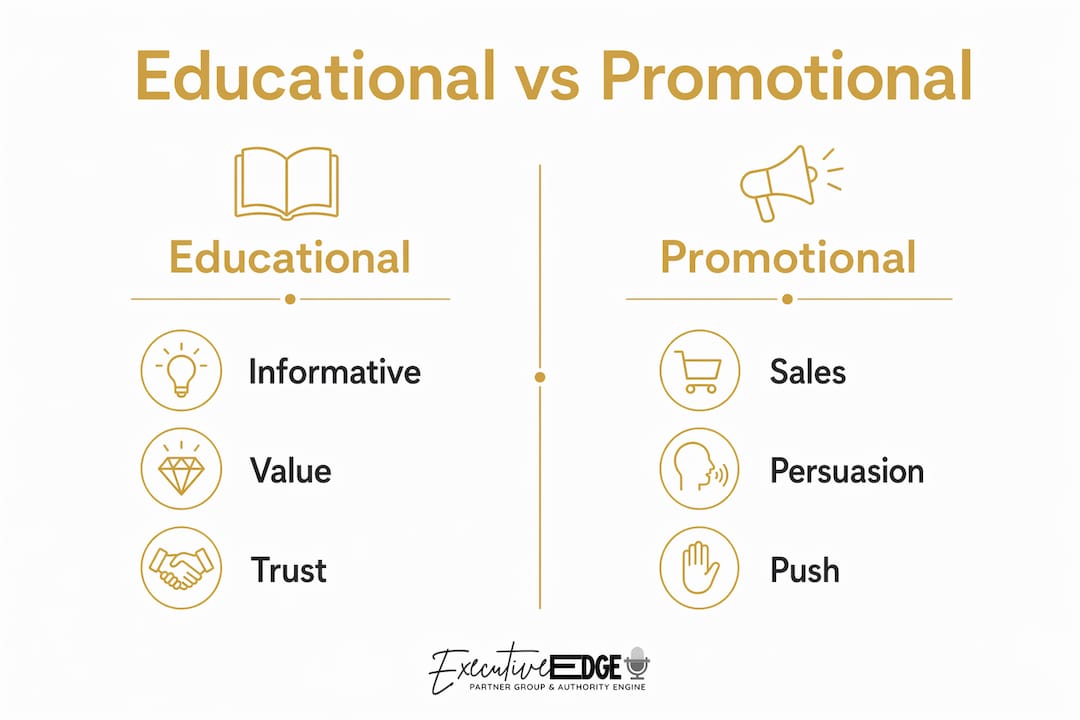
Promotional content says "buy from us." Educational content says "here is what you need to know." The difference in audience response is significant. Promotional content gets scrolled past. Educational content gets saved, shared, and bookmarked. Outcome-focused content outperforms generic brand content because it answers real questions with proof points like outcomes data, case studies, and expert expertise rather than generic branding.
Pro Tip: Strip every piece of content you create and ask: "Does this teach something, or does it just promote something?" If the answer is the latter, rewrite it before publishing.
Core educational marketing strategies and content types
Effective educational marketing strategies start before a single word is written. Content development must start with analysis of learner needs and alignment with specific learning outcomes, not production. Skipping this step is the most common reason educational content fails to generate results.
Audience and topic analysis
Before creating anything, identify the specific questions your audience is asking. Use tools like Google Search Console, AnswerThePublic, or Reddit to find real language your prospects use. A law firm in Tyler might discover that "what happens if I miss a court date" gets searched far more than any branded legal term. That insight shapes the entire content plan.
Content formats and their strengths
Multi-format content such as blogs, videos, podcasts, and infographics enhances reach and effectiveness of educational content marketing. Different formats serve different stages of the buyer journey and different learning preferences.
| Format | Best use | Strength |
|---|---|---|
| Blog articles | SEO and long-form explanation | Ranks in search, builds authority |
| Short-form video | Social media and quick answers | High engagement, shareable |
| Podcasts | Thought leadership and depth | Builds loyalty over time |
| Infographics | Data and process visualization | Easy to share and remember |
| Case studies | Late-stage trust building | Proof of real-world results |
| Email newsletters | Nurturing existing audience | Direct, consistent touchpoint |
SEO and AI-driven discovery
Organic search is the primary discovery channel for educational content, and SEO foundations are non-negotiable for visibility. This means writing content that directly answers specific questions, using clear headings, and building topical authority across a subject area rather than publishing random one-off posts. Understanding how content marketing works as a system is the foundation for getting this right.
Mapping content to the buyer journey
Educational marketing strategies must address multiple decision-makers and long buyer journeys, requiring different content assets at each funnel stage. A prospect who just discovered your brand needs different content than someone comparing you to a competitor. Top-of-funnel content educates broadly. Mid-funnel content addresses specific concerns. Bottom-of-funnel content provides proof and removes objections.
How AI and digital trends are reshaping educational content in 2026
2026 is a genuinely disruptive year for content marketing. AI-first search and market shifts have made this the most disruptive period in two decades for educational marketing. That disruption creates opportunity for businesses willing to adapt.
Here is what is changing right now:
-
AI search engines summarize content directly. Tools like Perplexity and ChatGPT pull answers from published content and cite sources. Businesses with clear, well-structured educational content get cited. Businesses without it get ignored. Understanding how AI search discovery works is now a core marketing skill.
-
Privacy regulations are limiting ad targeting. As cookie-based targeting shrinks, educational content becomes one of the few reliable ways to attract qualified prospects without paid ads. Businesses that built content libraries over the past three years are now seeing compounding returns.
-
Younger audiences distrust promotional content. Gen Alpha and Gen Z consume content differently. They skip ads, use ad blockers, and trust peer recommendations and educational creators far more than brand advertising. Educational content meets them where they already are.
-
Proof matters more than promises. Trust in institutions is at a historic low, which requires marketing to focus on authenticity, personalization, and proof, not traditional promotional methods. Testimonials, case studies, and data-backed claims now carry more weight than polished brand messaging.
Pro Tip: When writing for AI search visibility, structure your content with a direct answer in the first sentence of each section. AI tools extract the clearest, most direct answers. Vague introductions get skipped.
How to create educational content that actually teaches
Most branded educational content fails because it lacks clear teaching structure. Effective educational content must follow a structure: present abstract concepts, provide concrete examples, and enable practice to facilitate real learning. That three-part structure is the difference between content that informs and content that changes behavior.
A practical creation process
Start with a single question your audience is asking. Write a direct answer in the first sentence. Then expand with context, examples, and evidence. End with a clear takeaway or next step. This structure works for blog posts, videos, and podcast episodes equally well.
Use plain language throughout. If you would not say a word in a normal conversation, do not write it. Jargon signals that you are writing for yourself, not your reader. The goal is to make the reader feel smarter after consuming your content, not confused.
Incorporate social proof at every stage. Real client results, specific numbers, and named outcomes build far more trust than general claims. "We helped a local contractor increase website leads by 40%" is more persuasive than "we get results."
Common pitfalls to avoid
- Publishing content without first researching what your audience actually wants to learn
- Writing in brand voice instead of teaching voice, which reads as promotional
- Skipping examples and going straight to abstract advice
- Producing content in only one format and missing large segments of your audience
- Measuring success only by traffic instead of by engagement, time on page, and conversions
- Never updating older content, which loses search rankings over time
Pro Tip: Record yourself explaining your topic out loud before writing. The natural language you use when speaking is almost always clearer and more engaging than what you write when staring at a blank page.
Why I think most businesses are leaving their best content on the table
After working with business owners across multiple industries, the pattern I see most often is this: the owner has deep expertise and genuine insight, but none of it is published anywhere. It lives in their head, in client conversations, and in the answers they give on sales calls. That knowledge is the most valuable content they could ever produce. It is specific, credible, and impossible for a competitor to copy.
The businesses that win with educational content are not the ones with the biggest budgets. They are the ones willing to share what they know before they get paid for it. That feels counterintuitive. But the trust it builds is the reason clients choose them over a cheaper option.
The AI search shift makes this even more urgent. When a prospect asks ChatGPT or Perplexity who the best consultant in their field is, the answer comes from published content. If you have not published anything, you do not exist in that conversation. This is something I see consistently with East Texas businesses that have years of expertise but almost no digital footprint to show for it.
The good news is that you do not need to become a full-time content creator. You need a system that turns your existing knowledge into published, discoverable content across the right channels. That system, built and maintained consistently, compounds over time in ways that paid ads simply cannot.
— David Domm
How Executive Edge Partner Group helps you build content authority
Building a library of educational content takes time, structure, and consistency. Executive Edge Partner Group works with business owners, consultants, and service professionals who want to turn their expertise into published content that ranks in search and gets cited by AI tools.
The Executive Edge Authority Engine handles content planning, production, and distribution across blogs, podcasts, YouTube, and social media. It is built specifically for professionals who want to grow their online visibility without spending all their time creating content. If you are ready to build the kind of authority that attracts clients before they ever contact a competitor, visit Executive Edge Partner Group to learn how the system works for your business.
FAQ
What is educational content marketing in simple terms?
Educational content marketing is the practice of publishing useful, informative content that teaches your audience something relevant to your industry. The goal is to build trust and credibility before asking for a sale.
How does educational content marketing differ from regular content marketing?
Regular content marketing includes any content a brand publishes, including promotional posts. Educational content marketing specifically focuses on teaching the audience something useful, with proof and structure, rather than promoting a product or service directly.
What are the best examples of educational content?
The strongest examples include how-to blog posts, explainer videos, case studies with real outcome data, industry guides, and podcast episodes that answer specific audience questions. Brands like HubSpot and Grammarly are widely cited models for this approach.
Why is educational content marketing important in 2026?
AI-powered search tools now summarize and cite published content directly. Businesses with clear, well-structured educational content get cited in AI answers. Businesses without it lose visibility to competitors who have invested in content authority.
How do I start creating educational content for my business?
Start by identifying the top five questions your best clients asked before hiring you. Write a direct, clear answer to each one. Publish those answers as blog posts or videos, structured with a direct answer first, followed by examples and evidence.