

Social proof online is the use of others' actions, reviews, and endorsements to build trust and influence visitor behavior before a purchase decision is made. It works by filling the gap between what a visitor knows about your business and what they need to feel confident enough to act. For business owners and marketers in Tyler and East Texas and beyond, understanding how social proof works online is the difference between a website that converts and one that leaks revenue. The psychological principle, first named by Robert Cialdini in Influence, is now one of the most measurable conversion drivers in digital marketing.
How social proof works online: the core mechanism
Social proof works by externalizing trust. When a visitor lands on your website, they have no direct experience with your product or service. Social proof compensates for that gap by showing them what others have already experienced, making the decision feel lower-risk. The visitor borrows confidence from the crowd.
The mechanism is rooted in two cognitive shortcuts: social validation (if others chose this, it must be good) and the bandwagon effect (I should do what the majority does). These are not weak nudges. They are primary drivers of online purchasing behavior, and every major e-commerce and SaaS platform builds its conversion architecture around them.

What makes this especially powerful online is scale. A physical store might display a few testimonials on a wall. A website can show thousands of verified reviews, real-time purchase activity, trust badges, and industry certifications simultaneously. The cumulative effect is a pattern of credibility that visitors perceive as a whole, not as individual data points.
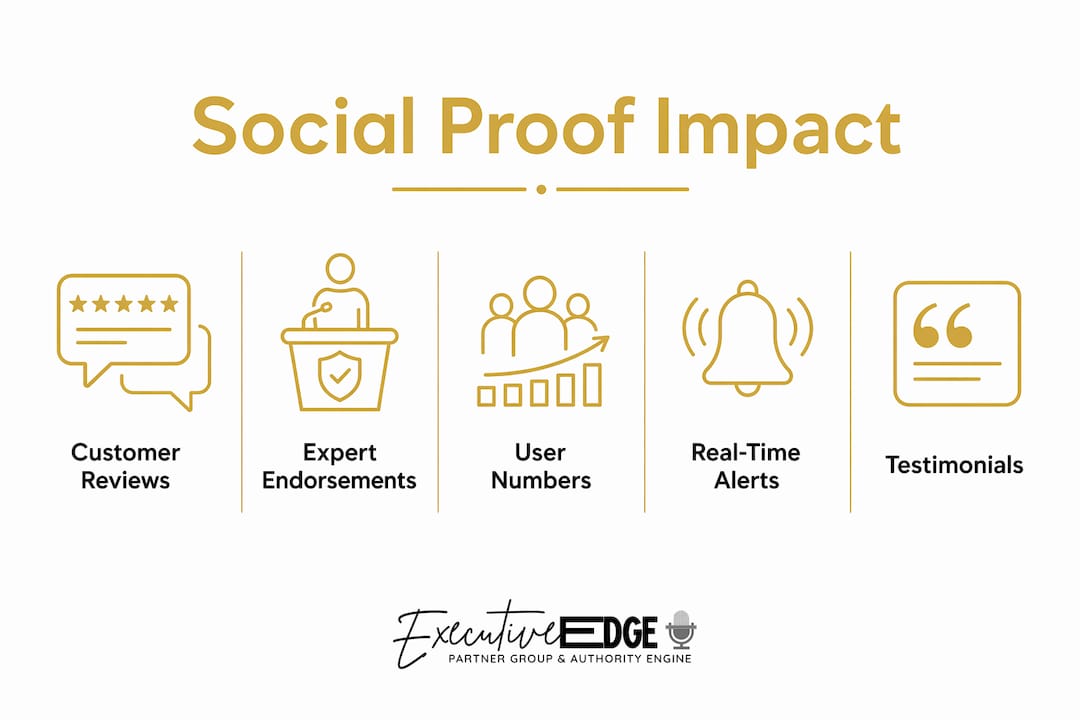
What types of social proof have the biggest impact?
Not all social proof carries equal weight. The type you choose, and how you present it, determines how much trust it actually transfers.
| Social proof type | Primary mechanism | Relative impact |
|---|---|---|
| Customer reviews and ratings | Peer validation | Very high |
| Testimonials (named, specific) | Relatability and specificity | High |
| Aggregate user numbers | Wisdom of the crowd | High |
| Micro-influencer endorsements | Authority and reach | Medium to high |
| Trust seals and certifications | Institutional credibility | Medium |
| Real-time activity alerts | Urgency and FOMO | Medium |
| Celebrity endorsements | Aspirational association | Variable |
The most accessible starting point for most businesses is user social proof: reviews, ratings, and testimonials. Just five product reviews can increase purchase likelihood by 270% compared to having none, with even greater lifts on higher-priced items. That number is not a ceiling. It reflects how dramatically trust shifts when a visitor moves from zero evidence to minimal evidence.
Real-time social proof, such as live purchase alerts or active visitor counts shown by tools like ProveSource or TrustPulse, can lift conversions by 10 to 15% by triggering urgency and social validation simultaneously. This type works best for e-commerce and high-traffic service pages where activity is genuinely frequent. Showing a live counter on a page with three visitors a day reads as hollow.
Pro Tip: For aesthetic brands and service businesses, a dedicated social proof strategy that matches proof type to audience segment consistently outperforms generic review displays. Specificity is the multiplier.
Where you place social proof matters as much as what it says
Placement is the variable most business owners underestimate. You can have the strongest testimonials in your industry and still see them ignored if they sit at the bottom of a page no one scrolls to.
The research on this is direct. Positioning social proof adjacent to your primary CTA can increase conversion by up to 68%. That is not a small optimization. It reflects the principle that trust must be present at the exact moment of decision, not before or after it.
Here is how to think about placement by page type:
- Homepage. Lead with aggregate numbers (clients served, years in business, total reviews) above the fold. This establishes baseline credibility before the visitor reads anything else.
- Product or service pages. Place specific testimonials and star ratings directly adjacent to the primary CTA button. The visitor should see proof and the action button in the same visual field.
- Landing pages. Stack three to five distinct proof types: a named testimonial, a logo bar of recognizable clients, and a quantified result. Stacking three to five types produces greater lifts than any single type alone, provided they do not repeat the same claim.
- Checkout and cart pages. Use trust seals, security badges, and a single strong testimonial focused on satisfaction or ease of the purchase process. Anxiety peaks at checkout. Proof that addresses that specific fear converts.
- Email sequences. Include social proof in follow-up emails, particularly in the second or third touchpoint. Repeated exposure to credible proof across multiple contacts compounds trust over time.
Pro Tip: Anchor your strongest piece of proof, your most specific, named, result-driven testimonial, directly above or beside your primary CTA. Not in the footer. Not in a carousel. Right next to the button.
Why social proof influences behavior: the psychology behind it
The bandwagon effect and social validation are the two primary psychological triggers, but the nuances matter for marketers who want to use this tool precisely.
Fear of Missing Out (FOMO) is the engine behind real-time social proof. When a visitor sees "12 people are viewing this right now" or "Sold 3 in the last hour," the scarcity signal activates loss aversion, one of the strongest motivators in behavioral economics. The visitor shifts from passive browsing to active consideration.
Specificity is what separates high-converting testimonials from generic ones. Visitors detect inauthentic social proof and it erodes trust rather than building it. "Great service, highly recommend!" does almost nothing. "We reduced our onboarding time by 40% in the first month using this system" does a great deal. The named, specific, outcome-focused claim is what triggers genuine belief transfer.
There is also an important limitation worth understanding. A 2025 study on email survey reminders found that social proof framing had no significant effect on open or response rates in that specific context. This matters because it confirms that social proof is not a universal conversion switch. Its effectiveness depends on the audience, the channel, the offer, and how the proof is framed. Testing is not optional. It is the only way to know what actually works for your specific audience.
Legal and ethical rules you cannot ignore
The FTC's Consumer Review Rule is now actively enforced. In December 2025, the FTC issued warning letters to 10 companies for violations including fake reviews and undisclosed paid endorsements, with fines reaching $53,088 per violation. This is not a theoretical risk. It is a live enforcement environment.
The rules are clear:
- Fake or fabricated reviews are prohibited, regardless of how they are generated, including AI-generated reviews.
- Incentivized reviews must be disclosed. If you offer a discount, gift, or any benefit in exchange for a review, that relationship must be stated clearly.
- Influencer partnerships require explicit disclosure. "#ad" or "#sponsored" is not optional.
- Suppressing negative reviews while amplifying positive ones is considered deceptive under the rule.
- AI tools used to collect or display reviews must include compliance verification processes, not just automation.
Ethical and transparent social proof is also more persuasive than manufactured proof. Visitors who sense inauthenticity disengage. The compliance path and the high-conversion path are the same path.
Pro Tip: Build a simple review sourcing protocol: request reviews only from verified customers, use your CRM to trigger the request at the right moment (post-delivery, post-service), and document the process. This protects you legally and produces better quality proof.
Practical steps to build and deploy social proof effectively
Getting social proof right is a system, not a one-time task. Here is how to build that system:
- Identify your happiest customers first. Look at your CRM data for repeat buyers, high NPS scores, or clients who have referred others. These are your best testimonial candidates. Ask them directly and specifically: "Can you describe the result you got and what made it work?"
- Automate feedback requests. Use CRM platforms like HubSpot, Salesforce, or Keap to trigger review requests at the right moment, typically within 24 to 48 hours of a positive experience. Timing is the largest variable in review volume.
- Build case studies from your best results. A case study with a named client, a specific problem, and a measurable outcome is the highest-converting form of written social proof. One strong case study outperforms ten generic testimonials.
- Test placement and format. Run A/B tests on testimonial placement relative to your CTA. Test video testimonials against written ones. Test star ratings against narrative quotes. The data from your own audience is more reliable than any benchmark.
- Use AI-driven personalization. AI-driven CRM systems that show visitors testimonials matched to their industry or segment can lift conversion by up to 260%. Tools like Mutiny or Proof allow this kind of segmentation without custom development.
- Track the right KPIs. Measure conversion rate on pages with and without social proof, bounce rate on key landing pages, and time on page. These tell you whether your proof is working or just decorating the page.
Social proof is not a set-it-and-forget-it asset
Here is what I have seen consistently working with business owners on their digital authority: most treat social proof as a decoration rather than a conversion system. They collect a few testimonials, paste them on the homepage, and move on. Then they wonder why their website does not convert.
The businesses that get real results from social proof treat it as a living asset. They rotate testimonials based on what is performing. They match proof to the specific concern a visitor segment has at that moment in the funnel. They test relentlessly. And they build proof collection into their operations, not as a marketing afterthought, but as a standard part of the customer experience.
I also think the compliance piece is underweighted. Most small and mid-sized businesses have no formal review sourcing process. They are one FTC complaint away from a serious problem. Getting this right is not complicated. It just requires intentionality.
The businesses I see winning with social proof are not the ones with the most reviews. They are the ones with the most specific, credible, and strategically placed proof. Ten well-placed, outcome-specific testimonials beat 500 generic star ratings every time.
— David Domm
Build your authority with Executive Edge Partner Group

Social proof is one layer of a broader authority-building system. At Executive Edge Partner Group, we help business owners and marketers build the kind of online presence that earns trust before a visitor ever reads a testimonial. Our authority-building system combines content strategy, SEO, and AI-enhanced distribution to position your brand as the credible, visible choice in your market. If you are ready to turn your expertise and real customer results into a trust-building engine that works across Google, YouTube, and AI search platforms, we can build that system with you. Reach out to learn how we approach authority for businesses like yours.
FAQ
What is social proof in marketing?
Social proof in marketing is the use of third-party evidence, such as reviews, testimonials, endorsements, and user numbers, to build trust and reduce hesitation in potential buyers. It works by showing prospects that others have already made the decision they are considering.
How many reviews does a business need to see results?
As few as five reviews can increase purchase likelihood by 270% compared to having none. The first reviews produce the largest lift; gains become incremental after a credible baseline is established.
Where should social proof be placed on a website?
Social proof placed directly adjacent to your primary CTA can increase conversion by up to 68%. Product pages, landing pages, and checkout pages are the highest-impact placement locations.
Is it legal to incentivize customers to leave reviews?
Incentivized reviews are legal but must be disclosed clearly under the FTC Consumer Review Rule. Failing to disclose a paid or incentivized relationship can result in fines of up to $53,088 per violation.
Does social proof always increase conversions?
No. Research shows that social proof framing can have no significant effect in certain contexts, such as email survey reminders. Effectiveness depends on the audience, channel, offer type, and how the proof is presented. Testing is the only reliable way to confirm impact.