

Executive content strategy is the deliberate design and governance of leadership-driven content that builds authority, trust, and market influence for business success. Unlike general content marketing, this discipline focuses specifically on the executive voice as a business asset. It combines positioning statements, publishing cadences, editorial governance, and platform distribution into a repeatable system. When done right, it shapes how buyers, partners, and competitors perceive your organization before a single sales conversation begins.
What is executive content strategy and why does it matter?
Executive content strategy is a leadership-focused content planning and management discipline that turns an executive's expertise into a structured publishing program. The industry standard term for the broader practice is content strategy, defined as a documented operating system that decides what content to produce, for whom, and how. Executive content strategy applies that same rigor specifically to leadership voices.
The core components include positioning statements, audience definitions, content models, editorial calendars, brief templates, and governance RACI charts. Each element serves a distinct function. Positioning statements define the executive's unique point of view. Governance RACI charts clarify who creates, reviews, approves, and publishes content. Without these artifacts, most executive content programs collapse into sporadic LinkedIn posts with no compounding effect.
The importance of content strategy at the executive level goes beyond visibility. Buyers want to hear from real executives sharing deep, authentic insights rather than generic brand voices. That shift in expectation means your content program is now a direct input to revenue, not just a marketing expense.

What are the essential components of an effective executive content strategy?
A mature executive content strategy runs on six core artifacts. Each one removes a decision from the publishing workflow and replaces it with a repeatable system.
| Component | Function |
|---|---|
| Positioning statement | Defines the executive's unique perspective and audience |
| Content model | Specifies formats, topics, and structural rules |
| Taxonomy | Organizes content by theme, funnel stage, and audience |
| Editorial calendar | Sets publishing dates, topics, and ownership |
| Brief templates | Standardizes content assignments for writers and editors |
| Governance RACI | Assigns roles: who creates, reviews, approves, and distributes |
These six core artifacts allow teams to create content systematically, eliminating ad hoc decisions that slow production and dilute quality.
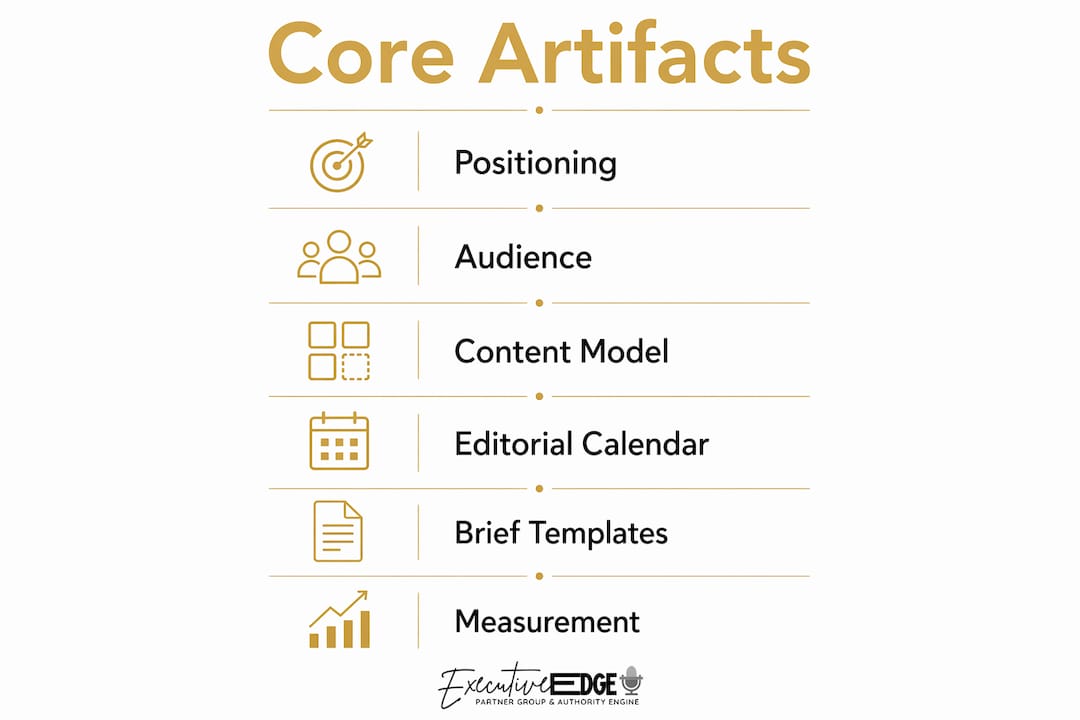
The editorial calendar deserves special attention. Most executives treat it as a scheduling tool. It is actually a strategic filter. Every piece of content on the calendar should map to a business goal, an audience segment, or a competitive narrative you want to own.
Pro Tip: Build your brief templates before you hire any writer or ghostwriter. A strong brief captures your voice, your audience's core concerns, and the business outcome each piece must serve. This single document saves more revision time than any editing tool.
- Positioning statement: Answers "Why should this audience listen to this executive?"
- Content model: Defines the mix of short posts, long articles, video, and original research
- Taxonomy: Tags content so it can be repurposed and distributed across channels
- Editorial calendar: Connects publishing dates to business events, campaigns, and sales cycles
- Brief templates: Give ghostwriters and editors a consistent starting point
- Governance RACI: Prevents bottlenecks by clarifying every decision point in the workflow
How does executive content strategy differ from general content strategy?
General content strategy is the organizational operating system for all content. Content marketing is the tactical execution within that system, designed to acquire and retain customers. Executive content strategy is a specialized layer that uses leadership voices to build belief and trust at a level that brand content cannot reach.
Here is how the three disciplines compare:
- General content strategy: Governs all content across an organization. Covers SEO, product pages, support docs, and campaigns. Audience is broad.
- Content marketing: Executes specific campaigns to generate leads and retain customers. Focused on volume and conversion metrics.
- Executive content strategy: Focuses on one or a few leadership voices. Prioritizes depth, credibility, and market perception over volume. Measured by trust signals, pipeline influence, and sales cycle length.
Executive content shortens sales cycles and shapes market narratives in ways that brand content simply cannot replicate. A CMO publishing original research on buyer behavior does more for pipeline than ten blog posts from the company account. The reason is simple: buyers attribute credibility to people, not logos.
Effective executive thought leadership involves original frameworks, data-driven case studies, and contrarian perspectives. These formats create knowledge and position executives as market authorities. Generic brand content rarely achieves that effect.
What publishing cadence and content types maximize executive authority?
The most practical framework for executive content planning is the 3-1-1 cadence: three short-form posts per week, one long-form article per month, and one major project per quarter. This structure balances sustainability with compounding authority over time.
Here is how to execute it:
- Three short posts per week: Publish on LinkedIn. Share observations, reactions to industry news, or one-sentence insights from your work. Each post should take no more than 15 minutes to write or review.
- One long-form article per month: Publish on your corporate website or LinkedIn Articles. Minimum 800 words. This is where you develop a full argument, share data, or present a framework.
- One major project per quarter: Original research, a keynote talk, a podcast series, or a co-authored report. This is your authority anchor for the quarter.
Platform selection matters as much as cadence. LinkedIn drives conversations and buyer discovery. Your corporate website serves as a reference point for buyers doing due diligence. Earned media placements in trade publications extend your reach to new audiences. Sales enablement tools distribute your content directly into active deals.
Pro Tip: Every long-form article you publish should generate at least four short-form posts. Pull a stat, a contrarian claim, a framework visual, and a reader question from the same piece. This is how you maintain content velocity without doubling your workload.
Different executive roles require different content angles. CTOs want technical depth. CFOs require financial insights. CMOs focus on growth. CEOs shape industry vision. A single executive publishing program rarely serves all four audiences equally, so your content model must specify which audience each piece targets.
What challenges do executives face when implementing content strategies?
Time scarcity is the most common obstacle. Most executives can commit 30–60 minutes per week to content, which is not enough to maintain a 3-1-1 cadence without support. The solution is not to reduce the cadence. The solution is to build a production system around the executive's limited time.
Internal marketing teams often struggle to turn raw executive ideas into polished, high-authority content. This gap requires ghostwriting support or expert content operators who can capture the executive's voice and maintain quality at scale.
Common obstacles and how to address them:
- Time scarcity: Use a weekly 20-minute voice memo or interview to capture ideas. A ghostwriter or editor converts that input into finished content.
- Voice inconsistency: Build a voice guide that documents sentence structure preferences, vocabulary, and opinion boundaries. Review it with every new writer.
- Audience misalignment: Map each content piece to a specific buyer persona before writing begins. Use your taxonomy to enforce this discipline.
- Approval bottlenecks: Assign a single approver in your governance RACI. Multiple reviewers kill publishing speed.
- Content isolation: Integrate executive content with your sales team. Share published pieces with account executives so they can use them in active conversations.
Pro Tip: If you are a business owner in Tyler and East Texas building your first executive content program, start with one platform and one content type. Master LinkedIn short posts for 90 days before adding long-form articles. Consistency on one channel beats scattered presence across five.
Podcast hosting is one of the most efficient formats for executives with limited writing time. A 30-minute recorded conversation generates a transcript, a blog post, multiple short clips, and social content in a single session.
How does executive content strategy accelerate business outcomes?
Executive content is a strategic multiplier that shortens sales cycles and creates demand by connecting buyer skepticism with brand authority. It shifts the content program from volume to signal-rich material that drives pipeline.
The mechanism is straightforward. When a buyer encounters your executive's published perspective before a sales call, they arrive with pre-built trust. The sales conversation starts further along the decision process. Objections that would normally consume two or three meetings are already addressed in published content.
| Business outcome | How executive content drives it |
|---|---|
| Shorter sales cycles | Buyers arrive pre-educated and pre-convinced |
| Higher close rates | Trust is established before the first meeting |
| Talent attraction | Top candidates research leadership before applying |
| Partnership credibility | Partners evaluate executive authority as a proxy for company quality |
| Competitive differentiation | Original frameworks and data are difficult to copy |
Executive content builds belief and trust faster than generic corporate content. That speed advantage compounds over time. An executive who publishes consistently for 12 months owns a body of work that functions as a permanent sales asset, not a campaign that expires.
Why most executive content programs fail before they start
I have worked with executives who had genuine expertise, strong opinions, and real stories worth telling. Most of them still failed to build a consistent content program. The reason was not lack of ideas. It was treating content as a task rather than a system.
The executives who succeed treat their content program the way they treat their sales pipeline. They track it, staff it, and hold it accountable to outcomes. They do not publish when inspired. They publish on schedule because the schedule is what builds compounding authority.
The other pattern I see consistently: executives underestimate how much their voice matters to buyers. A CEO publishing a contrarian take on industry trends does more for brand perception in one post than a month of corporate social media. Buyers are skeptical of brands. They are far less skeptical of people who demonstrate real knowledge.
The mindset shift is this: your content is not marketing. It is a business development asset that works while you sleep. Once you accept that framing, the investment in ghostwriting support, editorial governance, and distribution planning becomes obvious rather than optional.
How Executive Edge Partner Group helps leaders build content authority
If you are ready to move from sporadic posts to a structured authority program, Executive Edge Partner Group builds the system for you.

Executive Edge Partner Group provides done-for-you executive content strategy services, including ghostwriting, editorial governance, publishing cadence design, and multi-platform distribution. The team works with business owners, consultants, and executives across Tyler, Texas and beyond to transform real expertise into consistent, high-authority content. Whether you need a full content system or support executing a 3-1-1 cadence, the authority-building programs at Executive Edge Partner Group are built specifically for leaders who want results without becoming full-time content creators. Learn more and start building your executive presence today.
FAQ
What is executive content strategy in simple terms?
Executive content strategy is a structured plan for using a leader's voice and expertise to build authority, trust, and market influence through consistent, governed content publishing.
How does executive content strategy differ from content marketing?
Content marketing executes campaigns to generate leads. Executive content strategy focuses on leadership voices to build belief and shorten sales cycles, operating at a deeper level of trust than brand content.
What is the 3-1-1 publishing cadence?
The 3-1-1 cadence is a sustainable publishing framework that calls for three short posts per week, one long-form article per month, and one major project per quarter to build compounding authority over time.
What platforms should executives publish on?
LinkedIn is the primary platform for executive conversations and buyer discovery. Corporate websites serve buyer due diligence, and earned media placements extend reach to new audiences.
Do executives need a ghostwriter for content strategy?
Most executives do. Internal teams often lack the specialized skills to translate executive ideas into polished, high-authority content, making ghostwriting or expert content operators a practical necessity for maintaining quality and consistency.