

Content velocity is defined as the rate at which a marketing team produces and publishes content over time, serving as the operational engine behind faster audience reach and stronger SEO authority. This metric is distinct from "speed to market," which Storyblok frames as the strategic outcome. Content velocity is the operational input that makes that outcome possible. HubSpot's research on content cadence shows that publishing frequency directly correlates with lead generation thresholds. Contentful takes this further, defining content velocity in terms of "time to value," meaning how quickly published content begins delivering measurable results. For digital marketers and content creators, understanding this distinction is the difference between running a content program and running one that compounds over time.
What is content velocity and why does it matter?
Content velocity is the measurable pace at which your team moves ideas from brief to published asset. Storyblok distinguishes between velocity as an operational metric and speed to market as a strategic outcome. That distinction matters because you can improve your publishing pace without ever improving your market reach, if the content lacks purpose or distribution.
The importance of content velocity shows up most clearly in competitive markets. A brand publishing two well-structured articles per week builds indexed pages, earns backlinks, and signals topical authority to Google faster than a brand publishing two articles per month. The compounding effect is real and measurable. Contentful explains that higher velocity shortens the distance between idea and impact, which lets marketers use leading performance indicators instead of waiting weeks for trailing engagement data.

Content velocity also supports sales teams directly. Aprimo emphasizes that velocity enables timely responses to market trends and keeps sales collateral current. A slow content pipeline means your team is pitching with outdated case studies and stale blog posts. That costs deals.
How is content velocity measured beyond volume?
Most marketers track content velocity by counting published pieces per month. That number tells you very little. True velocity measurement requires process metrics that reveal where your workflow slows down.
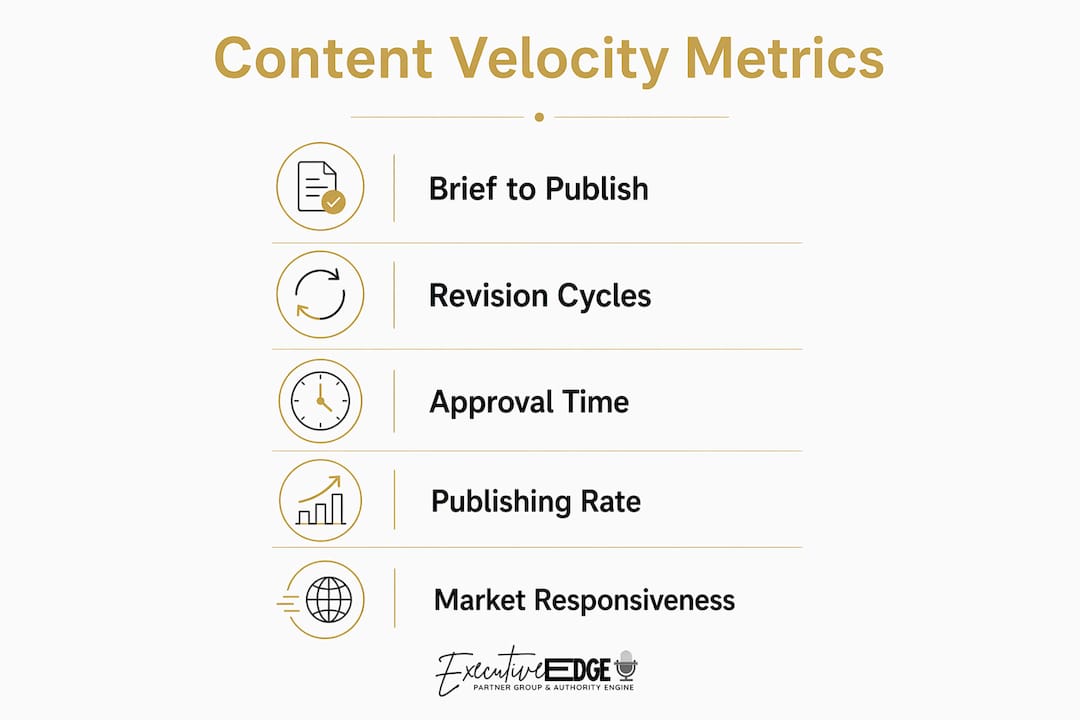
The metrics that actually matter include:
- Time from brief to publication: How many calendar days does it take from the moment a topic is assigned to the moment it goes live?
- Revision cycles per asset: How many rounds of edits does each piece require before approval?
- Asset reuse rate: How often does your team repurpose existing content into new formats rather than starting from scratch?
- Approval and governance lag: How many days sit between "draft complete" and "published"?
Aprimo recommends focusing on these operational workflow metrics rather than engagement metrics alone. Engagement tells you how content performed after publishing. Process metrics tell you why it took so long to get there.
The most overlooked bottleneck is the review cycle. Teams often spend more time in revision and approval than in actual writing. A piece that takes three hours to write but twelve days to approve has a velocity problem rooted in governance, not authorship. Fixing that requires process changes, not faster writers.
Pro Tip: Track your revision pipeline separately from your writing pipeline. Log the date each draft enters review and the date it exits. After 30 days, you will see exactly where your content velocity is bleeding out.
What tactics boost content creation speed without losing quality?
Increasing content production frequency without a quality drop requires process design, not just effort. The following tactics address the most common velocity killers.
-
Pre-plan a full month of content ideas. HubSpot advises that outlining a month's worth of topics in advance can cut preparation time by 50% or more. When writers start a session already knowing the topic, angle, and key points, they spend zero time on ideation and all their time on execution.
-
Reduce decision overhead. HubSpot identifies context switching and mid-project decision making as major velocity killers. Every time a writer has to stop and ask "what should I write about next?" or "who approves this?" you lose momentum. Build a content calendar and an approval chain before the month starts.
-
Use AI writing tools for first drafts. HubSpot's AI Content Writer, along with tools like Jasper and Copy.ai, can generate structured first drafts in minutes. These drafts still require human editing and fact-checking, but they eliminate the blank-page problem that slows many writers down.
-
Batch similar content types together. Writing three blog posts in one session is faster than writing one blog post, one social caption, and one email in three separate sessions. Batching keeps your brain in one mode and reduces the cognitive cost of switching formats.
-
Standardize content templates. A pre-built template for blog posts, case studies, and product pages removes structural decisions from every new piece. Writers fill in the framework rather than rebuilding it each time.
-
Assign clear ownership to every stage. Ambiguity about who reviews, who approves, and who publishes creates delays. A documented workflow with named owners at each stage removes that ambiguity entirely.
Pro Tip: Use the placeholder "[TK]" (short for "to come") inside drafts to mark sections that need additional research or data. This lets writers keep moving forward without stopping to hunt for a statistic mid-draft. Fill in the TKs during a dedicated research pass.
Understanding how content marketing works at a structural level also helps you identify which content types deliver the fastest return on production time.
Why does content velocity matter for SEO and lead generation?
Content velocity directly determines how fast your site builds the critical mass of indexed pages needed to generate organic leads. This is not a theory. It is documented in HubSpot's blogging research.
| Blog Article Count | Impact on Lead Generation |
|---|---|
| Fewer than 20 articles | Minimal organic lead growth |
| 20–50 articles | Lead generation begins to compound |
| 52+ articles | Median lead counts increase significantly |
| 100+ articles | Compounding keyword coverage and backlink acquisition accelerate |
The table above shows a clear threshold effect. Publishing 20 articles does not just mean 20 indexed pages. It means Google has enough signal to understand your topical authority, enough pages to surface in long-tail searches, and enough content for other sites to link to. Each new article adds to that foundation.
Higher content production frequency also supports backlink acquisition. Sites that publish consistently give other writers and journalists more material to reference. A blog that publishes once a month gives the internet 12 opportunities per year to earn a backlink. A blog publishing twice a week gives it 104 opportunities. The math is straightforward.
Content refresh cadence matters just as much as new content. Google favors pages that are updated regularly. A high-velocity content program should include a scheduled review of existing posts, updating statistics, adding new examples, and improving internal linking. This keeps older content competitive without requiring a full rewrite.
For local brand content strategies, velocity also determines how quickly a business can dominate local search terms before competitors build their own content libraries.
How does content velocity connect to iterative marketing?
Contentful's evolved definition frames content velocity not as raw publishing speed but as time to value. The question is not just "how fast can we publish?" but "how quickly does published content start delivering results?"
This framing connects velocity to iterative marketing cycles. When your team publishes faster, you get performance data faster. That data tells you which topics resonate, which formats convert, and which calls to action drive clicks. You then feed those insights back into the next content cycle. The loop tightens with every iteration.
The key benefits of aligning velocity with iterative cycles include:
- Faster signal collection: More published content means more data points on audience behavior in less time.
- Shorter optimization windows: You can test a headline format, measure click-through rates, and adjust within weeks rather than quarters.
- Reduced reliance on assumptions: High-velocity teams replace gut-feel content decisions with data-backed ones faster than low-velocity teams.
- Better audience alignment: Frequent publishing forces you to stay close to what your audience is searching for, which naturally improves relevance over time.
The warning here is real. Contentful recommends aligning velocity with content purpose and KPI targets specifically to prevent speed from outrunning relevance. A team that publishes 20 articles a month on loosely related topics will build a scattered content library that confuses both readers and search engines. Velocity without strategic focus produces noise, not authority.
The solution is to set velocity targets by content pillar. Decide how many articles per month support each core topic cluster, then hold that cadence. This keeps your content library coherent while still building at speed.
The velocity mistake most marketers make
Most marketers treat content velocity as a production problem. They hire more writers, buy more tools, and push for more output. The velocity does not improve. The reason is almost always the same: the bottleneck is not writing. It is everything that happens after writing.
I have seen content teams where writers finish drafts in two days and then watch those drafts sit in a review queue for three weeks. The writers are fast. The process is slow. Measuring velocity by counting published pieces per month hides this completely. You need to measure cycle time at every stage, not just at the end.
The other mistake is treating velocity as a goal in itself. Publishing faster only matters if the content serves a defined purpose. Before pushing for higher production frequency, map your content to specific KPIs. Are you trying to rank for 50 target keywords? Build to 52 published articles first. Are you trying to generate leads from organic search? Focus velocity on bottom-of-funnel topics before scaling top-of-funnel volume.
For businesses in Tyler and East Texas, this is especially relevant. Local markets have specific search patterns and competitive gaps that a focused, high-velocity content program can capture quickly. But only if the content is built around local intent, not generic topics that compete with national publishers.
Velocity is a multiplier. It amplifies whatever your content strategy already is. If the strategy is strong, more velocity means more results. If the strategy is weak, more velocity means more wasted effort.
— David Domm
How executive edge partner group helps you build content velocity
Building a consistent content production system is the hardest part of content marketing for most business owners and marketers.

Executive Edge Partner Group runs a done-for-you authority-building system that handles content planning, production, and multi-platform publishing so you can maintain high content velocity without becoming a full-time content creator. The system combines AI-assisted workflows, strategic content calendars, and distribution across Google, YouTube, and AI search platforms. Whether you are a consultant, contractor, or local business owner, Executive Edge Partner Group builds the content engine your brand needs to grow online visibility and stay ahead of competitors. Reach out to learn how the system works for your market.
FAQ
What is content velocity in marketing?
Content velocity is the rate at which a marketing team produces and publishes content over time. It is an operational metric that measures production pace, distinct from "speed to market," which is the strategic outcome that velocity enables.
How do you measure content velocity accurately?
Measure content velocity using process metrics: time from brief to publication, revision cycles per asset, and approval lag. Engagement metrics alone do not capture where your workflow slows down.
How many blog posts do you need to see SEO results?
HubSpot's research shows lead generation begins to compound once a blog reaches 20–50 published articles, with median lead counts increasing significantly at 52 or more posts.
What is the biggest bottleneck in content velocity?
The review and approval cycle is the most common bottleneck. Teams frequently spend more time waiting for approvals than writing, which means velocity improvements require process changes in governance, not just faster authorship.
What is the difference between content velocity and content volume?
Content volume counts total published pieces. Content velocity measures the rate and efficiency of production over time, including how long each piece takes to move through the full workflow from brief to publication.