

Most local business owners pour money into ads, get a short spike in visibility, and then watch it disappear the moment the budget runs out. There is a better way. To genuinely grow local brand with content is to build something that compounds over time, earns trust before a customer ever calls you, and keeps working long after you publish it. This guide covers the full picture: how to define your brand identity, plan a hyperlocal content strategy, execute it across the right channels, measure what matters, and scale it without losing the authenticity that makes local businesses worth choosing.
Table of Contents
Key Takeaways
| Point | Details |
|---|---|
| Start with brand clarity | Define your local values and unique position before creating a single piece of content. |
| Go hyperlocal, not just local | Neighborhood-specific content outperforms generic city-level pages for both search and trust. |
| Consistency beats volume | A steady publishing rhythm builds more authority than sporadic bursts of content. |
| Measure real business outcomes | Track conversions, repeat visits, and call volume, not just page views or likes. |
| Content is a long-term asset | Unlike ads, well-built content reduces customer acquisition costs over months and years. |
How to Grow Local Brand with Content: Start with Identity
Before you write a word, record a video, or post anything online, you need to answer one question clearly: what does your local business stand for, and who exactly are you talking to? This sounds obvious. Most businesses skip it anyway, and their content ends up sounding like everyone else in town.
Your local brand identity is the combination of your values, your voice, your expertise, and the specific problem you solve better than your competitors. A plumber who specializes in older homes in a historic neighborhood has a completely different story to tell than a general plumber covering the whole metro area. The more specific you are, the more your content will resonate.
Here is where most local businesses go wrong with their messaging:
-
They describe what they do instead of why it matters to a specific customer
-
They use the same generic language as every competitor (“quality service,” “trusted professionals”)
-
They never address the real fears, questions, or frustrations their customers bring through the door
-
They fail to connect their content themes back to a consistent brand personality
To build a real local brand strategy, start by interviewing your five best customers. Ask them what they were worried about before hiring you, what made them choose you, and what they would tell a friend about your business. Their words are your content brief.
Pro Tip: Use Google’s “People Also Ask” results for your service category plus your city name to find the exact questions your local audience is already typing into search. These become your first ten content topics.
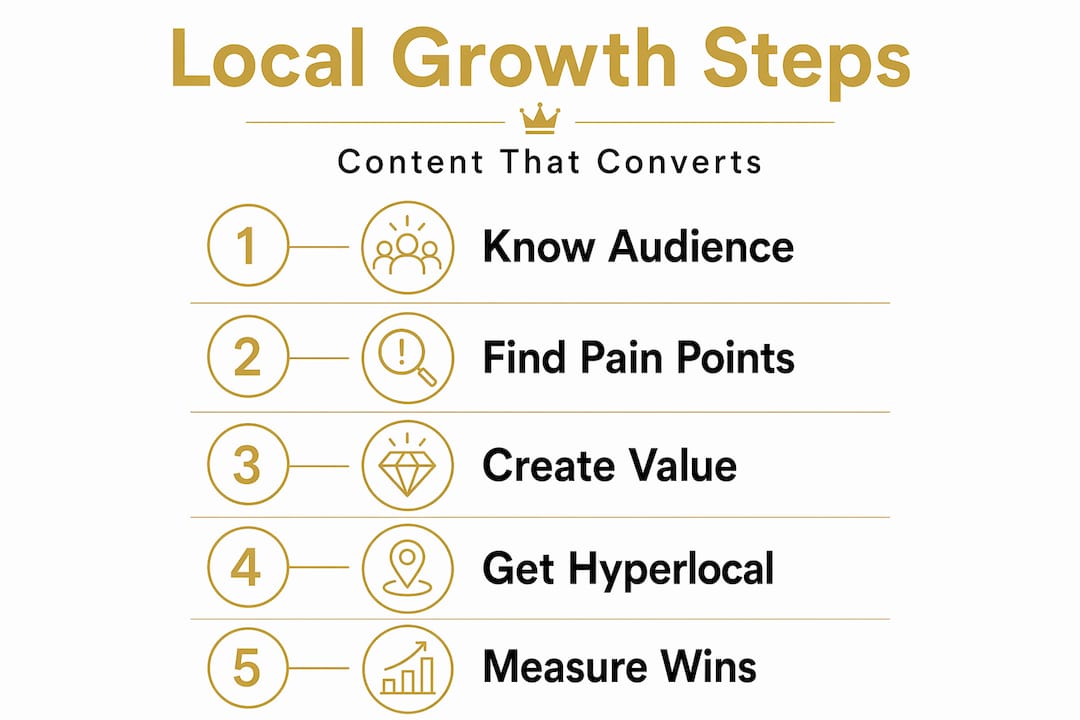
Tools like Google Trends filtered by region, local Facebook groups, and Nextdoor community threads give you a live feed of what your neighbors actually care about. That research is the foundation of content that builds trust with a local audience before they ever meet you.
Planning a hyperlocal content strategy
The difference between a local content strategy and a hyperlocal one is specificity. Generic local content says “We serve the Dallas area.” Hyperlocal content says “Here is what homeowners in Lakewood need to know about foundation repairs after this summer’s drought.” One of those earns a click and a bookmark. The other gets scrolled past.
Answer-first content that addresses hyper-specific local friction, things like neighborhood regulations, seasonal conditions, and community events, generates far higher local relevance than any generic city mention. This is not just good SEO. It is good customer service delivered in content form.
Here is a practical framework for building your content calendar around local specificity:
-
Map your service neighborhoods. List every distinct area, zip code, or community you serve. Each one is a potential content pillar, not just a keyword to drop into a single page.
-
Identify seasonal and event hooks. What happens in your community in March, July, or October that connects to what you do? A tax preparer in a college town has a completely different content calendar than one serving retirees.
-
Create neighborhood-level pages and posts. Broad page fatigue hurts local SEO. One generic city service page signals nothing. Unique pages per geographic segment prove you actually know and serve that area.
-
Balance content types. Aim for roughly 60% educational content (how-to guides, FAQs, explainers) and 40% trust-building content (case studies, founder stories, community involvement).
-
Set a publishing rhythm you can maintain. Two well-researched posts per month beats eight rushed ones. A content strategy tied to local events and audience needs stays relevant and sustainable.
| Content type | Frequency | Primary goal |
|---|---|---|
| Neighborhood-specific blog post | 2x per month | Local search visibility |
| Short-form video (Google, social) | 1x per week | Trust and engagement |
| Google Business Profile post | 2x per week | Local discovery |
| Email newsletter | 2x per month | Repeat visits and loyalty |
| User-generated content feature | As available | Social proof |
Executing tactics that build real visibility
Knowing what to create is half the battle. The other half is knowing how to distribute it so the right local people actually see it. This is where most content marketing for local businesses stalls out. Business owners publish a blog post, share it once on Facebook, and wonder why nothing happens.
Here is what actually moves the needle for local brand awareness:
-
Founder storytelling. People buy from people. A short video of you explaining why you started your business, filmed on your phone in your shop, will outperform a polished corporate ad almost every time for a local audience.
-
Google Business Profile as a content channel. Most businesses treat their GBP as a directory listing. It is actually a publishing platform. Regular posts, Q&A responses, and photo updates all feed the algorithm and show up in local search results.
-
User-generated content. Ask happy customers to share photos or short videos of their experience. Repost them with permission. This content carries more credibility than anything you produce yourself because it is not self-promotional.
-
Local influencer and creator partnerships. You do not need someone with a million followers. A local food blogger, a neighborhood mom with 3,000 engaged Instagram followers, or a community podcast host can put your brand in front of exactly the right people.
-
Collaborations with complementary businesses. A wedding photographer and a florist serving the same city can co-create content that reaches both audiences. Building partnerships as an expert source amplifies reach without doubling your workload.
AI-driven discovery platforms are compressing how quickly customers make decisions. Businesses with vague or thin content get skipped entirely. Your content needs to answer the customer’s next question before they think to ask it.
Pro Tip: When optimizing content for local search, use place-specific phrases the way a local would say them, not the way a marketer would write them. “Best HVAC near Midtown” is how people search. “Premium climate control solutions in the metropolitan area” is how nobody searches.

Measuring what actually matters
Vanity metrics feel good and tell you almost nothing useful. Page views, follower counts, and post impressions are inputs, not outcomes. When you are trying to build brand awareness locally and grow a real business, you need to track metrics that connect to revenue.
Here is the comparison that clarifies what to watch:
| Vanity metric | Meaningful metric |
|---|---|
| Total page views | Pages visited before a contact form submission |
| Social media followers | Engagement rate from local accounts |
| Post impressions | Click-throughs to your phone number or directions |
| Video views | Watch time and return viewer percentage |
| Email list size | Open rate and reply rate from local subscribers |
Beyond the numbers, pay attention to the qualitative signals. Are customers mentioning your content when they call? Are they saying “I saw your video about X and that is why I called you”? That is the clearest sign your content is doing its job.
Local search visibility is not optional marketing infrastructure. A buyer who is ready to spend money right now may never find you if your content is not showing up where they are looking. Track your Google Business Profile views, direction requests, and call clicks monthly. These numbers tell you whether your content is earning real-world attention.
Sustaining and scaling your content over time
The businesses that win with content long-term are not the ones who publish the most. They are the ones who build systems that keep producing without burning out the owner.
Content marketing compounds over time. A blog post written today can bring in customers two years from now. A video series you build this quarter becomes a sales tool your team uses indefinitely. Unlike paid ads, this is an asset that grows in value rather than disappearing when the budget stops.
As your local brand grows, the smartest shift you can make is moving from being the sole content creator to being the content director. You provide the expertise, the opinions, and the brand voice. A team, a system, or a service handles the production and distribution. Brands at the growth stage often shift 40 to 45 percent of their marketing budget toward content creation specifically because it reduces dependence on paid advertising over time.
Local marketing that scales well requires modular systems and clear processes, not just more effort. Build templates, repurpose content across formats, and document what works so you can repeat it.
Pro Tip: Record one 10-minute explanation of your most commonly asked customer question each month. That single recording becomes a blog post, a YouTube video, three social clips, and an email. One input, five outputs.
My honest take on local content in 2026
I have worked with enough local businesses to say this plainly: most of them are dramatically underestimating what content can do for them, and almost all of them are overcomplicating how to get started.
Here is what I have seen consistently. The businesses that build real authority in their local markets are not the ones with the biggest budgets or the most polished production. They are the ones who show up consistently, speak specifically to their community, and treat content as a long-term investment rather than a short-term campaign.
The post-AI search environment has made hyperlocal authority more valuable, not less. When AI tools summarize search results for a user, they pull from sources that have demonstrated clear, specific, credible expertise in a topic and location. Generic content gets filtered out. Detailed, neighborhood-specific, answer-first content gets surfaced.
What I have found actually works is this: start with one content format you can sustain, get specific about who you are talking to and where they live, and publish consistently for six months before you judge the results. The businesses I have watched struggle are the ones who try everything at once, see no immediate return, and quit before the compounding effect kicks in.
Community and creator partnerships are the most underused tool in local content marketing. One collaboration with a trusted local voice can do more for your brand in a week than six months of solo posting.
Start deliberately. Iterate consistently. The local authority you build through content is one of the few things in marketing that genuinely belongs to you.
— David
How Eepartnergroup helps local brands grow through content

Building a content engine from scratch while running a business is genuinely hard. That is exactly what Eepartnergroup’s Executive Edge Authority Engine is designed to solve. The system takes your expertise, your story, and your local market knowledge and turns it into a consistent stream of strategic content across blogs, video, social media, and AI-optimized platforms. You stay focused on your business. The content keeps working.
For local businesses that want to build real brand authority without becoming full-time content creators, Executive Edge handles the strategy, production, and distribution. The result is a growing library of content assets that earn trust, improve local search visibility, and bring in customers who already know why they are calling you. If you are ready to stop relying solely on ads and start building something that lasts, Eepartnergroup is worth a conversation.
FAQ
What does it mean to grow a local brand with content?
Growing a local brand with content means using educational, community-focused, and search-optimized material to build visibility and trust with a specific geographic audience. Unlike paid ads, this approach builds compounding authority over time.
How is hyperlocal content different from regular local SEO?
Hyperlocal content targets specific neighborhoods, communities, or micro-markets rather than broad city-level keywords. Neighborhood-specific pages signal authentic local presence to both search engines and potential customers.
How long does content marketing take to show results for local businesses?
Most local businesses see meaningful organic traction within three to six months of consistent publishing. Content compounds over time, meaning results accelerate the longer you maintain a steady output.
What content types work best for local brand awareness?
Founder stories, neighborhood-specific blog posts, Google Business Profile updates, and short-form video consistently outperform generic promotional content for building local brand awareness. User-generated content adds social proof that no owned content can replicate.
Do I need a big budget to start content marketing for my local business?
No. A smartphone, a clear understanding of your audience’s questions, and a consistent publishing schedule are enough to start. The investment is primarily time and strategic focus, not production budget.