

AI content tools are software systems that generate text, ideas, and structured content by predicting word sequences based on statistical patterns learned from large datasets. Understanding how AI content tools work gives content creators, marketers, and business professionals a real advantage. These tools do not think or research the way humans do. They predict. That distinction changes everything about how you should use them. For business owners in Tyler, Texas and across East Texas, knowing this difference separates teams that get results from those that get generic output.
How do AI content tools technically generate text?
AI content generation works through a process called autoregressive token prediction. The model reads your input, then predicts the next token one word fragment at a time, based on statistical probability patterns learned during training. Each predicted token becomes part of the context for the next prediction. The result is text that reads as coherent and confident, even when the underlying facts are wrong.
Large language models (LLMs) power most modern AI writing tools. These neural networks train on billions of text examples, learning grammar, style, tone, and common knowledge patterns. They do not store a database of verified facts. They store relationships between words and ideas. That is a critical distinction.

Natural Language Processing (NLP) sits underneath the generation layer. NLP analyzes grammar and stylistic markers to interpret context, sentiment, and intent from your prompt. When you write a detailed brief, NLP layers parse it for audience signals, topic scope, and tone cues before generation begins. Better input produces better output, every time.
The hallucination problem stems directly from this architecture. Because the model predicts rather than retrieves, it can produce confident but incorrect claims with no warning. A statistic, a name, a date. All can be fabricated with the same fluency as accurate content. This is not a bug being patched. It is a structural feature of how these systems work.
Pro Tip: Never treat AI-generated text as a first draft ready for publication. Treat it as a structured brainstorm that requires fact verification before it earns a byline.
What does a professional AI content workflow look like?
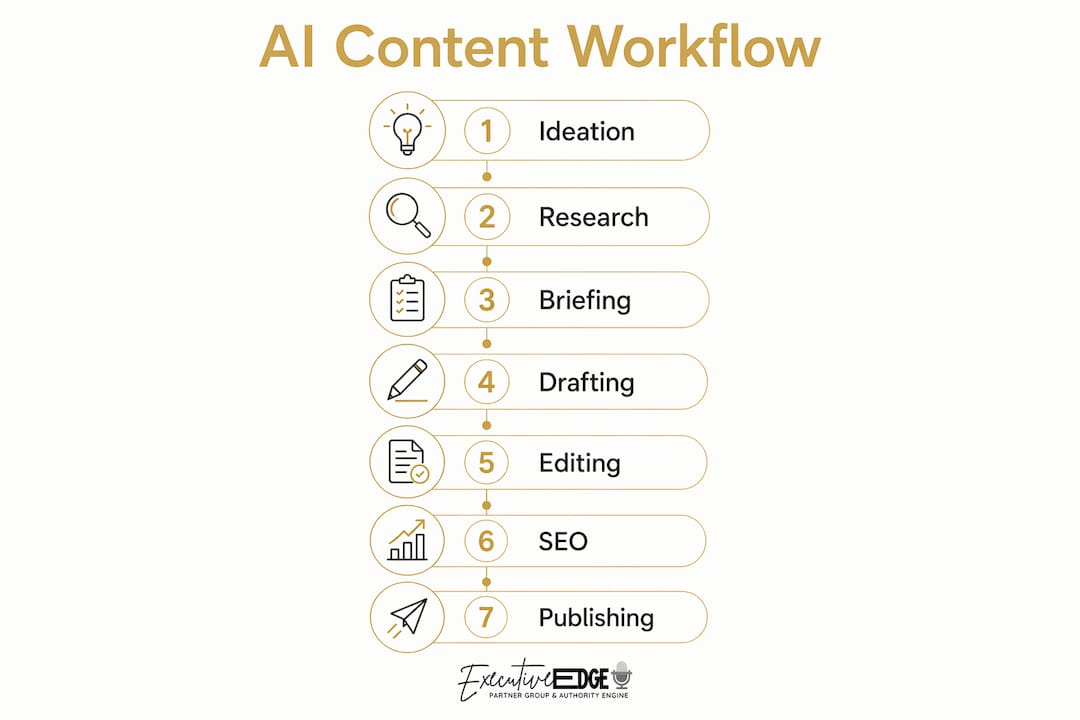
A professional AI content workflow follows a multi-stage pipeline of 6–7 steps, not a single prompt. Each stage serves a distinct purpose. Collapsing them into one step is the most common mistake creators make.
Here is what a production-grade pipeline looks like:
- Discovery and ideation. Identify the topic, search intent, and audience questions. AI tools surface trending queries and content gaps at this stage.
- Research and fact-gathering. Collect verified data, quotes, and sources before any generation begins. This step is human-led or uses retrieval-augmented generation (RAG) to pull from trusted sources.
- Brief creation. Write a detailed brief specifying tone, audience, structure, word count, and key claims. Detailed briefs reduce generic output and align AI drafts with brand voice.
- AI drafting. Feed the brief into the generation tool. The AI produces a structured draft based on your constraints.
- Editorial review. A human editor checks for factual accuracy, brand voice, logical flow, and depth. This is not optional.
- SEO and schema optimization. Apply keyword placement, meta descriptions, and structured data markup.
- Distribution and repurposing. Publish across channels and repurpose the core content into social posts, video scripts, and email sequences.
AI handles roughly 70% of content production labor across research synthesis, drafting, and repurposing. Humans own the critical 30% that includes strategy, voice refinement, and fact verification. That ratio matters because it tells you where to spend your time.
Pro Tip: Build your brief before you open any AI tool. A one-page brief with audience, tone, key claims, and structure will produce a draft that needs 20 minutes of editing instead of two hours.
What types of AI content tools assist different parts of creation?
The AI writing tools market organizes itself by function. Each category solves a specific problem in the content creation process.
- Ideation and research tools surface trending topics, common search questions, and content gaps. They analyze search data and competitor coverage to identify what your audience is actively looking for.
- Draft generation tools produce outlines, section drafts, and full articles from structured briefs. These are the tools most people picture when they think of AI writing software.
- Editing and refinement utilities adjust tone, tighten sentences, flag passive voice, and check for stylistic consistency. Some include basic factual verification layers.
- SEO optimization tools analyze keyword placement, readability scores, and semantic coverage. They compare your draft against top-ranking pages and suggest structural improvements.
- Distribution and repurposing tools convert long-form content into social media posts, email newsletters, video scripts, and short-form clips. This is where AI content workflows deliver the most time savings for busy teams.
| Function category | Primary use case | Human input required |
|---|---|---|
| Ideation tools | Topic discovery, gap analysis | High (strategy decisions) |
| Draft generation | Outlines, full article drafts | High (brief creation, editing) |
| Editing utilities | Tone, style, readability | Medium (final judgment) |
| SEO tools | Keyword and structure analysis | Medium (interpretation) |
| Repurposing tools | Multi-channel distribution | Low (review and approve) |
The most effective teams use tools from multiple categories in sequence, not a single all-in-one platform. Each specialized tool does its job better than a generalist system.
What are the common limitations and risks of AI content tools?
Hallucination is the most serious risk in AI content creation. The model generates false confident claims because it predicts plausible text, not verified facts. A fabricated statistic in a published article damages credibility in ways that take months to repair.
Generic output is the second major failure mode. Without a detailed brief, AI tools produce content that sounds professional but says nothing specific. It covers the topic without owning a point of view. Readers and search engines both penalize this kind of content.
The risks break down into four categories worth monitoring:
- Factual errors. Dates, names, statistics, and citations can all be fabricated. Manual fact-checking or RAG-based retrieval is the only reliable fix.
- Voice drift. AI defaults to a neutral, averaged tone. Without explicit tone instructions in the brief, output loses brand character quickly.
- Shallow depth. Single-prompt generation produces surface-level coverage. Multi-stage workflows with research inputs produce substantive content.
- SEO mismatch. AI drafts often miss semantic coverage that search engines reward. An SEO review stage catches these gaps before publishing.
"The human-in-the-loop approach is the defining factor that separates valuable AI-generated content from generic, low-value output. Fact verification and voice consistency are not finishing touches. They are the product."
Quality gates with human editorial review are not optional steps. Skipping them produces content that looks complete but fails on accuracy and authority. The gate does not slow production. It protects the investment you made in every previous stage.
How can creators and business professionals integrate AI tools effectively?
Effective integration starts with one principle: AI accelerates execution, humans own strategy. When that boundary is clear, workflows scale without quality loss.
Follow these steps to build a workflow that holds up under real production pressure:
- Write the brief first. Define your audience, the core claim, the tone, and the structure before touching any AI tool. The brief is the product of your thinking. The AI draft is the output of your brief.
- Separate research from generation. Gather your facts, sources, and data points manually or with a RAG-enabled tool before drafting begins. Feed verified information into the generation prompt.
- Use AI for repurposing at scale. One long-form article can become five social posts, an email, a video script, and a podcast outline. AI handles this content repurposing work faster than any human team.
- Build a quality gate into every workflow. Assign a human reviewer to check factual accuracy, brand voice, and SEO alignment before any piece publishes.
- Measure and refine. Track which content formats and topics perform best. Use that data to improve your briefs and adjust your pipeline over time.
For a local attorney, contractor, or consultant in East Texas, this workflow means publishing consistent, authoritative content without hiring a full content department. The AI handles volume. The human handles authority. That combination builds brand trust over time in ways that paid ads alone cannot replicate.
What I've learned about AI tools that most guides won't tell you
Most articles about AI writing tools focus on the technology. I focus on the failure points, because that is where the real lessons live.
The biggest mistake I see professionals make is treating AI output as a finished product. They run a prompt, get a clean-looking draft, and publish it. Six months later, they wonder why their content builds no authority and ranks for nothing competitive. The draft was the starting point, not the finish line.
The second mistake is underinvesting in the brief. A vague prompt produces vague content. A detailed brief that specifies audience, tone, core argument, and key facts produces a draft that needs editing, not rebuilding. The brief is where your expertise enters the workflow. Skip it, and the AI has nothing real to work with.
The third thing most guides miss is this: AI content tools are not a replacement for having something to say. They are a production system for saying it faster. If your business has genuine expertise, real client results, and a clear point of view, AI amplifies that. If you have nothing to say, AI produces polished nothing. The tools do not create authority. You do.
— David Domm
How Executive Edge Partner Group builds AI workflows that actually work
Executive Edge Partner Group combines AI-assisted content production with human editorial oversight to help business owners build real authority online.

The system handles the full pipeline: ideation, research, briefing, drafting, editing, SEO optimization, and multi-channel distribution. Business owners contribute their expertise. Executive Edge Partner Group handles the production. The result is consistent, authoritative content that builds visibility across Google, YouTube, and AI search platforms without requiring clients to become full-time content creators. If you are ready to put your expertise to work online, visit Executive Edge Partner Group to see how the system works.
FAQ
What does an AI content tool actually do?
An AI content tool generates text by predicting word sequences based on statistical patterns learned from large training datasets. It produces drafts, outlines, and ideas, but requires human review for accuracy and brand voice.
Why do AI writing tools produce incorrect information?
AI tools predict plausible text rather than retrieve verified facts, which causes hallucination. Separating fact-gathering from generation, using retrieval-augmented generation (RAG) or manual research, is the standard fix.
How many stages does a professional AI content workflow have?
A professional AI content workflow follows 6–7 structured stages including ideation, research, briefing, drafting, editorial review, SEO optimization, and distribution. Single-prompt methods produce lower quality output.
How much of content production can AI handle?
AI handles roughly 70% of production labor including research synthesis, drafting, and repurposing. Humans own the remaining 30%, which covers strategy, voice, and fact verification.
What is the most important step in an AI content workflow?
The brief is the highest-leverage step. Detailed briefs specifying tone, audience, and structure reduce generic output and align AI drafts with brand standards more than any other single input.