

Getting found on AI search means making your business visible and citable on AI-powered platforms like ChatGPT, Perplexity, Google AI Overviews, and Gemini. These platforms no longer just list links. They generate direct answers, and they pull from a specific pool of trusted, well-structured sources. For local business owners and service providers in Tyler, East Texas, and beyond, this shift changes everything about how customers discover you online. The businesses that show up in those AI-generated answers are not always the biggest. They are the clearest, the most credible, and the most technically accessible.
What does it take to get found on AI search?
The industry term for this practice is Generative Engine Optimization, or GEO. It sits alongside traditional SEO and Answer Engine Optimization (AEO) as the three pillars of modern search visibility. GEO focuses specifically on making your content extractable and citable by AI systems that use retrieval-augmented generation (RAG). RAG means the AI fetches a small set of relevant documents and builds its answer from those. It prioritizes semantic clarity and content density over raw backlink counts. That distinction matters enormously for how you structure your website and content.
The technical setup AI engines require
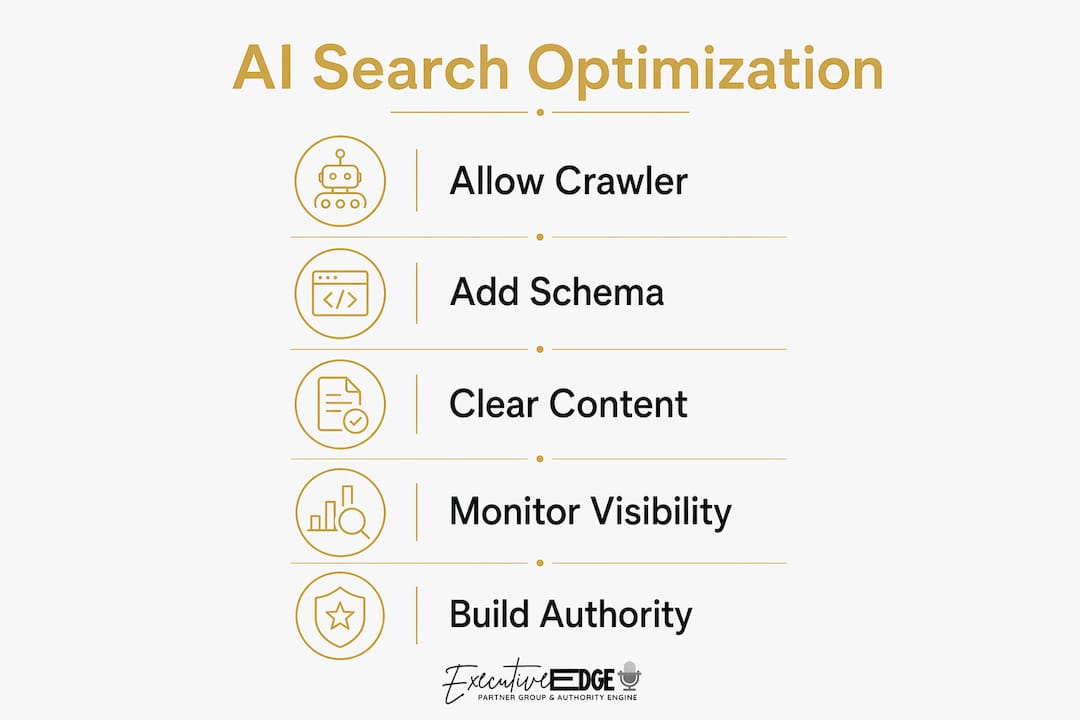
Before any content strategy works, your site must be technically open to AI crawlers. Blocking OAI-SearchBot in your robots.txt file removes your site from ChatGPT Search's citation pool entirely. Check your robots.txt file today and confirm OAI-SearchBot is allowed.

Schema markup is the second non-negotiable. FAQ and Article schema allow AI engines to pull exact question-and-answer pairs verbatim from your pages. Without schema, AI systems have to guess at your content's structure. With it, they can extract and cite you precisely.
Tools and requirements at a glance
| Requirement | Tool or Method | Why It Matters |
|---|---|---|
| AI crawler access | robots.txt (allow OAI-SearchBot) | Required for ChatGPT Search indexing |
| Structured data | FAQ and Article schema | Enables verbatim AI extraction |
| Brand entity consistency | Wikipedia, Wikidata, Google Business Profile | Builds trusted identity across platforms |
| Mention monitoring | Semrush AI Visibility Toolkit, Optimly | Tracks citations and sentiment per platform |
| Page speed | Core Web Vitals optimization | Pages under 0.4s First Contentful Paint average significantly more citations |
Pro Tip: Check your Wikidata entry and Google Business Profile for name, address, and category consistency. ChatGPT Search relies heavily on Wikipedia and Wikidata to resolve brand identity. Inconsistent data across platforms weakens your authority signal.
How should you structure content for AI citation?
AI engines do not reward length. They reward clarity. The most cited pages start with a self-contained answer capsule of 120–150 words directly under the H2 heading. That capsule answers the question completely, without requiring the reader to scroll further. Think of it as writing for someone who will only read the first paragraph. Because with AI, that is often exactly what happens.
Content with added statistics improves AI visibility by 41%, expert quotes improve it by 37%, and inline citations improve it by 22%. Keyword stuffing, by contrast, reduces visibility by 10%. Those numbers tell a clear story: AI engines reward substance and penalize manipulation.
Writing practices that earn AI citations
- Lead with the answer. Place your core claim in the first sentence of every section. Do not build up to it.
- Use natural language. Write the way a knowledgeable person speaks. Semantic completeness beats keyword density every time.
- Add statistics with context. A bare number means nothing. Follow every stat with one sentence explaining what it implies.
- Include expert quotes. Attributed quotes from real professionals signal E-E-A-T (Experience, Expertise, Authoritativeness, Trustworthiness) to AI systems.
- Keep paragraphs short. Three to five sentences per paragraph makes content easier for AI to chunk and extract.
- Link to authoritative sources. Inline citations signal that your content is grounded in verified information.
Google's 2026 generative AI search guide confirms that traditional SEO remains foundational. Core ranking and quality systems still feed generative AI features. That means your existing SEO work is not wasted. It is the base layer that GEO builds on.
Pro Tip: Shorter, well-structured pages often outperform long pillar pages for AI citation. A focused 600-word page with a clear answer capsule can beat a 3,000-word guide that buries the answer. Study the difference between short-form and long-form content strategies to find the right balance for each topic.
Which off-page strategies improve AI search visibility?
Backlinks built your Google rankings. Brand mentions build your AI visibility. Third-party mentions without backlinks correlate with AI citations at a rate of 0.664, compared to just 0.218 for backlinks. Brands with strong third-party validation see dramatically higher AI citation frequency. That means getting your name mentioned in trusted places matters more than getting a link from them.
"Genuine community engagement and answering real user questions leads to natural mentions favored by AI as high-trust validation. Astroturfing or overly promotional tactics backfire and get ignored or buried." — ismybrandinai.com
The platforms that carry the most weight with AI engines include Reddit threads, industry roundups, podcast appearances, local news features, and partner site mentions. These are the places where real people discuss real businesses. AI systems treat that kind of organic mention as a trust signal.
Here is what actually works for building off-page AI visibility:
- Answer questions on Reddit and Quora in your area of expertise. Do not promote. Just help. Genuine answers get cited.
- Pitch yourself to industry podcasts. A transcript mention on a respected podcast carries significant weight with AI engines.
- Get listed in editorial roundups. "Best contractors in Tyler" or "Top consultants in East Texas" style articles are gold for AI citation.
- Earn mentions on partner sites. Co-authored content, guest posts, and collaborative resources all generate the kind of unlinked mentions AI engines trust.
- Build your social proof systematically. Reviews, testimonials, and third-party ratings all contribute to the trust signals AI engines evaluate.
Avoid any tactic that feels manufactured. AI engines are trained on human-generated content and they recognize patterns of artificial promotion. Authentic presence in real communities is the only off-page strategy that compounds over time.
How do you monitor and measure AI search visibility?
AI engines often disagree on which brands to surface. About 62% of the time, different AI platforms surface different brands for the same query. A strong showing on Perplexity does not guarantee the same result on ChatGPT or Google AI Overviews. Each platform must be tracked individually.
The most practical approach is systematic prompt testing. Type your business category and location into each AI platform weekly. Note whether your brand appears, how it is described, and what sources are cited. That data tells you exactly where your visibility gaps are.
Monitoring workflow by platform
- ChatGPT Search. Test branded and category queries. Note which sources ChatGPT cites. If competitors appear and you do not, study their content structure.
- Google AI Overviews. Run your target queries in Google and check the AI Overview panel. Google's system still leans on traditional SEO signals, so page quality matters here.
- Perplexity. Perplexity cites sources visibly. If your site appears as a citation, you can see exactly which page earned it.
- Gemini. Test conversational queries that a customer might actually ask, such as "Who is the best HVAC contractor near me?"
- Track sentiment. Tools like Semrush AI Visibility Toolkit and Optimly track mentions and sentiment across platforms, not just presence.
Pro Tip: Run the same query on three different AI platforms every Monday morning. Record the results in a simple spreadsheet. After four weeks, you will have a clear picture of where you are visible and where you are invisible. That data drives every content and off-page decision you make.
| Platform | Primary Signal | Best Monitoring Method |
|---|---|---|
| ChatGPT Search | OAI-SearchBot access, brand entity | Weekly prompt testing |
| Google AI Overviews | Traditional SEO + E-E-A-T | Google Search Console + manual checks |
| Perplexity | Cited sources, content clarity | Direct query testing |
| Gemini | Conversational relevance | Natural language query testing |
| All platforms | Third-party mentions | Semrush AI Visibility Toolkit, Optimly |
What I have learned about AI search as a local business advisor
Working with local businesses on visibility strategy, I keep seeing the same pattern. Business owners spend months perfecting their website and then wonder why AI engines still do not mention them. The answer is almost always the same: their content answers questions they think customers are asking, not the questions customers actually type into ChatGPT.
The businesses that win in AI search write for the reader first and the algorithm second. They answer real questions with real specificity. A plumber who writes "How long does it take to replace a water heater in a 1970s home?" will get cited before a plumber whose homepage just says "Quality plumbing services." AI engines are built to find the most useful answer. Be the most useful answer.
The other mistake I see constantly is treating AI search as a one-time project. It is not. AI platforms update their models, change their citation patterns, and shift which sources they trust. The businesses that maintain visibility are the ones running weekly prompt tests, updating their content regularly, and staying active in the communities where their customers ask questions. The Search Everywhere approach covers traditional search, AI answers, and community platforms together. That is the only model that holds up long-term.
— David Domm
Ready to build your AI search presence?
Getting visible on AI platforms takes a clear plan and consistent execution. Executive Edge Partner Group works with local businesses, consultants, and service providers to build the kind of content and brand authority that AI engines cite and trust.
From structured content creation to off-page mention building and systematic AI visibility tracking, Executive Edge Partner Group handles the full process. You bring the expertise. The system turns it into discoverability across ChatGPT, Google AI Overviews, Perplexity, and more. Visit Executive Edge Partner Group to learn how the Authority Engine can put your business in front of the customers who are already searching for you.
FAQ
What is generative engine optimization?
Generative Engine Optimization (GEO) is the practice of structuring content and building brand authority so that AI-powered search engines like ChatGPT and Perplexity cite your business in their generated answers. It works alongside traditional SEO, not instead of it.
How do I get my business cited by ChatGPT?
Allow OAI-SearchBot in your robots.txt file, add FAQ and Article schema to your pages, and write clear answer capsules of 120–150 words at the top of each key page. Third-party brand mentions on trusted platforms also significantly increase citation frequency.
Does traditional SEO still matter for AI search?
Yes. Google's 2026 generative AI search guide confirms that core SEO ranking and quality systems still feed generative AI features. Strong traditional SEO is the foundation that GEO and AEO build on.
Why does my business appear on one AI platform but not another?
AI engines disagree on which brands to surface about 62% of the time. Each platform uses different signals and training data. You must monitor and optimize for ChatGPT, Google AI Overviews, Perplexity, and Gemini individually.
How often should I check my AI search visibility?
Run prompt tests on each major AI platform at least once per week. Use tools like Semrush AI Visibility Toolkit or Optimly to track mentions and sentiment automatically between manual checks.