

Turning speaking experience into online content is the practice of transforming recorded talks, webinars, or presentations into structured, shareable digital assets that build professional visibility and authority. A single 30-minute speaking engagement can produce 10–15 unique content assets, making it one of the most efficient content strategies available to professionals. The industry term for this process is content repurposing, and it applies equally to keynote speeches, panel discussions, webinars, and workshop presentations. For business owners and consultants in Tyler and East Texas, this method turns every speaking opportunity into a long-term digital asset that keeps working after the event ends.
How do you turn speaking experience into online content?
Content repurposing from speaking engagements starts with one core principle: your talk is a raw material, not a finished product. The recorded audio or video is the source. Everything else, including blog posts, social media clips, FAQs, and email newsletters, flows from that single recording.

The efficiency gains are real and measurable. AI writing tools can reduce the time needed to create blog posts, show notes, and captions from a transcript from a full day down to 30–45 minutes. That time savings compounds across every speaking engagement you do. Professionals who build a repeatable system report that initial repurposing sessions take 2–3 hours, but that time drops to under 90 minutes once the workflow is established.
The key mindset shift is treating your speaking calendar as a content production schedule. Every confirmed talk is a future library of digital material. That reframe changes how you prepare, how you structure your presentations, and how you record them.
What tools do you need before you start?
The right tools make the difference between a chaotic repurposing attempt and a repeatable system. Essential tools fall into three categories: transcription, AI writing, and video editing.
| Tool Category | Examples | Primary Function |
|---|---|---|
| Transcription | Descript, Otter.ai | Convert audio/video to editable text |
| AI Writing | ChatGPT, Claude, Jasper | Draft blog posts, captions, and summaries from transcripts |
| Video Editing | Descript, Vidocu | Clip highlights, add captions, export short-form video |
Beyond software, clean audio is the single most important technical requirement. A recording with background noise or poor microphone quality produces a messy transcript. A messy transcript multiplies editing time and reduces the quality of every asset downstream.
Structured presentations also matter. Talks built around clear sections and distinct teaching points are far easier to repurpose than free-flowing, conversational talks. Modular teaching points allow easy extraction of checklists, FAQs, and standalone articles without major restructuring.
Pro Tip: Before your next speaking engagement, outline your talk in three to five distinct segments, each with a clear takeaway. This structure maps directly to individual content pieces and cuts your post-event editing time significantly.
How do you transform a recorded talk into multiple content formats?
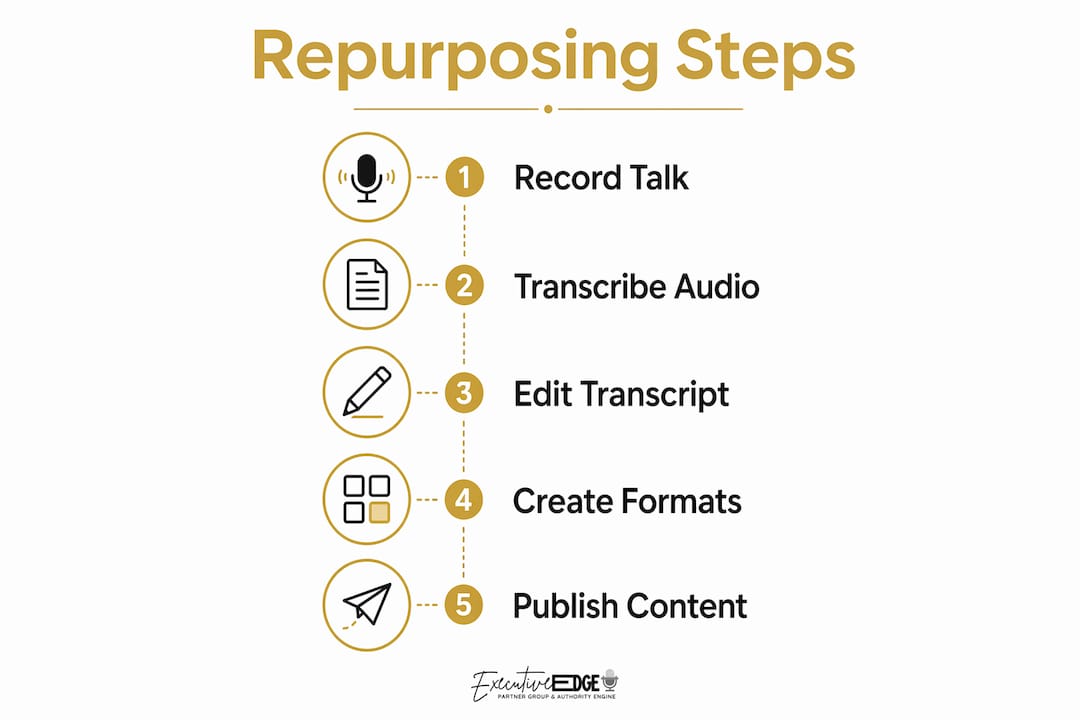
The repurposing workflow follows a clear sequence. Skipping steps produces lower-quality assets and wastes time.
- Record and export. Capture the full talk in video and audio. Export both formats immediately after the event.
- Generate a transcript. Run the audio through Descript or Otter.ai. A transcript converts a linear recording into a searchable, non-linear database of ideas and insights.
- Clean the transcript. Remove filler words, false starts, and repeated phrases. This step is not optional. Raw transcripts read poorly and undermine your professional credibility.
- Identify segments. Break the cleaned transcript into logical sections. Each section becomes a candidate for a standalone content piece.
- Draft written content. Use an AI writing tool to generate a first draft of each blog post, article, or FAQ from the relevant segment. Edit for your voice and accuracy.
- Pull video clips. Identify two to four high-energy or high-insight moments from the recording. Clip these for short-form video on LinkedIn, YouTube Shorts, or Instagram.
- Mine audience questions. If your talk included a Q&A session, those questions are direct signals of what your audience wants to know. Each question is a potential FAQ article or social post.
- Distribute across platforms. Publish the long-form article on your website, share clips on social media, and send a summary to your email list.
Pro Tip: Never try to repurpose an entire talk in one sitting. Process one segment at a time. This keeps quality high and prevents the mental fatigue that leads to shortcuts.
The table below shows how a single talk maps to specific content formats.
| Content Type | Typical Length | Best Platform | Primary Purpose |
|---|---|---|---|
| Long-form blog post | 1,000–2,000 words | Website / LinkedIn | SEO authority |
| Short-form article | 400–700 words | LinkedIn / Medium | Thought leadership |
| Social media caption | 100–300 words | LinkedIn, Instagram | Engagement |
| Short video clip | 60–90 seconds | YouTube Shorts, LinkedIn | Reach and visibility |
| Email newsletter | 300–500 words | Email list | Audience retention |
| FAQ page | 5–10 questions | Website | Search discoverability |
| Checklist or guide | 1 page | Website / PDF | Lead generation |
What are the common pitfalls when repurposing speaking content?
The most common mistake professionals make is treating a raw transcript as a finished article. Speaking and writing are distinct communication modes. Spoken language relies on tone, pacing, and physical presence. Written language relies on structure, clarity, and precision. A direct transcript without editing reads as disorganized and unprofessional.
Here are the most frequent pitfalls and how to correct them:
- Publishing raw transcripts. Transcripts contain filler words, incomplete sentences, and verbal tics. Always edit before publishing. Treat every transcript as a rough draft.
- Trying to repurpose an unstructured talk. Talks without clear sections produce content without clear structure. Build modular segments into every presentation before you deliver it.
- Ignoring audience questions. Live Q&A sessions capture real audience pain points. Failing to record and use those questions wastes one of the richest content sources available.
- Creating content with no link back to your speaker profile. Failing to link derivative content back to your speaker profile undermines lead conversion and personal brand growth.
- Repurposing everything at once. Batch processing an entire talk in one session leads to rushed edits and inconsistent quality. Work through one segment per session.
- Skipping the editing pass for written clarity. AI-generated drafts need a human editing pass. They often miss nuance, repeat phrases, and occasionally misrepresent the speaker's intent.
The underlying principle is this: effective repurposing requires editing to remove filler language and curate for written clarity. The editing step is where your professional authority either gets built or gets lost.
How does repurposed content build long-term brand authority?
Repurposed content only builds authority when it connects back to a central hub. A collection of disconnected articles and clips generates traffic but not trust. Linking repurposed content to centralized speaker profiles and event pages boosts SEO and turns content into an authority-building asset rather than vanity traffic.
A practical brand authority system built from speaking content includes these elements:
- A centralized speaker profile page on your website that lists all talks, topics, and published content derived from each engagement.
- Internal links connecting each blog post or article back to the speaker profile and to related content pieces. This signals topical authority to search engines.
- Consistent naming conventions across all platforms so that your name, topic, and event appear identically whether on LinkedIn, YouTube, or your website.
- AI search visibility. Repurposed content that answers specific questions gets cited by AI platforms like ChatGPT and Perplexity. Understanding how AI search discovery works helps you structure content to appear in those results.
- Email follow-up sequences that deliver repurposed content to attendees after the event. This keeps your audience engaged and drives traffic back to your website.
- Social media distribution using short clips and captions to extend reach beyond the original audience. Platforms like LinkedIn reward consistent, expert-level content with increased organic visibility. Reviewing social content types that drive results helps you match format to platform.
The long-term compounding effect is significant. Each piece of repurposed content adds to a growing library of indexed, searchable material that positions you as the authority on your topic. That library works continuously, long after the original speaking event is forgotten.
Why most speakers leave their best content on the table
I have worked with professionals who deliver genuinely excellent talks and then walk away with nothing to show for it online. The talk happens, the audience applauds, and then the recording sits on a hard drive for months. That pattern is one of the most consistent missed opportunities I see.
The fix is not complicated, but it does require a system. The speakers who build real authority online are not necessarily the best presenters. They are the ones who treat every talk as the beginning of a content cycle, not the end of one. They record everything, clean their transcripts, and publish consistently. Over time, their digital footprint grows while others stay invisible.
One thing I have learned from experience: the editing step is where most professionals give up. They see the raw transcript, feel overwhelmed by how much work it needs, and abandon the process. The answer is to lower the bar for the first draft. Use an AI writing tool to get a rough article on the page, then spend 20 minutes editing it into something you are proud to publish. That 20 minutes is the difference between a content library and a hard drive full of forgotten recordings.
The professionals I respect most in this space treat their speaking calendar and their content calendar as the same document. Every confirmed talk is a scheduled content drop. That mindset, more than any tool or tactic, is what separates speakers who build authority from those who just speak.
— David Domm
How Executive Edge Partner Group helps speakers build content authority
Professionals who speak regularly have more content potential than almost any other group. The challenge is capturing it consistently and turning it into a system that produces results.
Executive Edge Partner Group works with business owners, consultants, and executives who want to build authority online without becoming full-time content creators. The done-for-you system handles transcription, content drafting, SEO structuring, and multi-platform publishing so that every speaking engagement produces a measurable digital return. If you are ready to stop leaving your best content on the stage and start building a library that works for you, Executive Edge Partner Group is the place to start.
FAQ
What does it mean to repurpose a speaking engagement?
Repurposing a speaking engagement means converting a recorded talk into multiple digital content formats, including blog posts, social media clips, FAQs, and email newsletters, so the content continues generating value after the event.
How many content pieces can one talk produce?
A single 30-minute speaking engagement can produce 10–15 unique content assets, including articles, video clips, social posts, and checklists, depending on how well the original talk was structured.
Do I need to edit the transcript before publishing?
Yes. Raw transcripts contain filler words, incomplete sentences, and spoken patterns that read poorly in written form. Effective repurposing requires editing for written clarity before any content is published.
What tools do I need to start repurposing my talks?
The core toolset includes a transcription tool such as Descript or Otter.ai, an AI writing tool such as ChatGPT, Claude, or Jasper, and a video editing tool for clipping highlights. These three categories cover the full repurposing workflow.
How does repurposed content help with SEO?
Repurposed content linked back to a centralized speaker profile creates a network of indexed, topically related pages. This linkage strategy signals authority to search engines and increases the likelihood of appearing in both traditional and AI-powered search results.