

AI-enhanced content is defined as content created or improved through artificial intelligence tools that support human writers, editors, and marketers at every stage of the content process. The industry standard term for this practice is "AI-assisted content creation," and it sits in a distinct category from fully automated, AI-generated content. Over 40 million users now rely on AI-assisted writing tools, and 87% of marketers name thin or generic content as their top challenge. Those two facts together explain exactly why AI-enhanced content has become the standard for serious content programs. For business owners in Tyler and East Texas, understanding this distinction is the difference between content that builds authority and content that gets ignored.
What is AI-enhanced content and how does it work?
AI-enhanced content uses machine learning models to assist humans at specific points in the content lifecycle, not to replace the human entirely. The AI handles pattern-heavy, repetitive, or data-intensive tasks. The human retains responsibility for strategy, voice, accuracy, and final judgment.

This approach is fundamentally different from dropping a prompt into a chatbot and publishing whatever comes out. AI works best as a collaborator that shifts human focus toward high-value ideation and away from mechanical tasks. The result is content that carries genuine expertise while moving faster through production.
The content lifecycle has five clear stages where AI adds measurable value:
- Ideation and research. AI tools analyze search trends, competitor gaps, and audience questions to surface topics a human researcher might miss or take hours to find manually.
- Drafting. AI generates structured first drafts based on briefs, outlines, or voice recordings, giving writers a starting point rather than a blank page.
- Editing and optimization. Machine learning in content editing catches readability issues, flags passive constructions, and suggests keyword placement without overriding the writer's judgment.
- Repurposing. A single long-form article can be broken into social posts, email sequences, and short video scripts by AI, compressing what used to take days into hours.
- Distribution and targeting. AI analyzes audience behavior to recommend the best channels, formats, and send times for each piece of content.
Pro Tip: Set your brand voice guidelines as a written document before using any AI drafting tool. Feed that document into the tool's context window at the start of every session. This single step prevents the generic, off-brand output that frustrates most content teams.
How does AI-enhanced content differ from AI-generated content?
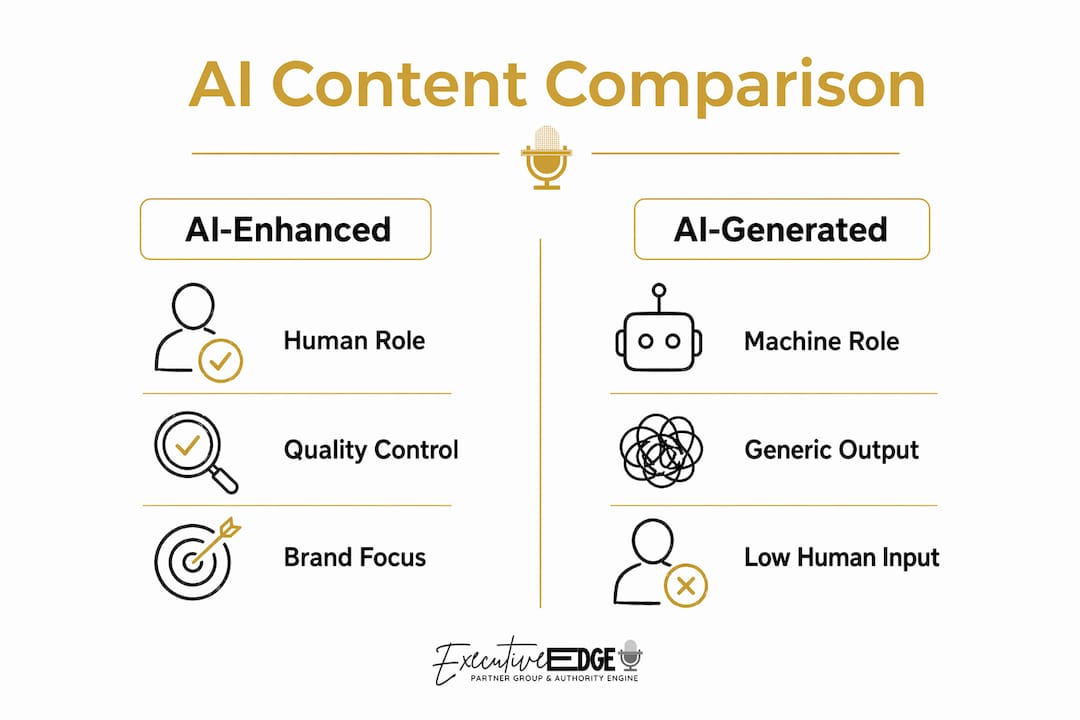
The distinction matters more than most marketers realize. AI-generated content is produced almost entirely by a machine, with minimal human input beyond the initial prompt. AI-enhanced content keeps a human in the loop at every critical decision point.
The table below shows the practical differences:
| Factor | AI-enhanced content | AI-generated content |
|---|---|---|
| Human involvement | High — strategy, editing, final approval | Low — prompt input only |
| Brand voice accuracy | Consistent with human oversight | Variable, often generic |
| Factual accuracy | Human-verified | Requires heavy post-generation review |
| Credibility risk | Low | High |
| Best use case | Authority content, thought leadership | High-volume, low-stakes drafts |
Nine in ten B2B buyers now use AI tools to research vendors, and they can detect generic AI content within two paragraphs. That statistic should change how every marketer thinks about quality control. Credibility loss at the top of the funnel is expensive and hard to recover.
Advanced AI content systems address this risk by grounding generation in brand-specific context. Brand context layers encode voice, audience profile, platform rules, and product information before any content is generated. Some systems add confidence scoring that flags off-brand language or unsupported claims before a piece ever reaches a human editor. That kind of quality gate is what separates a professional AI-enhanced workflow from a copy-paste operation.
Benefits and challenges of AI-enhanced content strategies
The benefits of AI-generated content, when paired with strong human oversight, are concrete and measurable. Speed is the most obvious gain. The AI Content Operator framework, for example, compresses ideation to publication from weeks to days by combining generative research, retrieval-augmented generation, and workflow automation. That kind of cycle compression lets a small team produce content at a volume that previously required a full editorial department.
The core benefits include:
- Speed. AI drafting and repurposing cut production time significantly across text, video, and social formats.
- Personalization at scale. Machine learning in content distribution matches the right message to the right audience segment without manual segmentation work.
- Cost efficiency. Smaller teams can maintain consistent publishing schedules without proportional headcount increases.
- Creative expansion. AI surfaces angles, formats, and topic clusters that human teams often overlook when working under deadline pressure.
The challenges are equally real and worth naming directly:
- Generic content risk. Without strong editorial oversight, AI output defaults to the average of everything it has been trained on. Average content does not build authority.
- Audience sophistication. Readers, especially in B2B markets, recognize AI-generated patterns quickly. Detection erodes trust faster than silence would.
- Regulatory compliance. The EU AI Act, effective august 2, 2026, requires content provenance and transparency for AI-written content. Standards like C2PA provenance signing are now part of compliant content workflows for teams publishing internationally.
Pro Tip: Treat AI output as a first draft, not a final product. Build a one-step editorial review into every AI-assisted workflow. A 15-minute human review catches the errors that destroy credibility and takes far less time than rebuilding trust after a public mistake.
Practical examples of AI-enhanced content across formats
The most effective applications of AI-enhanced content keep real human expertise at the center and use AI to amplify it. These are not theoretical use cases. They are happening across industries right now.
Blog and long-form content. A consultant records a 20-minute voice memo explaining a client problem they solved. An AI tool transcribes, structures, and drafts a 1,500-word article from that recording. The consultant reviews, adds specific examples, and publishes. The result carries genuine expertise because it started with genuine expertise. This is how scalable content creation works in practice.
Social media content. AI tools take a published article and generate platform-specific variations: a LinkedIn post with a professional framing, a shorter version for X, and a question-based prompt for Facebook. Each version is adapted to the platform's tone and character limits without the writer starting from scratch four times.
Video content. AI-assisted visual content combines real people and real products with AI-driven overlays, captions, and editing effects. AI-enhanced creative achieves high-production quality at a fraction of traditional production costs, and it holds viewer attention longer than static formats. For a deeper look at why this matters for search, the research on video content ranking is worth reviewing.
Homepage and product page personalization. Netflix's GenPage initiative demonstrated that adding rich, domain-specific context to AI prompts produced a 20% reduction in serving latency and significantly better engagement compared to simply scaling AI capacity. That result shows how AI enhances writing and layout decisions at scale, not just content creation.
Advertising technology platforms like Valiz show how AI-driven visual overlays and targeting work together to make campaigns more relevant without replacing the human creative direction behind them.
Why I think most businesses are using AI content backwards
Most businesses I see adopt AI content tools by starting with the output. They open a tool, type a prompt, and try to fix what comes back. That is the wrong direction entirely.
The businesses getting real results from AI-enhanced content start with their own expertise. They record their knowledge, document their processes, and capture their real opinions. Then they use AI to structure, format, and distribute that material faster. The AI serves the human insight. The human insight does not serve the AI's limitations.
The audience detection problem is real and getting worse. Sophisticated buyers identify generic AI content within two paragraphs. That is not a future risk. It is happening in every market right now, including here in East Texas, where service-based businesses compete on trust and local reputation above everything else.
My honest view is that AI-enhanced content is the most significant productivity shift in content marketing since the CMS. But it only works when the human brings something worth amplifying. If the input is generic, the output will be worse. If the input is specific, experienced, and honest, AI makes it faster, wider-reaching, and more consistent than any solo creator could manage alone.
— David Domm
How Executive Edge Partner Group supports your AI content strategy
Executive Edge Partner Group builds AI-enhanced content systems for business owners, consultants, and local brands who want authority and visibility without becoming full-time content creators.

The Executive Edge Authority Engine combines AI-assisted drafting, multi-platform publishing, and GEO and AEO optimization to help your expertise reach the right audience across Google, YouTube, and AI search platforms. Every piece of content starts with your real knowledge and your brand voice. AI handles the production work. The result is a consistent, credible content presence that builds trust over time. If you are ready to put your expertise to work online, Executive Edge Partner Group is the place to start.
FAQ
What is AI-enhanced content in simple terms?
AI-enhanced content is content that a human creates or directs, with AI tools assisting at specific stages like drafting, editing, or distribution. The human remains responsible for strategy, accuracy, and brand voice throughout the process.
How is AI-enhanced content different from AI-generated content?
AI-enhanced content keeps humans in control of quality and strategy, while AI-generated content is produced almost entirely by a machine with minimal human input. The key difference is the level of human oversight and editorial review applied before publication.
Can audiences tell when content is AI-generated?
Yes. Nine in ten B2B buyers can detect generic AI content within two paragraphs, which directly affects brand credibility and buyer trust. AI-enhanced content reduces this risk by grounding output in real human expertise and editorial review.
What are the main benefits of AI-enhanced content for marketers?
The primary benefits are faster production cycles, consistent publishing volume, and the ability to personalize content across multiple channels without proportional increases in team size. These gains compound over time as the AI learns more about your brand context.
Does AI-enhanced content require compliance with new regulations?
The EU AI Act, effective august 2, 2026, requires transparency for AI-written content, including provenance standards like C2PA signing. Content teams publishing internationally should build compliance steps into their AI workflows now rather than retrofitting them later.