

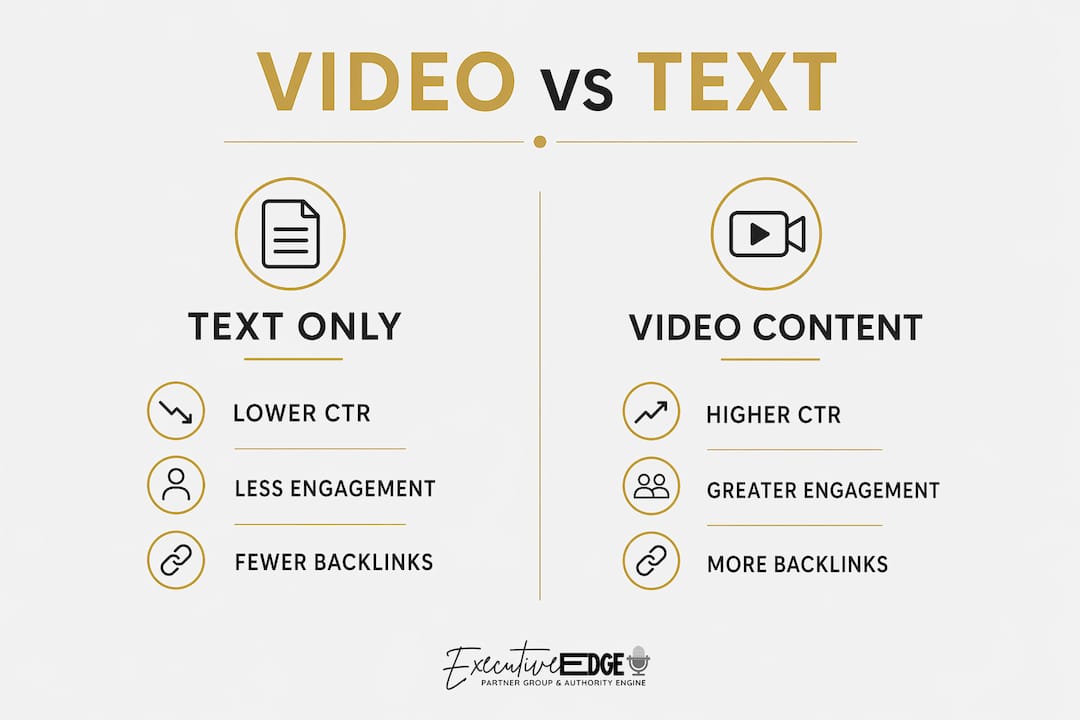
Video content ranks higher in search results because it directly improves the engagement signals that search algorithms use to evaluate content quality. Pages with video see 2.6x longer dwell time compared to text-only pages, and landing pages with video convert at 86% higher rates on average. Google, YouTube, and Meta platforms all reward content that keeps users engaged longer. For business owners in Tyler and East Texas, understanding why video content ranks higher is no longer optional. It is the difference between being found and being invisible.
Why video content ranks higher than text alone
The core reason video outperforms text in search rankings comes down to user behavior. When a visitor watches a video, they stay on the page longer. That extended time on page tells Google the content is relevant and satisfying to the user's search intent.
Search engines measure several behavioral signals to determine ranking quality:
- Dwell time: The average time a user spends on a page before returning to search results
- Bounce rate: The percentage of users who leave without interacting further
- Session duration: How long a user stays on your site across multiple pages
- Click-through rate (CTR): How often users click your result in search listings
Video improves all four of these metrics simultaneously. A user who watches a three-minute explainer video is far less likely to bounce than one who skims a paragraph and leaves. That behavioral pattern compounds over thousands of visits and pushes the page up in rankings.
Short-form videos, live streams, and user-generated content (UGC) each contribute to retention in different ways. Short-form keeps attention during quick searches. Live content creates urgency. UGC builds social proof that encourages deeper browsing. The format matters less than the principle: keep the viewer engaged, and the algorithm rewards you.
Pro Tip: Add captions to every video you publish. Roughly 85% of social media videos are watched without sound. Captions keep silent viewers engaged and give search engines additional text to index, which directly supports your video content SEO.
How search engines evaluate video using multimodal AI
Video has evolved from a nice-to-have content format into a core ranking factor. The reason is technical: modern search algorithms use multimodal AI, specifically large language models (LLMs), to literally watch and listen to video content. These systems analyze visual frames, spoken audio, and on-screen text to assess whether a video is credible, relevant, and authoritative.
This matters for your E-E-A-T score. E-E-A-T stands for Experience, Expertise, Authoritativeness, and Trustworthiness. It is Google's framework for evaluating content quality. Video provides direct evidence of all four criteria in a way that text alone cannot. A doctor explaining a diagnosis on camera demonstrates expertise visually. A contractor showing a completed project proves experience. Text can claim these things. Video verifies them.
"Growing use of multimodal LLMs means search engines literally 'watch' and 'listen' to videos to ground knowledge graph answers, reducing hallucinations and improving ranking trustworthiness of high-quality video content." — Video-First SEO Optimization
Here is how video signals compare to text-only signals in AI ranking models:
| Ranking Signal | Text-Only Content | Video Content |
|---|---|---|
| E-E-A-T verification | Indirect (claims only) | Direct (visual/audio proof) |
| Dwell time impact | Low to moderate | High |
| Rich snippet eligibility | Limited | Video carousels, thumbnails |
| AI hallucination risk | Higher | Lower (grounded content) |
| Multimodal indexing | Not applicable | Full audio + visual analysis |
Video thumbnails also increase CTR by 41% on average when they appear in search results. That higher CTR feeds back into the ranking algorithm as another positive signal, creating a self-reinforcing cycle of visibility.

Does video content generate more backlinks and social shares?
The answer is yes, and the mechanism is straightforward. High-quality videos attract natural backlinks because other publishers reference them as definitive, credible sources. A well-produced explainer video on a niche topic becomes the go-to resource that bloggers, journalists, and industry sites link to without being asked.
Backlinks remain one of the strongest off-page SEO signals. Every time a credible site links to your video page, it transfers domain authority to your domain. That authority lifts not just the video page but your entire site in search rankings.
Social sharing amplifies this effect. Platforms like Facebook, TikTok, and Instagram are built for video distribution. A single video that resonates emotionally or educationally can generate hundreds of shares, each one driving new traffic back to your site. That traffic signals to Google that your content is worth surfacing to more users.
Small businesses and professional service providers benefit from this dynamic in ways that large brands often overlook. A local attorney in Tyler, Texas who publishes a clear, honest video explaining estate planning basics will earn links from local news sites, financial blogs, and community resources. That local video authority compounds over time into a durable SEO advantage.
Pro Tip: Create niche-specific video content that answers questions no one else in your industry is answering on camera. Niche videos face less competition for backlinks and are far more likely to become the definitive reference on that topic.
How to optimize video content for higher search rankings
Knowing why videos perform better is only half the equation. Execution determines whether your video content actually climbs the rankings. Follow these steps in order:
-
Optimize titles and descriptions with target keywords. Write video titles the same way you write page titles: lead with the primary keyword, keep it under 60 characters, and make it specific. Descriptions should include your keyword naturally within the first two sentences, followed by a detailed summary of the video's content.
-
Add keyword-rich captions and transcripts. Search engines cannot watch your video the way a human does. Captions and full transcripts give crawlers the text they need to understand and index your content accurately. This directly improves your video content SEO.
-
Embed videos natively on your site rather than just linking out. Embedding keeps users on your domain, which means dwell time and session duration metrics accrue to your site. Linking to an external YouTube page sends users away from your domain entirely.
-
Submit a video sitemap. A video sitemap tells Google exactly where your videos are, what they contain, and how to index them. Without one, your videos may never appear in video carousels or Google Discover.
-
Add structured data markup (schema). VideoObject schema gives search engines precise metadata about your video: title, description, duration, upload date, and thumbnail URL. This markup is what enables rich snippets in search results.
-
Target long-tail keywords where video competition is lower. Broad keywords like "marketing tips" are dominated by large publishers. A long-tail phrase like "how to get more local customers with video" has far less competition and a much clearer user intent that video content can satisfy directly.
-
Add video to pages already ranking on page one or two. This is the highest-leverage move in video SEO. Pages with existing authority gain faster ranking boosts from added video because the improved dwell time and CTR signals compound on top of an already-trusted page. You are not starting from zero. You are accelerating momentum that already exists.
Consistent visual branding across your videos also builds recognition over time. Viewers who see the same intro style, color scheme, and presenter across multiple videos develop trust faster. That trust translates into longer watch times, more return visits, and stronger engagement signals for the algorithm.
Video vs. other content formats: 2026 rankings and trends
The performance gap between video and other content formats is not narrowing. It is widening. Pages featuring video are 53 times more likely to rank on the first page of Google than text-only pages. That statistic, originally from Forrester, has only grown more relevant as AI-generated text floods search results and makes written content harder to differentiate.
| Content Format | First-Page Ranking Likelihood | Avg. Engagement Rate | Backlink Potential |
|---|---|---|---|
| Text-only articles | Baseline | Low to moderate | Moderate |
| Images + text | 1.5x baseline | Moderate | Low |
| Video (embedded) | 53x baseline | High | High |
| Short-form vertical video | Highest social ROI | Very high | Moderate |
Short-form vertical videos generate 3.2x higher ROI than other content types in 2026. That ROI advantage reflects where user attention actually lives: Instagram Reels, TikTok, and YouTube Shorts dominate mobile screens and feed directly into Google Discover recommendations.
AI-generated text content faces a saturation problem. Search engines are actively working to filter out low-quality AI text. Video provides a differentiation signal that text cannot fake. A real person on camera, demonstrating real knowledge, is exactly the kind of verified expertise that multimodal AI ranking systems are designed to reward.
The trajectory for 2026 and beyond points toward algorithm preference for multimodal content across all major platforms. Zero-click searches, Google Discover, and AI-generated answer panels all favor content that can be verified visually and audibly. Video is the format built for that environment.
What i've learned after watching video transform rankings
I have seen the same pattern repeat across dozens of content strategies: a business publishes strong written content, earns decent rankings, then adds a single well-produced video to their top-performing page. Within 60 to 90 days, that page climbs. Dwell time goes up. Bounce rate drops. The page earns a featured snippet or a video carousel placement it never had before.
The mistake most marketers make is treating video as a separate channel rather than as a ranking amplifier for content they already own. Your best-performing blog post is the first place you should add video, not the last.
Cost is the objection I hear most often. My honest response: a smartphone, a ring light, and a quiet room produce video that ranks. Production quality matters far less than clarity, specificity, and consistency. Publish one useful video per week for six months and the compounding effect on your video content engagement rates will be measurable and significant.
Consumer behavior among Gen Z and younger millennials has permanently shifted toward video as the default format for learning and discovery. Search engines follow user behavior. That means video is not a trend. It is the new baseline for competitive content.
Use your metrics to guide production decisions. Watch time, CTR, and ranking movement tell you exactly which videos are working and which topics deserve a follow-up. Treat video SEO as an experiment with measurable outcomes, not a creative exercise with vague goals.
— David Domm
Ready to put video to work for your business?
Video is the clearest path to higher rankings, stronger authority, and more qualified traffic in 2026. Executive Edge Partner Group builds done-for-you video content systems specifically for business owners, consultants, and local brands who want to compete online without becoming full-time content creators.

If you are a service-based business, professional, or local brand in Tyler, Texas or anywhere in East Texas, Executive Edge Partner Group can help you build a video-driven content strategy that improves your search visibility and builds lasting authority. From YouTube strategy to video for local customers, the system is built around results you can measure. Explore what Executive Edge can do for your business today.
FAQ
Why does video content rank higher than text?
Video content ranks higher because it increases dwell time, reduces bounce rates, and provides multimodal signals that AI-powered search algorithms use to verify content quality and relevance. Pages with video are 53 times more likely to reach Google's first page than text-only pages.
How does video improve SEO rankings specifically?
Video improves SEO by extending the time users spend on a page, increasing CTR through rich snippets and video thumbnails, and earning natural backlinks from publishers who reference video as a credible source. These signals collectively tell search engines the content satisfies user intent.
What type of video performs best for SEO in 2026?
Short-form vertical video generates 3.2x higher ROI than other formats and dominates engagement on Google Discover, YouTube Shorts, and Instagram Reels. For SEO specifically, embedded explainer videos on existing high-ranking pages produce the fastest ranking gains.
Do i need professional production to rank with video?
No. Search engines evaluate relevance, clarity, and engagement, not production budget. A clearly filmed, well-structured video with accurate captions and keyword-optimized metadata will outperform a polished video with no SEO optimization.
How do i make my video content visible in search results?
Submit a video sitemap, add VideoObject structured data markup, embed videos directly on your site rather than linking out, and write keyword-rich titles and descriptions. Optimized video thumbnails increase CTR by 41% on average and trigger video carousel placements in Google search results.