

Scalable content creation is the process of increasing content output sustainably by using governed systems, repeatable workflows, and technology to maintain quality and consistency at scale. The industry term for this practice is content scalability, and it applies to every marketer or creator who needs to publish more without burning out or diluting their brand. A scalable content strategy combines three core pillars: content governance, structured production workflows, and selective use of AI. Without all three, teams either produce too little or publish too much low-quality material. For business owners in Tyler, Texas, and beyond, getting this system right is the difference between building lasting authority and spinning wheels.
What is scalable content creation and why it matters to marketers
Scalable content creation is defined as a system that lets you produce more content across more channels without proportionally increasing cost, time, or headcount. It is not simply writing faster. The goal is to build a repeatable production engine that holds quality constant as volume grows.
The core components of a working content scalability system are:
- Content governance: A set of rules, documents, and approval processes that keep messaging consistent across every piece you publish.
- Repeatable workflows: Defined steps for ideation, drafting, reviewing, and publishing that any team member can follow without reinventing the process each time.
- AI-assisted production: Technology that handles drafts, formatting, and distribution tasks so human experts can focus on strategy and refinement.
- Quality gates: Checkpoints built into the workflow where content is reviewed for accuracy, brand voice, and topical relevance before it goes live.
- Content clusters: Groups of related pieces that build topical authority together rather than isolated articles chasing high-volume keywords.
The biggest mistake marketers make is treating content scalability as a volume problem. Contextual density beats sheer volume for SEO and audience engagement. That means one well-researched cluster of five interconnected articles outperforms fifty thin, unrelated posts. Search engines increasingly reward brands that demonstrate deep expertise on a topic, not brands that simply publish often.
Content marketing also requires treating SEO, product messaging, and narrative as one integrated system rather than separate jobs. When those three elements are siloed, the result is content that ranks poorly, confuses readers, and fails to convert. A scalable system forces alignment from the start.

How to build an effective scalable content creation system
Building a system that scales starts with an honest audit of what you already have. Most teams discover bottlenecks at the review stage, not the drafting stage. Fixing the wrong bottleneck wastes time and money.
Follow these six foundational steps:
- Audit your current workflow. Map every step from idea to published piece. Identify where content stalls, who approves what, and how long each stage takes.
- Create a product truth document. This is a canonical reference that captures your brand's core claims, differentiators, tone, and messaging rules. Brands without this document experience claim drift, where messaging becomes inconsistent and generic across channels.
- Define roles clearly. Assign ownership for strategy, drafting, editing, SEO review, and publishing. Overlapping responsibilities create delays and inconsistent output.
- Build templates and content calendars. Templates and content calendars keep teams aligned on brand voice and reduce time spent on individual approvals or revisions. A template for a blog post, a social caption, and a video script each saves hours per month.
- Establish quality gates. Set specific criteria for what passes each stage: factual accuracy, voice coherence, SEO requirements, and call-to-action clarity. Content that fails a gate goes back for revision, not forward to publishing.
- Add AI and automation last. Build the human foundation first. Automating a broken process only produces broken content faster.
Pro Tip: Start your product truth document with three sentences: what your brand does, who it serves, and the one claim no competitor can make. Every piece of content you produce should connect back to at least one of those three sentences.
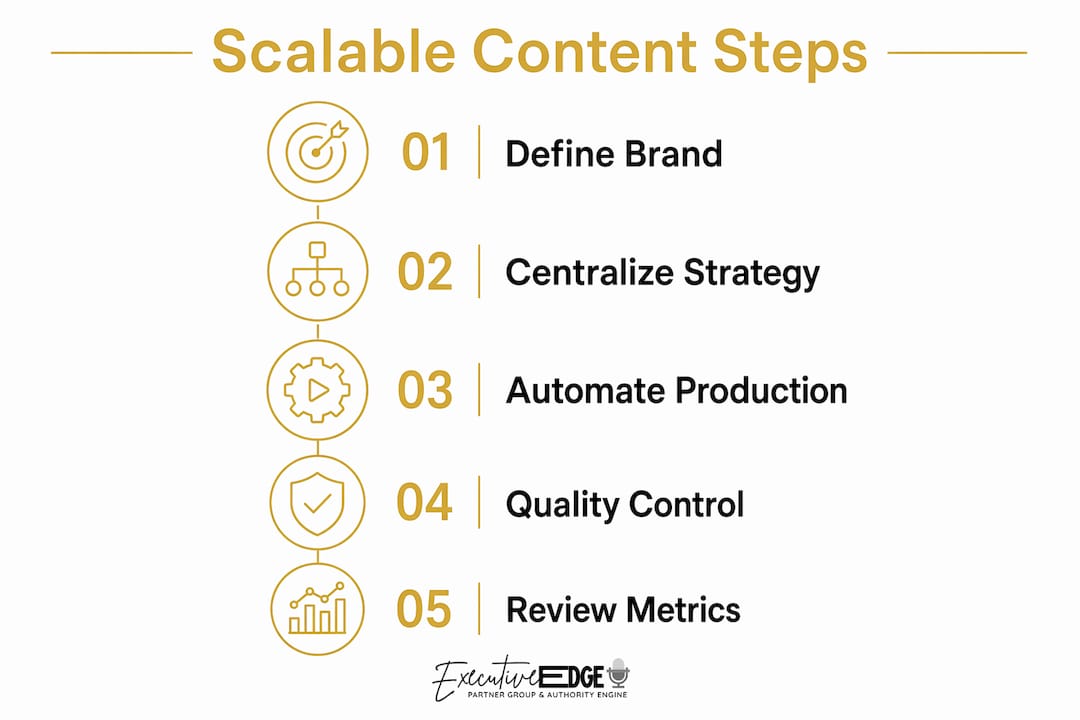
A well-designed workflow acts as an operational engine. Enterprises that centralize strategy, automate production, and enforce governance programmatically manage distributed teams far more effectively than those relying on informal coordination. The same principle applies to small teams and solo creators.
How does AI fit into effective content production?
AI is a force multiplier for content teams, not a replacement for human expertise. The distinction matters because many marketers automate the wrong tasks and then wonder why their content feels generic.
The most effective hybrid workflow looks like this:
- AI drafts the structure and first pass. Based on a brief tied to your product truth document, AI generates an outline and a working draft.
- A human expert refines the draft. The writer adds original insight, real examples, and brand-specific language that AI cannot generate from a prompt alone.
- Automation handles structural SEO tasks. Meta-tagging, internal linking, and localization are repetitive tasks that automation handles well, freeing creative teams for strategic work.
- A quality gate review closes the loop. A human editor checks the final piece against the product truth document before publishing.
Pro Tip: Never feed AI a vague prompt. Give it your product truth document, the target keyword, the intended audience, and the specific angle. Specific inputs produce specific outputs.
AI reduces marketing workload most effectively when it handles volume tasks while humans handle judgment tasks. The teams that get this ratio right produce more content, not just faster content. One pillar piece can generate many derivative assets efficiently: a long-form article becomes a podcast script, a series of social posts, and a short video. That multiplier effect is the real benefit of automating content creation.
The warning worth repeating: automating broken workflows only increases chaos. If your editorial process is unclear before you add AI, AI will produce unclear content at higher volume. Fix the process first.
Common pitfalls when you scale content and how to avoid them
Scaling content exposes every weakness in a content operation. The teams that scale successfully are the ones that treat each problem as a system failure, not a people failure.
The most common pitfalls are:
- Claim drift. Without a product truth document, different writers describe the same product differently. Over time, your brand sounds inconsistent and untrustworthy.
- Volume without relevance. Publishing more content on unrelated topics dilutes topical authority. Search engines stop treating you as a definitive source on anything.
- Skipping quality gates under deadline pressure. One bad piece can undermine months of credibility. Quality gates exist precisely for high-pressure moments.
- One-time setup thinking. Content scaling is not a one-time project but a cycle of ongoing improvement and adaptation. Teams that set up a system and walk away see performance decay within months.
Topical authority is a cumulative metric built over time by consistent, high-value content delivery. Chasing viral moments or high-volume keywords at the expense of depth is the fastest way to lose the ground you have already built.
Automation in marketing works best when it supports a clear editorial direction, not when it substitutes for one. The brands that win at scale are the ones that publish less than they could but more than their competitors do consistently. Consistency and clarity compound. Volume without both is noise.
Reviewing your content velocity metrics every quarter gives you a data-driven signal for when to accelerate and when to pull back. That kind of iterative approach keeps quality high without requiring a full system rebuild every time performance dips.
Why governance is the real foundation of content at scale
Scaling content without governance is like building a house without a blueprint. You can move fast, but nothing lines up.
The teams I have watched succeed at content scalability all share one habit: they write things down before they publish anything. The product truth document, the style guide, the approval chain. These documents feel like overhead until the moment a new writer joins the team or a client asks why two blog posts say different things about the same product. At that point, governance is not overhead. It is the only thing standing between you and a credibility problem.
The other lesson I keep seeing confirmed is that AI works best for teams that already have strong editorial instincts. If you know what good content looks like, AI helps you produce it faster. If you do not, AI produces mediocre content faster. The tool amplifies what is already there. This is something I see consistently with East Texas businesses that come to Executive Edge Partner Group after trying to scale on their own. They have the expertise. They just need the system.
The final point is about patience. Topical authority builds cumulatively. A content operation that publishes two well-governed, deeply researched pieces per week will outperform one that publishes ten thin pieces per day within six months. The data on this is consistent. Slow and right beats fast and generic every time.
— David Domm
How Executive Edge Partner Group supports your content growth
Building a content system that holds up at scale takes more than good intentions. It takes a clear process, the right tools, and someone who has done it before.

Executive Edge Partner Group works with business owners, consultants, and local brands to build the exact kind of governed, AI-assisted content systems described in this article. From product truth documents and editorial workflows to multi-platform publishing and AI-enhanced distribution, the team handles the architecture so you can focus on your expertise. Whether you are starting from scratch or fixing a system that has stopped performing, Executive Edge Partner Group offers a done-for-you approach built for sustainable, long-term visibility. Explore how the Authority Engine can put your content to work.
FAQ
What is scalable content creation in simple terms?
Scalable content creation is a system that lets you produce more content consistently without sacrificing quality or brand consistency. It combines governance documents, repeatable workflows, and selective use of AI.
What is the biggest risk when scaling content production?
Claim drift is the most common risk. Without a canonical product truth document, different writers describe your brand differently, creating inconsistent and untrustworthy messaging over time.
How does AI help with content scalability?
AI handles first drafts, structural SEO tasks like meta-tagging and internal linking, and content repurposing. Human editors then refine the output for accuracy, brand voice, and strategic depth.
What is a quality gate in content production?
A quality gate is a defined checkpoint in the publishing workflow where content is reviewed against specific criteria, including factual accuracy, brand voice, and SEO requirements, before it moves forward.
How long does it take to build a scalable content system?
Building the foundation, including a product truth document, defined roles, templates, and quality gates, typically takes four to six weeks. Adding AI and automation layers comes after the human foundation is solid.