

What is evergreen content, exactly?
Evergreen content is information that stays useful and relevant long after it's published, independent of news cycles, trending topics, or seasonal events. Think of it the way you'd think of a reference book: someone picking it up six months or two years from now gets the same value as the person who read it on day one.
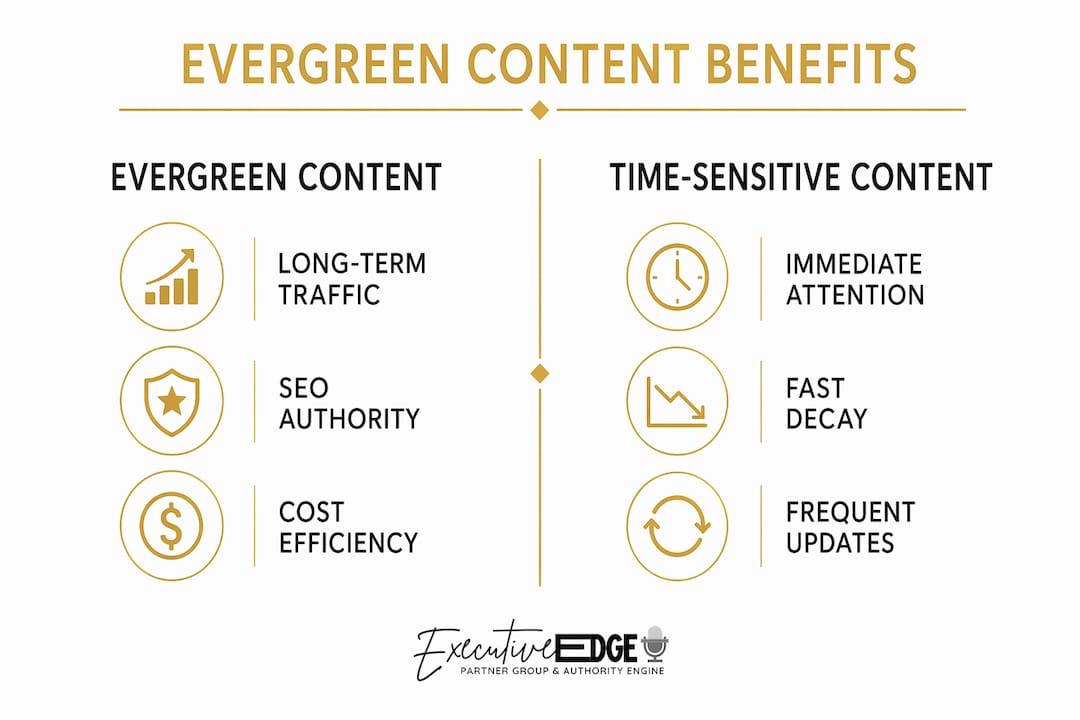
The term comes from the evergreen tree, which keeps its leaves year-round. In content marketing, the parallel holds. A well-built evergreen piece keeps ranking, keeps getting cited, and keeps attracting readers because the underlying question never expires.
Common formats include:
- How-to guides and tutorials
- FAQs and definition articles
- Beginner's guides to stable topics
- Glossaries and reference pages
- Case studies built around timeless principles
The traffic these pieces generate tends to compound. A news article spikes and fades. An evergreen guide climbs slowly, earns backlinks over months, and can sit on page one for years.
Why evergreen content matters for your marketing

Most content marketing operates on a treadmill: publish, get a brief traffic spike, watch it decay, publish again. Evergreen content breaks that cycle. It builds a floor of compounding brand authority that rises over time rather than resetting with every new post.

The SEO benefits are real and specific. Content that earns its ranking through accumulated authority holds its position through algorithm updates. Content that ranks on freshness alone decays the moment the news cycle moves on. Backlinko and SEMrush both point to durable, high-authority content as the backbone of sustainable organic traffic.
Evergreen content also reduces your dependence on paid acquisition. When you own search positions for questions your audience asks repeatedly, you're not renting attention. You're building an asset. That distinction matters most when ad costs rise or platform algorithms shift.
Key benefits at a glance:
- Steady organic traffic without constant republishing
- Lower long-term content production costs per lead
- Stronger email nurture sequences built on stable, useful material
- Reduced volatility when platforms change their distribution rules
What formats work best for evergreen content?
Not every format ages equally. The ones that hold up longest tend to address recurring questions with clear, structured answers. Evergreen marketing assets include cornerstone SEO guides, supporting articles, email nurture sequences, lead magnets, and micro-communities.
Here's what each format does well:
- Cornerstone SEO guides: A definitive answer to a core problem in your industry. A "how to choose a contractor" guide, for example, stays relevant because the decision criteria don't change year to year.
- Checklists and templates: Readers can use them immediately, and they don't go stale the way statistics-heavy posts do.
- Email nurture sequences: A welcome series or onboarding sequence built around buyer questions keeps converting new subscribers for years without a rewrite.
- Lead magnets: Calculators, playbooks, and decision frameworks built around stable problems outlast trend-driven content by a wide margin.
- Micro-communities: Small groups built around a topic generate the same recurring questions repeatedly, making them natural homes for evergreen content.
Pro Tip: A "how to choose [product or service]" guide is one of the most durable evergreen formats because purchase decision criteria rarely change. Build one for your core offering and link your other content back to it.
What does not qualify as evergreen content?
A lot of content gets labeled evergreen when it isn't. The distinction matters because treating time-sensitive content as a long-term asset leads to wasted effort and misleading traffic expectations.
Content that does not qualify:
- News stories and breaking coverage: Freshness is the entire value. Once the story fades, so does the traffic.
- Trending topic posts: "What marketers are talking about this week" has a shelf life measured in days.
- Seasonal or event-specific content: Holiday gift guides, conference recaps, and product launch announcements serve a moment, not a year.
- Posts built around specific statistics that update annually: A "2024 social media usage stats" roundup becomes outdated the moment new data drops.
- Content tied to a specific software version: Step-by-step tutorials for tools that update frequently require constant maintenance to stay accurate.
News-cycle content spikes when a story breaks, then decays as freshness signals fade. Confusing that pattern with evergreen performance leads to a content strategy that feels productive but never builds lasting equity.
How to create evergreen content that actually ranks
Creating durable content takes more than picking a stable topic. New evergreen content must genuinely outperform what already exists. Top-ranking evergreen pieces need to be meaningfully better than existing results in utility, depth, and design, because the competition for stable topics is fierce and backlink profiles are already established.
Follow these steps:
- Choose a stable topic. Use Google Trends to confirm the search demand is consistent, not seasonal. A flat or gently rising trend line is what you want.
- Map the intent. Understand whether readers want to learn, compare, decide, or implement. Match your format to that intent.
- Build the cornerstone asset. Write a complete answer. Use clear headings, step-by-step sections, and decision frameworks. Readers should be able to act on it immediately.
- Add supporting pieces. Cover sub-questions and objections in shorter articles that link back to the cornerstone using descriptive anchor text.
- Optimize for SEO. Use answer-first formatting, include the primary keyword naturally in the title and early in the body, and structure the piece for featured snippets.
- Wire it into your funnel. Add internal links from related posts, include the piece in your email welcome sequence, and use it as a lead magnet where appropriate.
- Plan the update cadence. Note which facts, statistics, and tool references will need refreshing. Evergreen content requires patience: it can take months to rank, but the traffic it builds is durable.
Pro Tip: Publish fewer pieces and support them harder. Ten well-built cornerstone articles with strong internal linking will outperform fifty thin posts every time.
How evergreen content performs in AI-driven search
AI search engines don't weight content by recency the way traditional search once did. They favor authoritative, query-matched, and durable content regardless of publication date. A strong evergreen piece can remain a preferred citation source long after it was first published.
That shift changes the calculus for content investment. If you want to appear in AI-generated answers on platforms like Perplexity or in Google's AI Overviews, you need content that AI engines trust as a stable reference. Freshness alone won't get you there. For a deeper look at how this works, AI search visibility is worth understanding as a separate discipline.
Key points for AI-focused content structure:
- Write answer-first: lead with the direct answer, then expand
- Use named entities, specific tools, and cited figures to signal authority
- Maintain the piece so it stays accurate; outdated facts erode AI citation potential
- Build topical depth across a cluster of related pieces, not just one standalone post
- Understand how AI-enhanced content differs from simply using AI to write faster
For SaaS brands and service businesses, maximizing content visibility in AI search requires the same foundational approach: authoritative, well-structured, and consistently maintained.
How to measure whether your evergreen content is working
Traffic volume is the obvious metric, but it tells only part of the story. Track these KPIs to get a full picture:
| Metric | What it tells you |
|---|---|
| Organic sessions over time | Whether traffic is compounding or flat |
| Keyword ranking position | How authority is building for target queries |
| Backlinks earned | Whether other sites treat the piece as a reference |
| Time on page | Whether readers find the content genuinely useful |
| Conversion rate | Whether the piece moves readers toward a next step |
| Return visitor rate | Whether readers come back or share the piece |
Parse.ly data shows that evergreen content consistently outperforms time-sensitive content on return visitor rates, which reflects genuine utility rather than novelty-driven clicks. Review these metrics quarterly. A piece that was ranking on page two six months ago may have climbed to page one without a single rewrite, or it may need a targeted update to push past a competitor.
Why evergreen content is the right bet for local businesses
For business owners in Tyler and East Texas, the case for evergreen content is especially clear. Paid advertising costs keep rising, and platform algorithms change without warning. An evergreen content base gives you something neither of those things can take away: owned search positions that keep generating leads whether or not you're running ads that week.
The businesses that build durable authority online aren't the ones publishing the most. They're the ones publishing the most useful content and maintaining it. Executive Edge Partner Group exists precisely to help service businesses, consultants, and local brands build that kind of asset base without becoming full-time content creators.

If you're ready to stop renting attention and start building something that compounds, Executive Edge Partner Group can help you get there.
FAQ
What is evergreen content in simple terms?
Evergreen content is information that stays relevant and useful over a long period, like how-to guides, FAQs, and definitions, rather than content tied to current events or trends.
How long does it take for evergreen content to rank?
It typically takes several months for evergreen content to build ranking authority, but the traffic it earns tends to be durable and compounds over time rather than spiking and fading.
What makes content evergreen vs. time-sensitive?
Evergreen content addresses questions that don't change with the news cycle, such as "how to write a business plan." Time-sensitive content, like a news story or seasonal promotion, loses relevance once the moment passes.
Is evergreen content important for AI search?
Yes. AI-driven search engines favor authoritative, query-matched content regardless of publication date, making well-maintained evergreen pieces strong candidates for AI citations and featured answers.
How often should you update evergreen content?
Review evergreen content at least once or twice a year to refresh statistics, update tool references, and confirm the information is still accurate. The structure and core argument rarely need to change.