

Content repurposing is the practice of taking existing content and reshaping it into different formats suited for varied platforms and audiences to extend its lifespan and impact. It is not cross-posting the same file everywhere, and it is not simply recycling old text with minor edits. True repurposing transforms a single source asset into multiple platform-native pieces, each built to match the behavior of its audience and the preferences of its algorithm. As of 2026, 94% of marketers engage in content repurposing and report it outperforms creating new content from scratch. For business owners in Tyler and East Texas, that stat represents a real competitive advantage hiding inside content they have already produced.
What is content repurposing and how does it differ from recycling?
Content repurposing is defined as the deliberate transformation of one piece of content into multiple new formats, each adapted for a specific platform, audience, and context. The industry sometimes uses the term "content recycling," but the two concepts are not identical. Recycling typically means reposting or lightly refreshing old content. Repurposing means rebuilding it with purpose.
A blog post recycled is the same blog post published again. A blog post repurposed becomes a LinkedIn carousel, a short video script, a podcast talking point, and an email newsletter section. Each derivative serves a different reader in a different environment. That distinction matters because platforms reward content that feels native, and audiences engage with content that fits how they consume information in that space.

The core principle behind professional content repurposing is that one strong idea can carry multiple formats. A single podcast episode, webinar, or long-form article contains enough raw material to generate 10–20 unique pieces across platforms over several weeks. That multiplier effect is what separates repurposing from any other content efficiency tactic.
How does content repurposing work: core processes and workflows?
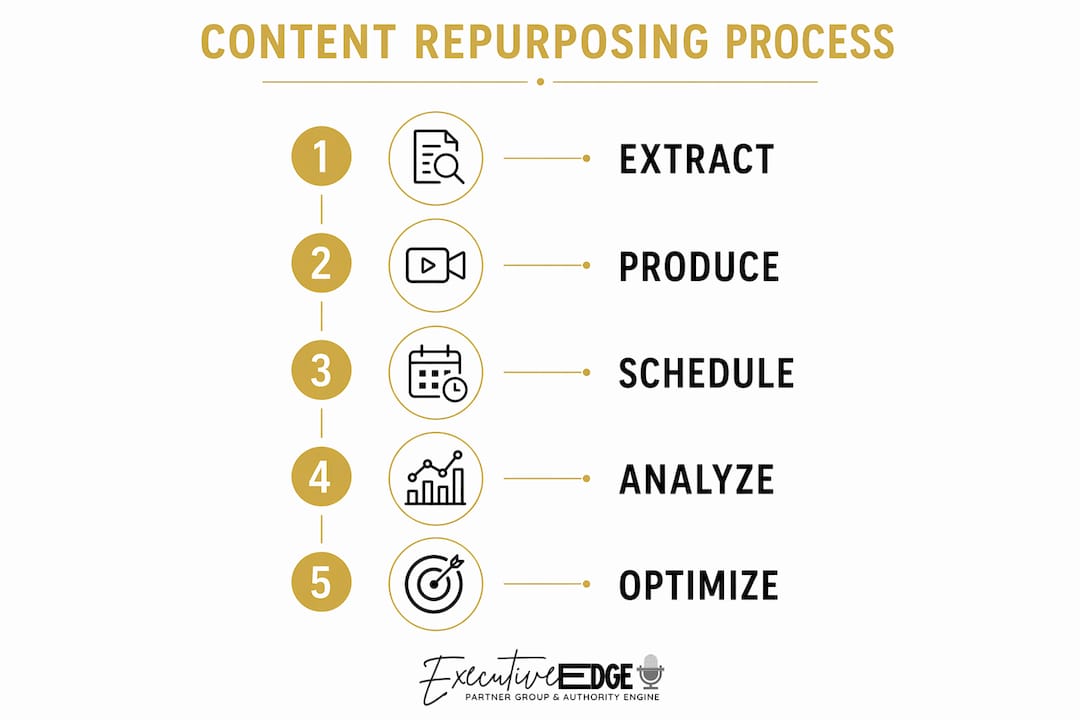
Effective repurposing follows a repeatable three-stage process: extract, produce, and schedule. Each stage has a distinct function, and skipping any one of them produces weaker results.
Stage 1: Select your source asset. Start with a high-quality long-form piece. Podcasts, webinars, keynote presentations, and in-depth blog posts make the strongest source assets because they contain dense ideas, quotable moments, and structured arguments. Thin content produces thin derivatives.
Stage 2: Build an extraction document. Before creating anything, build an extraction document that pulls out the atomic units of your source: key quotes, statistics, frameworks, step-by-step processes, and strong opinions. This document shifts derivative creation from drafting to assembly. Writers stop staring at blank pages and start selecting from a prepared library of raw material.
Stage 3: Produce platform-native derivatives. Use the extraction document to build each piece. Common repurposing patterns include:
- Format repurposing: A blog post becomes a video script or a podcast script becomes a written article.
- Platform repurposing: A YouTube video becomes a TikTok clip, a LinkedIn post, and an Instagram Reel, each edited for its platform's norms.
- Atomization: A long-form piece gets broken into standalone micro-content, such as quote graphics, short clips, or single-tip social posts.
Stage 4: Schedule with spacing. Spacing repurposed content over 4–7 days per platform improves reach and avoids algorithm penalties. Publishing all derivatives at once reduces the individual reach of each post. A 30-day distribution calendar built around one source asset is a practical standard.
Pro Tip: Before you produce a single derivative, spend 20 minutes building your extraction document. That one step cuts production time in half and keeps every piece on-message.
What are the key benefits and measurable impacts of repurposing content?
The business case for repurposing content is direct: it produces more output with less effort, and it reaches more people without requiring more original ideas.
- Time savings: 70% of marketers save up to 5 hours weekly by repurposing rather than creating net-new content. Five hours per week compounds into meaningful capacity over a quarter.
- Extended reach: Different platforms attract different audiences. A LinkedIn article reaches professionals. A YouTube Short reaches visual learners. A podcast clip reaches commuters. Repurposing puts the same idea in front of all three groups.
- Brand consistency: Every derivative carries the same core message, which reinforces your positioning across every channel without requiring separate strategy documents for each platform.
- SEO value: Repurposed content generates varied content types, including video transcripts, short articles, and social posts, that create additional indexed assets and internal linking opportunities.
- Higher ROI: Net-new content creation requires research, drafting, editing, and publishing for every single piece. Repurposing concentrates that investment in one source asset and multiplies the return.
The efficiency argument is especially strong for solo creators and small teams. A single well-produced podcast episode, handled through a proper repurposing workflow, can fill an entire month of content across three or four platforms.
"Repurposing turns one content idea into multiple platform-optimized pieces, multiplying impact without multiplying creation time. It is the closest thing to a content production multiplier that most marketers will ever find."
Scalable content creation depends on exactly this kind of system. Without repurposing, scaling content means hiring more people. With repurposing, it means building better workflows.
Which tools support effective content repurposing in 2026?
AI tools have changed the speed at which repurposing workflows operate. They handle the mechanical steps so human editors can focus on quality and strategy.
- Descript transcribes audio and video, generates summaries, and allows clip creation directly from a transcript. It removes the manual work of finding the best moments in a long recording.
- Opus Clip uses AI to identify the highest-engagement moments in a video and automatically generates short clips with captions. It is built specifically for the atomization pattern.
- ChatGPT drafts derivative text from transcripts or extraction documents. It produces first drafts of LinkedIn posts, email summaries, and blog sections at speed.
- PostKit organizes repurposing workflows and helps teams manage derivative production from a single source asset.
- Buffer and Later handle cross-platform scheduling but offer limited transformation capabilities. Scheduling tools differ from repurposing tools. They distribute content but do not adapt it.
The critical limitation of every AI tool in this list is the same: AI aids execution but cannot replace human editorial input for authority and quality. AI drafts are starting points. A human editor must remove generic filler, add specific examples, and inject the voice that makes content worth reading.
For a deeper look at how these tools fit into a broader content system, the guide on AI content tools covers the mechanics in detail. For teams focused on producing short-form content from long-form sources, the atomization pattern is the most direct application.
Pro Tip: Use AI to generate your first draft from the extraction document, then spend 15 minutes editing for voice, specificity, and any claim that needs a real example. That edit is where authority is built.
Platforms like POPJAM.IO also demonstrate how creative automation can blend AI speed with human-directed strategy, which is the right balance for any repurposing workflow that needs to maintain brand quality at scale.
What common mistakes undermine professional content repurposing?
Most repurposing failures come from one of five predictable errors. Knowing them in advance saves weeks of wasted effort.
- Cross-posting instead of repurposing. Uploading the same video to YouTube, TikTok, and Instagram without editing it is cross-posting. TikTok and YouTube throttle content with incorrect aspect ratios or competitor watermarks. Each platform requires its own edit.
- Publishing everything at once. Releasing all derivatives on the same day collapses their individual reach. Space distribution over 4–7 days per platform to let each piece perform before the next one goes live.
- Skipping the extraction document. Teams that jump straight from source asset to derivative production create inconsistent content and miss the strongest material. The extraction document is not optional. It is the foundation of the workflow.
- Accepting AI output without editing. AI drafts are fast but generic. A LinkedIn post that reads like it was written by a machine does not build trust. Human editing is what makes repurposed content feel original.
- Reformatting without adding value. A blog post turned into a Twitter thread that just lists the same sentences in shorter form is not repurposing. It is reformatting. Each derivative needs to add something: a clearer example, a stronger hook, a format that suits how that audience reads.
Pro Tip: Build a simple checklist for every derivative: correct aspect ratio, platform-native caption style, no competing watermarks, and at least one new example or hook not in the original. That checklist catches 90% of common errors before publishing.
The marketers who get the most from repurposing treat it as a production system, not a shortcut. The system requires discipline, but it produces consistent output that compounds over time.
Why repurposing is the skill I wish I had learned earlier
I spent years treating every piece of content as a standalone project. A podcast episode was a podcast episode. A blog post was a blog post. The idea that one strong idea could fuel an entire month of content across multiple platforms felt like a theory, not a practice.
What changed my thinking was watching a single 45-minute webinar generate 14 separate pieces of content over three weeks, all of them performing better than most of the net-new content I had produced that quarter. The webinar had a clear argument, specific examples, and a strong point of view. The extraction document pulled out six quotes, three frameworks, and two data points. From there, the derivatives almost built themselves.
The part most marketers underestimate is the editorial step. AI can draft a LinkedIn post from a transcript in 30 seconds. But the post that actually gets engagement is the one where a human editor replaced the generic opener with a specific claim and added a real example from the source material. That edit takes five minutes. It is the difference between content that gets scrolled past and content that gets shared.
Repurposing is now a baseline skill for any marketer serious about building authority without burning out. The creators I see winning in 2026 are not producing more content. They are producing smarter content from fewer source assets, and they have built systems that make the process repeatable. That is the standard worth aiming for.
— David Domm
How Executive Edge Partner Group supports your content repurposing strategy

Executive Edge Partner Group builds done-for-you content systems for business owners, consultants, and local brands who want to grow their authority online without becoming full-time content creators. The team specializes in transforming existing expertise, speaking experience, and real-world knowledge into long-form and short-form content distributed across Google, YouTube, and AI-driven search platforms. For businesses in Tyler, TX and beyond, that means a repeatable content engine built around your voice and your market. If you are ready to put a professional content repurposing system to work for your brand, Executive Edge Partner Group is the place to start.
FAQ
What is content repurposing in simple terms?
Content repurposing is the process of taking one existing piece of content and transforming it into multiple new formats for different platforms and audiences. It is distinct from cross-posting because each derivative is adapted to fit its platform natively.
How many pieces of content can one source asset produce?
A single high-quality long-form asset such as a podcast or webinar can generate 10–20 unique pieces of platform-native content over several weeks. The exact number depends on the depth of the source material and the number of platforms targeted.
How much time does content repurposing save?
70% of marketers report saving up to 5 hours weekly by repurposing content instead of creating new content for every platform. That time savings compounds significantly over a full quarter.
What is the difference between content repurposing and content recycling?
Content recycling means reposting or lightly refreshing existing content. Content repurposing means rebuilding that content into a new format with a new hook, structure, and platform-specific presentation. Repurposing adds value; recycling only extends shelf life.
Do I need AI tools to repurpose content effectively?
AI tools like Descript, Opus Clip, and ChatGPT accelerate the execution steps of repurposing, but they are not required. Human editorial judgment is the non-negotiable element. AI handles drafting and clipping; a human editor handles voice, accuracy, and quality.