

The five content marketing trends that matter most in 2026 are AI governance and agentic workflows, zero-visit visibility through AEO and GEO, sensory multimedia creative, the channel shift back to email and owned media, and first-party data personalization. The single most valuable action you can take right now: build one modular, evidence-dense asset per buyer stage that is structured for AI ingestion and compelling enough for humans to read, share, and cite.
According to CMI's 2026 B2B research, 95% of B2B marketers already use AI-powered applications, yet the teams pulling ahead are not the ones producing the most content. They are the ones pairing AI with stronger fundamentals. That gap between volume and performance is the defining tension of 2026.
The three trends to act on first:
- AI governance and agentic AI — AI agents now handle tagging, optimization, and multi-format adaptation; without governance, brand safety and measurement collapse.
- Zero-visit visibility (AEO/GEO) — AI-driven answer engines surface your content without a click; structure and clarity determine whether you get cited.
- Sensory multimedia and owned channels — email and owned media deliver the highest ROI while sensory-rich creative cuts through AI-generated noise.
Pro Tip: Before you build anything new, audit your existing top-performing asset. Can it be broken into a scrapeable definition, a short video, a podcast clip, and a social post? If not, restructure it. That one asset, rebuilt as a modular system, is your fastest path to AI citation and human engagement simultaneously.
Table of Contents
- 1. The top content marketing trends for 2026, ranked by impact
- 2. AI in 2026: governance, agentic workflows, and strategic use
- 3. Zero-visit visibility: how to win when AI answers replace clicks
- 4. Sensory multimedia creative: translating Adobe's four 2026 themes into campaigns
- 5. Channel strategy for 2026: why email and owned media are your best investment
- 6. First-party data, personalization, and ABM/ABX in 2026
- 7. Experiential marketing's comeback and how it feeds your content program
- 8. Measurement in 2026: the metrics that matter when clicks decline
- 9. A six-step playbook for applying 2026 trends with limited resources
- What these trends mean for service businesses and local teams
- Further reading and primary sources
- Sources
- FAQ
1. The top content marketing trends for 2026, ranked by impact
These are the trends with the clearest evidence behind them, ordered by how directly they affect reach, trust, and revenue for most marketing teams.
- AI governance and agentic AI — CMI reports AI tools lead 2026 investment priorities at 45%; the risk is not using AI, it is using it without controls.
- Zero-visit visibility / AEO and GEO — WordStream identifies zero-visit visibility as the most influential trend of 2026; AI answers replace clicks, so citation share becomes the new organic metric.
- Sensory, human-centered multimedia — Adobe's 2026 Creative Trends forecast recommends sensory, emotionally resonant creative as the counterweight to mass-produced AI content.
- Email and owned media resurgence — eMarketer's FAQ data shows email at roughly 28% ROI and SEO at roughly 26.1%; owned channels are the safest hedge against algorithm volatility.
- First-party data and personalization — Consent-based data collection and ABM/ABX orchestration are no longer optional; they are the infrastructure for any personalized content program.
- Experiential and live content — CMI's research shows experiential marketing at 33% of 2026 investment priorities; live events generate modular assets that feed every other channel.
- LLM-targeted content creation — Clutch x Conductor's survey found 77% of marketers now create content specifically to be detected by LLMs, making GEO a mainstream discipline, not an experiment.
- Video-first assets with transcript optimization — Video transcripts are increasingly cited by AI overviews; a YouTube video without a structured transcript is a missed citation opportunity.
- Podcast as authority and discovery channel — Audio-first content builds trust at depth; podcast trends in 2026 point toward shorter, topic-specific episodes designed for AI summarization.
- Automation beyond content generation — Distribution workflows, performance tagging, and A/B testing are where automation delivers the most leverage after the draft is written.
- Influencer and creator collaboration models — Micro-creator partnerships with local or niche audiences outperform broad influencer deals on trust and conversion metrics.
- Sustainability and social responsibility content — Audiences expect brands to take positions; content that reflects genuine values outperforms performative messaging on long-term trust metrics.
2. AI in 2026: governance, agentic workflows, and strategic use
AI accelerates content production. It does not automatically improve performance. That distinction is where most teams go wrong.
CMI's 2026 B2B research describes high-performing teams as those that "breathe with AI" — combining technology with strengthened fundamentals rather than using AI purely to increase output. The teams struggling are the ones that automated volume without auditing quality or building review systems.
Where AI adds the most value in 2026:
- Agentic workflows — AI agents now handle content tagging, SEO metadata generation, performance analysis, and multi-format adaptation without human prompting at each step.
- Research and synthesis — AI compresses the time to gather competitive intelligence, identify content gaps, and summarize source material.
- Optimization loops — Headline testing, CTA variation, and distribution timing are faster and more data-driven with AI assistance.
- Transcript and metadata generation — For video and podcast content, AI-generated transcripts and chapter markers directly improve AEO/GEO discoverability.
Where AI creates risk:
- Hallucination and factual drift — AI-generated drafts require human fact-checking, especially for regulated industries or data-heavy claims.
- Brand voice erosion — Without a documented voice guide and review threshold, AI output trends toward generic phrasing that weakens brand differentiation.
- Measurement gaps — eMarketer's Content Marketing 2026 analysis notes that performance and measurement consistently lag behind AI-driven production increases.
Governance checklist for AI-assisted content:
- Document a brand voice guide and attach it to every AI prompt template.
- Set a human review threshold: any content that makes a factual claim, cites a statistic, or carries legal/medical implications requires editor sign-off before publishing.
- Tag AI-assisted content in your CMS for provenance tracking; this supports internal audits and emerging "human-made" labeling considerations.
- Build an approval workflow with at least two checkpoints: draft review and pre-publish quality check.
- Review AI agent outputs weekly for drift, especially in automated distribution and metadata generation.
Pro Tip: Connect your AI tools to your existing editorial calendar in a platform like Notion, Airtable, or Asana. When AI-generated drafts land directly in your review queue with a status tag, the governance step becomes a workflow habit rather than an afterthought.
For a deeper look at AI-enhanced content production and how to integrate it safely, that guide covers the practical governance steps in detail.
3. Zero-visit visibility: how to win when AI answers replace clicks
Zero-visit visibility is not a future concern. It is the primary distribution reality for content marketers in 2026. AI-powered answer engines, Google's AI Overviews, and tools like Perplexity and ChatGPT surface answers directly, often without sending a single click to the source. Your content either gets cited or it gets skipped.
WordStream names zero-visit visibility the most influential trend for 2026 and recommends structure and clarity as the primary levers for improving AI citation potential. Clutch x Conductor's survey of roughly 459 content marketing professionals found that 77% already create content specifically to be detected by LLMs, and about 25% now identify LLMs as a primary audience.
AEO and GEO are distinct disciplines from classic SEO. eMarketer's reporting frames GEO (Generative Engine Optimization) and AEO (Answer Engine Optimization) as emerging specializations that require different content architecture than traditional keyword-ranked pages.
Practical AEO/GEO tactics:
- Open every major section with a direct, scrapeable definition or answer — one sentence that an AI can lift and cite without context.
- Use question-led subheadings (H2 and H3) that mirror how users phrase queries in conversational AI tools.
- Add FAQ schema and HowTo schema markup to pages where the content answers procedural or definitional questions.
- Optimize video and podcast transcripts with chapter markers, timestamps, and keyword-dense summaries in the first 100 words.
- Build modular content blocks: each section should stand alone as a complete answer, not require the surrounding article to make sense.
Checklist for AI-friendly content structure:
- Lead paragraph answers the question directly in one to two sentences.
- Subheadings are phrased as questions or complete claims, not noun phrases.
- Key definitions appear in the first sentence of the relevant section.
- Structured data markup is applied (FAQ, HowTo, Article schema).
- Video and audio content includes a full transcript published on the same page.
- Internal links connect related modular assets so AI crawlers can follow topical authority chains.
Pro Tip: Test your content against AI tools directly. Paste your article's URL or a key section into Perplexity or ChatGPT and ask the question your article answers. If the AI does not cite your content or misrepresents your answer, that is a structural signal — not a keyword problem. Fix the opening sentence of the relevant section first.
4. Sensory multimedia creative: translating Adobe's four 2026 themes into campaigns
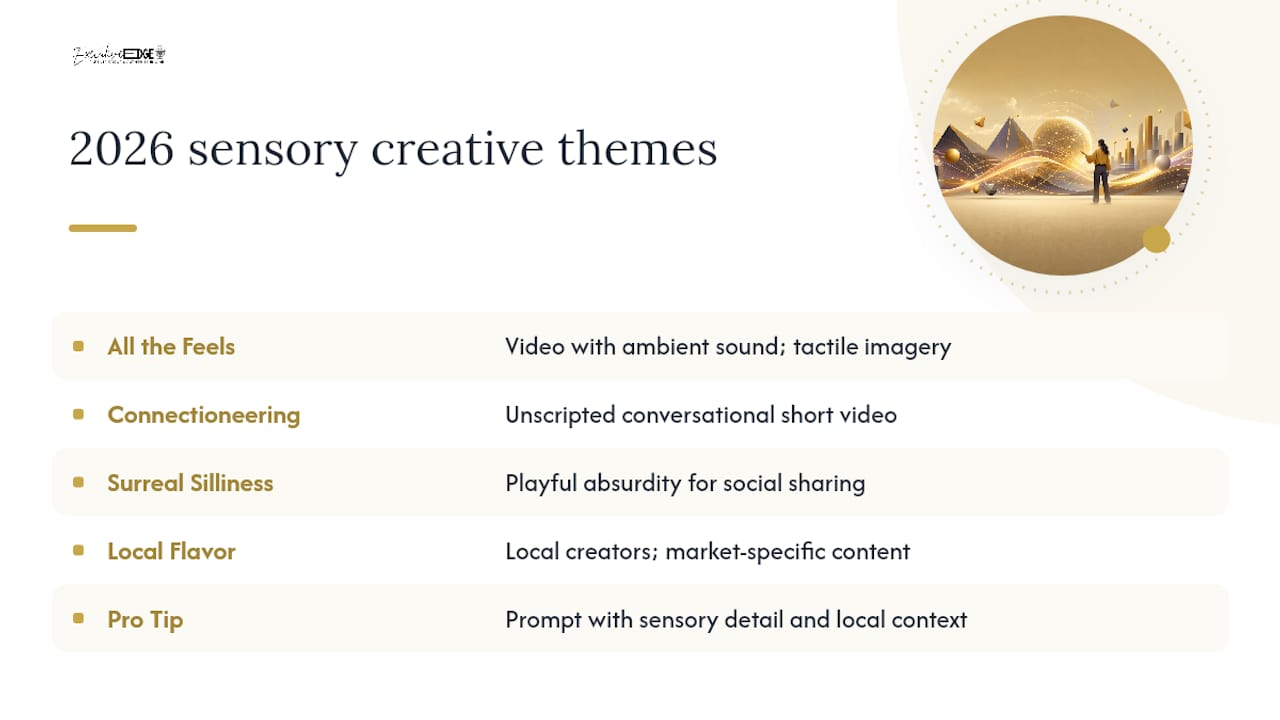
The reason sensory, human-centered creative matters more in 2026 is simple: AI-generated content is abundant and increasingly indistinguishable at the surface level. Adobe's 2026 Creative Trends research frames this as a shift from polished automation to work that engineers emotional resonance quickly. The four themes Adobe identifies are not aesthetic preferences. They are strategic signals about what audiences respond to when everything else looks the same.
All the Feels centers on emotional texture: content that triggers a physical or emotional response before the rational brain engages. For marketers, this means video with ambient sound design, photography with tactile depth, and copy that uses sensory language rather than feature lists. A campaign play: produce a 60-second brand film with no voiceover, only music and environmental sound, and let the visuals carry the emotional argument.
Connectioneering is about designing for genuine human connection in an era of AI-mediated interaction. The format that fits this theme best is unscripted, conversational video — a founder interview, a client conversation, or a behind-the-scenes walkthrough. For local brand social content, this translates directly to short-form video that shows real people, real locations, and real outcomes rather than polished brand messaging.
Surreal Silliness gives brands permission to be unexpected and playful. The content play here is not random humor; it is deliberate tonal contrast. A B2B brand that produces one piece of genuinely funny, slightly absurd content per quarter earns more social sharing and brand recall than a year of informational posts. Think illustrated explainers with unexpected visual metaphors, or short-form video that subverts a familiar format.
Local Flavor is the most immediately applicable theme for service businesses. It means leaning into geographic and cultural specificity rather than generic "universal" messaging. Partner with local creators, reference local landmarks and events, and build content that could only come from your specific market. AI-generated content cannot replicate genuine local knowledge.
Pro Tip: When prompting generative AI tools for visual or written content, add sensory and contextual detail to your prompts: specify texture, ambient environment, emotional tone, and local context. "A professional headshot" produces generic output. "A professional portrait in warm afternoon light, taken in a brick-walled office with visible bookshelves, conveying quiet confidence" produces something worth using.
5. Channel strategy for 2026: why email and owned media are your best investment
Search-driven clicks are less reliable than they were two years ago. AI Overviews, zero-click answers, and generative summaries intercept traffic before it reaches your site. The channels that bypass that interception are the ones worth investing in now.
eMarketer's FAQ on content marketing reports that email delivers roughly 28% ROI and SEO roughly 26.1% (per CoSchedule's December 2025 data), making them the two highest-performing channels even as AI disrupts click-through rates. Email is the only major channel where you own the relationship entirely.
How to rebuild and strengthen owned channels:
- Build a subscription funnel. Every piece of content you publish should have one clear next step: subscribe to the newsletter, download the guide, or join the community. Without a subscription mechanism, you are building an audience for someone else's platform.
- Create gated authority assets. A well-researched guide, a proprietary framework, or an original data report gives people a reason to exchange their email address. These assets also perform well as AEO/GEO citations.
- Repurpose systematically. A single long-form article becomes a newsletter section, three social posts, a short video script, and a podcast talking point. That is five assets from one production cycle.
- Invest in your podcast and YouTube channel. Both platforms have their own search algorithms and are increasingly cited by AI tools. Video transcripts and podcast show notes are high-value AEO assets.
- Treat your blog as an owned media property, not a content dump. Blogging builds trust when it is consistent, specific, and structured for both human readers and AI ingestion.
Repurposing checklist:
- Long-form article → newsletter summary → three social posts → short video script → podcast talking point
- Podcast episode → transcript → blog post → quote graphics → short-form video clips
- Webinar or live event → recording → edited highlight reel → transcript → FAQ article
Metrics to track for owned channels:
- Email open rate and click-to-open rate (engagement quality, not just volume)
- Newsletter subscriber growth rate (week over week)
- Direct and branded search traffic (a proxy for brand authority)
- Content-attributed pipeline or lead volume
- AI citation share (track how often your content appears in AI-generated answers)
Content beats cold outreach on every long-cycle metric for service businesses, and owned channels are where that advantage compounds over time.
6. First-party data, personalization, and ABM/ABX in 2026
First-party data is the foundation of every personalized content program in 2026. Third-party cookies are gone in most environments, and privacy regulations continue to tighten. If you do not have a consent-based data collection system in place, personalization at scale is not possible.
Minimum governance requirements:
- Explicit consent at every data collection point, with clear language about how data will be used.
- Segmentation hygiene: review and clean your lists quarterly; stale segments produce misleading personalization signals.
- Documented retention policies: define how long you keep behavioral data and what triggers deletion.
- Role-based access controls for any system that stores contact or behavioral data.
Activation: mapping data to content workflows
The most effective personalization in 2026 is not "Hello, [First Name]" in a subject line. It is content sequencing based on behavior. Someone who downloads a guide on a specific topic should receive a follow-up email with the next logical piece of content on that topic, not a generic newsletter.
- Content triggers — Set behavioral triggers in your email platform (HubSpot, Klaviyo, ActiveCampaign, or similar) that fire when a contact views a specific page, downloads an asset, or attends an event.
- Sequencing — Map a three to five-step content sequence for each buyer stage. Each step should answer the next logical question the buyer has.
- Orchestration — For ABM/ABX programs, coordinate content delivery across email, paid retargeting, and direct outreach so the account receives a consistent message across channels.
ABM/ABX content checklist:
- Identify your top 20 to 50 target accounts and map their content consumption patterns.
- Create one account-specific or industry-specific piece of content per quarter.
- Track account-level engagement: page views, content downloads, and event attendance by company.
- Align sales and marketing on content handoff triggers — when does a content-engaged contact become a sales conversation?
Pro Tip: Start with behavioral segmentation before investing in advanced personalization technology. A simple tag in your CRM that identifies whether a contact has consumed "awareness" or "decision-stage" content will outperform a sophisticated AI personalization engine built on a dirty, unsegmented list.
7. Experiential marketing's comeback and how it feeds your content program
Live and hybrid experiences are regaining investment and attention in 2026. CMI's research shows experiential marketing at 33% of 2026 B2B investment priorities, behind only AI tools at 45% and owned media at 32%. The reason is not nostalgia for in-person events. It is that live experiences generate modular content assets that feed every other channel simultaneously.
A single 90-minute workshop produces a recording, a transcript, a blog post, five short-form video clips, a podcast episode, and a dozen social posts. That is a month of content from one event.
Experiment ideas for small teams:
- Micro-webinars (30 minutes) — A focused, single-topic webinar with a live Q&A generates high-quality audience questions that become FAQ content and AEO-optimized articles.
- Live podcast recordings — Record a podcast episode in front of a small live audience, either in-person or via a live stream. The audience interaction adds authenticity that edited studio recordings rarely achieve.
- Virtual roundtables — Invite three to five clients or industry peers for a structured conversation. The recording becomes a long-form video, and the insights become a research-style report.
- In-person workshops — Even a small, local workshop generates testimonials, case study material, and community-building content that AI cannot replicate.
KPIs for experiential content:
- Attendance and registration conversion rate
- Content assets generated per event (track this explicitly)
- Email subscribers acquired through event registration
- Downstream content engagement from event-generated assets
- Pipeline influenced by event attendees within 90 days
Asset reuse model: A 60-minute virtual workshop on a specific industry topic produces a full recording (YouTube), a transcript (blog post and AEO asset), five 60-second clips (social and YouTube Shorts), a summary email (newsletter), and a follow-up guide (gated asset). That is six distinct content assets from one production session.
8. Measurement in 2026: the metrics that matter when clicks decline
The shift in measurement is straightforward: stop optimizing for output metrics and start tracking influence and citation share. Clicks, impressions, and page views are still useful, but they do not capture the value of content that gets cited in an AI answer, referenced in a sales conversation, or shared in a private Slack channel.
eMarketer's analysis is direct on this: performance and measurement consistently lag behind AI-driven production increases. Teams that invest in better measurement infrastructure now will have a significant advantage when reporting to leadership in 12 months.
Recommended 2026 content marketing dashboard:
| Metric | What it indicates | Frequency |
|---|---|---|
| AI citation share | How often your content appears in AI-generated answers | Monthly |
| Branded search volume | Proxy for brand authority and recall | Monthly |
| Email subscriber growth rate | Owned audience health | Weekly |
| Content-attributed pipeline | Revenue influence of content | Monthly |
| Engagement rate (time on page, scroll depth) | Content quality and relevance | Weekly |
| Backlink velocity | Domain authority and citation signals | Monthly |
| Social share rate | Organic amplification and resonance | Weekly |
| Event-to-content asset ratio | Experiential content efficiency | Per event |
Experiment checklist for AEO/GEO validation:
- Query your target topics in ChatGPT, Perplexity, and Google AI Overviews. Record whether your content is cited.
- Track changes in branded search volume after publishing a new modular asset.
- A/B test scrapeable lead definitions (one-sentence answers at the top of sections) against narrative openings. Measure AI citation frequency over 30 days.
- Monitor direct traffic and newsletter signups as proxies for zero-visit brand awareness.
9. A six-step playbook for applying 2026 trends with limited resources
This playbook is the fastest route to measurable traction in 90 days for teams that cannot afford to chase every trend simultaneously. Pick the two or three trends most relevant to your audience and business model, then execute these six steps in sequence.
Step 1: Prioritize ruthlessly (Week 1–2) Audit your current content against the trend list. Identify the one channel and one content format where you already have traction. Double down there before expanding.
Step 2: Build one modular anchor asset (Week 2–4) Choose a topic where you have genuine expertise. Write a long-form, evidence-dense piece structured for AEO: scrapeable definitions, question-led subheadings, FAQ schema. This is your citation foundation.
Step 3: Implement AI governance (Week 3–4) Document your brand voice guide. Set up a two-checkpoint review workflow for all AI-assisted content. Tag AI-generated drafts in your CMS. This takes one afternoon to set up and prevents months of brand drift. See the how online trust is built playbook for the governance framework.
Step 4: Optimize for AEO/GEO (Week 4–6) Apply FAQ schema and Article schema to your top 10 pages. Rewrite the opening paragraph of each to lead with a direct, scrapeable answer. Publish transcripts for any video or podcast content you have.
Step 5: Activate owned channels (Week 6–10) Launch or relaunch your email newsletter with a clear subscription CTA on every content page. Set up three behavioral triggers in your email platform. Repurpose your anchor asset into at least three additional formats.
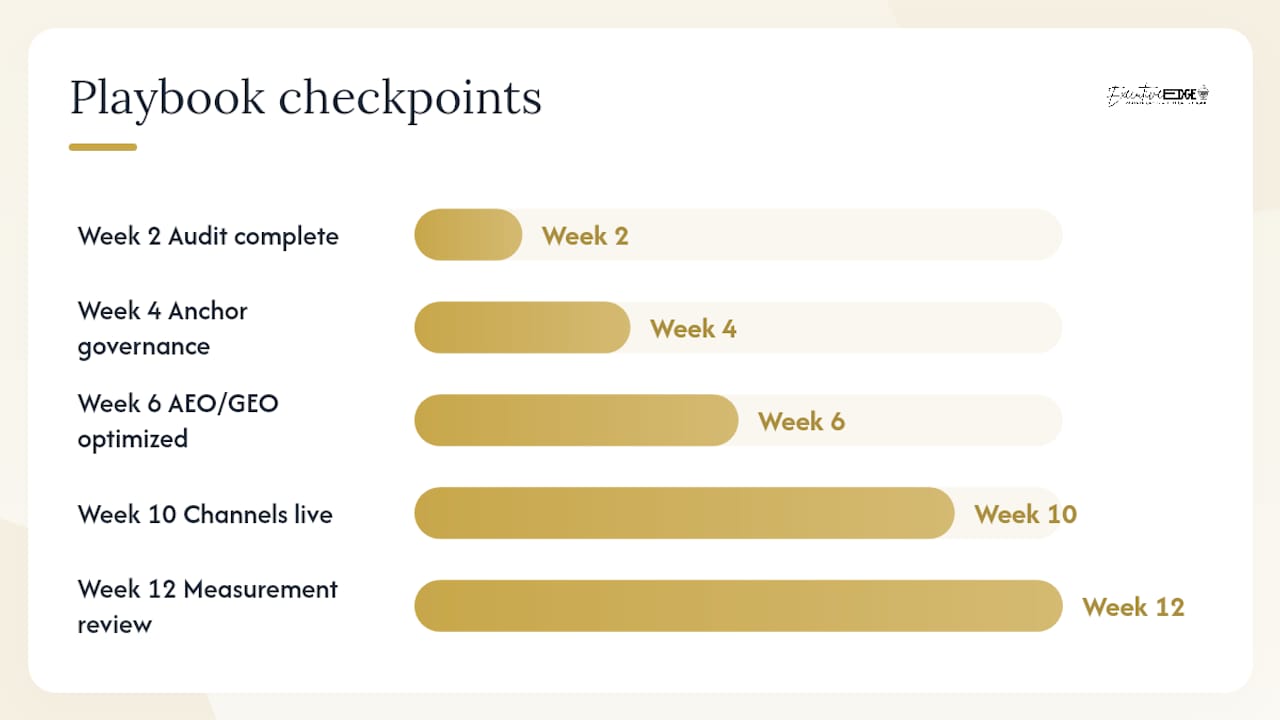
Step 6: Measure and iterate (Week 10–12) Run the AEO/GEO experiment checklist from Section 8. Review your dashboard metrics. Identify the one tactic with the clearest signal and allocate more resources to it in the next quarter.
12-week checkpoint summary:
- Week 2: Audit complete, priorities set
- Week 4: Anchor asset published, governance in place
- Week 6: AEO/GEO optimization applied to top pages
- Week 10: Owned channel activation live, repurposing running
- Week 12: First measurement review, iteration plan documented
Pro Tip: If your team is stretched thin, the single highest-leverage move is to treat your podcast or YouTube channel as the primary asset and repurpose everything else from it. One recorded conversation per week, properly transcribed and structured, feeds your blog, newsletter, social, and AEO strategy simultaneously.
For teams that want this entire system built and managed without adding headcount, Executive Edge Partner Group runs the full authority-building and content amplification workflow as a done-for-you service, covering podcast production, blog articles, YouTube, social content, AEO/GEO optimization, and performance tracking.
What these trends mean for service businesses and local teams
The 2026 content marketing trends are not abstract. For service-based businesses, the practical implication is this: the firms that build genuine local authority through consistent, structured, human-centered content will outperform larger competitors who rely on AI volume alone.
The businesses I see winning in markets like Tyler, Texas and East Texas are not the ones with the biggest ad budgets. They are the ones who show up consistently in AI answers, in local search, and in their clients' inboxes with content that actually reflects their expertise. The trends in this article are not about keeping up with technology. They are about using technology to amplify what you already know.
The types of content that build trust for service businesses have not changed fundamentally. What has changed is the infrastructure needed to distribute that content across AI-driven discovery platforms, owned channels, and multimedia formats simultaneously. That is exactly what the Executive Edge Authority Engine is built to do.
Further reading and primary sources
- CMI B2B Content and Marketing Trends: Insights for 2026 — primary survey data on AI adoption, investment priorities, and experiential marketing in B2B.
- Adobe: The four creative trends that will define marketing in 2026 — research-driven forecast on sensory and human-centered creative themes.
- Adobe 2026 Creative Trends Forecast (Business) — practical guidance on prompting for sensory detail and local authenticity.
- eMarketer: Content Marketing 2026 — analysis of AI's impact on production, performance gaps, and the rise of GEO/AEO.
- eMarketer FAQ: AI saturation, zero-click search, and what's still working in 2026 — channel ROI data including email and SEO performance benchmarks.
- WordStream: The 8 Most Influential Content Marketing Trends for 2026 — practitioner analysis of zero-visit visibility, structure, and multimedia.
- Clutch x Conductor: The 2026 State of AI Content Report — survey data on LLM-targeted content creation and GEO adoption rates.
Sources
- The four creative trends that will define marketing in 2026 | Adobe Blog
- B2B Creative Trends Report: 2026 Creative Trends Forecast
- Content Marketing 2026
- The 8 Most Influential Content Marketing Trends for 2026 | WordStream
- Clutch x Conductor: The 2026 State of AI Content Report
FAQ
What are the most important content marketing trends for 2026?
The five highest-priority trends are AI governance and agentic workflows, zero-visit visibility through AEO and GEO, sensory multimedia creative, the channel shift to email and owned media, and first-party data personalization. CMI's 2026 research confirms AI tools lead investment priorities at 45%, but performance depends on pairing AI with stronger fundamentals.
What is zero-visit visibility and why does it matter in 2026?
Zero-visit visibility means your content gets cited in an AI-generated answer without the user clicking through to your site. WordStream identifies it as the most influential trend of 2026; optimizing for AI citation share is now as important as optimizing for traditional search rankings.
How should marketers use AI in their content programs without losing quality?
Use AI for research, metadata generation, transcript creation, and optimization loops, but apply a documented governance workflow with human review at every factual or brand-sensitive checkpoint. CMI's data shows the highest-performing teams combine AI with stronger marketing fundamentals, not just higher output volume.
Which content channels deliver the best ROI in 2026?
Email and SEO remain the top two channels by ROI, at roughly 28% and 26.1% respectively, according to eMarketer's FAQ reporting citing CoSchedule's December 2025 data. Both channels benefit from owned-media investment and are less exposed to AI-driven traffic disruption than paid or organic social.
How do you measure content marketing success when clicks are declining?
Track AI citation share, branded search volume, email subscriber growth, and content-attributed pipeline alongside traditional engagement metrics. eMarketer's analysis notes that measurement consistently lags AI-driven production; building a dashboard that captures influence, not just output, is the critical upgrade for 2026.