

The most effective types of content for service businesses are those that establish expertise, build human connection, and educate prospects before they ever make contact. Service businesses face a different content challenge than product brands. You cannot photograph your service or ship a sample. Your content must do the work that a product's packaging does: communicate value, build confidence, and reduce risk. For business owners in Tyler and East Texas, this distinction matters more than ever as local markets grow more competitive and buyers research online before picking up the phone.
1. What are the best types of content for service businesses?
The best content for service businesses balances authority, trust, and education working together as a system. No single format wins alone. A law firm that only publishes blog posts misses the trust signals that video and case studies provide. A contractor who only posts before-and-after photos misses the educational content that pre-qualifies buyers and reduces price objections. The goal is a content mix that meets prospects at every stage of their decision.
Service brands must focus content on building trust and showcasing their problem-solving approach, not just creating desire the way product brands do. That shift in purpose changes everything about which formats you choose and how you use them.

2. Educational blog posts and guides
Educational content shifts client conversations away from price by teaching prospects how to evaluate the service they are buying. When a prospect understands what separates a quality provider from a cheap one, they stop shopping on price alone. That makes educational content one of the most direct tools for protecting your margins.
The most effective educational formats for service businesses include:
- Long-form guides (2,000–3,500 words) that answer the buyer's top questions in one place
- FAQ pages that reduce uncertainty and pre-qualify leads before they call
- How-to articles that demonstrate your process and expertise
- Glossary posts that define industry terms your clients encounter
Flagship guides of 2,000–3,500 words answering the buyer's top questions outperform multiple thin posts. One thorough guide ranks better, earns more links, and serves readers longer than five shallow articles on the same topic.
Pro Tip: Build educational content around the questions your best clients asked before they hired you. Those questions reveal exactly what your next client needs to see.
3. Case studies and proof-driven content
Specific, transparent case studies create pre-sold leads, reducing the sales effort required to close a deal. A prospect who reads a detailed case study about a client just like them arrives at the sales conversation already convinced. That is the highest-value content a service business can produce.
Effective case studies share four elements:
- Client context: who the client is and what situation they were in
- The challenge: the specific problem they needed solved
- Your solution: what you did and why you chose that approach
- Measurable outcome: numbers, timelines, or clear before-and-after results
Specificity drives credibility. Vague case studies ("We helped a local business grow") do nothing. Named clients, real numbers, and honest descriptions of the challenge build the trust that generic testimonials cannot.
Pro Tip: Repurpose each case study into a social media post, a short video summary, and a pull quote for your service pages. One case study can fuel a month of content across channels.
4. Behind-the-scenes and humanizing content
90% of consumers prioritize authenticity in brand interactions, making human-centered content critical for profitable service relationships. That statistic points to a clear opportunity. Most service businesses publish polished, formal content and skip the human moments that actually build connection.
Behind-the-scenes content includes:
- Team introductions and day-in-the-life posts
- Process reveals showing how you deliver your service
- Personal stories about why you started your business
- Honest posts about challenges you have solved or lessons you have learned
This type of content builds familiarity before the first call. A prospect who has seen your team, heard your story, and watched how you work already feels like they know you. That familiarity shortens the sales cycle and increases the likelihood they choose you over a competitor they found through a search ad.
Pro Tip: Authenticity beats production quality every time. A genuine 60-second phone video of your team at work outperforms a stiff, scripted promotional video.
5. Video and podcast content
Video and audio build trust faster than text by showing authentic brand personality. A written bio tells prospects who you are. A video shows them how you think, how you communicate, and whether they want to work with you. That is a fundamentally different level of connection.
The multimedia formats that perform best for service businesses are:
| Format | Best use | Primary benefit |
|---|---|---|
| Explainer videos | Complex services or processes | Simplifies decision-making |
| Client testimonial videos | Proof and trust building | Social validation |
| Podcast episodes | Long-form authority building | Deep audience connection |
| Short social clips | Awareness and reach | Broad distribution |
| Infographics | Data or process visualization | Shareable and scannable |
YouTube specifically gives local service businesses a platform where prospects actively search for answers. A plumber who publishes a video explaining how to spot a hidden leak earns trust from every viewer, whether or not they call that week.
Social media platforms serve primarily as distribution and feedback channels, not direct lead sources for most service businesses. Choose platforms based on where your audience already spends time, not where you feel most comfortable posting.
6. Service page content
Most service businesses waste traffic by sending visitors to weak service pages that lack clear offers and proof. A service page is not a brochure. It is a conversion tool. Every page should answer three questions: What do you do? Who is it for? What happens next?
Strong service pages include a specific offer, at least one proof element (testimonial, case study excerpt, or credential), and a frictionless path to contact. A phone number buried in the footer is not a frictionless path. A visible call-to-action above the fold is.
Service pages also benefit from supporting content. A page about your consulting services performs better when it links to a related guide, a relevant case study, and a short video overview. That combination gives every type of prospect the format they prefer.
7. Social media content for local visibility
Local brand social media content works differently from national brand content. Local service businesses build trust through consistency and community connection, not viral reach. Posting three times a week about your work, your team, and your clients' results builds a recognizable presence in your market over time.
The formats that drive results for local service businesses on social media include short educational clips, client shoutouts (with permission), community involvement posts, and process photos. These formats show up in local feeds, get shared by clients, and keep your brand visible between purchase decisions.
Avoid the trap of posting only promotional content. A feed full of "hire us" messages trains your audience to scroll past you. A feed that teaches, entertains, and shows real work earns attention and referrals.
8. Email content and newsletters
Email is the one channel you own outright. Social platforms change their algorithms. Search rankings shift. Your email list stays yours. For service businesses, a consistent email newsletter keeps you top of mind with past clients, warm leads, and referral partners.
The most effective service business newsletters share one useful insight per issue, reference a recent piece of content, and include a low-pressure next step. That structure respects the reader's time and keeps open rates high. Monthly is the minimum frequency. Weekly works for businesses with enough content to fill each issue without repeating themselves.
Educational content for business authority works especially well in email format because subscribers have already opted in. They want to hear from you. Give them something worth reading.
9. How to align content types with the buyer journey
A content strategy for service businesses works best when each format serves a specific stage of the buyer journey. Sending a detailed case study to someone who has never heard of you is like proposing on a first date. The sequence matters.
The three-stage framework:
- Top of funnel (awareness): Educational blog posts, short videos, and social content introduce your expertise to people who do not know you yet.
- Middle of funnel (consideration): Process content, behind-the-scenes posts, and detailed guides help prospects evaluate whether you are the right fit.
- Bottom of funnel (decision): Case studies, testimonials, and strong service pages close the gap between interest and action.
Auditing your existing content first ensures that service pages have specific offers, proof, and frictionless contact pathways. Before creating anything new, check whether your current pages and posts are doing their jobs. Most businesses find gaps at the bottom of the funnel, where conversion content is weakest.
Pro Tip: Map your five best clients' buying journeys backward. What did they read, watch, or hear before they called? That map tells you exactly which content types to prioritize.
For professional services firms, content marketing for advisors follows the same funnel logic. Educational content at the top, proof content at the bottom, and human-centered content throughout.
What I have learned about content that actually works
The businesses I see winning with content in 2026 are not the ones publishing the most. They are the ones publishing the most useful. There is a real difference.
I have watched service businesses spend months building a blog with dozens of posts that generate no leads, while a competitor publishes one thorough guide and a handful of case studies and books out their calendar. The difference is almost never the format. It is the depth and the intent behind the content.
The hardest thing to convince service business owners of is that teaching your audience everything you know does not give away your business. It builds it. Clients who understand your process, your standards, and your results do not shop around. They call you first and they pay your rate.
East Texas businesses face a specific version of this challenge. Local markets reward trust more than any other factor. A business that shows up consistently with real, useful content earns a reputation that no ad budget can buy. Start with one flagship guide, two or three honest case studies, and a behind-the-scenes video. Build from there. The businesses that commit to that foundation are the ones still growing two years from now.
— David Domm
How Executive Edge Partner Group helps service businesses get found
Building a content system that covers education, proof, and human connection takes time and consistency. Most service business owners know what they should be doing. Finding the hours to do it is the real obstacle.
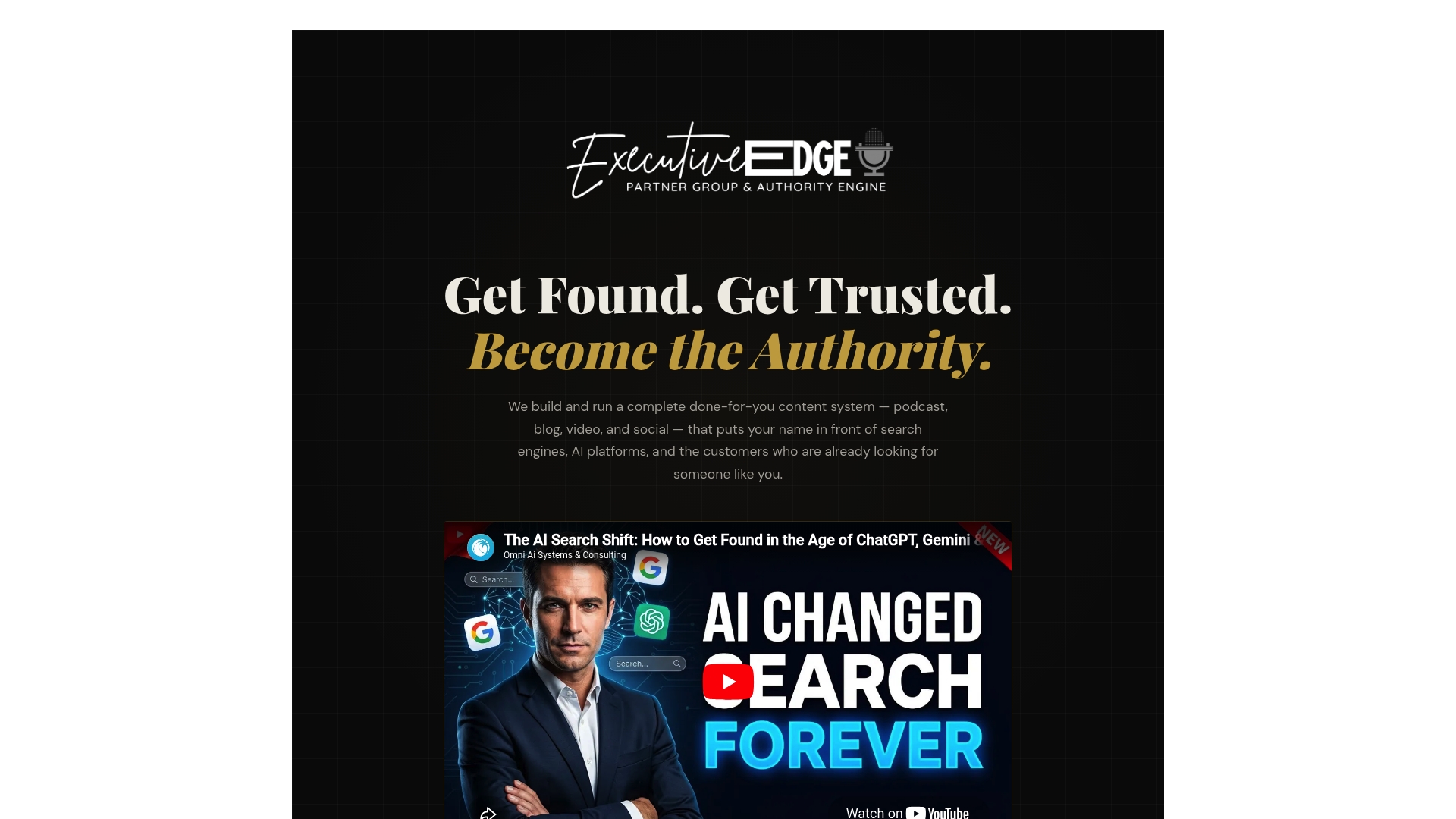
Executive Edge Partner Group works with service business owners to build and distribute authority-driven content across search, video, and AI platforms. The system turns your expertise into blog posts, podcast episodes, YouTube videos, and social content without requiring you to become a full-time content creator. From content strategy to distribution, the process is built for business owners who want results without adding another job to their week. If you are ready to build a content presence that earns trust and drives leads, Executive Edge Partner Group is the place to start.
FAQ
What types of content work best for service businesses?
Educational guides, case studies, and video content are the most effective formats for service businesses. These formats build authority, demonstrate results, and create trust before a prospect makes contact.
How does educational content help service businesses win clients?
Educational content reduces price objections by helping prospects understand the value of quality service. An informed buyer is more likely to pay your rate and less likely to shop on price alone.
How long should a service business blog post be?
Flagship guides of 2,000–3,500 words outperform multiple shorter posts for service businesses. One thorough guide that answers the buyer's top questions ranks better and serves readers longer than several thin articles.
Why do case studies matter for service business content?
Case studies with specific client details, challenges, solutions, and measurable outcomes pre-sell leads effectively. A prospect who reads a detailed case study arrives at the sales conversation already confident in your ability to deliver.
How often should a service business publish content?
Consistency matters more than frequency. Publishing one high-quality piece per week across your primary channels outperforms daily low-effort posts. Audit your existing content first, then build a schedule you can maintain without sacrificing quality.