

Educational business content is defined as any format that teaches your audience something useful while positioning your brand as the credible source of that knowledge. The best examples of educational business content include how-to guides, case studies, explainer articles, personalized video tutorials, and decision frameworks. Each format serves a distinct role in moving prospects from awareness to trust. For business professionals and entrepreneurs in Tyler, East Texas, and beyond, publishing this kind of content consistently is one of the most reliable ways to build long-term authority without relying solely on paid advertising.
1. What are the most effective types of educational business content?
Thought leadership research identifies 15 content formats with educational types at the core, including how-to guides, frameworks, and explainer articles. Each format addresses a different stage of the buyer's journey. A prospect who just discovered your business needs a different piece of content than someone already comparing options.
The primary formats and their roles:
- How-to guides: Walk readers through a specific task step by step. They rank well in search and get cited by AI tools because they answer direct questions.
- Case studies: Show real outcomes with real numbers. They build credibility faster than any claim you can make about yourself.
- Explainer articles: Break down complex topics into plain language. They work best for audiences who are new to your field.
- Frameworks: Give readers a repeatable system. A named framework (like a "3-Step Audit Process") becomes associated with your brand over time.
- Long-form deep dives: Cover a topic so thoroughly that readers bookmark the page. Long-form content and video build authority better than short social posts by demonstrating depth and genuine familiarity with a subject.
- FAQ content: Answers the exact questions your audience types into Google or asks an AI assistant.
- Video tutorials: Teach visually and build personal connection with your audience.
Pro Tip: Rotate your content formats intentionally. Publish a how-to guide one week, a case study the next, and a framework piece after that. This approach addresses different buyer stages and keeps your content feed from going stale.
2. How can businesses build buyer trust through educational content?

Trust is built before the sale. Authority content should teach before it sells, with calls to action positioned as natural next steps such as checklists or templates rather than hard pitches. This principle separates content that converts from content that gets ignored.
The structural features that make educational content trustworthy:
- Proof of expertise in the first 200 words: Readers decide quickly whether you know what you are talking about. Trust-building educational posts include specific proof of expertise early and "what didn't work" sections to increase credibility.
- Citing real sources: Linking to research, standards, or third-party data signals that your claims are grounded in fact, not opinion.
- Acknowledging limitations: Telling readers when your advice does not apply builds more trust than pretending your solution works for every situation.
- Decision-tree structure: Organize content around the reader's actual decisions, not around your product taxonomy. Ask "what does the reader need to decide next?" and answer that question directly.
Pro Tip: Use real data and named examples in every piece. A sentence like "In our work with a local contractor, we found that X happened" is ten times more credible than a generic claim about what "businesses typically experience."
3. Real-world examples of educational business content formats
Concrete examples show how these formats work in practice, not just in theory.
How-to tutorial series: A law firm publishes a five-part guide called "How to Prepare for Your First Business Contract Review." Each article covers one step, links to the next, and ends with a downloadable checklist. The series ranks for multiple search terms and positions the firm as the obvious choice before a prospect ever calls.
Case study with failure included: A marketing consultant writes a case study that shows what they tried first, why it failed, and what they changed. Building a use-case list and including proof of expertise plus limitations prevents generic content and raises the quality of the educational post significantly.
Personalized AI-generated video: A financial advisor sends each new prospect a short video that addresses their specific situation by name and references their stated goals. Personalized AI-generated videos can increase perceived instructional value more than non-personalized human-recorded videos. That finding matters because it means personalization is not just a nice touch. It measurably changes how useful the content feels.
Executive YouTube content: A business owner records a 12-minute video explaining how to read a profit and loss statement for non-accountants. The video attracts searches, builds subscribers, and gets shared in professional communities. You can see how this approach works in practice by looking at executive YouTube content that builds authority over time.
Long-form framework article: A consultant publishes a 2,500-word piece introducing their proprietary "4-Phase Client Onboarding System." The article becomes a reference piece that gets linked to from other sites and cited in AI search results.
Repurposed anchor content: One long-form article gets broken into a LinkedIn post series, a podcast episode, a short video, and an email newsletter. This approach, where depth anchor pieces get repurposed across channels, multiplies the reach of a single piece of thinking without requiring you to generate new ideas every day.
4. How to structure educational business content for AI discoverability
AI tools like ChatGPT, Perplexity, and Google's AI Overviews pull answers from content that is clearly structured and easy to parse. Instructional content with step-by-step, "How Do I," and FAQ formats using plain language improves AI discoverability and usefulness for readers. This is not a minor technical detail. It determines whether your content gets cited or ignored by AI systems.
AI-ready content requires clear labeling, recency citations, and unambiguous structure for best retrieval. The practical implication is that vague, meandering articles will not get picked up. Specific, numbered, and clearly labeled content will.
The table below shows how different structural choices affect both reader experience and AI retrieval:
| Content Feature | Reader Benefit | AI Retrieval Benefit |
|---|---|---|
| Numbered steps | Easy to follow | Parsed as a complete workflow |
| Question-format headings | Matches search intent | Directly answers AI queries |
| Plain language | Accessible to all readers | Reduces ambiguity for AI parsing |
| Recency citations | Builds credibility | Signals content is current |
| Clear section labels | Improves scannability | Helps AI identify topic boundaries |
| Defined terms | Reduces confusion | Improves entity recognition |
Treat each educational piece as a complete workflow. Cover the full task from start to finish. Do not assume the reader will find the missing steps somewhere else. Understanding how AI search discovery works gives you a real advantage when structuring content for both human readers and AI platforms.
5. Why I think most business content fails at being educational
Most business content is promotional content wearing an educational costume. I have reviewed hundreds of articles from consultants, attorneys, and service businesses, and the pattern is consistent. The piece starts with a vague promise, spends three paragraphs explaining why the topic matters, and then ends with a call to action before it has actually taught the reader anything.
Real educational content requires you to give away your thinking. That feels uncomfortable for many business owners because they worry about giving too much away. The opposite is true. The more specifically you teach, the more authority you earn. A reader who finishes your article knowing exactly how to do something will trust you far more than a reader who finished your article knowing only that you exist.
The other failure I see consistently is the absence of failure. Content that only shows success reads as marketing. Content that includes what did not work, what the limits are, and what conditions change the outcome reads as expertise. That distinction is what separates a trusted advisor from a vendor.
For businesses building content programs, I recommend starting with a use-case list before writing a single word. Write down every specific situation your clients face. Then write content for each situation, not for each service you offer. That shift in framing produces content that readers actually search for and that AI systems actually cite. The value of consistent educational content compounds over time in a way that one-off posts never do.
— David Domm
How Executive Edge Partner Group helps businesses publish authority content
Executive Edge Partner Group works with business owners, consultants, and local brands who want to publish consistent, authoritative educational content without becoming full-time writers or video producers.
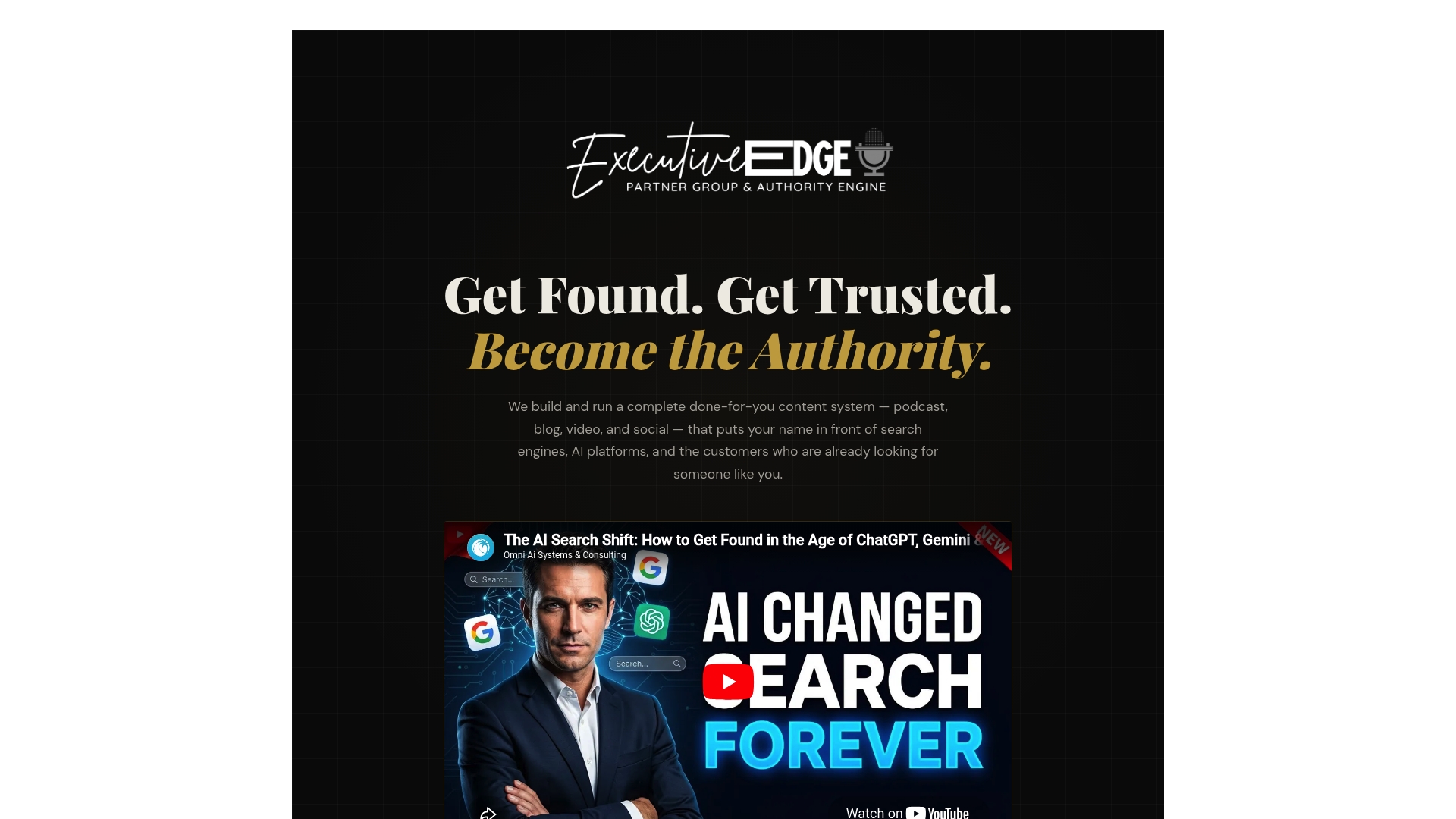
The system handles content planning, long-form article creation, video production, podcast episodes, and multi-platform distribution. It is built specifically for service businesses, professionals, and entrepreneurs who have real expertise but not the time or team to turn that expertise into published content at scale. For businesses in Tyler and East Texas looking to build trust and visibility online, Executive Edge Partner Group offers a done-for-you content system designed to grow your authority month over month. The goal is not just more content. It is content that earns citations, builds trust, and brings the right clients to you.
FAQ
What counts as educational business content?
Educational business content is any format that teaches your audience a specific skill, process, or concept related to your field. Common formats include how-to guides, case studies, explainer articles, video tutorials, and decision frameworks.
How does educational content build trust with potential clients?
Trust-building content includes proof of expertise early, cites real sources, and acknowledges limitations. Readers trust content that teaches honestly more than content that only promotes.
Why does content structure matter for AI search results?
Structured content with numbered steps and question-format headings gets retrieved more reliably by AI tools because it is easier to parse and matches the way users phrase questions.
How often should businesses publish educational content?
Consistency matters more than frequency. Publishing one thorough, well-structured piece per week outperforms publishing five thin posts. Consistent educational content builds compounding authority over time.
What is the difference between educational content and thought leadership?
Thought leadership expresses original opinions and frameworks. Educational content teaches specific skills or processes. The strongest business content programs combine both, using educational formats to demonstrate expertise and thought leadership to differentiate the brand.