

An entrepreneur podcast authority strategy is a deliberate plan to use podcasting as business infrastructure that builds trust, generates referrals, and positions you as the go-to expert in your niche. This is distinct from casual content creation. The industry term for this approach is "thought leadership podcasting," and it operates on a fundamentally different logic than chasing downloads. Entrepreneurs who treat their podcast as a trust-building engine, rather than a content project, see compounding returns in the form of discovery calls, partnerships, and inbound referrals. For business owners in Tyler, Texas and across East Texas, this approach is one of the most cost-effective ways to stand out in a crowded local market.
What is an entrepreneur podcast authority strategy?
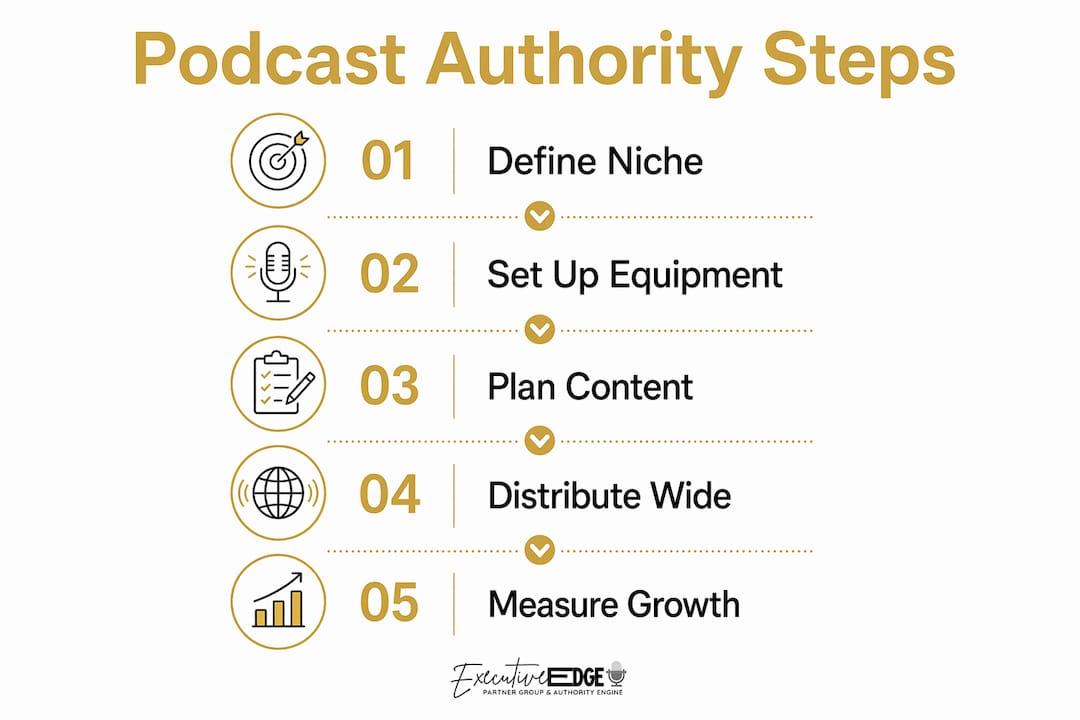
An entrepreneur podcast authority strategy is the structured use of podcasting to build expert positioning, audience trust, and business growth over time. The core insight is this: podcasting as business infrastructure means you measure success by clarity, referrals, and partnerships, not by download counts. That shift in measurement changes everything about how you plan, produce, and publish.
Most entrepreneurs start a podcast thinking about content. The ones who build real authority start thinking about positioning. Your podcast is the mechanism that delivers your expertise to the right people, repeatedly, until they trust you enough to hire you, refer you, or partner with you. That process takes time, and it requires a system.

Executive Edge Partner Group works with entrepreneurs who want to build this kind of authority without becoming full-time content creators. The system they use combines strategic content planning, multi-platform distribution, and AI-assisted workflows to make the process repeatable and sustainable.
What tools and setup do you need to launch an authority podcast?
The right equipment removes friction. A USB condenser microphone such as the Blue Yeti or Audio-Technica ATR2100x delivers broadcast-quality audio without a studio. Pair it with free or low-cost editing software like Audacity or GarageBand, and you have a production setup that costs less than one month of paid advertising.
Podcast hosting is where most entrepreneurs underinvest. Your host needs to support RSS distribution to all major directories, including Spotify, Apple Podcasts, and Amazon Music. Platforms like Buzzsprout, Podbean, or Transistor handle this automatically. The goal is to publish once and appear everywhere without manual uploads.
| Feature category | What to look for |
|---|---|
| Audio recording | USB or XLR mic, pop filter, acoustic treatment |
| Editing software | Noise reduction, multi-track, export to MP3/WAV |
| Podcast hosting | Auto-distribution, analytics, RSS feed management |
| Social scheduling | Batch publishing, clip upload, caption generation |
| Automation tools | Guest portals, email sequences, show note templates |
Automation in podcast marketing, including auto-publishing, guest portal management, and social scheduling, is what separates a sustainable show from one that burns out by episode 20. Podcast-specific systems manage the entire marketing workflow end-to-end, which generic creator tools do not.
The mindset shift matters as much as the tools. Treat every production decision as a systems question. If you cannot repeat the process in two hours per episode, the workflow is too complex to sustain.
Pro Tip: Record your first five episodes before you publish episode one. This buffer gives you time to refine your workflow without the pressure of a live publishing deadline.
How do you create podcast content that builds real authority?
Authority content starts with a clear authority stamp. An authority stamp is a specific one-liner that communicates exactly who you help and what outcome you deliver. An example: "I help service-based business owners get more referrals without paid ads." That sentence does more trust-building work than a ten-minute bio.
Your origin story is the second pillar. Listeners connect with the "why" before they trust the "what." A well-told origin story, delivered in the first three episodes, sets the emotional foundation for everything that follows. It does not need to be dramatic. It needs to be honest and specific.
Episode topics should map directly to client pain points. The fastest way to identify these is to list the ten questions you get asked most often in sales calls or client conversations. Each question is a potential episode. This approach keeps your content relevant and positions you as someone who understands the problems your audience actually faces.
Guest strategy accelerates authority through association. When you interview credible guests, their reputation transfers to your show. Choose guests who serve the same audience you do, even if they offer different services. The relationship you build during the interview often becomes a referral partnership long after the episode publishes.
Common podcast messaging mistakes to avoid:
- Describing what you do instead of the outcome you deliver
- Using industry jargon that your ideal client does not recognize
- Changing your niche or positioning before giving it 30 episodes to compound
- Opening every episode with a long personal story before delivering value
- Ignoring listener questions as episode topic sources
How do you maximize reach through multi-platform distribution?
Every podcast episode is a source for 31+ unique marketing assets when you apply a systematic repurposing process. That number includes the full audio episode, a YouTube video, a blog post, social media captions, email newsletter content, quote graphics, and short-form video clips. Distributing across at least eight platforms multiplies your discoverability without requiring you to create new content from scratch.
The most effective short-form approach involves marking three high-value moments during recording and turning them into 30–60 second clips with strong opening hooks. These clips perform well in vertical video formats on Instagram Reels, TikTok, and YouTube Shorts. Each clip links back to the full episode, creating a discovery funnel from short-form attention to long-form trust.
Scheduling automation handles the publishing calendar. Tools that batch-schedule clips across platforms let you record once and publish all week. This is how a solo entrepreneur competes with a media company's output without hiring a team.
Pro Tip: Add a voice message prompt at the end of every episode. Listener voice messages generate shareable user-generated content and create a viral engagement loop that grows your community organically.
| Distribution tactic | Primary benefit |
|---|---|
| Podcast directories (Spotify, Apple, Amazon) | Passive organic discovery |
| YouTube full episodes | Search engine visibility |
| Short-form clips (Reels, Shorts, TikTok) | Broad audience reach |
| Email newsletter | Direct audience retention |
| Blog post per episode | Long-term SEO compounding |
| LinkedIn article repurpose | B2B authority positioning |
For a deeper breakdown of how to build this kind of system, the 2026 podcast marketing guide from Executive Edge Partner Group covers the full workflow in practical detail.
How do you measure authority growth and stay consistent long-term?
Authority compounds slowly, and most entrepreneurs quit before it pays off. Measurable inquiries begin after maintaining a consistent publishing schedule for at least nine months. That timeline feels long, but it reflects how trust actually builds in a market.
The metrics that matter are not downloads. Track these instead:
- Clarity score: Can new listeners describe what you do after one episode?
- Discovery call mentions: How often do prospects say they found you through the podcast?
- Referral growth: Are past clients or guests sending new contacts your way?
- Partnership inquiries: Are other professionals reaching out to collaborate?
- Episode library depth: Do you have 30+ episodes creating a searchable content archive?
Consistency over 36 episodes generates SEO authority and referrals that compound over time. Each episode adds to a digital library that works for you around the clock. A prospect who finds episode 12 six months after it published is just as valuable as a live listener.
Chasing vanity metrics, specifically download counts and social media likes, leads directly to burnout. Downloads measure reach. They do not measure trust. A podcast with 200 highly engaged listeners in your exact niche outperforms one with 10,000 passive listeners who never buy.
Treat your episode library as a business asset that appreciates over time. Review your metrics quarterly, not weekly. Adjust topics based on which episodes generate the most discovery call mentions, not the most plays.
What I have learned about podcasting as a business tool
Podcasting taught me that most entrepreneurs confuse activity with infrastructure. Publishing an episode feels productive. But unless that episode is part of a system designed to build trust and generate referrals, it is just content that disappears into the feed.
The entrepreneurs I have seen succeed with podcasting share one trait: they commit to the long game before they see results. They publish episode 15 with the same care as episode one, even when the analytics look flat. That persistence is not blind faith. It is an understanding that authority compounds the same way interest does. The returns are invisible early and then suddenly obvious.
For entrepreneurs in Tyler and East Texas, the local market advantage is real. A consistent podcast positions you as the regional expert in your category long before a national competitor notices the market. That window of opportunity closes once the space gets crowded.
The production quality question trips people up more than it should. Good audio matters. A professional-sounding show signals that you take your work seriously. But perfect production with inconsistent publishing beats nothing. A show that publishes every week with solid audio will always outperform a show that publishes quarterly with studio-quality sound.
Align every episode with a specific business goal. If your goal is more discovery calls, end every episode with a clear, simple call to action. If your goal is partnership development, feature guests who serve your audience. The podcast should serve the business, not the other way around.
— David Domm
How Executive Edge Partner Group supports podcast authority building
Building authority through podcasting requires a system, not just a microphone. Executive Edge Partner Group provides a done-for-you authority engine that handles content planning, production workflows, multi-platform distribution, and SEO positioning for entrepreneurs who want results without managing every detail themselves.
The team at Executive Edge Partner Group works with consultants, service providers, and local business owners who are ready to build long-term trust and visibility through consistent, expert-positioned content. If you want a podcast that generates referrals and positions you as the authority in your market, explore the full system and see how the process works. You can also review their thought leader podcast strategies to understand what a well-built authority podcast looks like in practice.
FAQ
What is an entrepreneur podcast authority strategy?
An entrepreneur podcast authority strategy is a structured plan to use podcasting as business infrastructure that builds expert positioning, trust, and referrals over time. It prioritizes clarity and consistency over download counts.
How long does it take to build authority through podcasting?
Measurable inquiries typically begin after nine or more months of consistent publishing. Authority compounds gradually, with the strongest results appearing after 30 to 36 episodes.
What metrics should entrepreneurs track for podcast success?
Track discovery call mentions, referral growth, partnership inquiries, and episode library depth rather than downloads. These indicators reflect actual business impact and trust growth.
How many platforms should I distribute my podcast to?
Distribute to at least eight platforms, including Spotify, Apple Podcasts, YouTube, and major social channels. Systematic multi-platform distribution turns one episode into 31+ unique marketing assets.
What is an authority stamp and why does it matter?
An authority stamp is a specific one-liner that states exactly who you help and what outcome you deliver. It builds trust quickly and distinguishes your brand during what experts call the current "trust recession" in the market.