

Podcast marketing is the practice of promoting your brand through audio content combined with multi-channel distribution, SEO, and audience conversion tactics. Understanding how podcast marketing works means recognizing it as a system, not a single tactic. That system includes content creation, multi-platform distribution, guest amplification, search optimization, and email list building. Business owners in Tyler, Texas and across the country are using this approach to build real authority in their markets, not just rack up download numbers.
How podcast marketing works as a five-layer system
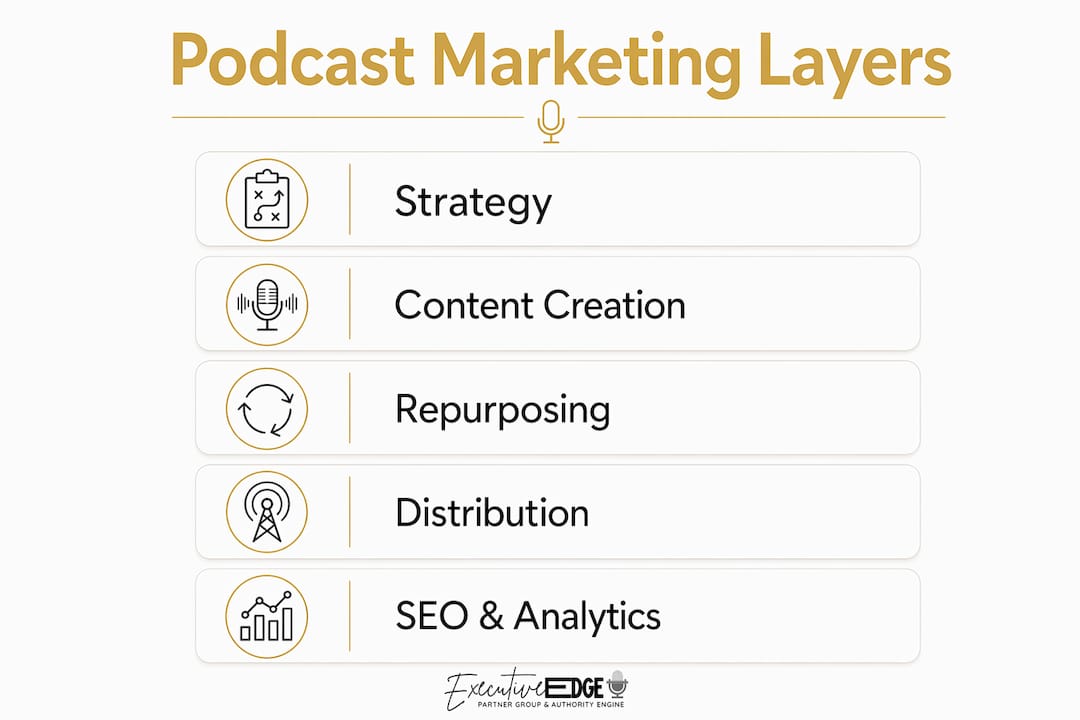
Podcast marketing functions best as a five-layer system that combines owned audio content with paid promotion, extending reach and feeding traffic back into your funnel. Each layer depends on the others. Skip one, and the whole system underperforms.
The five layers are:
- Content creation: Producing a long-form episode plus all the repurposed assets that come from it
- Multi-platform distribution: Publishing your episode and its derivative content across every channel your audience uses
- Guest amplification: Structuring each guest appearance so their audience becomes yours
- Podcast SEO: Making your episodes findable through text-based assets like transcripts and show notes
- Email list building: Converting listeners into subscribers and subscribers into customers
Most business owners treat podcasting as content creation alone. That is the most common reason podcasts stall after 20 episodes. The content is good, but the system around it is missing. Without distribution, SEO, and email capture working together, even a well-produced show stays invisible.
Pro Tip: Build your promotion workflow before you record your first episode. Decide where each asset will be published, who will share it, and how it will capture email addresses. Starting with the system in place means every episode works harder from day one.
The five-layer model also protects against burnout. When promotion is systematized, you are not reinventing the wheel after every recording session. You follow a repeatable process, and the results compound over time.

How repurposing and distribution multiply your reach
Turning one episode into 31+ assets distributed across eight or more platforms is the core of effective podcast promotion. That number sounds large until you break it down.
A single 45-minute interview episode can produce:
- The full audio episode published to Spotify, Apple Podcasts, and Amazon Music
- A full-length YouTube video upload
- Three to five short video clips (vertical format for Instagram Reels, TikTok, and YouTube Shorts)
- Three audiograms for Twitter and LinkedIn
- A long-form blog post adapted from the episode transcript
- A newsletter edition summarizing the episode's top insights
- Five to ten social media text posts pulling direct quotes or key moments
- A guest promotion kit with pre-written captions and shareable links
Planning repurposing before recording by marking moments for clips yields a more efficient promotion workflow. During the recording, note timestamps for three moments that would work as standalone 30–60 second clips with a clear hook. That simple habit cuts post-production time significantly.
Pro Tip: Create a guest promotion kit for every episode. Give your guest pre-written captions, a short audiogram, and a direct link to the episode. Guests who receive ready-to-post assets share far more often than those who receive a generic "episode is live" email.
Platform-native content outperforms repurposed content that ignores format. A vertical video clip edited for Instagram Reels performs better than a horizontal clip uploaded without adjustment. Repurposing into native formats like audiograms and routing traffic into email newsletters are proven promotional levers. Paid promotion plays a supporting role here. It amplifies content that already performs organically. It does not replace the organic foundation.
What role does podcast SEO play in discoverability?
Podcast SEO is the practice of making audio content findable through text-based signals that search engines and AI platforms can read. Search engines cannot listen to audio. That single fact defines the entire SEO strategy for podcasters.
| SEO element | What it does | Why it matters |
|---|---|---|
| Crawlable transcript | Gives search engines text to index | Enables snippet extraction and keyword matching |
| Episode-specific page | Creates a stable URL for each episode | Consolidates ranking signals to your domain |
| Structured metadata | Adds PodcastEpisode schema markup | Improves AI and voice search discoverability |
| Detailed show notes | Provides keyword-rich context | Supports internal linking and back catalog discovery |
| Canonical URL | Prevents ranking signal dilution | Keeps authority on your site, not a third-party host |
Each episode needs its own dedicated page with a stable URL, title, description, and crawlable transcript. Without that page, your episode exists only inside podcast apps. It earns no Google ranking, no AI citation, and no organic traffic.
Canonical linking consolidates ranking to the owner's site rather than splitting authority across Spotify, Apple Podcasts, and your own domain. This is a technical detail most podcasters miss entirely. The result is that their best episodes rank for the podcast platform, not for their own website.
Starting SEO tasks during ideation rather than after recording improves indexing speed and social hook performance. Choosing your episode title and primary keyword before you record means your show notes, transcript headers, and social captions all align from the start. That alignment is what builds layered relevance across your back catalog over time. For a deeper look at how transcripts and structured metadata work together, the guide on podcast local visibility covers the technical setup in practical terms.
How do you measure podcast marketing effectiveness?
Downloads are a misleading metric. A download means a file was requested. It does not mean anyone listened. Marketers who optimize for downloads end up chasing a number that has no direct connection to business outcomes.
The metrics that actually matter are:
- Completion rate: The percentage of listeners who finish an episode. An 80%+ completion rate signals that your content resonates and holds attention.
- Listen-through rate: How far into an episode the average listener gets before dropping off
- Email subscriber growth: New subscribers attributed to podcast calls to action
- Ratings and reviews: Qualitative signals of audience trust and satisfaction
- Listener survey responses: Direct feedback on topics, format, and guest preferences
An 80% completion rate is a meaningful benchmark. It means four out of five listeners who start an episode finish it. That level of engagement is rare in any content format and signals genuine authority in your niche.
Dashboards often show vanity metrics that do not improve decision-making. Total downloads, total plays, and follower counts look impressive in reports but tell you nothing about whether your podcast is building trust or driving conversions. Replace those with completion rate, email growth, and direct revenue attribution.
Paid podcast advertising works best as an amplifier rather than a shortcut. Run paid promotion only after your organic metrics show strong engagement. Spending money to amplify an episode with a 40% completion rate accelerates failure. Spending money to amplify an episode with an 85% completion rate accelerates growth.
What I've learned about podcast marketing that most guides skip
Most podcast marketing advice focuses on tactics. Record consistently. Post on social media. Get guests. That advice is not wrong. It is just incomplete.
The businesses I see build real authority through podcasting share one habit: they systematize promotion before they record. They know exactly what will happen to each episode before the microphone turns on. The guest kit is templated. The blog post structure is ready. The email sequence is written. Recording is the last step, not the first.
The second thing most guides skip is the role of email. Social media distributes your content. Email converts your listeners. A podcast without an email capture strategy is a brand awareness tool with no conversion path. Every episode should drive listeners to a specific opt-in, whether that is a free resource, a checklist, or a newsletter. That list is the asset that outlasts any algorithm change.
Guest amplification is also underused. Most hosts send a guest a link and hope for a share. The hosts who grow fastest send a complete kit: a pre-written LinkedIn post, a vertical video clip, a quote graphic, and a direct message template. Guests share what is easy to share. Make it easy.
For businesses building authority in niche markets, podcasting has an advantage that no paid ad can replicate. A 45-minute conversation positions you as a peer to your guest and a trusted voice to your audience. That positioning compounds. Each episode adds to a body of work that search engines index, AI platforms cite, and potential clients find months or years later. The authority-building potential of podcast hosting is one of the most underrated long-term assets in professional marketing.
Patience is not optional here. The system takes three to six months to show compounding results. Businesses that quit at episode 15 never see what episode 40 would have built.
— David Domm
How Executive Edge Partner Group supports your podcast marketing strategy
Executive Edge Partner Group works with business owners, consultants, and local brands who want a complete podcast marketing system without managing every moving part themselves.

The team at Executive Edge Partner Group handles content repurposing, multi-platform distribution, SEO setup, and guest amplification workflows so each episode reaches its full potential. The focus is on building long-term authority and discoverability across Google, YouTube, and AI search platforms. If you are ready to turn your expertise into a content system that works consistently, visit Executive Edge Partner Group to see how the authority engine works for service-based businesses and local brands.
FAQ
What is podcast marketing?
Podcast marketing is the practice of promoting a brand through audio content combined with multi-channel distribution, SEO, and email audience building. It works as a system, not a single tactic.
How many assets can one podcast episode produce?
A single episode can produce 31 or more marketing assets, including video clips, audiograms, blog posts, social captions, and newsletter editions distributed across eight or more platforms.
Why do downloads not measure podcast success?
Downloads only confirm a file was requested, not that anyone listened. Completion rate, listen-through rate, and email subscriber growth are more reliable indicators of real engagement and business impact.
How does podcast SEO work?
Podcast SEO relies on text-based assets like transcripts, show notes, and episode-specific web pages with structured metadata. Search engines cannot index audio, so crawlable text is the only way to rank in Google or appear in AI search results.
When should paid podcast advertising start?
Paid promotion should start only after organic metrics show strong engagement, particularly completion rates above 80%. Paid amplification accelerates what already works organically. It does not fix weak content or low retention.