

Blogging builds trust by giving potential customers genuine, useful answers before they ever contact you. A well-maintained blog positions your business as the expert who helped them understand their problem, not just another company competing for their wallet. The most effective blogs in 2026 do something ads simply cannot: they educate before selling, creating a relationship built on demonstrated knowledge rather than promotional claims. For business owners in Tyler and East Texas, that distinction often determines who wins the customer and who gets ignored.
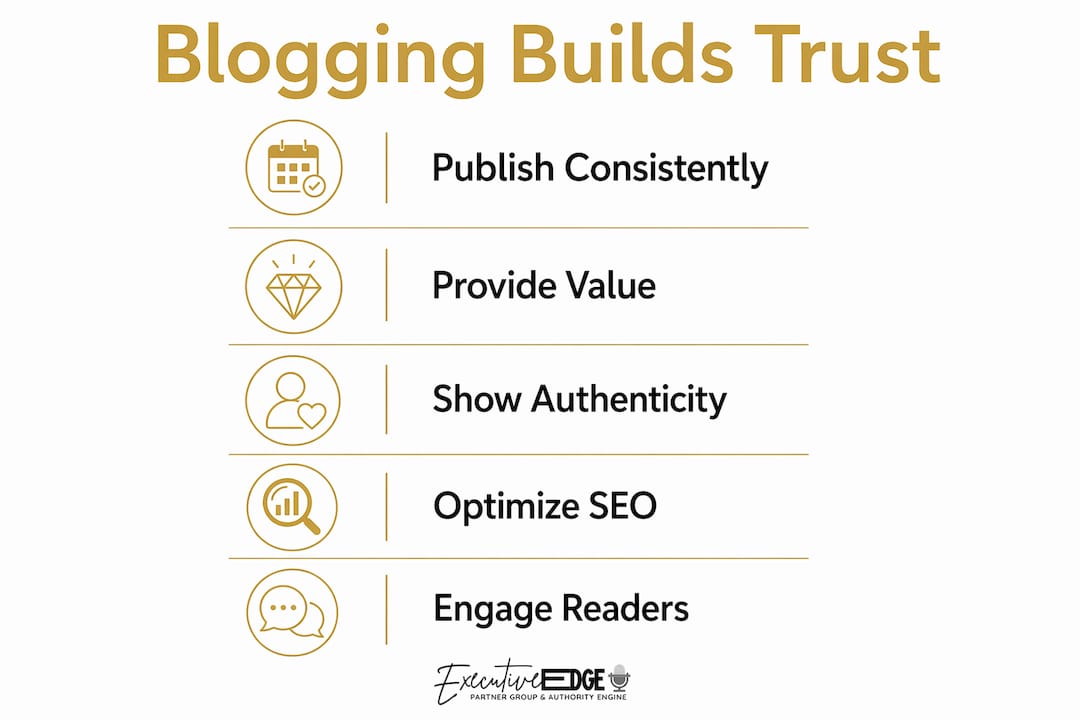
The core trust-building elements in a successful blog:
- Value over promotion: Answer real questions your customers are already asking
- Authenticity: Share first-hand experience, case studies, and honest perspectives
- Consistency: Publish regularly so readers know you are reliably present
- SEO and AI visibility: Deep, specialized content earns citations from AI-driven search
- Relationship building: Engage readers over time, not just at the point of sale
Table of Contents
- Why providing value matters more than traditional selling
- Showing versus telling: how authentic content creates real credibility
- How blogging powers SEO and AI-driven search in 2026
- Why consistent publishing builds lasting brand authority
- How Executive Edge Authority Engine helps you build trust at scale
- Strategies for engaging readers and encouraging interaction
- How to measure whether your blog is actually building trust
- Common blogging mistakes that erode trust and how to avoid them
- Executive Edge Partner Group builds your authority without the grind
- FAQ
Why providing value matters more than traditional selling
Customers in 2026 are skeptical of ads and have learned to tune out promotional messaging fast. What they respond to is a business that helps them solve a problem without immediately asking for something in return. A blog does exactly that.
When you publish how-to guides, FAQ posts, and educational breakdowns of your industry, you remove the friction that stops people from buying. They arrive uncertain; they leave confident. That confidence transfers directly to your brand.
Effective value-driven content types include:
- How-to guides that walk readers through a process step by step
- FAQ posts that address the questions your sales team answers every day
- Educational articles that explain industry concepts in plain language
- Comparison posts that help readers make informed decisions
Transparent, helpful blogging consistently outperforms promotional content in earning consumer confidence. The business that taught someone how to solve their problem becomes the obvious choice when that person is ready to buy.
Showing versus telling: how authentic content creates real credibility
Polished sales copy tells readers you are great. A detailed case study, a behind-the-scenes process breakdown, or an honest account of a project challenge shows them. The difference in credibility is not subtle.
Authentic storytelling connects emotionally in a way that marketing copy cannot replicate. When readers see real experience on the page, they trust the author because the content feels earned, not manufactured.
Practical ways to show rather than tell:
- Case studies with specific outcomes and honest context
- Process walkthroughs that reveal how you actually work
- Industry observations based on your direct experience
- Lessons learned from real projects, including what went wrong
Expert authorship amplifies this effect. Readers share and link to content from people they trust. When company leaders write under their own names and share from personal experience, the blog gains authority that anonymous marketing copy never achieves.
How blogging powers SEO and AI-driven search in 2026
AI search platforms like Google AI Overviews and ChatGPT pull answers from content they consider authoritative. Thin, generic blog posts rarely make that cut. Deep, specialized content built around real expertise does.
Blogging forms a core part of Generative Engine Optimization (GEO), the practice of structuring content so AI systems cite and surface it in generated results. Businesses with substantial, specialized blog archives are far more likely to appear in those results than competitors with sparse content.
Unlike paid ads, a blog compounds its value over time. A post published today can attract traffic, answer questions, and generate leads for years. Ads stop the moment you stop paying. Your blog keeps working.
Pro Tip: Link your blog posts to related internal resources on AI search strategy. Readers who find one useful article often explore deeper, and internal linking signals topical authority to search engines. Check out this guide on AI search discovery for a practical starting point.
Why consistent publishing builds lasting brand authority
Regular publishing signals that your business is active, engaged, and committed to its audience. A blog with the last post dated a long time ago tells a different story than one updated regularly and frequently.
Consistency does something subtler too: it trains your audience to expect value from you. When readers know new content is coming, they return. Returning readers become familiar with your thinking. Familiarity becomes trust.
Practical consistency strategies:
- Build a content calendar at least one month ahead
- Mix short updates with deeper long-form posts to balance output with depth
- Use series-based content to guide readers through multi-step topics over time
- Publish quality articles regularly rather than chasing volume
Consistent content publishing correlates with stronger lead generation, better customer retention, and measurable growth in brand authority. The cadence matters as much as the quality.
How Executive Edge Authority Engine helps you build trust at scale
Most business owners know they should be blogging. The problem is time, not intention. Executive Edge Authority Engine solves that by turning your existing expertise into published, optimized content without requiring you to become a full-time writer.
The system takes what you already know and transforms it into blog articles, podcast episodes, YouTube videos, and social media content, all built around SEO, GEO, and AEO strategies. That means your knowledge reaches Google, AI search platforms, and local results simultaneously.
Key capabilities of the Executive Edge Authority Engine:
- AI-assisted content workflows that reduce production time without sacrificing depth
- Voice and video cloning technology for multi-format content at scale
- Multi-platform publishing across blogs, podcasts, YouTube, and social channels
- Local market positioning for service-based businesses and professionals
- Authority positioning campaigns designed for long-term credibility, not short-term traffic spikes
The system is built specifically for service businesses, consultants, attorneys, medical professionals, contractors, and executives who need authority content but cannot afford to produce it manually every week.
Strategies for engaging readers and encouraging interaction
A blog that nobody responds to is a missed opportunity. Engagement turns passive readers into active community members, and community members into loyal customers.

The most effective engagement strategy is also the simplest: respond to every comment, promptly and specifically. When readers see that a real person is listening, they come back and bring others.
Additional engagement tactics that work:
- Ask a direct question at the end of each post to invite comments
- Invite topic suggestions so readers shape future content
- Use series-based posts that give readers a reason to return for the next installment
- Share posts across social channels with a specific angle or question to spark conversation
Content that reflects real-world experience rather than generic advice generates more responses. Readers engage when they feel the author actually understands their situation. Generic content gets skimmed and forgotten.
How to measure whether your blog is actually building trust
Traffic numbers tell you reach. Trust shows up in different metrics. Watch for these signals that your blog is doing its real job:
| Metric | What it signals |
|---|---|
| Return visitor rate | Readers found value and came back |
| Time on page | Content held attention long enough to be read |
| Comment volume | Readers felt engaged enough to respond |
| Lead quality | Prospects arrive pre-educated and ready to buy |
| Referral traffic | Other sites trust your content enough to link it |
| Sales cycle length | Educated buyers close faster |
A shorter sales cycle is one of the clearest trust signals a blog can produce. When prospects arrive already familiar with your thinking and your process, the conversation starts further along. Your sales team stops re-explaining the basics and starts closing.
Track these metrics monthly. Trends over three to six months reveal whether your content strategy is compounding or stalling.
Common blogging mistakes that erode trust and how to avoid them
Publishing consistently matters, but publishing the wrong way actively damages credibility. These mistakes are more common than most business owners realize.
Writing only about yourself. Posts that read like press releases push readers away. Every article should answer a question the reader actually has, not celebrate your latest award.
Inconsistent publishing. A blog that goes silent for months signals neglect. Readers interpret gaps as a sign the business is struggling or disengaged. A modest, reliable cadence beats sporadic bursts.
Ignoring visual quality. Amateur blog design undermines even excellent content. Poor typography, cluttered layouts, and low-quality images signal an unprofessional operation before anyone reads a word.
Generic, surface-level content. Posts that could have been written by anyone about any business in any industry add no credibility. Specificity, first-hand experience, and genuine depth are what separate trusted sources from noise.
No author attribution. Anonymous content feels corporate and distant. Named authors with visible credentials and real perspectives build the kind of personal trust that drives referrals.
Avoiding these mistakes is not complicated. It requires treating your blog as a professional asset, not an afterthought. The businesses that do that consistently are the ones readers recommend.
Executive Edge Partner Group builds your authority without the grind
Most business owners have the expertise. What they lack is the system to publish it consistently, across the right channels, in a format that AI search and Google actually reward.
Executive Edge Partner Group delivers that system. Rather than spending your evenings writing blog posts, you contribute your knowledge and the platform handles production, optimization, and distribution across blogs, podcasts, video, and social media. The result is a growing library of authority content that works for you around the clock, compounding reach and credibility over time.

This is not a generic content mill. The Authority Engine platform is built specifically for service businesses, consultants, professionals, and local brands that need to be found and trusted online. If you are ready to turn your expertise into a long-term trust asset, visit Executive Edge Partner Group to get started.
FAQ
Why does blogging build trust more effectively than ads?
Blogging educates before selling, creating familiarity and credibility that ads cannot replicate. Readers who learn from your content associate your brand with expertise, not interruption.
How often should a business publish blog posts to build trust?
Consistency matters more than frequency. Publishing one or two quality articles per month builds trust reliably, as long as the cadence stays predictable and the content stays genuinely useful.
Does blogging help with AI search results in 2026?
Yes. Specialized, authoritative blog content is a core input for Generative Engine Optimization (GEO), and businesses with deep content archives are more likely to be cited in AI-generated search results.
What types of blog content build the most credibility?
Educational articles, how-to guides, case studies, and FAQ posts consistently outperform promotional content in building reader trust, because they prioritize the reader's needs over the business's sales goals.
How can Executive Edge Partner Group help with trust-building content?
Executive Edge Partner Group's Authority Engine turns your existing expertise into optimized, multi-format content published consistently across blogs, podcasts, and social channels, without requiring you to write everything yourself.