

Online trust is built through a layered combination of demonstrable reputation, professional visual signals, visible security, consistent social proof, and sustained topical content distributed across platforms. That is the short answer. The longer one is that trust is hierarchical: a meta-synthesis of 89 empirical studies across 67,843 participants found that reputation and information accuracy are the strongest predictors, followed by security and transparency, with social proof as a critical support layer.
Two numbers frame the priority order clearly:
- 75% of users judge a company's credibility based directly on website design quality.
- First impressions form in under 50 milliseconds, meaning visitors decide whether to stay before they read a single word.
Start with quick design and accuracy fixes. Add security badges and social proof next. Then build the content engine that proves, rather than just claims, your expertise.
Stat to know: The 2026 synthesis of 89 studies places reputation and accuracy at the top of the trust hierarchy, above security, above reviews. Fix what you say before you ask anyone to believe it.
Table of Contents
- What are the six pillars of online trust?
- Why does visual design shape credibility so fast?
- How do reputation and accuracy become visible proof?
- What security and transparency signals do customers actually look for?
- How do you collect and display social proof that actually converts?
- What content strategy builds topical authority for AI-era discovery?
- Which technical UX signals keep visitors engaged and build trust?
- How do you measure trust, and what timelines are realistic?
- How do you scale trust-building without hiring full-time staff?
- How trust actually develops for small professional brands
- The Authority Engine: a done-for-you path to scale trust
- FAQ
- Selected sources and further reading
What are the six pillars of online trust?
Building digital credibility follows a clear priority order. Here are the six pillars, ranked by strategic impact:
- Reputation and information accuracy — Verified credentials, factual claims, and transparent outcomes. The meta-analytic evidence puts this first.
- Visual design and first impressions — Clean, professional presentation that signals competence before a visitor reads anything.
- Security and transparency — HTTPS, payment badges, plain-language privacy policies, and visible contact information.
- Social proof and third-party validation — Verified reviews, media mentions, case studies, and customer counts.
- Content strategy and topical authority — Educational, POV-led content published consistently across owned and third-party channels.
- Technical UX and accessibility — Core Web Vitals, mobile-first layouts, accessible navigation, and fast load times.
Quick prioritization: In the first 30 days, fix design and accuracy. By day 90, add security signals and begin collecting reviews. Between months 6 and 12, build topical authority through distributed content.
Why does visual design shape credibility so fast?
First impressions form in under 50 milliseconds. That means your hero section, typography, and color palette are doing trust work before your headline lands. Professional web design is not a vanity investment; it is the first filter visitors apply.
Stat: 75% of users base credibility judgments on website design quality alone.
Quick-win checklist:
- Clean hero area with a clear value statement
- Consistent typography (two fonts maximum)
- Visible phone number, email, and physical address
- Mobile-first layout that loads in under 3 seconds
- No broken images, expired promotions, or intrusive pop-ups
- Accessible color contrast ratios
A non-designer can run a credibility audit in under an hour: open your site on a phone, screenshot the homepage, and ask three people who don't know your business what you do and whether they'd trust you with their credit card. Their hesitations are your fix list.
Pro Tip: Run a simple A/B microtest on your hero section. Change only the headline and the primary image, send equal traffic to both versions for two weeks, and measure bounce rate and contact-form submissions. Even a 5% improvement in bounce rate compounds significantly over a year.
How do reputation and accuracy become visible proof?
Reputation is not what you say about yourself. It is what verifiable evidence says about you. The meta-analytic hierarchy places reputation and accuracy above every other trust signal, which means a polished site with vague claims still loses to a plainer site with documented results.
Reputation checklist:
- An About page with named team members, real photos, and specific credentials
- Author bios that include role, measurable outcomes, and verifiable affiliations
- Case studies with specific before/after metrics, not just "we helped a client grow"
- Transparent pricing or at minimum a clear explanation of how pricing works
- Visible office address and direct contact options
A strong author bio follows this structure: current role + one measurable outcome + one verifiable credential + a short client category list. Linking to a LinkedIn profile or a published third-party mention adds another layer of verification that visitors can check independently.
Cite third-party studies when you make claims. Link to industry standards. Avoid phrases like "industry-leading" unless you can point to a named ranking that says so.
What security and transparency signals do customers actually look for?
Security is a hygiene factor. Visitors expect it; they notice its absence. Security worries are a material cause of checkout abandonment, and payment badges near CTAs directly reduce that friction.
Security checklist:
- HTTPS on every page, not just checkout
- Payment badges (Visa, Mastercard, PayPal, or your processor's mark) near purchase buttons
- PCI DSS or SOC 2 references where applicable to your business type
- A plain-language privacy policy that answers three questions: what you collect, why, and how to opt out
- Cookie consent management that is functional, not just decorative
- Simple data-access controls so users can request or delete their information
Place security badges and guarantee seals directly adjacent to your primary CTA buttons, not buried in the footer. Visitors scan for them at the moment of decision.
Pro Tip: Write a one-paragraph privacy summary and place it above your full policy. It should answer: "We collect X, we use it for Y, and you can opt out by doing Z." Most visitors will never read the full policy, but they will read 60 words.
How do you collect and display social proof that actually converts?
Authentic third-party signals reduce perceived risk faster than any first-party claim. Social proof works because it shifts the credibility burden from you to your customers.
Step-by-step collection plan:
- Ask for reviews within 48 hours of a completed project or purchase, when satisfaction is highest.
- Aggregate reviews from Google, LinkedIn, and any industry-specific platform relevant to your niche.
- Request short video testimonials from your top three clients. A 60-second phone video beats a polished studio testimonial for authenticity.
- Display real-time activity notifications (recent purchases, new sign-ups) on high-traffic pages where appropriate.
- Respond to every negative review within 24 hours. Acknowledge the issue, offer a resolution path, and keep the tone professional. A handled complaint often builds more trust than a perfect score.
A strong testimonial format: client role (not company name) + the specific problem they had + the measurable result. "Our organic traffic grew 40% in 90 days" is more persuasive than "Great service, highly recommend."
What content strategy builds topical authority for AI-era discovery?
Trust is earned by useful, evidence-backed content that demonstrates a real point of view and appears across owned and third-party channels. Topical authority in the AI search era requires three layers: a foundational on-site content base, a distinct POV that separates you from generic information, and off-site proof that confirms the brand-topic association.
Content formats that build authority:
- Long-form hub pages that answer the primary question in your niche completely
- Case studies with specific metrics (not just "we helped a client")
- Short-form explainer videos (60–90 seconds) on YouTube and social channels
- Podcast episodes that demonstrate practitioner-level depth on a recurring basis
- How-to guides with numbered steps and specific thresholds
Distribution checklist:
- Publish hub and supporting cluster pages on your site.
- Syndicate podcast clips and YouTube shorts to LinkedIn and Instagram.
- Secure guest contributions or editorial mentions on third-party sites.
- Repurpose your strongest proof points (a specific result, a proprietary observation) across every channel so AI systems encounter the same brand-topic association repeatedly.
A "signature proof point" is a repeatable result or proprietary observation that others will cite. It might be a specific percentage improvement you've achieved consistently, or a named framework you've developed. Once you have one, build content around it across every channel. Educational content that genuinely helps without immediately selling is what compounds into long-term authority.
Which technical UX signals keep visitors engaged and build trust?
Speed, mobile friendliness, and accessible navigation are not optional. They are trust signals that search engines and AI discovery platforms both measure.
Technical checklist:
- Core Web Vitals: Largest Contentful Paint under 2.5 seconds, Cumulative Layout Shift under 0.1, Interaction to Next Paint under 200ms
- Mobile-first layout verified on actual devices, not just browser emulation
- Clear CTA flows with no more than two steps to contact or purchase
- Descriptive alt text on all images
- Logical heading hierarchy (H1 → H2 → H3) for screen readers and AI parsers
- Contact and lead forms with minimal required fields
| Technical signal | What to monitor | Recommended tool |
|---|---|---|
| Core Web Vitals | LCP, CLS, INP scores | Google Search Console |
| Uptime | — | UptimeRobot |
| Broken links | Zero tolerance | Screaming Frog |
| Mobile usability | No viewport errors | Google Mobile-Friendly Test |
| Accessibility | WCAG AA | WAVE or axe DevTools |
Schedule quarterly accessibility reviews. Image compression and server-level caching are two of the fastest wins: they cost almost nothing and visibly improve perceived professionalism.

How do you measure trust, and what timelines are realistic?
| KPI | What it indicates | Sample target |
|---|---|---|
| Conversion rate | Visitors taking desired action | 2–5% for service pages |
| Review velocity | Rate of new verified reviews | 2–4 new reviews per month |
| Average review rating | Aggregate sentiment | — |
| Organic/referral traffic | Content authority compounding | growth over several months |
| Citation/mention count | Third-party brand-topic association | 5+ new mentions per quarter |
| SERP/AEO visibility | AI and search engine presence | Tracked via Search Console |
Timeline expectations:
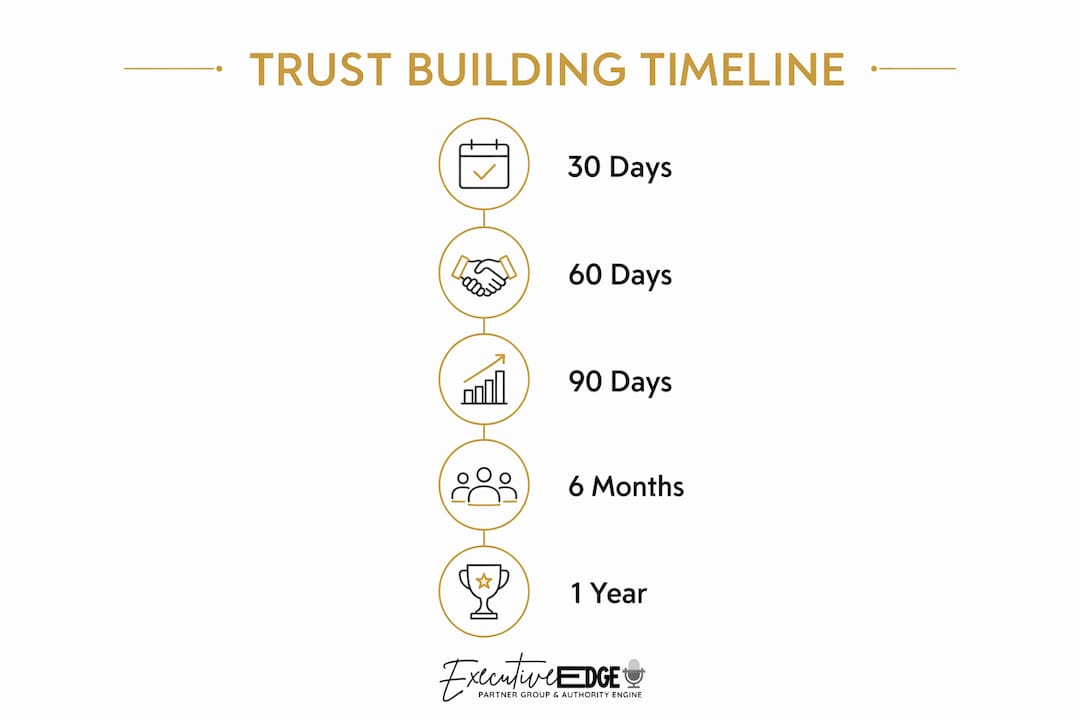
- 30 days: Design fixes, accuracy updates, security badges live, first review requests sent.
- 90 days: Foundational content published, review velocity established, social proof displayed.
- 6–12 months: Topical authority visible in organic traffic, AI citations, and referral mentions.
Budget shapes vary. A DIY approach using tools like Google Search Console, Canva, and a review aggregator runs under $200/month but demands significant time. A hybrid agency project for design and content setup typically runs $2,000–$5,000 as a one-time investment. A fully managed retainer covering content production, distribution, and KPI tracking ranges from $1,500–$5,000+ per month depending on output volume and scope.
How do you scale trust-building without hiring full-time staff?
A managed system handles the production, distribution, and measurement so you focus on your actual business. Here is what a credible vendor should deliver:
- A documented editorial calendar with at least 30 days of planned content
- Multi-format production: podcast, video, blog, and short-form social in one workflow
- A proof distribution plan that includes third-party channels, not just your own site
- A KPI dashboard you can read without a data analyst
- Quarterly strategy reviews tied to measurable outcomes
Red flags when evaluating partners:
- No measurable KPIs in the proposal
- Opaque reporting with no access to raw data
- Promises of first-page rankings within 30 days
- One-size-fits-all content with no industry or audience specificity
- No clear ownership of content assets if you cancel
Before signing, confirm three things in writing: the deliverables cadence (what ships each week), who owns the content assets, and the cancellation terms. A reputable partner has no problem putting all three in the contract.
How trust actually develops for small professional brands
The path for most small professional brands follows a predictable sequence. They fix the obvious credibility gaps first: an outdated About page, no reviews, a site that looks like it was built in 2014. Then they start producing content and realize that consistency matters more than volume. The brands that build durable authority are the ones that commit to a point of view and distribute it repeatedly across channels, not the ones that publish 30 blog posts and go quiet.
This is something we see consistently with businesses in Tyler and East Texas: the professionals who invest in accuracy and distributed proof before expensive advertising campaigns outperform those who chase reach without a credibility foundation. Get the evidence right first. Then amplify it.
The Authority Engine: a done-for-you path to scale trust
Most business owners know what they need to do to build authority. The problem is time. Executive Edge Partner Group's Authority Engine is built for service-based business owners, consultants, and local professionals who want the full trust-building system without managing it themselves.
The system delivers weekly podcast production, blog articles, YouTube videos, short-form social content, AEO and GEO-focused optimization, AI-assisted distribution, and a KPI dashboard that shows exactly where your visibility and trust signals stand. No hiring, no editorial juggling. You show up as the expert; the system handles the rest.
If you are ready to stop being the best-kept secret in your market, start here.
FAQ
How long does it take to build online trust?
Quick wins like design fixes and security badges take 30 days. Foundational trust, including verified reviews and accurate content, is visible within 90 days. Topical authority that shows up in organic search and AI citations typically takes 6–12 months of consistent effort.
What is the single most important trust signal for a website?
According to a meta-synthesis of 89 empirical studies, reputation and information accuracy rank above all other trust signals, including security and social proof. Fix what you claim before you ask anyone to believe it.
How do reviews affect online trust?
Verified reviews from real customers reduce perceived risk and confirm your claims from a third-party perspective. Responding to negative reviews promptly and professionally often builds more credibility than a perfect rating.
Can a small business build trust without a large content team?
Yes. A managed, done-for-you system like Executive Edge Partner Group's Authority Engine handles multi-format content production, distribution, and KPI tracking without requiring an in-house team.
What KPIs should I track to measure trust improvements?
Track conversion rate, review velocity, average review rating, organic and referral traffic growth, citation counts, and SERP or AEO visibility. Review them monthly against the 90-day and 6-month benchmarks in your plan.
Selected sources and further reading
| Source | Why it matters | Where applied |
|---|---|---|
| Consumer Trust: Systematic Review (89 studies) | Meta-analytic hierarchy of trust determinants | Pillars overview, BLUF, measurement |
| NotiProof: Website Trust Guide | 75% design stat, trust signal categories, badge placement | BLUF, design section, security section |
| First Impressions Study (Taylor & Francis) | Sub-50ms first impression evidence | Visual design section |
| Backlinko: Topical Authority in AI Search | Three-layer topical authority pyramid | Content strategy section |
| Webbiquity: Content Authority Guide | Educational content formats and cadence | Content strategy, scaling section |
| Vineesh Rohini: Trust Guide 2026 | Practical playbook covering UX, security, and monitoring | Technical UX, measurement sections |
| Small Business Currents: Online Trust | Practical trust-building for online businesses | Social proof, transparency sections |