

Authentic, consistent, and transparent content is the most reliable way to build community trust. Not polished press releases. Not promotional campaigns. The content that earns real trust addresses what your community actually cares about, speaks honestly about limitations, and shows up reliably over time. The 5 Cs of Trust — Competence, Communication, Commitment, Caring, and Character — give you a practical framework for every piece of content you create. When those five qualities show up consistently in your messaging, people stop seeing you as an institution and start seeing you as a resource they can count on.
Key approaches that work:
- Storytelling: Real stories from real community members carry more weight than any official statement.
- Transparency: Acknowledge what you don't know and what hasn't worked yet.
- Two-way communication: Ask questions, respond to feedback, and close the loop publicly.
- Consistent publishing: Regular content signals reliability, not just effort.
- Trusted partnerships: Amplify voices your community already respects.
Practical strategies to build community trust through content
The most effective trust-building content starts with a simple question: what does your community actually need to know right now? Not what you want to announce. Educational content that addresses real questions — costs, trade-offs, comparisons, and honest assessments of what works and what doesn't — consistently outperforms promotional messaging in building credibility. Expert Tom Wardman identifies this approach as the foundation of trusted brand content, noting that addressing cost, potential problems, and honest comparisons earns far more trust than polished marketing claims.
Consistency matters as much as quality. Communities need to hear and see information multiple times before it fully registers, which means a single well-crafted post does far less than a steady stream of clear, relevant updates. Publishing on a predictable schedule signals that you're reliable, not just reactive. Think of it as showing up the same way a trusted neighbor does: regularly, without fanfare, and with something useful to say.
Storytelling and transparency work together in a way that neither does alone. When you share a story about a real challenge your community faced and what you learned from it, you create connection. When you pair that story with honest data or a frank acknowledgment of what didn't go as planned, you build credibility. The combination is what community engagement research consistently points to as the difference between participation and passive observation.
Two-way feedback is where most organizations fall short. Publishing content is one thing. Actively inviting responses, reading them, and then visibly acting on what you heard is another. Co-creation opportunities — where community members help shape the content itself — go even further. When people see their input reflected in what you publish, they become invested in your message rather than just exposed to it.
- Create content that answers real questions, not just organizational priorities.
- Publish on a consistent schedule your audience can anticipate.
- Use storytelling paired with honest data to build both connection and credibility.
- Invite feedback through surveys, comment sections, and open forums.
- Highlight community voices and co-created content alongside your own.
Pro Tip: Strike a balance between professional polish and genuine empathy. Over-produced content often reads as distant and corporate. A conversational tone, even in formal communications, keeps your audience engaged and signals that real people are behind the message.
What gets in the way of community trust, and how to fix it
The most common trust barriers aren't dramatic failures. They're quiet, cumulative patterns that erode confidence over time. Inconsistent communication is one of the biggest. When your messaging changes tone, frequency, or focus without explanation, people fill the gap with skepticism. Lack of transparency compounds this quickly, especially when communities sense that difficult information is being withheld or softened.
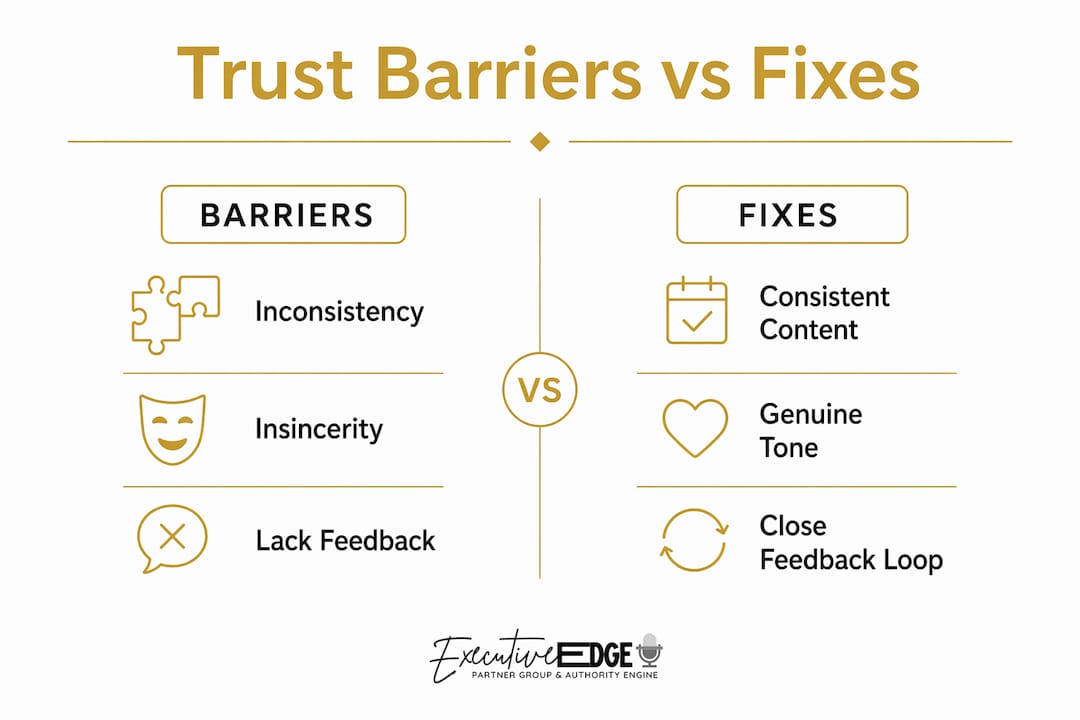
Perceived insincerity is harder to diagnose but just as damaging. It shows up when content feels performative — when organizations talk about listening but never visibly act on what they heard. Cultural misunderstandings create a different kind of barrier: content that doesn't reflect the language, values, or lived experience of specific community segments signals exclusion, even when that's not the intent. Ignoring feedback, even unintentionally, sends the same message.
| Barrier | Why it erodes trust | Practical fix |
|---|---|---|
| Inconsistent communication | Creates confusion and signals unreliability | Publish on a set schedule; use consistent tone and terminology |
| Lack of transparency | Breeds suspicion about hidden agendas | Share limitations, setbacks, and decision rationale openly |
| Perceived insincerity | Makes engagement feel performative | Close feedback loops publicly; show how input shaped decisions |
| Cultural misunderstandings | Signals exclusion to specific groups | Tailor language, imagery, and examples to each community segment |
| Ignoring feedback | Discourages future participation | Acknowledge all feedback; report back on what changed as a result |
Closing the feedback loop is the single most underused fix. When a community member submits a suggestion or raises a concern, they're watching to see what happens next. A public summary of what was heard and what changed as a result — even when the answer is "we couldn't implement this, and here's why" — does more for trust than any polished announcement. The Philadelphia Equitable Community Engagement Toolkit frames this as a core obligation: communities need to see that their participation produced something real.
Ongoing commitment is what separates organizations that build trust from those that merely attempt it. One transparent post doesn't undo years of inconsistency. Trust accumulates through repeated, reliable follow-through.
How trusted messengers and partnerships strengthen your content
People trust people before they trust institutions. That's not cynicism — it's how community credibility actually works. A message delivered by a respected local figure, a neighborhood association leader, or a subject matter expert carries weight that the same message from an official channel often doesn't. Identifying and working with trusted messengers is one of the highest-leverage moves available to any community leader or public information officer.

Trusted messengers include community leaders, local clergy, school principals, business owners, and subject matter experts who already have the confidence of the people you're trying to reach. Partnerships with community organizations — libraries, nonprofits, neighborhood associations, faith communities — extend your content's reach into networks you can't access on your own. These partnerships also lend authenticity that institutional content struggles to generate independently.
The key is selecting partners whose values and credibility align with your message. A partnership that feels transactional undermines the trust you're trying to build. The best collaborations are ones where the partner genuinely believes in what you're communicating and has a real stake in the outcome.
- Identify two or three community figures your audience already trusts and respects.
- Co-create content with partners rather than simply asking them to share yours.
- Give trusted messengers the flexibility to speak in their own voice, not yours.
- Acknowledge partnerships publicly to signal transparency about who is involved.
- Evaluate partners based on community alignment, not just reach or follower count.
What research says about content that actually builds trust
The evidence on trust-building content points in a consistent direction: personal connection and clear next steps matter more than production quality. Groups that prioritize face-to-face introductions and personal connection gestures see meaningfully higher member retention after six months. That same research shows that giving participants a clear next step immediately after their first interaction significantly increases the likelihood of repeat engagement.
Two-way feedback loops accelerate participation faster than almost any other tactic. When a Bristol youth club introduced a weekly open-mic format on Zoom, active participation grew substantially within a few weeks. The mechanism isn't complicated: people return when they feel heard, and they feel heard when the conversation is genuinely two-directional.
Stat to know: Offering a clear "next step" after a first event greatly increased the likelihood of repeat attendance, according to a 2022 report by the National Council for Voluntary Organisations.
Content that acknowledges limitations builds more trust than content that claims perfection. Educational, non-promotional content that honestly discusses trade-offs and potential problems consistently outperforms polished marketing in credibility studies. Named authorship and real data further strengthen perceived authority, both for human readers and for AI-driven search platforms that increasingly surface content based on authoritative signals like named experts and cited sources.
The Content Marketing Institute frames this as "community alchemy" — the process of turning audiences into loyal communities through connection, co-creation, and consistency. The organizations that pull it off treat their content as a platform for community voices, not a megaphone for their own.
Pro Tip: Create "community artifacts" — tangible outputs like published summaries, updated web pages, or visual reports that show exactly how community input shaped a decision. These artifacts prevent engagement from feeling like a performance and give participants something concrete to point to.
Why local context and consistency are the real trust multipliers
Most trust-building frameworks focus on tactics. The harder truth is that tactics without genuine local knowledge tend to fall flat. Communities can tell when content was written for a generic audience and then lightly adapted for them. The language feels slightly off. The examples don't quite fit. The concerns that matter most locally go unaddressed.
What actually works is content that reflects a real understanding of the specific people you're trying to reach. That means knowing which issues carry the most weight in your community, which communication channels your audience actually uses, and which voices they already trust. For business owners and community leaders in Tyler and East Texas, that local attunement isn't a nice addition to a content strategy. It's the foundation of one.
Consistency compounds over time in a way that single efforts never can. A community that sees the same organization show up reliably, month after month, with honest and relevant content starts to expect that reliability. Expectation becomes trust. Trust becomes the kind of loyalty that survives setbacks and disagreements. The benefits of consistent publishing aren't just about search rankings — they're about becoming the source your community reaches for first.
Leadership authenticity is the thread that holds it together. Content that reflects genuine care and honest communication signals character, which is one of the five foundational Cs of trust. When leaders are visibly present in their content — not hiding behind institutional language — communities respond.
Practical ways to integrate these elements daily:
- Review your content calendar monthly against actual community feedback and questions.
- Assign named authors to key content pieces to signal accountability and expertise.
- Track which topics generate the most questions and responses, then publish more of those.
- Set a publishing rhythm you can sustain for 12 months, not just the next quarter.
- Measure trust indicators like repeat engagement, direct feedback, and community referrals alongside standard metrics.
If you want a system that handles the consistency and authority-building side of this work without requiring you to become a full-time content creator, Executive Edge Partner Group builds that for you. The Authority Engine turns your expertise into educational content distributed across search, AI platforms, and local channels — so your community finds you first.

FAQ
What are the 5 Cs of building trust?
The 5 Cs of Trust are Competence, Communication, Commitment, Caring, and Character. Together, they form a framework for diagnosing and repairing trust gaps in any relationship or community context.
How do you build community trust?
Building community trust requires consistent, transparent communication that addresses real needs, closes feedback loops, and visibly acts on what the community shares. Showing up reliably over time matters more than any single well-crafted message.
How do businesses build trust through content?
Businesses build trust through educational, non-promotional content that honestly addresses costs, trade-offs, and limitations rather than leading with marketing claims. Named authorship and real data further strengthen credibility with both audiences and search platforms.
What are the 5 Cs of community engagement?
A widely used community engagement framework identifies Clarity, Consistency, Compassion, Creativity, and Closure as the five pillars of meaningful public engagement. Closure — giving participants something tangible that reflects their input — is the most commonly skipped and the most important for sustaining long-term participation.