

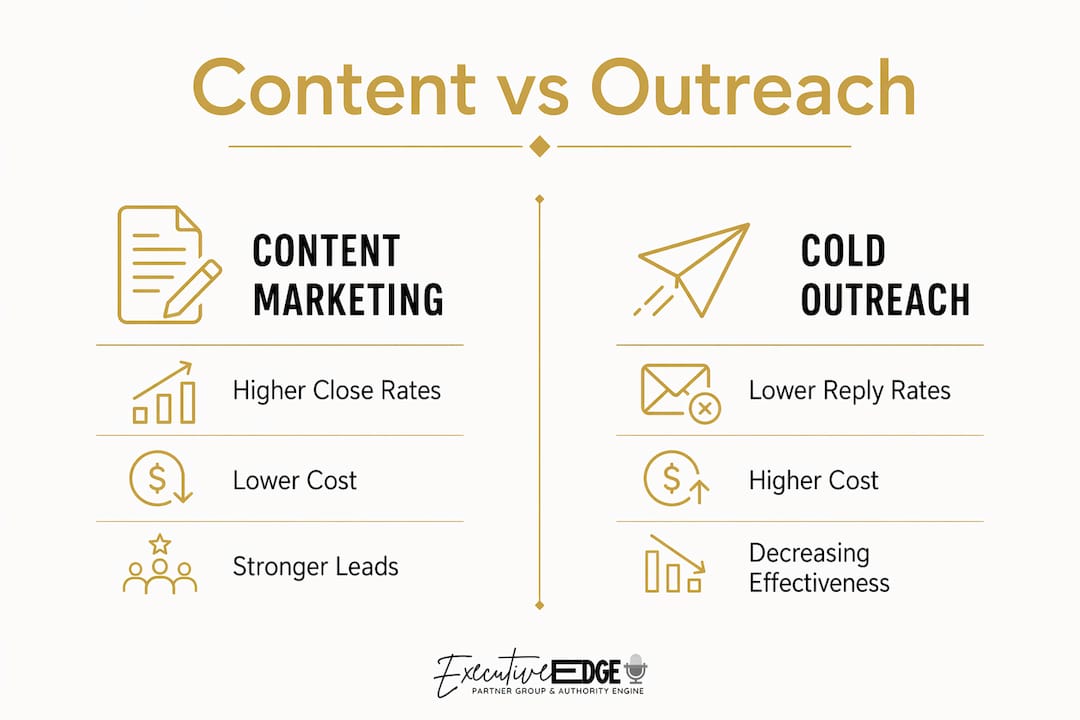
Content marketing is defined as the practice of publishing educational, authoritative material that attracts qualified buyers before a sales conversation ever begins. It is also the most cost-efficient lead generation method available to business owners today. Inbound leads close at 14.6%, compared to just 1.7% for cold outreach. That gap is not a rounding error. It represents a fundamentally different relationship between buyer and seller. For business owners and marketers in Tyler, Texas and across East Texas, understanding why content beats cold outreach is the difference between chasing prospects and having them find you first.
Why content beats cold outreach on lead quality and cost
The core advantage of content marketing is not just volume. It is the quality of the leads it produces. Inbound leads cost 61% less per lead than outbound campaigns, saving businesses roughly $14 per lead on average. That savings compounds over time as your content library grows.
Content also scales in ways cold outreach cannot. Companies with active content ecosystems generate 67% more leads, and content costs 62% less per lead over three years than outbound campaigns. Publishing four or more quality pieces monthly yields three times more leads, with returns typically materializing between months 6 and 9. Cold outreach produces no such compounding effect. Every new campaign starts from zero.

The cost comparison is equally stark at the per-lead level. Content marketing averages $92 per lead compared to $225 for paid search. Cold outreach costs vary, but the conversion rate of 1.7% means you are paying for a high volume of contacts to generate a small number of qualified conversations. Content flips that equation.
Pro Tip: Consistency matters more than volume. Publishing two well-researched articles per month outperforms publishing ten thin posts. Quality content builds indexed authority that compounds; low-quality content disappears.
| Metric | Content marketing | Cold outreach |
|---|---|---|
| Average close rate | 14.6% | 1.7% |
| Average cost per lead | $92 | $225+ |
| Lead volume over 3 years | 67% more | Flat or declining |
| Long-term ROI | Compounds monthly | Resets each campaign |
| Buyer trust built | High | Low |
How modern B2B buyer behavior makes content non-negotiable
The B2B buying process has changed structurally, not just incrementally. 83% of B2B buying journeys now happen away from sales reps, and 61% of buyers actively prefer rep-free research experiences. This means your content is doing the selling before your team ever picks up the phone.
Buyers are also using AI tools to accelerate their research. 54% of buyers use AI tools for product information and vendor comparisons before contacting sales. If your business does not appear in AI-generated answers, comparison pages, or search results, you are invisible during the most critical stage of the buying cycle. This is what makes Generative Engine Optimization (GEO) and Answer Engine Optimization (AEO) so important for modern content strategy.
B2B buying is now confirmation, not selection. Buyers form shortlists via AI research before they ever engage with a vendor. By the time a prospect contacts you, they have already decided you are credible or they have not. Content is what builds that credibility in advance. A blog article, a YouTube video, or a podcast episode can do the trust-building work that a cold email simply cannot.
The content types that build the most trust with buyers include:
- Pricing transparency pages that answer cost questions directly
- Case studies showing real client outcomes with specific results
- Comparison content that addresses alternatives honestly
- Thought leadership articles written by founders or operators
- FAQ pages that answer the questions buyers actually search for
- Video content showing the person behind the business
Pro Tip: Founder-led content generates 8x more engagement than brand pages and is 3x more trusted by LinkedIn users. If you are a business owner, your personal voice is your most underused marketing asset.
What makes cold outreach increasingly difficult to rely on
Cold outreach is not dead, but it is badly wounded as a standalone growth strategy. Reply rates fell from 8.5% in 2019 to 1.8% in 2025, driven by spam filters, email deliverability protocols, and inbox fatigue. That decline shows no sign of reversing.
The structural problems go beyond deliverability. Most cold campaigns fail because of poor list quality, generic messaging, and incorrect follow-up timing. A prospect who has never heard of your business has no reason to trust a cold email. Without prior content exposure, your outreach lands in a credibility vacuum.
Cold outreach also requires constant manual effort. Every new campaign demands fresh lists, new copy, and ongoing testing. There is no asset being built. When you stop sending, the pipeline stops. Content, by contrast, acts as asynchronous credibility infrastructure, enabling prospects to self-qualify before the first sales interaction. That infrastructure keeps working while you sleep.
When cold outreach is used, these practices improve results significantly:
- Reference a specific trigger, such as a recent hire, funding round, or published article, to show genuine research.
- Keep the first message to three sentences or fewer. Long emails get deleted.
- Follow up using a 3-7-7 day cadence. 93% of replies are captured within this sequence.
- Use personalization that goes beyond first name. Reference the prospect's actual business context.
- Never pitch in the first message. Open with a relevant observation or question instead.
Advanced personalization referencing specific triggers doubles reply rates to up to 18%, yet only 5% of senders use this approach consistently. Cold outreach works when it is precise and warm. It fails when it is generic and volume-driven.
How to combine content and outreach for maximum pipeline growth
The strongest marketing programs do not choose between content and outreach. They sequence them. Content builds awareness and trust. Outreach follows up with prospects who have already been warmed by that content. This is the "allbound" model, and it produces measurable results.
Hybrid strategies combining outbound and content yield 38% higher revenue growth than single-channel efforts. The mechanism is straightforward. A prospect who has read your articles, watched your videos, or heard your podcast is far more likely to respond to a cold email than someone who has never encountered your brand. Content does the heavy lifting. Outreach closes the loop.
Pro Tip: Before sending a cold email, check whether the prospect has engaged with any of your content. A message referencing a specific article they may have read converts at a significantly higher rate than a generic pitch. Use your content marketing strategy to create the warm environment outreach needs to succeed.
The sequencing works like this. Publish content that answers the questions your ideal buyers are already searching for. Distribute that content across Google, YouTube, LinkedIn, and AI platforms. Then use targeted outreach to reach prospects who fit your ideal client profile, referencing your content as a credibility signal. The content has already done the trust work. The outreach simply opens the conversation.
| Tactic | Strength | Best use case |
|---|---|---|
| Content marketing | Builds trust, compounds over time | Long-term pipeline and authority |
| Cold outreach | Creates immediate awareness | Short-term pipeline and specific targeting |
| Hybrid allbound | Combines both advantages | Sustained growth and qualified pipeline |
For business owners across East Texas, this integrated approach is particularly powerful. Local service businesses, consultants, and professional firms can publish authority-building video content that establishes credibility in their market, then follow up with targeted outreach to specific prospects in their region.
What I have learned after years of watching businesses choose outreach over content
Most business owners choose cold outreach because it feels like action. You send emails, you make calls, you get a response the same week. Content feels slower and less certain. That perception is accurate in the short term and completely wrong over any meaningful time horizon.
The businesses I have seen struggle most are the ones that never built a content foundation. They run cold campaigns, get inconsistent results, and then run more campaigns. They are always starting over. The businesses that built consistent content, even slowly, eventually reach a point where inbound leads outnumber outbound efforts. That crossover point is real, and it typically arrives between months 6 and 12 of consistent publishing.
Cold outreach is not something to abandon entirely. It has a legitimate role in a well-built marketing program. But treating it as your primary growth engine in 2026 is like trying to fill a leaking bucket. Content is what fixes the leak. It answers buyer questions before they ask them, builds trust before a conversation starts, and creates a searchable, citable presence that works around the clock.
The advice I give every business owner is simple. Start with the questions your best clients asked before they hired you. Write those answers down. Publish them. Do that consistently for six months and watch what changes in your pipeline. The impact of consistent content on brand authority is not theoretical. It is the most reliable growth lever available to any business that is willing to be patient.
— David Domm
Building authority without cold outreach dependency
Business owners who want to grow without relying on cold campaigns need a content system, not just content ideas.
Executive Edge Partner Group specializes in building exactly that. The Authority Engine program transforms your expertise into long-form and short-form content published across Google, YouTube, AI platforms, and local search. It is a done-for-you system designed for business owners, consultants, attorneys, contractors, and service professionals who want to build trust and visibility without becoming full-time content creators. If you are ready to build a content presence that generates qualified leads while you focus on your business, Executive Edge Partner Group is the place to start. The conversion rate advantage of content-driven inbound leads over cold outreach makes the investment straightforward.
FAQ
Why does content marketing have a higher close rate than cold outreach?
Content marketing attracts buyers who are already researching solutions, making them far more qualified when they reach out. Inbound leads close at 14.6% versus 1.7% for cold outreach because the buyer has already built trust through your content before the first conversation.
How long does content marketing take to produce results?
Content marketing typically produces compounding returns between months 6 and 9 of consistent publishing. Businesses publishing four or more quality pieces monthly see three times more leads than those relying on outbound campaigns alone.
Is cold outreach still worth using in 2026?
Cold outreach works best as a supplement to content, not a standalone strategy. Reply rates have fallen to 1.8% on average, but advanced personalization referencing specific triggers can push rates to 18% when combined with a warm content foundation.
What content types build the most buyer trust?
Pricing transparency pages, case studies with specific results, founder-led video content, and comparison articles are the formats buyers trust most. 83% of B2B buyers complete most of their research before contacting a vendor, so these content types must be findable and credible before outreach begins.
What is the "allbound" marketing strategy?
The allbound strategy combines content marketing with targeted cold outreach in sequence. Content builds awareness and trust first. Outreach then contacts prospects who have been warmed by that content, producing 38% higher revenue growth than using either channel alone.