

Content repurposing is the practice of taking one strong asset and adapting it into multiple platform-native formats so it reaches audiences who would never find the original. Done systematically, it works: 94% of marketers repurpose content, and systematic workflows consistently generate 4–7x unique audience reach and more leads than original content. Repurposing also cuts production time by 60–80%, meaning your team creates less from scratch and distributes more of what already works.
The core idea is not recycling. It is extraction and adaptation. A single pillar piece, say a 3,000-word guide or a 45-minute webinar, contains 5–10 distinct insights, each of which can become a LinkedIn post, a short video, an email, an infographic, or a podcast segment. The audience on LinkedIn is not the same person who found your blog through Google. Reaching both requires the same insight in two different forms.
Key benefits at a glance:
- Reach: Multi-channel distribution expands visibility to audiences who prefer audio, video, or social formats over long-form text
- Engagement: Multichannel repurposing increases engagement by 25–35% compared to single-channel publishing
- Efficiency: Repurposing a blog post into multiple derivatives adds some additional work but produces several additional distributed pieces
- Lead generation: 60% of marketers report that repurposed content generates more leads than original content
- SEO compounding: Multiple pieces targeting similar keywords across platforms build search authority over time
- Burnout prevention: You stop reinventing ideas daily and start extracting more value from what you have already built
How to extract multiple formats from a single content asset
The biggest mistake in repurposing is treating the original piece as the finished product. It is raw material. The workflow that actually scales starts with a single hero asset and breaks it into what practitioners call atomic units: individual insights, data points, frameworks, or stories that can each stand alone on a specific platform.

Extracting roughly ten atomic units from one pillar asset, then rewriting each for its target platform's native format, is the method that separates real repurposing from copy-paste distribution. A LinkedIn post is not a truncated blog paragraph. A Twitter/X thread is not a bulleted list from your article. Each unit needs its own hook, its own framing, and its own ending.
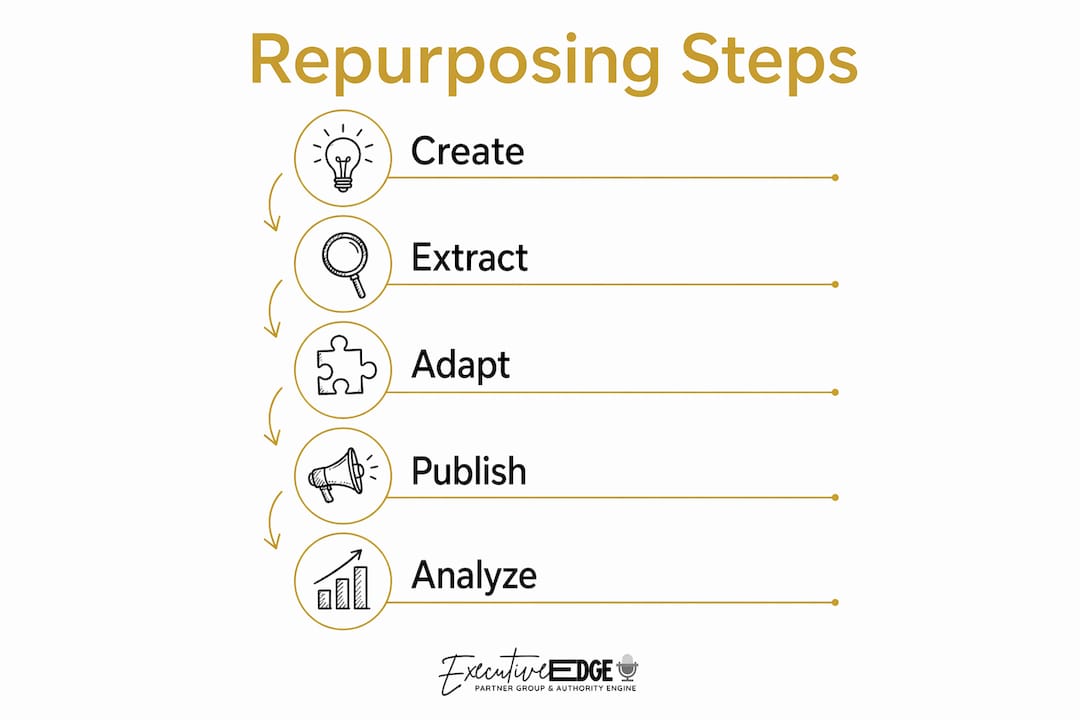
Here is a practical framework for the extraction process:
- Audit first: Identify your highest-performing assets by organic traffic, shares, or conversion data. Only those qualify for full repurposing treatment.
- Map the atoms: Read through the asset and pull out each distinct insight, statistic, framework, or story. A 3,000-word post typically yields 6–10 atoms.
- Assign by platform behavior: Match each atom to the format where it fits naturally. A checklist becomes a carousel. A counterintuitive claim becomes a Twitter/X thread opener. A narrative example becomes an email segment.
- Rewrite, do not reformat: Change the hook, the structure, and the framing for each platform. The idea stays the same. The expression changes completely.
- Space the drops: Distribute across a two-week window so followers on multiple platforms do not see the same idea twice in one day.
- Track by atom: Note which atomic units drive the most engagement per channel. That data shapes your next repurposing cycle.
Pro Tip: Build a master repurposing document for each hero asset. Paste the extracted atoms into a shared doc with a column for each platform. This prevents copy-paste errors and gives your team a single source of truth for every derivative piece.
The framework below maps common hero formats to their most productive derivatives:
| Hero format | Top derivative assets | Estimated channel reach |
|---|---|---|
| Pillar blog post | LinkedIn carousel, email sequence, Twitter/X thread, YouTube Short, infographic | 12–18 channels |
| Webinar recording | 5–7 short clips, transcript blog post, podcast episode, quote graphics, slide deck | 15–22 channels |
| Podcast episode | Blog post from transcript, pull-quote graphics, LinkedIn text post, short-form videos, newsletter feature | 10–15 channels |
| Research report | Executive summary blog, data visualizations, press release, findings webinar, social stat cards | 20–30 channels |
Align your repurposing volume with your team's actual capacity. A solo creator who commits to two formats consistently will outperform a team that attempts ten formats and abandons half of them by week three.

Which repurposing formats actually move the needle?
Not every format deserves equal attention. The right choice depends on where your audience spends time and what type of content they consume there. Here are the formats that consistently deliver results, along with how to use each one well.
Social snippets (carousels and threads)
Carousels on Instagram and LinkedIn work because they are built to be saved and shared. Each slide should carry one idea, not a paragraph. A 10-slide carousel from a pillar post typically outperforms the post itself on saves and shares. Twitter/X threads work differently: lead with a bold or counterintuitive claim, then build evidence across 5–8 tweets, and close with a clear takeaway. LinkedIn articles repurposed from blog posts see a 45% increase in shares compared to standard posts.
Short-form video
Short-form video under 60 seconds is the most shared content type on social media. The repurposing play here is to pull the single sharpest insight from a longer recording and build a 60–90 second clip around it. Open with the result or the counterintuitive claim, then explain it. Batch-record all clips for the week in one 30-minute session rather than filming one at a time.
Podcast episodes
Repurposing blog content into podcast episodes increases reach by 30% by capturing commuters, gym-goers, and anyone who prefers audio over reading. The key adaptation: written content needs spoken cadence. Rewrite the script so it sounds like someone talking, not reading. Tools like SparkPod can convert a published article URL into a podcast-style audio script you can edit before recording.
Email sequences
A single pillar post can feed a three-email nurture sequence. Email one introduces the core problem. Email two delivers the framework or solution. Email three provides a case example and a next step. Email repurposing delivers strong ROI because the audience has already opted in. Newsletters featuring curated content from blog posts see a 15% increase in click-through rates.
Infographics
Infographics are liked and shared on social media 3 times more than any other content type. They work best for data-heavy sections of a pillar post: a framework with steps, a comparison table, or a set of statistics. Websites that use infographics experience a 12% increase in traffic. Build them from Canva or Figma templates so each one takes under 15 minutes to produce.
Slide decks
A slide deck version of a pillar post works on LinkedIn's document feature and on SlideShare. Each slide carries one point. The format rewards people who want to scan rather than read, and it performs well in B2B contexts where decision-makers prefer structured summaries over long articles.
Format selection checklist:
- Is your audience active on this platform?
- Does your team have the bandwidth to maintain quality there consistently?
- Does the atomic unit you are adapting fit the platform's native consumption style?
- Can you add at least 30% new framing or context to avoid pure duplication?
| Content atom | Best format | Platform fit |
|---|---|---|
| Big explanation or framework | Podcast or long-form video | Gives room for context |
| Checklist or step-by-step | Carousel or infographic | Easy to scan and save |
| Single sharp takeaway | Short social post or clip | Fast to consume and share |
| Narrative example | Email or audio segment | Works well in sequence |
| Data point or statistic | Stat card or Twitter/X post | Visual and shareable |
Why content repurposing pays off for marketing professionals
The economics are straightforward. If a piece of content costs $500 to produce and reaches one channel, your cost per channel is $500. Repurposed across 20 distribution channels, that same piece drops to $25 per channel. That is not a marginal efficiency gain. It is a different operating model for content marketing entirely.
The reach numbers back this up. Systematic repurposing yields 4–7x unique audience reach and generates more leads than original content alone. A blog post only reaches people who read blogs. The video version reaches YouTube searchers. The podcast version reaches commuters. Each format opens a segment that the original never touched.
| Benefit category | What the data shows | Source |
|---|---|---|
| Reach increase | Systematic repurposing yields 4–7x unique audience reach | Content Repurposing Statistics 2026 |
| Engagement lift | 25–35% more engagement vs. single-channel | Hootsuite |
| Lead generation | 60% of marketers report more leads from repurposed content | HubSpot via SparkPod |
| Time savings | 60–80% reduction in production time | Industry benchmarks |
| Content output | 40% more output without proportional time increase | InfluenceFlow |
| Social sharing | Infographics shared 3x more than other content types | Bloghunter |
Beyond reach, repurposing builds SEO authority over time. Multiple pieces targeting related keywords across different platforms compound in search rankings. A blog post derived from a video can rank in Google for years after the original video's views taper off. That long-tail value is something single-channel publishing never produces.
The burnout angle matters too. Content creation costs are rising, and 57% of marketers cite lack of resources as a top challenge. Repurposing addresses both problems by extracting more value from content already produced rather than demanding a fresh idea every day.
Best practices and pitfalls to avoid
The most common repurposing mistake is starting with the wrong content. Only repurpose high-performing assets with proprietary insights or original data. Repurposing a post that underperformed extends the reach of content your audience already showed limited interest in. Filter by organic traffic, shares, and conversion data before committing to the full treatment.
The second mistake is cross-posting without adaptation. Pasting the same caption from LinkedIn into a tweet, then emailing it to your list, trains your audience to treat your content as redundant. Once someone sees you email them the exact post they already read on Instagram, they stop opening your emails. The fix is channel-specific framing: the same core insight packaged differently for each platform's native culture feels relevant, not repetitive.
Pro Tip: Bake repurposing into your content creation workflow from the start, not as a post-publication afterthought. When you write a pillar post, simultaneously draft the email subject line, the LinkedIn hook, and the carousel concept. Retrofitting is always slower than designing for distribution from day one.
Common pitfalls and why they fail:
- Repurposing low-performing content: Weak source material produces weak derivatives regardless of format
- Attempting every channel at once: Spreading thin across too many platforms produces inconsistent presence everywhere and authority nowhere
- Measuring repurposed pieces against the original: A Twitter/X thread will never match a blog post's depth. Benchmark each piece against its own channel norms, not the original asset
- Publishing all derivatives at once: If your LinkedIn, Twitter/X, and Threads all push the same idea on the same morning, anyone following you on two platforms sees the repetition immediately
- Skipping the 30% new material rule: Derivatives that simply reformat without adding a new angle, example, or framing create the perception of spam
Focused repurposing on two or three high-impact formats consistently drives better growth than attempting to cover every channel. Executing fewer things consistently beats trying to do everything at once and burning out by month two.
How Executive Edge Partner Group approaches content repurposing at scale
The framework Executive Edge Partner Group uses with clients is built around one principle: content should have a second, third, and fourth life if the audience and channel justify it. Most businesses, especially service providers and local professionals, create one piece of content, post it once, and move on. That approach leaves most of the asset's value on the table.
The Authority Engine system at Executive Edge Partner Group combines AI-assisted drafting with human editorial judgment to extract atomic units from pillar content, adapt them for each platform's native format, and schedule distribution across a two-week window. AI handles the first draft of social copy and format adaptations. Human review handles tone, accuracy, and the platform-specific framing that AI alone gets wrong.
Key principles behind the approach:
- Signal before schedule: Repurpose content that has demonstrated value through traffic, shares, or conversions, not content that simply exists
- Platform-native rewriting: Every derivative gets a new hook, new structure, and new framing, not a reformatted copy of the original
- Batch production: Record all short-form videos for the week in one session. Generate all graphics from pre-built brand templates. Efficiency comes from batching, not multitasking.
- Weekly analytics review: Track which atomic units outperform channel benchmarks. LinkedIn derivative posts should outperform your average LinkedIn post by 40% or more on engagement. If they do not, the framing needs adjustment.
- Sustainable volume: Start with one pillar asset per week and two or three formats. Consistency over 90 days outperforms an aggressive sprint that collapses in week four.
For business owners in Tyler and East Texas, this system removes the need to become a full-time content creator. One well-built piece of expertise, extracted and distributed systematically, builds authority across Google, YouTube, LinkedIn, and AI search platforms simultaneously.
Pro Tip: If you produce a podcast or long-form video, that single recording is your highest-leverage source. A 20-minute episode can reliably produce 10–15 derivative posts across platforms. Start there before worrying about any other format.
Which tools actually help you repurpose content faster?
The right tools reduce execution time without replacing the judgment required to decide what to repurpose and how to frame it. Here is how to think about the stack by function.
Content extraction and drafting
AI writing tools like Claude, ChatGPT, and Jasper work well for generating first-draft social copy variations and format adaptations from a source document. Paste in the pillar content, prompt for platform-specific rewrites, and treat the output as a starting point. The AI draft handles structure. You handle voice, accuracy, and the platform-specific angle that makes the piece feel native rather than generic.
Graphic production
Canva and Figma are the standard tools for quote cards, stat graphics, and carousel slides. The key is building brand templates in advance so each new graphic takes under 15 minutes. Pre-built layouts with your colors, fonts, and logo mean you are filling in content, not designing from scratch each week.
Scheduling and distribution
Social scheduling tools like Buffer or native LinkedIn scheduling handle the distribution calendar. The tool matters less than the consistency of the cadence. Load everything for the following week on Friday so Monday morning is execution, not planning. For social media content types that require platform-specific formatting, scheduling tools also let you preview how each post renders before it goes live.
Audio and podcast production
SparkPod converts web articles, PDFs, and YouTube videos into podcast-style audio by extracting main ideas and building an editable script. For teams that want to reach audio audiences without building a full podcast production process, this reduces the barrier significantly.
Asset management
Organize your shared drive by hero asset, not by format. Every derivative should trace back to its source pillar piece so you can track total ROI per hero asset over time. A folder structure like "Q2 Webinar > LinkedIn Posts / Email Sequence / Short Videos" makes it easy to see what has been produced and what is still in the pipeline.
Your existing email service provider handles repurposed email sequences. The efficiency gain comes from having nurture sequence templates pre-built so adding new content from a pillar piece is a fill-in exercise, not a rebuild. For teams exploring how lead generation and website design connect to content distribution, the email channel is often where repurposed content converts best.
A repeatable weekly workflow built around these tools looks like this: Monday for asset selection and performance review, Tuesday for atomic extraction and AI-assisted drafting, Wednesday for social posts and graphics production, Thursday for video recording and final asset review, Friday for scheduling and analytics from the previous week. Teams of any size can run this cadence. The front-loaded work is building the templates and framing rules. After that, it is execution.

If you want a done-for-you system that turns your expertise into a multi-channel content engine, Executive Edge Partner Group builds and runs that system for you. From pillar content creation to platform-native distribution across Google, YouTube, LinkedIn, and AI search, the Authority Engine is designed for business owners and professionals who want to build real authority online without spending their week writing social posts.
FAQ
What is an example of repurposing content?
A 3,000-word blog post repurposed into a LinkedIn carousel, a three-email nurture sequence, a Twitter/X thread, and two short-form video clips is a standard repurposing cycle. Each derivative carries the same core insight adapted to its platform's native format and audience behavior.
What is the 5-to-1 rule in content repurposing?
The 5-to-1 rule means creating multiple smaller social media posts from every single long-form piece of content. Applied consistently, it extends the reach of each pillar asset across multiple channels without requiring new ideas for every post.
How do you measure whether repurposed content is working?
Benchmark each repurposed piece against its own channel norms, not against the original asset. A LinkedIn derivative should outperform your average LinkedIn post by 40% or more on engagement. A Twitter/X thread should generate at least 2x the impressions of your median single tweet.
How is repurposing different from reposting?
Repurposing keeps the core idea and rewrites the expression for a new platform, with a different hook, format, and framing. Reposting publishes the same content unchanged on a second channel or re-shares an old post without adaptation. Reposting trains audiences to ignore duplicate content; repurposing expands reach without that fatigue.
Which content format is the highest-leverage starting point for repurposing?
Video is the highest-leverage source format because one recording produces transcript text, short clips, pull quotes, still images, and audio. A 20-minute video can reliably produce 10–15 derivative posts across platforms. Long-form blog posts are the second strongest starting point, followed by podcast episodes with transcripts.