

Authority marketing is the deliberate practice of making your expertise visible through published frameworks, documented results, and earned media so buyers arrive already convinced you're right for them. The payoff isn't attention. It's cheaper, warmer demand: shorter sales cycles, higher close rates, and the ability to charge premium fees because prospects stop shopping you against five competitors before they even call.
Table of Contents
- What Is Authority Marketing, Really?
- Why Authority Marketing Actually Moves the Needle
- The Building Blocks of Real Authority
- A Step-by-Step Playbook to Build Authority
- Which Formats Build Authority Fastest?
- How Do You Measure Authority Marketing Success?
- What a Done-for-You Authority Engine Looks Like in Practice
- What Actually Works vs. What Sounds Good on Paper
- A Practical Next Step for Busy Professionals
- Sources
- FAQ
What Is Authority Marketing, Really?
Authority marketing is a trust-first strategy. Instead of chasing attention, you demonstrate expertise publicly through published ideas, documented case studies, and earned placements, so the buyer shows up pre-convinced rather than needing to be pitched. That distinction separates it from fame or follower counts, which measure reach without proving competence.
The mechanism behind it is what industry writers call the Authority Flywheel: it inverts the standard marketing sequence. You publish and demonstrate first, earn endorsements second, and only then ask for the sale. Each cycle feeds the next: a published framework earns a podcast invite, the podcast earns backlinks, the backlinks earn search visibility, and the visibility earns more invitations.
Three channel types drive that loop, and confusing them is where most professionals stall:
- Owned channels — your blog, podcast, book, or newsletter, where you control the message entirely.
- Earned channels — press mentions, guest podcast slots, and backlinks other people give you because your work merits it.
- Distributed channels — social platforms and syndication where your owned content gets reformatted and pushed to audiences you don't own.
If your current content lives only on social media with no owned home base, you're doing distribution without authority. That's the gap most "content marketing" efforts never close.
Why Authority Marketing Actually Moves the Needle
The business case is concrete, not aspirational. When a prospect finds your published framework before your sales team ever calls, the conversation starts at "how do we work together" instead of "why should I trust you." That single shift shortens sales cycles and lifts close rates, because objection handling has already happened on the page or in the podcast episode.
It also changes lead quality. Referrals and inbound leads generated through authority content tend to arrive with fewer price objections, since they've self-selected based on your published point of view rather than a generic ad.
The compounding effect is the part most professionals underestimate. A single strong piece of research keeps earning backlinks and press coverage for years, and every mention adds to your branded search volume. That branded search growth is a leading indicator most agencies ignore because it doesn't show up in a paid ad dashboard, yet it's often the clearest sign your authority is compounding rather than plateauing.
The Building Blocks of Real Authority
Authority isn't built from random blog posts. It's built from a small set of durable assets that function as evidence, not noise.
Intellectual assets come first: name and codify your methodology. Consultants who codify a framework and publish it shift demand from outbound prospecting toward inbound leads, because a named framework is memorable and shareable in a way generic advice never is. Call it something specific. "The Five-Stage Retention Model" gets referenced. "Our approach to customer retention" does not.
Social proof comes next, but it has to be methodical, not decorative. A single glowing testimonial is weak evidence. A documented case study with before-and-after specifics, structured the way you'd build social proof for growth, reads as evidence a skeptical buyer can verify.
Owned content is the spine: pillar posts, original research, and long-form pieces you can repurpose into a dozen smaller assets. Original research and consistent long-form coverage deliver the strongest signals because they earn backlinks and press on their own merit.
Visibility rounds it out, but strategically. Showing up everywhere is wasted effort. Authority is about appearing in the narrow set of places your buyers already pay attention to, whether that's a specific industry podcast or a single trade publication.
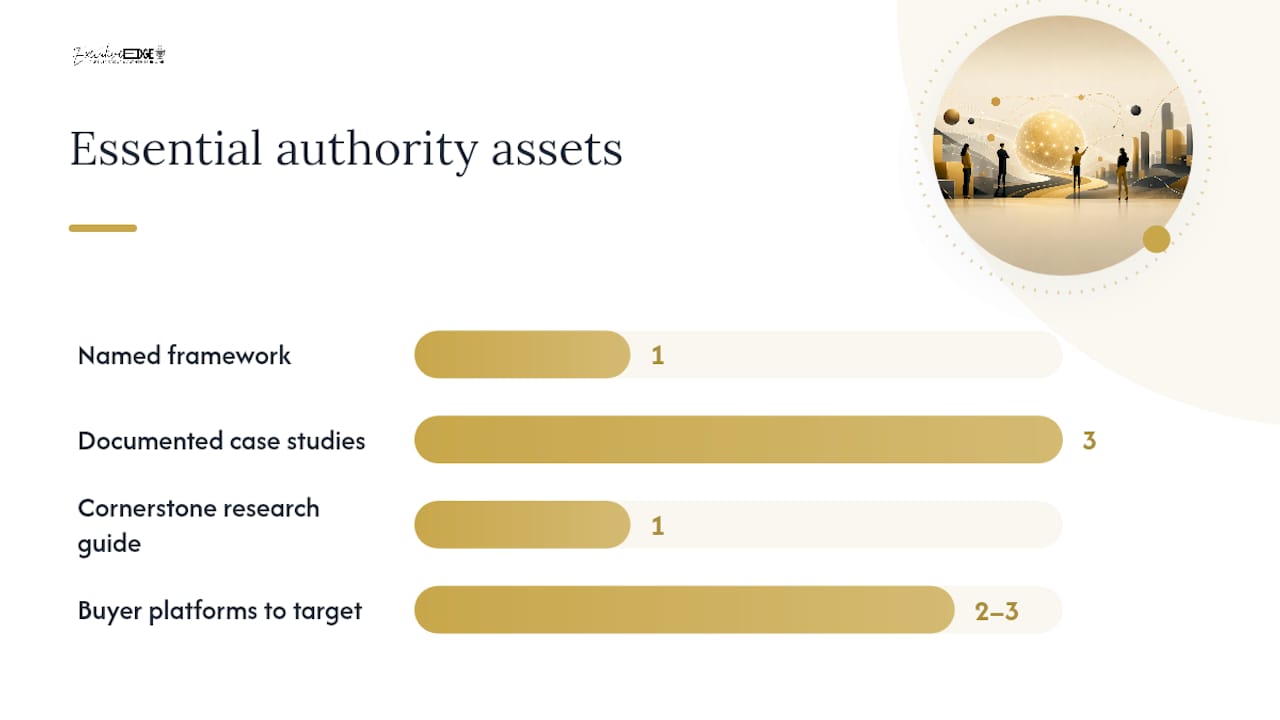
- Codify one named framework or methodology
- Document at least three detailed case studies with measurable outcomes
- Publish one cornerstone research piece or long-form guide regularly
- Identify the two or three platforms your buyers already trust
Pro Tip: Don't build a case study library after you've closed 50 clients. Start documenting outcomes with your very first three clients, even informally. Retroactive case studies are harder to source and less credible than ones tracked from day one.
A Step-by-Step Playbook to Build Authority
Building authority isn't random content production. It follows a sequence, and skipping steps is why most efforts stall at month two.
- Pick a narrow territory. Cross a specific topic with a specific audience and a specific point of view. "Marketing advice" is too broad. "Retention strategy for mid-size SaaS companies" is a territory you can own.
- Name your framework. Give your method a title and a short promise, even before it's a full book. Packaging your intellectual property as the spine of your content makes everything downstream easier to produce and easier to remember.
- Produce one cornerstone asset. Write the long-form piece, record the flagship podcast episode, or draft the book outline that anchors everything else.
- Repurpose relentlessly. Break that cornerstone into episodes, social posts, and short clips using a repeatable content workflow instead of starting from scratch each time.
- Pursue targeted earned placements. Pitch guest posts, niche podcasts, and trade press, aiming for the two or three outlets your buyers actually read.
- Document case studies as you go. Capture measurable results from every engagement, not just the impressive ones.
- Harvest referrals actively. Ask satisfied clients to point others to your published work, not just to you personally.
- Set a publishing cadence. Weekly is ideal; monthly is the realistic floor for momentum.
- Layer in SEO and distribution. Build topical clusters around your framework so search engines start associating your name with the subject.
- Review and compound. Every quarter, identify which asset generated the most inbound interest and double down on that format.
| Step | Time Horizon | Primary Output |
|---|---|---|
| Territory and framework | Weeks 1–2 | Named methodology |
| Cornerstone content | Weeks 3–4 | Flagship article, episode, or chapter |
| Repurposing and cadence | Ongoing | Weekly or biweekly output |
| Earned placements | Months 2–6 | Guest features, podcast guesting |
| Case study harvest | Ongoing | Documented client results |
Which Formats Build Authority Fastest?
Not every format carries equal weight, and picking the wrong one wastes months. Books and original research function as credibility infrastructure: a book-centric authority loop, where you organize your method into a book and build a simple funnel around it, can multiply qualified inbound leads for consultants.

Podcasts and podcast guesting deliver faster reach inside niche communities than almost any other format, since a thought leader podcast strategy puts you directly in front of an audience that already trusts the host. Long-form SEO content and topical clusters handle the discoverability side, building the trust that blogging creates over months rather than days.
The mistake is trying all of these at once. Pick one or two platforms where your buyers already gather:
- A weekly or biweekly podcast if your audience listens more than it reads
- A long-form blog with topical clusters if your buyers search before they buy
- Guest appearances on established shows if you need reach before you have a following
- LinkedIn as a distribution layer, following a structured six to twelve month cadence rather than posting sporadically
How Do You Measure Authority Marketing Success?
Most people over-track vanity metrics and under-track the ones that actually predict revenue. Branded search volume, organic inbound leads, and conversion rate from organic channels are the three that matter most, because they show whether people are actively looking for you by name rather than stumbling on you.
Secondary metrics matter too, just less urgently: backlinks, press mentions, and speaking invitations all signal that your authority is being recognized by other credible parties, which reinforces the EEAT signals search engines use to rank you over time.
| Metric | What It Signals | Check Cadence |
|---|---|---|
| Branded search volume | Recognition and recall | Monthly |
| Organic inbound leads | Demand generation | Monthly |
| Conversion rate (organic) | Lead quality and fit | Quarterly |
| Backlinks and press mentions | External validation | Quarterly |
| Speaking or podcast invitations | Peer-recognized authority | Quarterly |
A realistic timeline runs 4 to 12 months of consistent, targeted output before inbound volume noticeably shifts. Tracking these against your own content performance metrics keeps you honest about what's actually working versus what merely feels productive. Pairing that with a lead source tracking system lets you trace which authority asset actually converted a lead into a call, rather than guessing.
What a Done-for-You Authority Engine Looks Like in Practice
Most professionals stall on execution, not strategy. A managed system solves the production bottleneck by capturing your expertise once and distributing it continuously.
- One recording session and a guided intake produce weeks of usable material.
- Voice cloning technology extends that single session into podcast episodes, video, blog posts, and social content on an ongoing basis.
- AI-assisted workflows handle distribution across search, YouTube, and AI-driven discovery platforms with a GEO and AEO focus.
- Consultants, local professionals, and executives who lack the time to write or record weekly are the clearest fit, since the entire point is authority without becoming a content creator.
What Actually Works vs. What Sounds Good on Paper
The biggest mistake I see is professionals picking a territory too broad to own. "Business growth" gets you nowhere. "Retention strategy for regional healthcare groups" gets you booked. The second mistake is quitting around month three, right before the flywheel starts turning. Authority compounds late, not early.
The third mistake is tracking vanity metrics instead of branded search and inbound quality. For business owners in Tyler and East Texas, the leaders who stick with a modest weekly cadence for six months consistently outperform the ones who post daily for three weeks and stop. Consistency beats intensity every time.
— David Domm
A Practical Next Step for Busy Professionals
If the playbook above sounds right but the execution feels like a second full-time job, a done-for-you content system can close that gap. Instead of hiring a videographer, a podcast editor, and a writer separately, you sit for a single recording session and guided intake, and the system's voice-cloning and AI-assisted workflows turn that one session into weekly output across podcast, blog, video, and social channels.

This is built for consultants, local business owners, and executives who recognize the value of consistent authority-building but don't have hours each week to write, film, or edit. The system layers in SEO, Generative Engine Optimization, and Answer Engine Optimization so your published work stays discoverable as search itself shifts toward AI platforms. If you want to see how the intake and production process works for your specific business, visit the Authority Content System page and start the conversation.
Sources
- What Is 'Authority Marketing' and How Do You Achieve It? — Entrepreneur
- How to Build Authority That Attracts High-Ticket Clients | HighTicketHQ
- How to Build Authority Online as a Consultant Fast — Built&Written
- What Is Authority Marketing? (The Trust-First Play) — Instant Press Co.
- Authority Marketing: The Complete Guide to Building Trust — Red Stag Labs
FAQ
What Is Authority Marketing?
Authority marketing is the practice of publicly demonstrating expertise through frameworks, case studies, and earned media so buyers arrive already convinced of your credibility. It's a trust-first strategy rather than an attention-first one.
What Is Authoritative Marketing?
"Authoritative marketing" is generally used interchangeably with authority marketing: building credibility through published expertise rather than paid reach alone. Both terms describe the same trust-first sequence of publishing, earning endorsements, and then converting demand.
What Is an Example of Authority Advertising?
A consultant who codifies a named framework, publishes a book around it, and documents client case studies is a clear example. Consultants who codify and publish a method typically see inbound leads replace cold outbound prospecting over time.
What Is the Authority Principle in Marketing?
The authority principle holds that people trust and act on advice from sources they perceive as credible experts, which is why demonstrated expertise converts better than generic advertising. This is the psychological foundation behind the Authority Flywheel and why earning trust before asking for business outperforms interrupting a buyer's attention.
How Much Does a Done-for-You Authority System Cost?
Pricing for Executive Edge Partner Group's Authority Content System is available directly on its landing page, since costs depend on scope and content volume. Reach out through the site for current details specific to your business.