

A thought leadership content creation workflow is a repeatable, structured system for turning expert knowledge into credible content that builds authority and drives business growth. Without a defined process, even the most knowledgeable professionals publish inconsistently, distribute poorly, and fail to compound their expertise into market influence. 93% of B2B professionals find thought leadership built on original research effective for building trust. That number, from Ascend2's 2026 research, tells you exactly what the bar is. For business leaders and content marketers in Tyler, Texas and beyond, a disciplined workflow is the difference between occasional content and a genuine authority engine.
What does a thought leadership content creation workflow include?
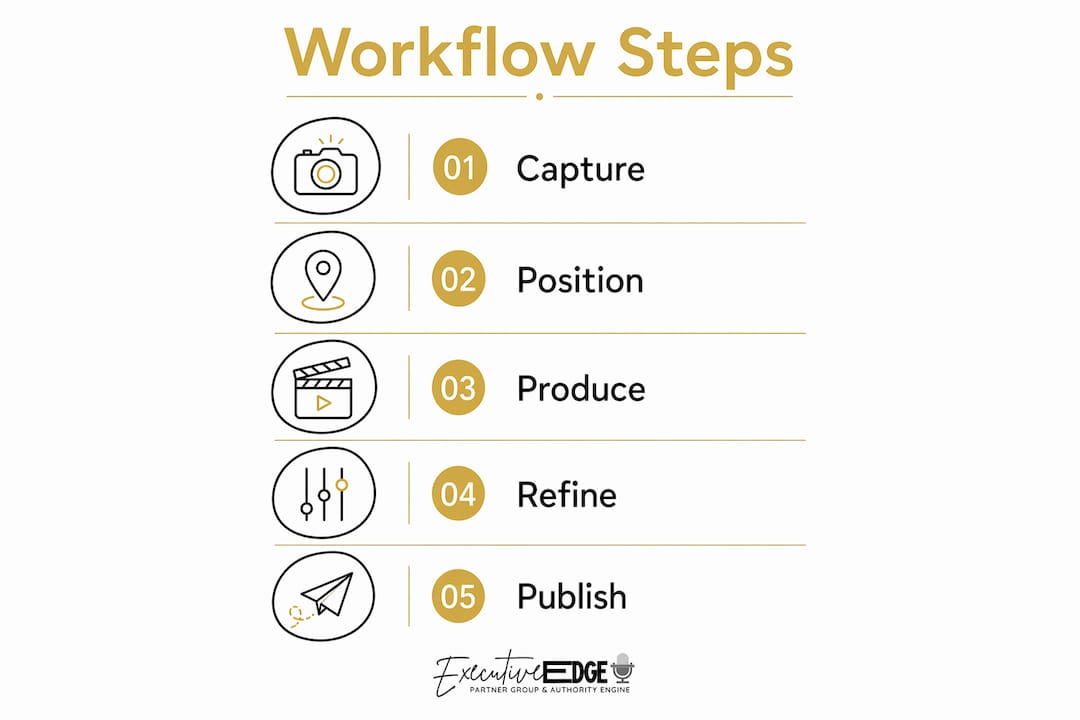
A thought leadership content creation workflow covers five core phases: idea capture, positioning, production, refinement, and distribution. Each phase has defined inputs, outputs, and time commitments. The industry term for this end-to-end approach is a content operations framework, and the workflow concept is the SEO-friendly shorthand most practitioners use when searching for guidance.
The workflow differs from a simple editorial calendar. A calendar tells you when to publish. A workflow tells you how to move from raw insight to published, distributed content that earns attention. Skipping the workflow and relying on the calendar alone is the most common reason thought leadership programs stall after three months.

The CEO-OS Framework structures this around five elements: Position, Pillars, Proof, Distribution, and Conversion Loop. Each element feeds the next. Your position defines what you stand for. Your pillars organize your recurring topics. Your proof is the original data, case studies, or experience that backs your claims. Distribution gets the content in front of the right people. The conversion loop turns readers into leads or clients.
What tools and prerequisites do you need before starting?
The right foundation prevents the most common workflow failures: running out of ideas, publishing in bursts, and ignoring distribution. Set these up before you write a single word.
Knowledge capture system
Capture ideas continuously using a dedicated tool. Notion, Apple Notes, or a voice memo app all work. The format matters less than the habit. Every observation from a client call, industry article, or conference conversation belongs in your backlog. A backlog of 30 to 50 ideas means you never face a blank page.
Channel selection
Pick your primary publishing channel first, then add secondary channels. Most B2B professionals anchor on LinkedIn and a long-form blog. 54% of buyers prioritize LinkedIn for thought leadership discovery. That makes LinkedIn the non-negotiable starting point for most business leaders.
Core tools overview
| Tool category | Purpose | Practical benefit |
|---|---|---|
| Content calendar | Schedule anchor assets and derivative posts | Prevents publishing gaps |
| AI writing assistant | Draft outlines, refine language, repurpose content | Cuts production time significantly |
| Analytics platform | Track engagement, reach, and conversion | Identifies what topics and formats perform |
| Idea capture app | Maintain a running backlog of insights | Eliminates blank-page paralysis |
| Email platform | Segment and distribute to audience lists | Extends reach beyond social algorithms |
AI writing assistants now play a central role in reducing marketing workload without sacrificing quality. Use them for drafting, not for generating original insight. Your experience and perspective are the irreplaceable inputs. The AI handles structure and speed.
Pro Tip: Set up your knowledge capture system before anything else. Spend one week logging every insight, question, and observation before you plan a single piece of content. You will have more ideas than you can use.
How do you execute the workflow step by step?
The five-phase execution process below gives you a repeatable system. Each phase has a clear deliverable and a realistic time estimate.
1. Capture ideas continuously (ongoing, 10 minutes daily)
Your idea backlog is the raw material for everything else. Log observations from client conversations, industry news, and your own experience every day. Tag each idea with a potential format: article, LinkedIn post, podcast episode, or short video. A backlog of 30 to 50 tagged ideas gives you three to six months of content without scrambling.
2. Develop your angle and positioning (1–2 hours per piece)
Every piece of thought leadership needs a clear, defensible point of view. Generic observations do not build authority. Ask: what do I believe that most people in my industry get wrong? What have I seen firsthand that contradicts conventional wisdom? Your angle is the answer. Intellectual honesty about uncertainty, including admitting when you do not have a complete answer, builds more trust than projecting false certainty. Readers recognize the difference immediately.
3. Create content with a clear structure (2–4 hours per anchor piece)
Effective thought leadership writing follows a proven structure: tension, decision, tradeoff, proof, principle, and invitation. Start with a tension your reader recognizes. Describe the decision or tradeoff at the center of the issue. Provide proof from original data, client experience, or credible research. State the principle that emerges. Close with an invitation to act, respond, or think differently. This structure, documented in InstantPress's 2026 content guide, works across formats because it mirrors how readers process new ideas.
The standard cadence for 2026 is one anchor asset monthly plus two to three derivative social posts weekly. An anchor asset is a long-form article, a detailed LinkedIn essay, a podcast episode, or a video. Derivative posts are shorter formats that pull a single insight from the anchor piece. This cadence is sustainable for most business leaders without a full content team.
4. Refine for clarity and impact (1 hour per piece)
Read every piece aloud before publishing. If you stumble over a sentence, rewrite it. Cut every sentence that does not add a new idea. Replace vague claims with specific examples or data. Check that your original angle is still visible in the final draft. Many thought leadership pieces lose their edge in editing because writers sand down the opinions to avoid controversy. Keep the edge. That is what makes the content worth reading.
Pro Tip: Batch write three to four pieces in a single session, then spread publishing over several weeks. Batch writing produces more consistent quality than writing one piece at a time under deadline pressure.
5. Publish and amplify across channels (1–2 hours per piece)
Publishing is the beginning of distribution, not the end. Post the anchor piece on your primary channel. Then execute a five-post LinkedIn sequence over the following two weeks, each pulling a different angle from the same piece. Send an email to your list. Share in relevant communities. Repurpose into a short video or audio clip. The 1:5 content-to-distribution ratio is the standard: for every one core piece, create at least five distribution touchpoints. That ratio is what separates thought leaders who build audiences from those who publish into silence.
How do you optimize distribution for reach and engagement?
Distribution is a strategy, not an afterthought. Multi-channel distribution with 30 or more touchpoints over 90 days exponentially increases the ROI of each thought leadership piece. Most professionals stop after the first post. That is the single biggest distribution failure in content marketing.
Distribution channels and best practices
- LinkedIn: Post the anchor piece, then run a five-post sequence over two weeks. Each post highlights a different insight, question, or data point from the original.
- Email newsletter: Segment your list by role or interest. Send a version of the content tailored to each segment's priorities.
- Podcast or video: Record a short audio or video version of the core argument. Podcast distribution extends reach to audiences who do not read long-form content.
- Community forums: Share relevant insights in LinkedIn groups, Slack communities, or industry forums where your audience is active.
- AI-powered search: 32% of buyers now use generative AI tools like ChatGPT for thought leadership discovery. Structure your content with clear definitions, direct answers, and named entities so AI platforms can cite it accurately.
Content repurposing map
| Anchor format | Repurposed formats |
|---|---|
| Long-form article | LinkedIn essay, email newsletter, short video, social quote cards |
| Podcast episode | Blog transcript, LinkedIn clips, audiogram, email summary |
| Research report | Infographic, LinkedIn carousel, webinar, press release |
| Webinar | Blog recap, short clips, email sequence, LinkedIn posts |
Matching content format to audience consumption preferences increases engagement significantly. A C-suite audience may prefer a concise LinkedIn essay. A technical audience may engage more with a detailed article or podcast. Know where your audience spends time and meet them there.
Pro Tip: Build a 90-day distribution calendar for every anchor piece at the time of publication. Map out every touchpoint in advance so distribution becomes a scheduled task, not a reactive scramble.
For business leaders who want to understand how AI platforms discover and surface content, the AI search discovery guide from Executive Edge Partner Group covers the mechanics in practical terms.
What are the most common workflow pitfalls and how do you fix them?
Most thought leadership programs fail not from lack of ideas but from lack of discipline. These are the patterns that derail otherwise capable professionals.
- Inconsistent cadence: Publishing three pieces in one month and nothing for six weeks destroys audience trust. Consistency signals reliability. Commit to the monthly anchor plus weekly derivative cadence and protect it.
- Skipping distribution: The biggest distribution failure is stopping after the initial launch. Compounding reach builds over weeks and months of sustained effort, not from a single post.
- Lack of original insight: Summarizing what others have already said does not build authority. Every piece needs at least one observation, data point, or perspective that readers cannot find elsewhere.
- Chasing quantity over quality: Thought leadership compounds in value over two to three years of consistent, quality output. Ten excellent pieces outperform fifty average ones every time.
- Ignoring AI-powered discovery: Structuring content for AI search optimization is no longer optional. Answer-engine optimization and generative engine optimization are now part of an effective content creation process.
Pro Tip: Local market context is an underused differentiator. Business leaders in Tyler and East Texas who reference regional trends, local industries, and community-specific challenges stand out in a sea of generic national content. Use what you know about your market.
Why I think most thought leadership programs are built backwards
Most professionals start with the content and figure out distribution later. That is the wrong order. After working with business leaders across multiple industries, the pattern is clear: the ones who build real authority plan their distribution channels before they write a single word. They know exactly where the content will live, who will see it, and how it will be repurposed before the anchor piece is drafted.
The second thing most programs get wrong is treating thought leadership as a campaign rather than infrastructure. A campaign has a start and end date. Infrastructure compounds. Quality and consistency over two to three years produce category authority that advertising cannot buy. The professionals I have seen build genuine influence treat their content workflow the same way they treat their financial systems: non-negotiable, maintained regardless of how busy things get.
AI tools have changed the production side of the workflow significantly. They cut drafting time and make repurposing faster. But the leaders who use AI content tools most effectively are the ones who use AI for structure and speed while keeping their original perspective front and center. The tool cannot replace the insight. It can only help you express it faster.
Intellectual honesty is the most underrated trust signal in thought leadership. Admitting when you are uncertain, when the data is mixed, or when your view has changed over time makes your confident claims far more credible. Readers know when they are being sold certainty that does not exist. Give them your real thinking and they will come back for more.
— David Domm
How Executive Edge Partner Group supports your authority-building workflow
Building a consistent thought leadership content workflow takes more than good intentions. It takes a system.

Executive Edge Partner Group works with business owners, consultants, and executives who want to build real authority online without becoming full-time content creators. The team handles content strategy, production, AI-assisted distribution, and multi-platform publishing so you can focus on your expertise while your content does the work. With a local presence in Tyler, TX, Executive Edge Partner Group understands the regional market dynamics that give local business leaders a genuine edge. If you are ready to build a content system that compounds over time, visit Executive Edge Partner Group to learn how the Authority Engine works.
FAQ
What is a thought leadership content creation workflow?
A thought leadership content creation workflow is a structured, repeatable process for turning expert knowledge into published content across multiple channels. It covers idea capture, positioning, production, refinement, and distribution.
How often should thought leadership content be published?
The standard cadence is one long-form anchor asset per month plus two to three shorter derivative posts per week. This schedule is sustainable for most business leaders and builds consistent audience trust over time.
What is the 1:5 content-to-distribution ratio?
The 1:5 ratio means every core piece of content should be repurposed into at least five distribution touchpoints. Experts recommend this ratio to maximize reach and ROI from each piece of thought leadership content.
How does AI affect thought leadership content distribution in 2026?
32% of B2B buyers now use generative AI tools like ChatGPT to discover thought leadership content. Structuring content with clear definitions, direct answers, and named entities helps AI platforms surface your work accurately.
How long does it take to build authority through thought leadership content?
Thought leadership content compounds in value over two to three years of consistent, quality output. There is no shortcut: sustained publishing and distribution over multiple years is what produces category authority.