

You can turn a single expert recording of around half an hour into a publishable, SEO- and AEO-ready blog post by following a structured extraction workflow: record, transcribe, extract several insights, build an answer-first outline, draft, optimize, and publish. That's the whole system. Expert-built content consistently outranks AI-only workflows — and the gap is wide enough to matter for any consultant or service provider trying to build real authority online.
Start capturing source material right now with this micro-checklist:
- Record your next client consultation or discovery call (with consent).
- Pull one contrarian insight you hold that most people in your field get wrong.
- Write down three concrete client examples you can anonymize.
- Note any specific numbers, outcomes, or timelines from recent work.
- Flag one recurring objection you hear and how you actually answer it.
Pro Tip: Before your next call, add a single question to your agenda: "What do most people misunderstand about this?" That one answer often becomes the strongest paragraph in the finished post.
The Expert-Extraction Protocol and Executive Edge Authority Engine both use this same foundation: expertise first, then content.
Table of Contents
- What source material is worth capturing?
- How do you convert a recording into a publishable blog post?
- How do you optimize repurposed posts for search and AI discovery?
- Copyable templates and prompts to speed up drafting
- Publishing cadence, distribution, and KPIs to track
- What does DIY vs. done-for-you actually cost?
- A real before-and-after: regional consulting firm
- What most professionals get wrong about this workflow.
- The done-for-you option: Executive Edge Authority Engine
- Sources
- FAQ
What source material is worth capturing?
The highest-value inputs for turning expertise into content are the ones you're already producing. Recorded discovery calls, client consultations, workshop recordings, keynote talks, and podcast episodes all contain dense, specific, experience-backed knowledge that generic AI content simply cannot replicate.
Prioritize these source types:
- Recorded consultations: Rich with real problems, real objections, and real solutions.
- Discovery calls: Often contain your clearest explanation of your methodology.
- Workshop or webinar recordings: Structured teaching moments that translate directly into how-to posts.
- Keynote or panel talks: High-density insight, already edited for a live audience.
- Podcast episodes: Conversational, quotable, and often 30–60 minutes of usable material.
Before you record anything for repurposing, handle permissions first. Get verbal or written consent from any client or participant whose words or situation will appear in the content. Build a short anonymization checklist: replace names, company names, revenue figures, and any detail that could identify the client. Redact anything covered by an NDA or that the client would reasonably expect to stay private. Publishing your methodology as content lets buyers self-qualify before they ever contact you — but only if the content is clean and ethically sourced.
Pro Tip: A 30-minute structured interview yields several citable insights. Ask three questions: "What's the most common mistake you see?", "Walk me through a specific example," and "What would you do differently?" You'll have more than enough to build a full post.

How do you convert a recording into a publishable blog post?
This is a repeatable workflow. Follow it in order and you'll produce a publish-ready draft in 2–4 writer-hours from a single expert session.
- Record and transcribe. Use Otter.ai, Descript, or Rev to transcribe. Otter and Descript run $10–$30/month; Rev charges per minute for human-reviewed transcripts. Budget 15–30 minutes for cleanup.
- Run extraction triage. Read the transcript twice. On the second pass, highlight every passage containing a specific number, a named entity, a contrarian claim, or a concrete example. These four categories produce the bulk of citable insight value.
- Build an insights-first outline. Don't force quotes into a pre-made structure. Let the extracted insights determine the H2 headings. One insight per H2, ordered by reader value.
- Draft answer-first. Open each H2 section with a 40–60 word direct answer. Then expand with the expert's own words, keeping 3–6 direct quotes in the finished piece.
- Edit for voice and compliance. Preserve the expert's phrasing. Shorten quotes only for clarity, never to make them sound more polished. Remove all client-identifying material. Tag every claim that needs a citation.
- Optimize and publish. Add meta description (written as an answer), internal links, and schema. Publish.
Content that includes specific numbers, failure cases, and concrete examples is prioritized by AI systems for citation. Generic advice gets skipped.
Time budget: One expert-hour of input typically produces a few writer-hours of output, yielding a post of several hundred to around a thousand words. Batch three sessions in a single month and you have a 6-week publishing runway.
How do you optimize repurposed posts for search and AI discovery?
Modern on-page optimization for expert content has two goals: rank in Google and get cited by AI answer engines. They require slightly different tactics, but most overlap.
On-page checklist:
- Match the H1 to the searcher's exact intent (question or job-to-be-done).
- Place a long-tail question in at least one H2.
- Write the meta description as a direct answer, under 155 characters.
- Use entity-rich language: name the methodology, the tool, the outcome, and the context.
- Open every H2 with a 40–60 word direct answer for Featured Snippet and AI Overview eligibility.
Schema and JSON-LD: The Expert-Extraction Protocol recommends mapping extracted entities to Wikidata and injecting hasPart and about relationships in your Article schema. A minimal implementation looks like this:
{
  "@type": "Article",
  "author": {"@type": "Person", "name": "Your Name"},
  "about": {"@id": "https://www.wikidata.org/wiki/Q[EntityID]"},
  "hasPart": {"@type": "WebPageElement", "cssSelector": "#key-section"}
}
AEO/GEO notes: Keep key facts in plain HTML text, never hidden behind tabs or accordions. Link to internal topic-cluster pages to signal topical depth. Avoid burying your main claim three paragraphs in.
Track these signals in Google Search Console: impressions for question-based queries, average position movement, and click-through rate on answer-intent pages. If your platform supports it, monitor AI Overview referral traffic separately.
Copyable templates and prompts to speed up drafting
Article outline template (insights-first):
- H1: [Primary question the post answers]
- Intro (100–150 words): direct answer + why it matters
- H2 #1: [Insight 1] — 200–250 words
- H2 #2: [Insight 2] — 200–250 words
- H2 #3: [Insight 3] — 200–250 words
- H2 #4: [Practical application or case example] — 150–200 words
- FAQ: 3 questions, 1–2 sentences each
AI prompt for entity extraction:
AI prompt for draft generation:
Sample headlines using intent-matching:
- "Why Most [Industry] Consultants Price Their Services Wrong — and What to Do Instead"
- "The 3-Step Framework [Expert Name] Uses to Close Discovery Calls"
- "What [Outcome] Actually Takes: A [Industry] Professional's Honest Breakdown"
Consent and anonymization request template:
Pro Tip: Turn your speaking experience into lasting content by recording every talk, even internal ones. A 20-minute team training often contains your clearest explanation of a core concept.
Publishing cadence, distribution, and KPIs to track
One expert session per month, batched into three articles, gives you a post every 10–12 days. That's a sustainable cadence for a busy practitioner and enough volume to build topical authority within 90 days.
Distribution sequence for each post:
- Publish the full post on your site with schema.
- Pull 3–5 short quotes for LinkedIn or social posts (use video marketing tools to clip any video version).
- Send a 150-word excerpt to your email list with a link to the full post.
- Add the post to your internal linking structure within 48 hours of publishing.
- Syndicate selectively — Medium or industry publications — only after Google has indexed the original.
KPIs to track:
- Early signals (weeks 1–6): Impressions, average position, time on page.
- Authority signals (months 2–6): Backlinks earned, referring domains, AI Overview appearances.
- Business signals (ongoing): Inbound leads that cite a specific post, discovery call conversion rate.
Long-form, high-data-density content earns more backlinks and longer time-on-page than short surface-level posts — a consistent finding in 2026 authority-building research. Aim for 1,000–2,500 words per expert-extraction post, not because length is the goal, but because genuine expert depth naturally fills that range.
Pro Tip: Blogging builds trust compounding over time. A post published today may generate its best leads 8–14 months from now. Track 90-day cohorts, not weekly spikes.
What does DIY vs. done-for-you actually cost?
| Component | DIY estimate | Done-for-you estimate |
|---|---|---|
| Transcription | $10–$30/month | Included |
| Writing and editing | 2–4 hours at your hourly rate | Included |
| SEO optimization | 2–4 hours at your hourly rate | Included |
| Schema and publishing | 30–60 min | Included |
| Monthly retainer | None | $1,500–$5,000+/month |
| Articles per month | 1–4 (capacity-dependent) | 4–12 (service-dependent) |
DIY works when you have a junior writer, a clear workflow, and 4–6 hours per article to spare. It breaks down when quality becomes inconsistent, publishing slows to once a month or less, or you need GEO/AEO implementation that requires technical schema work.
Hire help when:
- You're producing fewer than two posts per month despite having the source material.
- Your posts aren't ranking after 90 days and you can't diagnose why.
- You need entity-mapped schema and AI-citation optimization beyond basic on-page SEO.
- Your time is worth more than the retainer cost.
Pro Tip: Consultants who publish consistently win more clients — not because content replaces sales, but because it pre-qualifies buyers before the first call.
A real before-and-after: regional consulting firm
A regional operations consulting firm had strong client results but zero organic visibility. Their website ranked for their own name and nothing else. They had 18 months of recorded client calls and three workshop recordings sitting unused.
The workflow applied:
- Extracted 6–8 insights per recording across 12 sessions.
- Produced 24 posts over 90 days using the insights-first outline.
- Applied answer-first H2 openings and Article schema with author Person markup.
Results after 6 months:
- Organic impressions grew from under 500/month to over 14,000/month.
- Three posts earned Featured Snippet positions for question-based queries.
- Inbound discovery calls increased, with multiple prospects citing specific posts.
The Executive Edge Authority Engine uses this same extraction-to-publication workflow, scaled for ongoing production.
Pro Tip: Track which posts generate discovery calls, not just traffic. A post with 200 monthly visits and three qualified leads outperforms one with 2,000 visits and zero conversions.
What most professionals get wrong about this workflow.
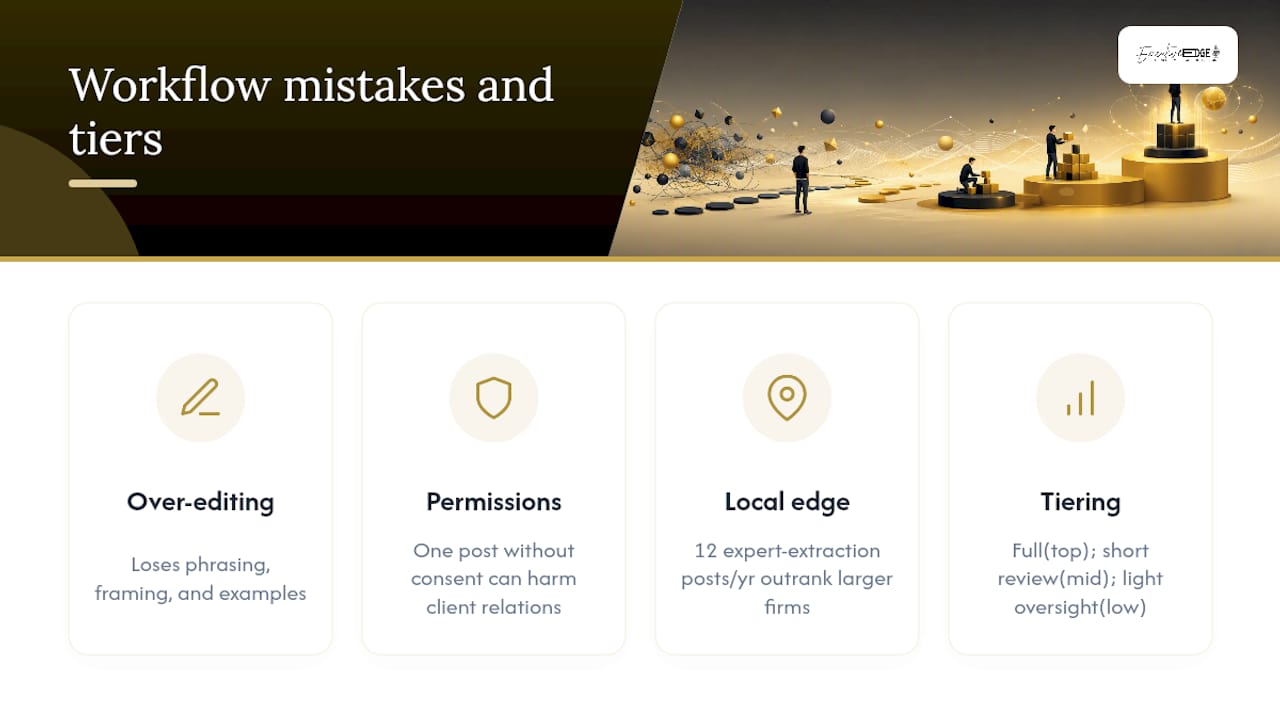
The biggest mistake isn't skipping schema or missing a keyword. It's over-editing the expert's voice out of the finished post. When a writer smooths every rough edge, the content loses the specific phrasing, the unusual framing, and the concrete examples that made the original recording worth capturing. AI systems and search engines detect entity novelty — the presence of named methodologies, specific outcomes, and unconventional claims. Sand those down and you're left with content that reads like everyone else's.
The second mistake is ignoring the permissions step. One post published without consent can create a client relationship problem that no amount of traffic is worth.
For small local businesses — the kind of firm you see throughout East Texas — this workflow is genuinely competitive. A Tyler-based financial advisor or contractor who publishes 12 expert-extraction posts per year will outrank larger firms that publish generic AI content, because the specificity of local expertise is itself a ranking signal.
Tier your production: top-competitive topics get the full expert workflow, mid-tier topics get a short expert review of an AI draft, and low-competition topics can run with lighter oversight. A common production split involves allocating some articles to full expert workflows, more to expert-reviewed AI drafts, and the rest to AI-assisted content with editorial oversight. That ratio keeps quality high without burning out your expert.
The done-for-you option: Executive Edge Authority Engine
If the workflow above is exactly what you need but you don't have the team or time to run it, Executive Edge Partner Group built the Executive Edge Authority Engine specifically for this situation.

The service handles expert extraction, transcription, draft production, SEO and AEO optimization, schema implementation, distribution, and performance tracking — every step covered under a single monthly engagement. You show up for the recording. Everything else is managed.
Typical engagements deliver 4–8 published posts per month, with full distribution across blog, social, and newsletter formats. Onboarding takes one strategy session to map your expertise to your audience's search intent.
For service-based professionals who want authority without becoming full-time content creators, this is the direct path. Eepartnergroup.
Sources
Transcription and cleanup: Otter.ai, Descript, Rev
Entity extraction and AI-assisted drafting: ChatGPT (GPT-4o), Claude, Gemini — use the prompt templates above
Schema generation: Google's Rich Results Test, Schema.org markup validator, Rank Math or Yoast SEO (WordPress)
Performance monitoring: Google Search Console, Ahrefs, Semrush
Distribution: Google Posts best practices for local visibility; Buffer or Hootsuite for social scheduling
Further reading:
- Thought Leadership OS for Solo Consultants: Frameworks, IP Development, and Publishing Systems (2026) | SoloClientStack
- SEO For Topic Experts: Rank On What You Know Fast
FAQ
How long does it take to repurpose one expert session into a blog post?
You can turn a single expert recording of around half an hour into a publishable blog post by following a structured workflow, typically requiring 2–4 writer-hours including transcription cleanup, extraction, drafting, and basic on-page optimization.
Do I need client permission to use consultation recordings in blog posts?
Yes. Obtain verbal or written consent before repurposing any client call, and anonymize all identifying details — name, company, revenue figures, and any NDA-covered information — before publishing.
How many blog posts can one expert session realistically produce?
One structured expert session of around half an hour typically yields several distinct insights, which can support one long-form post or multiple shorter posts depending on development depth.
What makes expert-extraction posts rank better than AI-only content?
Can Executive Edge Authority Engine handle the full workflow for my business?
Yes. Executive Edge Partner Group manages expert extraction, transcription, drafting, SEO and AEO optimization, schema, distribution, and tracking under one engagement. Visit Eepartnergroup to learn more.