

Content marketing for consultants is the practice of publishing expert knowledge, frameworks, and case studies to attract qualified clients without relying on cold outreach. It is the single most effective way for consultants to demonstrate expertise before a prospect ever picks up the phone. The industry term for this approach is thought leadership marketing, and it works because consulting buyers make decisions based on trust, not advertising. Consultants who publish consistently build that trust at scale. For independent consultants and boutique firms in Tyler, East Texas, and beyond, this is not a trend to watch. It is a growth system to build now.
Why consultants need content marketing to build authority
Consultants face a visibility problem more often than an expertise problem. A prospect searching for a supply chain consultant or an HR transformation advisor will encounter dozens of options. The consultant who has published a proprietary framework, a detailed case study, or a data-rich analysis wins the shortlist before the first conversation begins.

Consulting buyers audit intellectual capital extensively before sending a proposal request. That behavior means your content is doing sales work around the clock. A well-written article explaining your methodology shortens the sales cycle and reduces price resistance because the prospect already understands your value.
The difference between generic content and thought leadership content is specificity. Generic content covers broad topics anyone could write. Thought leadership content presents your proprietary method, your client results, and your interpretation of industry data. Proprietary frameworks and case studies are key differentiators that AI-generated content cannot replicate. That gap is your competitive advantage.
Named authorship matters too. Content published under your name, with your voice and your opinions, builds personal credibility faster than anonymous firm content. Readers connect with people, not logos.
- Proprietary frameworks: Publish your named methodology. Give it a title. Explain the steps. Prospects remember frameworks.
- Client case studies: Show the problem, your process, and the measurable outcome. Specificity builds trust.
- Data-rich long-form posts: Long-form content at 2,500+ words attracts backlinks 77% more effectively than shorter posts. More backlinks mean higher search visibility.
- Annual research reports: Original data positions you as a primary source in your niche, not just a commentator.
Pro Tip: Write one article that explains your core methodology in full detail. That single piece will do more to qualify prospects than any brochure or pitch deck you have ever created.
How does content marketing generate leads for consultants?
The lead generation impact of consistent publishing is measurable and significant. Consultants publishing one substantive article weekly close 2.4× more qualified leads than peers who publish sporadically. By year two, that cadence produces 30–60 inbound inquiries per month.
That number matters because inbound leads convert at a higher rate than outbound leads. A prospect who found you through your content already trusts your thinking. They arrive pre-sold on your expertise. The sales conversation shifts from "why should I hire you?" to "how do we get started?"
Consulting firms publishing weekly blog posts generate 67% more leads than those publishing less frequently. The same research shows that 89% of buyers trust peer-authored content over advertising. That trust gap is why content marketing outperforms paid ads for consultants over a 12–24 month horizon.
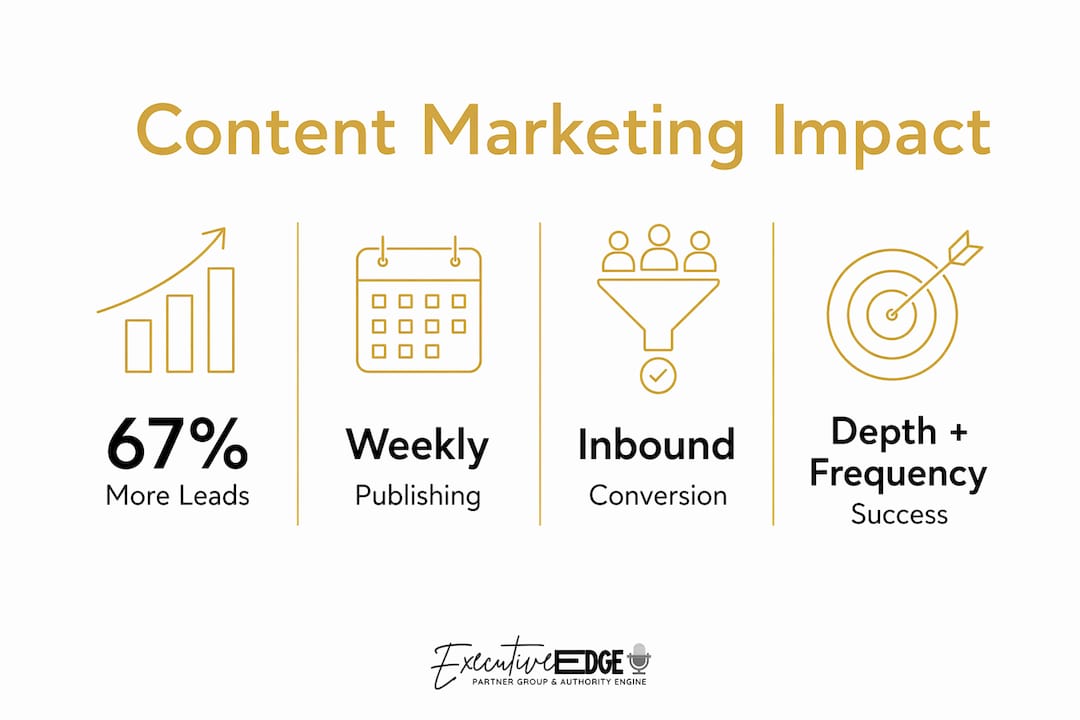
The revenue potential is concrete. Publishing one article per week sustains a $50,000–$500,000 annual revenue run rate from inbound alone by year two, depending on your fee structure and niche.
| Publishing cadence | Monthly inbound inquiries (year 2) | Lead quality |
|---|---|---|
| Daily short posts | Low | Low |
| Weekly substantive articles | 30–60 | High |
| Monthly long posts | 5–10 | Medium |
| Sporadic publishing | Unpredictable | Low |
"Independent consultants who publish one substantive article per week close 2.4× more qualified leads than peers, generating 30–60 inbound inquiries monthly by year two and a $50K–$500K annual revenue run rate from inbound alone."
The table and data above confirm one clear pattern: frequency and depth together drive results. Posting daily shallow content does not produce the same outcome as publishing one well-researched article each week.
What content strategy works best for consultants in 2026?
The most effective content strategy for consultants in 2026 combines a focused niche, a consistent weekly publishing cadence, AI-assisted production, and LinkedIn distribution. Each element reinforces the others.
-
Publish one substantive article per week. This is the proven sweet spot. It builds search authority over time without burning you out. Consistency compounds. A library of 50 well-written articles outperforms a single viral post every time.
-
Co-author with AI, but keep your voice in every piece. AI-assisted consulting firms generate 2.8× more inbound leads and cut production time by 77%, dropping from 11.4 hours per piece to 2.6 hours. That efficiency gain is real. The key is spending 20–30 minutes per piece adding your specific insight, client examples, and opinions. AI handles structure and drafting. You provide the expertise.
-
Focus on a narrow niche. Generalist content gets lost. A consultant who writes specifically about financial controls for mid-market manufacturers will rank higher and attract better-fit clients than one writing broadly about "business improvement."
-
Distribute on LinkedIn with personal engagement. LinkedIn distribution amplifies reach by 5–12× compared to company pages alone. Post your article, share a key insight in the caption, and respond to every comment. That engagement signals credibility to both the algorithm and your audience.
-
Prioritize these content formats: case studies, named frameworks, research-backed analysis, and client transformation stories. These formats perform best because they demonstrate results, not just knowledge.
Tools like Presly for business consultants help schedule and distribute content across platforms without adding hours to your week. Pairing a scheduling tool with an AI content workflow makes the weekly publishing cadence sustainable even when client work is heavy.
Pro Tip: Build a content calendar around your consulting process. Each stage of your methodology becomes an article topic. By the time a prospect reads through your library, they understand exactly how you work and why it produces results.
Common content marketing mistakes consultants make
Most consultants who try content marketing and quit do so because they made one of five predictable mistakes. Recognizing them early saves months of wasted effort.
-
Writing promotional content instead of educational content. Prospects ignore articles that read like sales pitches. Every piece should teach something useful. The sale happens as a byproduct of trust, not as the article's stated goal.
-
Publishing shallow, generic content. An article titled "5 Tips for Better Leadership" with no data, no client examples, and no original perspective adds nothing. Generic AI-generated content has 58% lower engagement than expert-authored content. Shallow content damages your credibility more than silence does.
-
Publishing inconsistently. Posting three articles in january and nothing until april signals to both search engines and prospects that you are not a reliable source. Consistency is the mechanism that builds compounding authority. A consistent publishing schedule is non-negotiable for long-term results.
-
Relying entirely on AI without adding expert input. AI tools accelerate production. They do not replace your judgment, your client stories, or your proprietary thinking. Content that reads like it was written by a machine without human review erodes the trust you are trying to build.
-
Ignoring LinkedIn distribution. Writing great content and posting it only to your website is like hosting a conference in a building with no address. LinkedIn is where consulting buyers spend time. Publishing there, engaging personally, and building a following turns your content into a lead generation channel, not just a portfolio.
The thought leadership content workflow that works is simple: write with depth, publish with consistency, distribute with intention, and inject your real expertise into every piece.
My honest take on content marketing for consultants
I have watched consultants with genuinely exceptional expertise sit invisible online while less experienced peers with active content programs win the clients. That pattern repeats itself constantly, and it frustrates me every time I see it.
The mindset shift that changes everything is treating content creation as a business system, not a creative project. Sporadic inspiration-based publishing produces sporadic results. A systemized weekly workflow produces compounding authority. Those are not the same thing.
What I have seen work, consistently, is consultants who inject their real voice into their content. Not polished corporate prose. Not recycled industry talking points. Their actual opinions, their specific client experiences, and their named methods. That authenticity is what separates content that builds a pipeline from content that fills a blog no one reads.
The consultants who resist this usually say the same things: "I don't have time," or "I'm not a writer." Both objections dissolve when you build a production system around your existing expertise. Twenty minutes of your input per week, structured into a repeatable workflow, is enough to produce one high-quality article. That is a manageable commitment with a measurable return.
East Texas consulting markets are no different from national ones in this regard. The consultants who show up consistently online, with real insight and a clear point of view, win the trust of buyers who have never met them in person. That is the power of content done right.
— David Domm
How Executive Edge Partner Group helps consultants build authority
Consultants who want to grow their inbound pipeline without becoming full-time content creators have a clear path forward with Executive Edge Partner Group.

Executive Edge Partner Group runs a done-for-you authority-building system built specifically for consultants, executives, and service professionals. The system turns your expertise into long-form articles, social content, and multi-platform distribution campaigns, all optimized for Google, YouTube, and AI-driven search platforms. You contribute your knowledge. The system handles production, publishing, and distribution. The result is a growing library of expert content that attracts qualified prospects and positions you as the recognized authority in your niche. Visit Executive Edge Partner Group to see how the system works and what it can do for your consulting practice.
FAQ
Why do consultants need content marketing?
Content marketing builds the trust and visibility that consulting buyers require before hiring. Consultants who publish consistently attract more qualified inbound leads and shorten their sales cycles.
How often should a consultant publish content?
One substantive article per week is the proven cadence. Consultants publishing at that frequency generate 67% more leads and close 2.4× more qualified opportunities than those who publish less often.
What types of content work best for consultants?
Proprietary frameworks, client case studies, and data-rich long-form articles perform best. These formats demonstrate real expertise and attract backlinks 77% more effectively than generic content.
How long does content marketing take to produce results for consultants?
Most consultants see meaningful inbound lead growth within 12–24 months of consistent weekly publishing. By year two, that cadence typically produces 30–60 inbound inquiries per month.
Can consultants use AI to create content?
Yes, with one condition: expert input must be added to every piece. AI-assisted workflows reduce production time by 77%, but generic AI content without human editorial input has 58% lower engagement than expert-authored content.