

Content marketing for real estate is defined as the practice of creating and distributing educational, hyperlocal, and multimedia content to attract buyers, sellers, and investors without relying on paid advertising. Real estate agents who use content consistently generate 5.4x more leads than those who do not publish at all. That gap is not a coincidence. It reflects a fundamental shift in how buyers and sellers research agents before ever picking up the phone. The agents winning in 2026 are not necessarily the ones with the biggest ad budgets. They are the ones who show up consistently with the right content, on the right platforms, for the right local audience. For real estate professionals in markets like Tyler, Texas and across East Texas, that local specificity is the competitive edge.
How real estate agents use content to generate leads
Content marketing is the primary lead generation engine for agents who have moved beyond cold calling and door knocking. 78% of agents publishing 31 or more short-form videos monthly report that content drives a significant share of their deals. That number tells you something direct: volume and consistency matter as much as quality. Agents who treat content as a one-time campaign rarely see results. Agents who treat it as an ongoing publishing practice build a lead pipeline that compounds over time.
The industry term for this approach is content marketing, and it operates on a simple principle. When a potential seller searches for "home prices in my neighborhood" or a buyer looks up "best school districts near me," the agent who published that answer owns the relationship before the conversation starts. Content positions agents as trusted guides rather than salespeople, and that distinction closes more deals.
What types of content do real estate agents use to engage their audience?
The most effective content formats in real estate fall into five clear categories, each serving a different stage of the buyer or seller decision process.
- Short-form video. Instagram Reels and YouTube Shorts drive the highest engagement per post of any format. Video listings generate 403% more inquiries than static photo-only listings. That is not a marginal improvement. It is a category difference. Agents who add video walkthroughs to every listing immediately separate themselves from the majority.
- Hyperlocal market updates. Sellers monitor neighborhood-specific price data before they ever contact an agent. Publishing monthly market reports for specific zip codes or subdivisions positions an agent as the local authority. Generic national market commentary does not build that trust.
- Buyer and seller guides. Educational content that explains the purchase process, closing costs, or what to expect during inspections answers questions prospects are already searching. This content works around the clock without any additional effort from the agent.
- Community stories and local events. Content about local restaurants, school events, or neighborhood developments builds emotional connection. Buyers do not just buy homes. They buy into communities.
- Virtual tours and staging content. Visual content that shows a home's potential, not just its current state, drives faster decisions. Instagram Reels earn 3.2x more saves and shares than static posts, making them the format of choice for listing promotion.
Pro Tip: Batch your content creation. Film five neighborhood videos in one afternoon, then schedule them across three weeks. Consistency beats intensity every time.
Agents who publish geo-optimized local content consistently outperform those who post reactively. The format mix matters less than the commitment to showing up for a specific audience in a specific place.

How do real estate agents use digital platforms and technology?
Platform selection determines whether content reaches high-intent prospects or disappears into the noise. The data here is blunt: 94.2% of agents get zero leads from TikTok, and 86.4% get zero leads from LinkedIn. These platforms attract broad audiences, not local buyers and sellers ready to act. Agents who chase follower counts on the wrong platforms waste time that could build real authority elsewhere.
The most effective digital ecosystem for real estate content works in a specific sequence:
- Own your website first. An IDX-enabled website serves as the content hub. It captures search traffic, hosts long-form market reports, and collects lead data. Agents who move prospects from social platforms into their own website gain far more control over the relationship than agents who rely on third-party portals.
- Connect your CRM. IDX search behavior reveals intent. When a visitor saves a search for three-bedroom homes under $400,000 in a specific neighborhood, that data feeds directly into a CRM. Automated follow-up sequences then nurture that lead without manual effort.
- Prioritize Google reviews. Agents with 20 or more Google reviews generate 2.7x more leads than those with fewer. Reviews function as social proof content that works passively. Every satisfied client is a content asset waiting to be activated.
- Use AI for efficiency, not replacement. 63% of agents use AI daily for content tasks, and 32% save six or more hours weekly by automating text-heavy work like listing descriptions and blog drafts. AI accelerates production. It does not replace the agent's voice or local knowledge.
- Focus video on Instagram Reels. Among social platforms, Instagram Reels consistently deliver the strongest return for real estate content. Short-form video on this platform reaches local audiences and drives shares that extend organic reach without paid promotion.
Pro Tip: Set up a saved-search alert on your IDX site so your CRM automatically flags anyone who views a listing more than three times. Those are your hottest leads.
The benefits of video content extend beyond listings. Agents who publish market commentary videos on their own sites build search authority that compounds over months and years.
What are the long-term benefits and ROI of consistent content marketing?
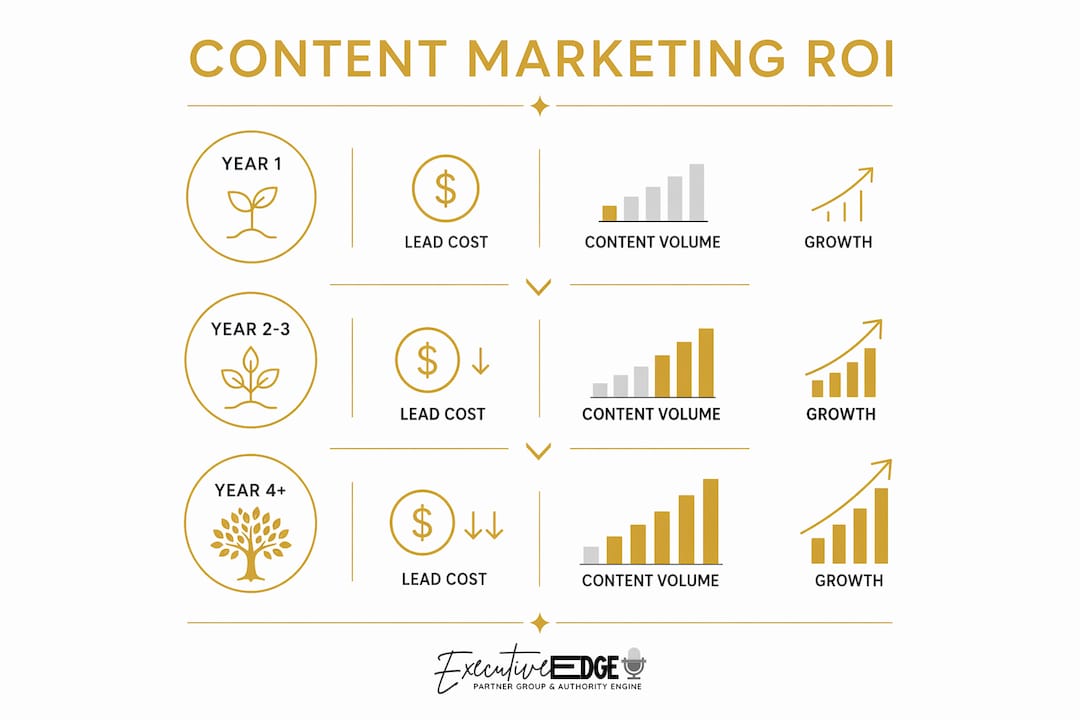
The economics of content marketing for real estate improve dramatically over time. Early-stage content costs more per lead. Sustained content costs far less.
| Stage | Approximate cost per lead | Key driver |
|---|---|---|
| Year 1 (starting out) | $80–$100 | Low content volume, limited authority |
| Year 2+ (consistent posting) | $7–$15 | Evergreen content builds compounding traffic |
| 4+ years, 5+ posts monthly | Lowest cost | 9x deal rate vs. inconsistent agents |
Agents who post consistently for four or more years and publish five or more short-form posts monthly report that content drives deals at nine times the rate of agents who post sporadically. That compounding effect is the single most underappreciated fact in real estate marketing. Most agents quit before the curve bends in their favor.
The tracking problem compounds this issue. 60% of agents do not track true lead sources, which means they systematically underestimate what content is doing for their business. A seller who found an agent through a YouTube video six months ago may tell their CRM they "heard about you from a friend." Without proper attribution through IDX and CRM integration, that content win goes uncounted. Agents who fix their tracking discover that content is already outperforming channels they thought were working.
Email marketing and sphere-of-influence outreach work best as complements to content, not replacements. A monthly market update email that links back to a detailed blog post on the agent's website drives both relationship maintenance and website traffic simultaneously.
How can real estate agents create a sustainable content strategy?
A sustainable content strategy for real estate rests on three pillars: hyperlocal focus, consistent scheduling, and owned-platform distribution.
- Go hyperlocal, not broad. Content about a specific subdivision, school district, or zip code outperforms generic market commentary every time. Sellers researching their neighborhood want data about their street, not national trends. Hyperlocal content builds trust before the listing conversation even starts.
- Build a content calendar with batch creation. Decide on a publishing cadence, whether that is two posts per week or daily short-form video, and stick to it. Batch creation, filming or writing multiple pieces in one session, removes the daily decision fatigue that kills most content programs.
- Apply local SEO to every piece. Every blog post, video title, and property description should target specific local and long-tail search queries. "Homes for sale in [neighborhood name]" and "what is my home worth in [city]" are the queries that attract high-intent traffic. Generic titles attract no one.
- Use gated content to capture leads. A free neighborhood price report, a first-time buyer checklist, or a home valuation tool placed behind an email capture form converts anonymous website visitors into named leads. This is where IDX integration pays off most directly.
- Balance your content mix. Written blog posts build search authority. Short-form video drives social engagement. Email newsletters maintain relationships. No single format does all three jobs well. A local brand content strategy that uses all three formats reaches prospects at every stage of their decision.
The agents who win with content are not the ones who post the most. They are the ones who post the most consistently about the most specific topics for the most specific audience.
What I've learned about content and patience in real estate marketing
Real estate agents consistently underestimate how long content takes to pay off, and they overestimate how quickly paid ads will save them. I have watched agents pour money into Facebook lead generation campaigns for six months, get frustrated, and quit. Then I have watched other agents publish two neighborhood videos per week for two years and suddenly find themselves with more referrals than they can handle. The difference is not talent. It is time horizon.
The data on the compounding effect is real. The cost-per-lead curve bends sharply after year two. But most agents never get there because they treat content like a campaign instead of a practice. A campaign has a start date and an end date. A practice just continues.
The other mistake I see constantly is ignoring lead source tracking. Agents who do not know where their leads come from cannot make good decisions about where to invest their time. They end up doubling down on platforms that feel busy but produce nothing, while their blog posts and YouTube videos quietly send them clients they never properly credit.
The agents I respect most in this industry treat their content library the way a financial advisor treats a portfolio. They add to it consistently, they track its performance, and they let compounding do the heavy lifting. That mindset, more than any specific tactic or tool, is what separates agents who build lasting businesses from those who are always chasing the next lead.
— David Domm
How Executive Edge Partner Group helps real estate professionals build content authority
Real estate professionals who want to build a content presence without becoming full-time content creators have a direct path forward with Executive Edge Partner Group.

Executive Edge Partner Group's Authority Engine system turns an agent's local expertise into published blog articles, short-form video scripts, social media content, and AI-optimized listings, all distributed across Google, YouTube, and local search platforms. The system is built specifically for service-based professionals who need consistent visibility without managing a content team. Agents in competitive markets use it to establish the kind of online authority that generates inbound leads instead of chasing them. If you are ready to build a content presence that compounds over time, Executive Edge Partner Group is the place to start.
FAQ
How do real estate agents use content to get more leads?
Real estate agents use content marketing by publishing hyperlocal blog posts, short-form videos, and market reports that attract buyers and sellers through search engines and social platforms. Agents with active content programs generate 5.4x more leads than those without one.
What content format works best for real estate agents?
Video is the highest-performing format. Listings with video generate 403% more inquiries than photo-only listings, and Instagram Reels earn 3.2x more shares than static posts.
How long does real estate content marketing take to produce results?
Consistent content marketing typically takes one to two years to significantly reduce cost per lead. Agents who post for four or more years report a 9x deal rate compared to sporadic posters.
Should real estate agents use TikTok or LinkedIn for content?
The data does not support either platform for lead generation. 94.2% of agents get zero leads from TikTok and 86.4% get zero from LinkedIn. Agents generate better returns by focusing on their own IDX website, Google reviews, and Instagram Reels.
How do real estate agents track whether content is generating leads?
Agents track content-driven leads by connecting their IDX website to a CRM that logs visitor behavior and saved searches. 60% of agents currently do not track lead sources accurately, which causes them to undervalue their content's real impact.