

Long-form content is defined as written material that covers a topic with enough depth, structure, and evidence to serve as a complete reference. For professionals and business leaders, this format is not optional. It is the primary mechanism for building online authority, earning trust from decision-makers, and appearing in both traditional search and AI-powered discovery platforms. Research confirms that pages covering multiple sub-questions within a topic are 161% more likely to be cited in AI Overviews than thin pages. That gap is too large to ignore. For business owners in Tyler and East Texas, where local reputation and online visibility often determine who gets the call, understanding why professionals need long-form content is a direct competitive advantage.
Why professionals need long-form content: the core case
Long-form content builds authority because it demonstrates the full scope of a professional's knowledge. A 500-word blog post can state an opinion. A 2,000-word article can prove it with definitions, comparisons, edge cases, and supporting data. That difference is what separates a brand that appears credible from one that actually is credible.
The research on this is clear. 97% of B2B marketers identify thought leadership as critical for full-funnel success. That means content must do more than attract clicks. It must move prospects from awareness to trust to decision. Long-form articles are the format best suited to carry that load.
The benefits of long-form content for professionals include:
- Authority and thought leadership. Comprehensive articles position you as the go-to expert in your field. Readers who finish a thorough guide leave with a clear sense of your expertise.
- Engagement and dwell time. Longer, well-structured content keeps readers on the page longer. Search engines interpret that signal as a quality indicator.
- SEO and AI visibility. Content covering definitions, comparisons, and edge cases is cited 2.4 times more frequently in AI-powered search results than thin pages. That citation advantage compounds over time.
- Natural backlinks. When your article is the most complete resource on a topic, other writers link to it because it saves their readers time. Comprehensive guides earn backlinks precisely because they eliminate the need for readers to search further.
- Trust with decision-makers. 74% of high-influence contributors report their comprehensive content is highly effective, compared to 29% for those producing generic material. That 45-point gap reflects the real cost of shallow content.
Pro Tip: Structure your long-form articles with a clear definition in the first paragraph. AI systems and search engines extract definitions near the top of the page most frequently, which directly improves your citation rate.
How does long-form content differ from short-form in professional contexts?
Short-form content and long-form content serve different jobs. Confusing the two is one of the most common mistakes professionals make with their content strategy.

Short-form content, typically under 600 words, works best for reactive engagement. A quick LinkedIn post about an industry trend, a brief social update, or a short email newsletter keeps you visible in feeds. It does not, however, establish you as the authority on a subject. It cannot. There is not enough space to prove depth.
Long-form content, by contrast, builds permanent authority. A detailed article, a research-backed guide, or a thorough case study becomes a reference that readers return to and share over time. The value of in-depth content lies in its durability. A well-written long-form piece continues to attract traffic and citations months or years after publication.
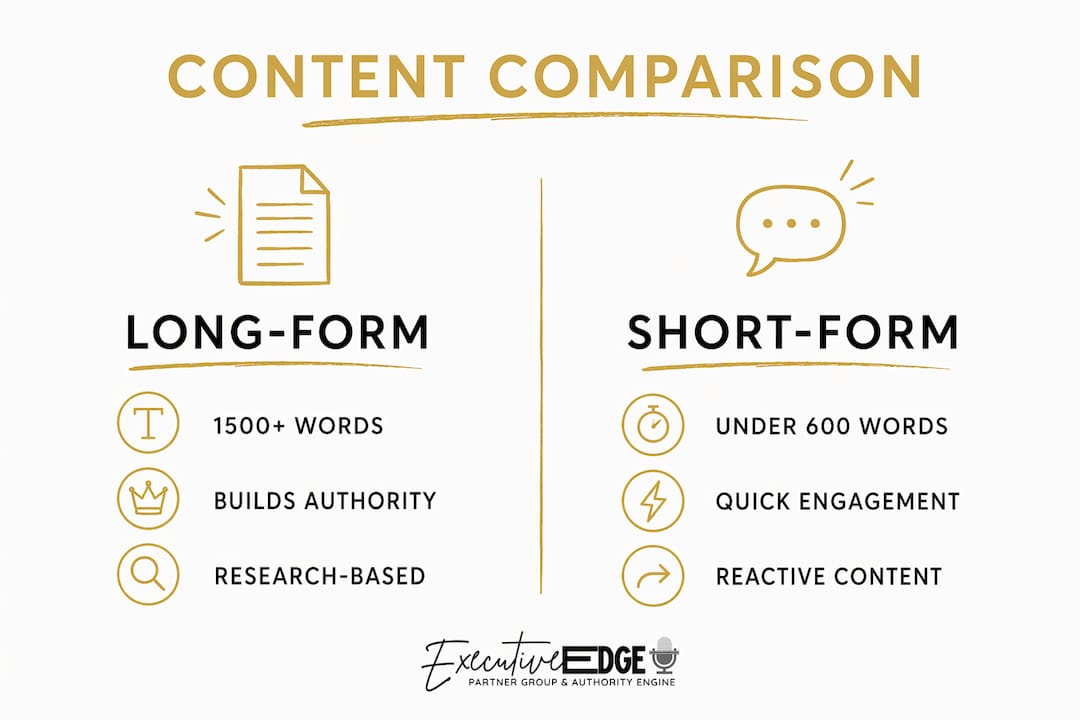
| Characteristic | Long-form content | Short-form content |
|---|---|---|
| Typical length | 1,500+ words | Under 600 words |
| Primary purpose | Build authority and trust | Maintain visibility and engagement |
| SEO impact | High, sustained | Low to moderate |
| AI citation likelihood | Significantly higher | Lower |
| Backlink potential | Strong | Minimal |
| Best distribution channel | Blog, LinkedIn articles, YouTube | Social feeds, email, stories |
The most effective professional content strategy uses both. One deep anchor post per week, supported by daily short reactive content, maximizes SEO and topical authority while keeping you present in your audience's daily feed. Neither format alone produces the same result as the two working together.
Pro Tip: Treat your long-form articles as the foundation and your short-form posts as the amplification layer. Each short post should point back to the deeper resource, driving traffic and reinforcing your authority on the topic.
What makes long-form content truly effective in 2026?
Length alone does not produce authority. A 3,000-word article full of filler is worse than a focused 1,500-word piece that answers every relevant question. Effective long-form content in 2026 follows a specific set of principles.
- Cover the full scope of the topic. Include definitions, comparisons, edge cases, and real-world lessons. Avoid the temptation to stay surface-level to keep things "accessible." Decision-makers want depth.
- Use a human, helping tone. 65% of decision-makers prefer a human, accessible tone. Frame your content as helping rather than selling. That shift lowers resistance and builds trust faster than any marketing assertion.
- Be transparent about tradeoffs and limitations. Founders and professionals who explore nuances and lessons learned rather than projecting perfection build human-level trust that polished marketing copy cannot match. Readers recognize honesty.
- Structure for AI extraction. Clear, extractable definitions near the top improve citation likelihood in AI search. Each subsection should be independently answerable. Write as if every H2 and H3 heading might be the only section a reader or AI system sees.
- Use original research when possible. Original research fuels content ecosystems that build trust across the entire buyer's journey. A single original study or survey can generate dozens of derivative articles, social posts, and speaking opportunities.
- Update content regularly. A well-structured article that goes stale loses its authority signal. Schedule quarterly reviews of your top-performing long-form pieces and update statistics, examples, and references.
The combination of depth, transparency, and structure is what separates content that earns citations from content that gets ignored.
How can professionals integrate long-form content into their strategy?
A practical long-form content strategy does not require writing a new guide every day. It requires a clear system.
- Plan anchor posts first. Identify the five to ten topics that define your expertise. Write one thorough, research-backed article on each. These become the permanent pillars of your online authority.
- Build a content ecosystem around each anchor. Every anchor post can generate social posts, email newsletters, short videos, and podcast episodes. Original research creates a platform that compels engagement across multiple channels without requiring you to start from scratch each time.
- Prioritize consistency over volume. One well-researched article per month outperforms four rushed posts. Consistent content builds the compounding authority signal that search engines and AI platforms reward.
- Distribute across multiple channels. Publish on your blog, share excerpts on LinkedIn, record a short video summary for YouTube, and reference the article in your email list. Multi-channel distribution multiplies the reach of a single piece of content.
- Measure what matters. Track organic search traffic, average time on page, backlinks earned, and AI citation appearances. These metrics tell you whether your content is building authority or just filling space.
Understanding how content marketing works at a structural level makes each of these steps easier to execute consistently.
The uncomfortable truth about long-form content most professionals miss
I have worked with enough business owners and executives to know the most common objection: "I don't have time to write 2,000-word articles." That objection is real. But it misidentifies the problem.
The actual problem is not time. It is the absence of a system. Professionals who produce consistent long-form content do not sit down and write from scratch every week. They capture their existing expertise through conversations, interviews, and recorded sessions, then convert that material into structured articles. The knowledge is already there. The process is what is missing.
The second thing I see consistently is professionals treating long-form content as a one-time project rather than a compounding asset. A single well-structured article can generate traffic, citations, and leads for years. That is a fundamentally different return on investment than a paid ad that stops working the moment the budget stops.
The third misconception is that AI-generated content at scale replaces this work. It does not. 35% of high-performing firms say original, long-form research is more valuable than generic AI-generated content for establishing trust. AI can assist the process. It cannot replace the professional's actual experience, judgment, and voice. That is what decision-makers are paying attention to. This is something I see consistently with East Texas professionals who invest in their own expertise as the content source rather than outsourcing their perspective entirely.
— David Domm
How Executive Edge Partner Group helps professionals build content authority
Building a long-form content system from scratch takes time most professionals do not have.

Executive Edge Partner Group runs a done-for-you authority-building system that converts your existing expertise into structured long-form articles, podcast episodes, video content, and multi-platform distribution. The system is built for professionals, consultants, executives, and service-based businesses in Tyler, Texas and beyond who want to appear prominently in Google, YouTube, and AI search without becoming full-time content creators. Every piece of content is built around your real knowledge and voice, not generic filler. If you are ready to turn your expertise into a permanent online authority asset, visit Executive Edge Partner Group to see how the system works.
FAQ
What is long-form content for professionals?
Long-form content is written material of 1,500 words or more that covers a topic with enough depth to serve as a complete reference. For professionals, it is the primary tool for building online authority and earning trust from decision-makers.
How does long-form content boost SEO?
Pages that cover multiple sub-questions within a topic are 161% more likely to be cited in AI Overviews than thin pages. Depth and topical completeness are the primary drivers of search and AI visibility in 2026.
How often should professionals publish long-form content?
One thorough anchor post per week, supported by daily short reactive content, maximizes topical authority while maintaining audience engagement. Consistency matters more than volume.
Does long-form content still matter with AI-generated content everywhere?
Yes. Original, long-form research is more valuable than generic AI-generated content for establishing trust, according to high-performing B2B firms. AI can support the writing process, but the professional's expertise and voice remain the core credibility signal.
What is the difference between long-form and short-form content for authority building?
Long-form content builds permanent authority through depth and comprehensive coverage. Short-form content maintains daily visibility and engagement. Both serve distinct roles in a complete content strategy.