

The fastest way to build real authority on LinkedIn is to pick one narrow niche, commit to a clear point of view, and publish on a consistent schedule for at least six months. Start today by rewriting your headline to name who you help and what outcome you deliver, then publish one post built around a genuine belief you hold about your industry. Expect meaningful traction within 6 to 12 months, showing up as inbound conversations and, eventually, influence over deals in your pipeline.
Table of Contents
- What Is LinkedIn Thought Leadership, and Why Does the Platform Matter So Much?
- The Four Pillars of Effective LinkedIn Thought Leadership
- How Should You Set Up Your LinkedIn Profile for Authority?
- Which LinkedIn Content Formats Actually Build Authority?
- How Often Should You Post to Build Momentum?
- How Do You Build Real Engagement, Not Just Views?
- Which Metrics Actually Prove LinkedIn Thought Leadership Is Working?
- What Mistakes Kill LinkedIn Thought Leadership Before It Starts?
- Executive Edge Authority Engine: What a Done-for-You Program Looks Like
- Author Perspective: Sustaining Thought Leadership Over the Long Run
- How to Start With Executive Edge
- Sources
- FAQ
What Is LinkedIn Thought Leadership, and Why Does the Platform Matter So Much?
LinkedIn thought leadership means publishing consistent, substantive content that demonstrates real expertise, rather than promotional posts about your company. It works because LinkedIn's own data backs it up with numbers most executives haven't seen.
The 2024 Edelman–LinkedIn B2B Thought Leadership Impact Report, based on a survey of 3,484 management-level professionals, found that strong thought leadership makes buyers measurably more receptive to outreach and more likely to include a provider in a request for proposal. That is not brand awareness. That is a documented shift in buying behavior tied directly to content people actually read and remember.
The platform mechanics reinforce this. LinkedIn's own marketing guidance confirms the algorithm favors individual voices over branded company pages, and rewards posts that hold attention rather than ones that ask for a click. A founder's personal post about a hard lesson learned will nearly always outperform the same company's polished corporate update, because LinkedIn's feed logic reads dwell time and genuine reaction as trust signals, not just impressions.
The business case in one number: Edelman and LinkedIn's research shows high-quality thought leadership directly increases the odds of RFP inclusion, meaning content you publish today can be shortlisting you for deals you haven't pitched yet.
That business impact shows up in a few concrete ways:
- Inclusion in RFPs and vendor shortlists before a formal pitch process begins
- Stronger pricing power, since buyers who trust your expertise negotiate less on price
- Inbound leads who arrive pre-sold on your point of view, shortening sales cycles
- A defensive moat, since Edelman's research frames strong thought leadership as protecting existing customers from competitor persuasion, not just winning new ones
The Four Pillars of Effective LinkedIn Thought Leadership
Every durable LinkedIn presence rests on four pillars: a tight niche, a clear point of view, consistency, and generosity. Skip any one of them and the content either blends into the noise or burns you out within a few months.
- Niche. Narrow your focus until it hurts a little. "Marketing advice" is not a niche. "Pricing strategy for B2B SaaS companies under $10M in revenue" is. A tight niche makes it obvious who should follow you and why, and it makes you the obvious person to think of when that specific problem comes up.
- Point of view. Generic advice is forgettable. Draft three to five "I believe" statements about your field, the kind that would make a peer in your industry raise an eyebrow. "I believe most law firms overinvest in SEO and underinvest in referral systems" is a POV. "SEO is important for law firms" is filler.
- Consistency. A brilliant post published once a month loses to a decent post published three times a week. Consistency is what turns a stranger scrolling past your name into someone who recognizes it on sight.
- Generosity. The Edelman report lists three markers of quality thought leadership: content that cites real research, helps readers reframe a challenge, and offers concrete, usable guidance rather than vague platitudes. Give away your actual thinking, not a teaser for a sales call.
Once you have your niche and POV drafted, map three or four content pillars directly to the problems your buyers lose sleep over. If you sell fractional CFO services, your pillars might be cash flow forecasting, fundraising readiness, and cost discipline during a slowdown. Every post you write should trace back to one of those pillars.
Pro Tip: Write your five "I believe" statements before you write a single post. If you can't defend one in an argument with a smart peer, it's not sharp enough to be your point of view yet.
How Should You Set Up Your LinkedIn Profile for Authority?
Most profiles read like resumes. An authority-building profile reads like a landing page, and the difference in inbound messages is significant.
Your headline should follow a simple formula: who you help, the outcome you deliver, and optionally your specialty.
Your About section should open with the specific problem you solve, not your biography. Save the résumé details for the bottom. Structure it in three short blocks: the problem you address, how you approach it differently, and a simple call to action, like inviting people to follow for weekly insight on that exact problem.
Your Featured section is prime real estate that most people leave empty or cluttered with old press releases. Use it for your three best posts, a short native video introducing your POV, and a link to a lead magnet or newsletter signup.
Turning on Creator Mode changes how your profile displays, replacing the "Connect" button with "Follow" for most visitors and surfacing your content pillars as hashtag topics under your headline. Combine that with a LinkedIn newsletter, which notifies your entire follower base every time you publish, and native articles, which LinkedIn's search treats differently than standard posts and which tend to have a longer shelf life in search results.
A six-item checklist to run through this week:
- Rewrite your headline using the who/outcome/specialty formula
- Rebuild your About section to lead with a problem, not a bio
- Curate Featured down to three strong, current pieces
- Turn on Creator Mode and select topics that match your niche
- Launch a newsletter tied to one of your content pillars
- Publish one native article that expands on your core POV
Which LinkedIn Content Formats Actually Build Authority?
Not every post format carries the same weight. Practitioner analysis of LinkedIn's algorithm behavior in 2026 shows the platform rewards dwell time and deep signals, meaning saves and substantive comments matter more than quick likes.
The format signal that matters most: posts that hold a reader's attention long enough to generate a save or a real comment tend to get pushed further into other feeds, which is why document carousels and long-form text posts consistently outperform quick promotional updates.
Four formats do most of the heavy lifting for LinkedIn thought leadership:
- Document carousels (PDF posts). These force LinkedIn to display your content page by page inside the feed, which naturally extends dwell time. They work especially well for frameworks, checklists, or step-by-step breakdowns.
- Long-form text posts. Social media research on post length confirms that longer, well-structured posts that develop one substantive idea tend to hold attention better than short promotional lines, provided the formatting uses short paragraphs and white space instead of dense blocks.
- Short native video. Best used for quick reactions, behind-the-scenes moments, or humanizing your POV. It rarely drives the same dwell time as text or carousels, but it builds recognition and trust, and it pairs well with the kind of practical B2B video strategy that keeps a feed feeling like a real person, not a content machine.
- Native articles. Lower velocity but longer shelf life, useful for evergreen POV pieces you want discoverable months after publishing.
A high-dwell post generally follows one of four templates: the failure lesson (what went wrong and what you'd do differently), the contrarian take (challenging conventional wisdom in your field), the named framework (a memorable, repeatable model with a title), or the behind-the-scenes look (showing the messy reality behind a polished outcome). Explore more proven post formats to build out a template library of your own.
How Often Should You Post to Build Momentum?
Consistency beats intensity. Practical guidance from LinkedIn thought leadership practitioners recommends a minimum of two posts per week, with three as the realistic target for compounding results over a 6 to 12 month horizon. Fewer than two, and the algorithm and your audience both lose the thread between posts.
- Set your cadence at three posts weekly, treating two as your floor on a busy week rather than your goal.
- Design two or three recurring series tied directly to your content pillars, something like a weekly "Mistake I See" post or a monthly deep dive on one client problem. Named, recurring series build recognition faster than one-off posts because followers start to anticipate them.
- Build a repurposing matrix so one piece of thinking becomes five assets: a long-form article becomes a document carousel, which gets clipped into two or three short video moments, which feeds a newsletter recap, which eventually becomes a blog post on your own site. This exact content workflow is what keeps consistent publishing sustainable instead of exhausting.
Podcasting fits naturally into this matrix too. A single recorded conversation can supply weeks of clips, quotes, and carousel content, which is why a defined podcast strategy works well as the raw material feeding everything else.
How Do You Build Real Engagement, Not Just Views?
The first hour after you publish matters more than most people realize. Early engagement velocity is an algorithmic lever, and the initial burst of comments and reactions in that window significantly predicts how widely LinkedIn distributes the post afterward.
A few tactics reliably generate that early velocity:
- Post when your specific audience is actually online, not at a generic "best time to post" hour
- Message two or three engaged connections directly and ask for their honest take on the post's idea
- Reply to every comment within the first 30 minutes to keep the conversation thread active
Commenting on other people's posts is just as important as your own publishing schedule, and it costs nothing. Three scripts that consistently spark real conversation instead of a generic "Great post!":
- "I've seen the opposite happen when [specific scenario]. Curious if that's just my industry or a broader pattern."
- "This connects to something I've been wrestling with: [related question]. How do you think about that piece?"
- "Strong take. What would change your mind on this?"
Building an actual community around your content means going beyond the feed. A newsletter keeps your best followers engaged between posts, showing up in their inbox rather than competing with algorithm luck. Hosting or speaking at LinkedIn Live events and staying active in relevant LinkedIn groups both add another layer of consistent visibility.
Pro Tip: Block 15 minutes before you publish your own post to comment thoughtfully on five other posts in your niche. It warms up your presence in the feed and often pulls those people into your comments section within the hour.
Which Metrics Actually Prove LinkedIn Thought Leadership Is Working?
Vanity metrics like follower count feel good and mean very little. The signals that actually correlate with pipeline are quieter: saves, inbound DMs from people who match your ideal client profile, profile views coming from your target accounts, and commenters who show up again and again on multiple posts.
The tracking gap most people miss: likes are the easiest metric to see and the weakest one to trust, while saves and repeat commenters are harder to spot but far more predictive of real business interest.
Simple tracking makes this measurable without extra software:
- Tag inbound LinkedIn leads in your CRM with a source field so you can trace deals back to specific posts
- Use UTM parameters on any link you share in a post or newsletter to track click-through into your site
- Keep a running note of qualitative signals, like a prospect mentioning a specific post during a sales call
For your first 90 days, watch profile views from target-account employees, saves per post, and DM volume. By the 12-month mark, you should be reviewing whether any closed deals can be traced back to LinkedIn engagement, and whether your average sales cycle has shortened for leads who found you through content, a pattern consultants report often once their content library matures.
What Mistakes Kill LinkedIn Thought Leadership Before It Starts?
Most people don't fail at this because their ideas are weak. They fail because of avoidable, repeatable mistakes.
- Posting inconsistently, then quitting after low engagement. Fix: commit to 90 days minimum before judging results, since the algorithm and your audience both need repetition to respond.
- Writing for everyone instead of a niche. Fix: narrow your topic until a stranger could guess your job from three posts alone.
- Leading with credentials instead of a point of view. Fix: open every post with the idea, not your title.
- Ignoring comments on your own posts. Fix: reply to every comment in the first hour, every time.
- Never engaging with anyone else's content. Fix: comment on five posts before you publish your own each week.
- Treating LinkedIn like a resume instead of a media channel. Fix: rewrite your profile using the setup steps above.
- Changing your point of view every time a post underperforms. Fix: persist through at least ten posts on a topic before deciding it doesn't resonate; change your POV only when the market itself shifts, not because one post flopped.
A short weekly maintenance check keeps you honest: did you hit your posting cadence, did you comment on others' content, and did you reply to everyone who engaged with you?
Executive Edge Authority Engine: What a Done-for-You Program Looks Like
Not every executive has the time to write, film, and publish consistently while running a business. Executive Edge Authority Engine exists for exactly that gap, built for business owners, consultants, and professionals who want the authority without becoming a full-time content creator.
Clients typically receive a weekly podcast episode, blog articles, short-form social content, and ongoing SEO, GEO, and AEO optimization designed for both traditional search and AI-driven discovery platforms.
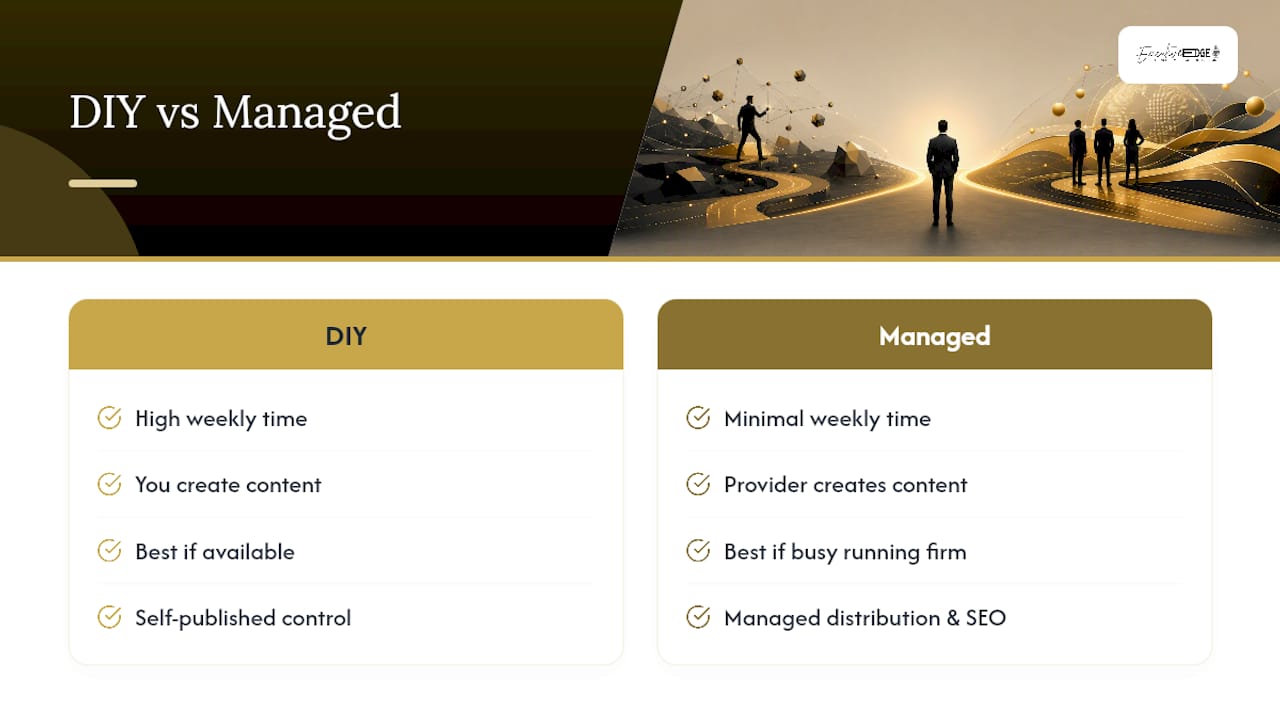
The decision between DIY and managed usually comes down to bandwidth. If you can commit real weekly hours to writing and filming, the DIY path above works. If your time is better spent running the business you're trying to build authority for, a managed system closes that gap.
Author Perspective: Sustaining Thought Leadership Over the Long Run
Most people quit LinkedIn thought leadership around week six, right when it starts working. Compounding results don't announce themselves. They show up quietly, as a DM from someone who's been reading for three months, or a prospect who mentions your last post before you've even opened your mouth in the sales call. This is something we see consistently with business owners across Tyler and East Texas who commit to the process without expecting instant traction. Give it the full 6 to 12 months before you judge whether it's working.
— David Domm
How to Start With Executive Edge
If you've read this far and the honest answer is "I believe in this, but I don't have the hours," you're exactly who Executive Edge Partner Group built this for. Business owners, consultants, and executives who want the RFP inclusion, the inbound leads, and the pricing power that come with real authority, without personally writing, filming, and editing every week.
The process starts with an audit of your current profile, positioning, and any existing content, followed by a content plan built around your specific niche and point of view, then a pilot month to prove the workflow before you commit long-term. Unlike hiring a traditional agency and managing a dozen freelancers yourself, Executive Edge Partner Group runs the entire system end to end, from the weekly podcast to the AEO-optimized blog posts to the short-form clips that fill your feed. If you're ready to see what a fully managed authority system looks like for your business, visit Executive Edge Partner Group to schedule your audit.
Sources
The 2024 Edelman–LinkedIn B2B Thought Leadership Impact Report provides the research backbone for the business case in this guide. LinkedIn's own marketing blog guidance and its collection of format examples offer platform-native direction. Hootsuite's post-length research rounds out the practical formatting advice.
- 2024 Edelman–LinkedIn B2B Thought Leadership Impact Report
- How to Create Impactful Thought Leadership Content (LinkedIn Marketing Blog)
- How to Use LinkedIn for Thought Leadership in 2026 (Linkboost)
- LinkedIn Thought Leadership Guide · Lunatic AI
- Hootsuite blog: Ideal social media post length
FAQ
What is thought leadership on LinkedIn?
It's consistent, substantive content published under an individual's name that demonstrates real expertise and a clear point of view, rather than promotional posts about a company or product.
Are LinkedIn thought leader ads worth it?
Paid amplification can extend the reach of a genuinely strong post, but Edelman's research suggests the underlying content quality, not ad spend, is what actually drives RFP inclusion and buyer receptiveness.
Who are the best thought leaders on LinkedIn?
There's no single official ranking, but the strongest voices consistently share a tight niche, a defensible point of view, and a publishing cadence of at least two to three posts weekly.
How do you post thought leadership content on LinkedIn?
Start with a document carousel or long-form text post built around one of your core beliefs, publish on a consistent schedule of two to three times weekly, and reply to every comment within the first hour to build early engagement velocity.