

What are the main types of thought leadership content formats?
Thought leadership content formats are the specific vehicles professionals use to communicate expertise, shape industry conversations, and earn trust from the audiences that matter most. The format you choose is not a cosmetic decision. It determines who finds your ideas, how deeply they engage, and whether they come back.
The 2024 Edelman-LinkedIn B2B Thought Leadership Impact Report makes the stakes clear: the highest-quality thought leadership provides concrete guidance, proprietary research, and helps buyers identify challenges they had not yet named. Generic content does none of that. Format is where that quality either shows up or disappears.
Here is a quick map of the formats covered in this article:
- Short-form content: Blog posts, LinkedIn posts, newsletters, opinion pieces, email digests
- Long-form and research-driven content: White papers, research reports, long-form articles, case studies, frameworks
- Live and conversational formats: Webinars, podcasts, panel discussions, interviews, speeches
- Multimedia and emerging formats: Explainer videos, vlogs, live streams, interactive infographics, polls, quizzes
- Authority-building formats: Op-eds, bylined articles, media profiles, books
- Personal and narrative formats: Personal storytelling, behind-the-scenes content, executive profiles
- Presentation formats: Keynote speeches, conference talks, slide decks
Executive Edge Partner Group's Authority Engine is built around this full spectrum, helping professionals turn real expertise into content that works across all of these channels without requiring them to become full-time creators.
Table of Contents
- 1. Short-form content formats build consistent visibility fast
- 2. Long-form and research-driven formats establish deep credibility
- 3. Live and conversational formats create trust at scale
- 4. Multimedia and emerging formats reach audiences written content misses
- 5. How do you choose the right thought leadership content format?
- 6. What does the research say about which formats actually work?
- 7. Why books still hold a unique place in thought leadership
- 8. Media interviews and profiles amplify authority you have already built
- 9. Personal storytelling builds the human connection that data alone cannot
- 10. Speeches and presentations remain among the highest-impact formats
- The format question most executives are asking wrong
- Authority-building content without the full-time creator workload
- FAQ
1. Short-form content formats build consistent visibility fast
Short-form content is the daily currency of thought leadership. It keeps you visible between the bigger, slower pieces and gives your audience a reason to stay connected week to week.
The most useful short-form formats include:
- LinkedIn posts and threads: The highest-leverage short-form channel for B2B professionals. A single post sharing a counterintuitive observation from your work can reach thousands of relevant buyers in 48 hours.
- Blog posts (500–900 words): Tight, focused pieces that address one specific question. They rank in search, feed social, and serve as the entry point for longer content.
- Email newsletters: A direct line to an audience that already opted in. Weekly digests, curated commentary, or brief opinion pieces work well here.
- Opinion pieces and commentary: Short takes on industry news or trends. These signal that you are paying attention and have a point of view worth reading.
- Curated collections: "Best of" roundups or resource lists that position you as a connector and filter for your audience.
The key with short-form is frequency paired with specificity. A vague post about "leadership lessons" disappears. A post about one specific decision you made, what it cost, and what you learned from it gets saved and shared. Executive Edge Partner Group's Authority Engine structures short-form delivery so that each piece connects back to a deeper content asset, turning quick reads into a pipeline rather than isolated moments.
For local brands and service businesses, social media content types that tie short-form posts to specific expertise areas tend to outperform generic promotional content by a wide margin.
2. Long-form and research-driven formats establish deep credibility
If short-form content keeps you visible, long-form content is what makes you credible. These formats do the heavy lifting of proving you actually know what you are talking about.
The formats that carry the most weight:
- Long-form articles (2,000+ words): Deep dives that cover a topic more thoroughly than any competitor piece. They rank well in search and get cited by others.
- White papers: The preferred format for B2B executives consuming research. A well-constructed white paper with original data can drive leads for years.
- Original research reports: Proprietary data is the single most cited type of thought leadership content. When you publish findings no one else has, you become the source.
- Frameworks and methodologies: Step-by-step processes that teach your audience how to think about a problem. These get shared, referenced, and embedded in other people's presentations.
- Case studies: Detailed breakdowns of real outcomes. According to the Edelman-LinkedIn report, authoritativeness is strongly associated with practical case studies and strong research citation.
The executives who build the most durable authority tend to publish one substantial long-form piece per month, then repurpose it across shorter formats. That single white paper becomes five LinkedIn posts, two newsletter issues, and a podcast episode. Executive Edge Partner Group's system is specifically designed around this kind of long-form content workflow, so the investment in one deep piece multiplies across channels.

3. Live and conversational formats create trust at scale
Reading about someone builds familiarity. Hearing them think out loud builds trust. That is the core advantage of live and conversational formats, and it is why they convert audiences into advocates faster than written content alone.
The most effective formats in this category:
- Podcasts: A weekly or biweekly podcast positions you as a consistent voice in your field. Featuring expert guests adds credibility and expands your reach to their audiences.
- Webinars: Live webinars let you demonstrate expertise in real time while fielding questions. The Q&A alone often generates more trust than the prepared content.
- Panel discussions and roundtables: Sitting alongside recognized peers signals that you belong in that conversation. Executive roundtables, in particular, carry significant authority weight.
- Video interviews: Whether you are the interviewer or the subject, these create a dynamic that written content cannot replicate. The back-and-forth reveals how you actually think.
- Live streams: Lower-production, higher-authenticity. A live stream of you walking through a real problem or reacting to industry news can outperform a polished video.
- Conference presentations and speaking engagements: A keynote slot at an industry event is still one of the fastest ways to establish authority with a concentrated, relevant audience.
Effective thought leadership integrates live events and interviews into a multi-channel strategy rather than treating them as standalone moments. The podcast episode becomes a blog post. The webinar recording becomes a YouTube video. The panel discussion clip becomes a LinkedIn post. Executive Edge Partner Group's podcast strategy framework is built around exactly this kind of content amplification approach.

4. Multimedia and emerging formats reach audiences written content misses
Saturated information environments reward formats that engage more than one sense. Video, interactive tools, and data visualization do not just look different from a blog post. They reach different people, hold attention longer, and get remembered more clearly.
Key formats in this space:
- Explainer videos: Short, focused videos that break down a complex concept. The Ascend2 Thought Leadership 2026 Report found that 53% of marketers identify interactive formats as the most effective thought leadership vehicles, closely tied with explainer videos.
- Vlogs and behind-the-scenes video: Authentic, lower-production content that shows your process. These build the personal connection that polished content often sacrifices.
- Interactive infographics: Data presented in a format readers can explore rather than just scan. Infographics were cited as highly effective by 51% of marketers in the same report.
- Polls and quizzes: Engagement tools that also generate data about your audience's beliefs and pain points. A well-designed poll can spark a conversation that runs for days.
- Data visualization and storytelling: Turning numbers into a narrative. When you have proprietary data, visualizing it makes it shareable and citable in ways a table never will be.
- Interactive assessments: Tools that let readers benchmark themselves against an industry standard. These generate leads while delivering genuine value.
Immersive content formats engage multiple senses, create emotional connection, and improve recall significantly more than written content alone. That is not a reason to abandon writing. It is a reason to add a layer.
5. How do you choose the right thought leadership content format?
Format selection is where most professionals get stuck. They either default to what they are comfortable with (usually writing) or chase whatever format seems popular without asking whether it fits their audience or their goals.
A more useful approach:
- Match format to audience behavior. Where does your audience actually spend time? A CFO reading industry reports on a Sunday morning is a different person than a startup founder scrolling LinkedIn at 7 AM. The format has to meet them where they are.
- Align format with your content goal. Building awareness calls for short-form, high-frequency content. Building credibility calls for long-form, research-backed pieces. Converting buyers calls for case studies and webinars. These are not interchangeable.
- Consider your production capacity honestly. A podcast you publish twice a year is worse than no podcast. A newsletter you send sporadically trains your audience to ignore you. Frequency matters as much as format.
- Match format to your communication style. Some executives think best in writing. Others come alive on camera. The format that plays to your natural strengths will always outperform the one you force.
- Plan for repurposing from the start. The most efficient thought leadership strategies treat every piece of content as a source asset. One long-form article or podcast episode should generate at least five to eight shorter pieces.
- Distribute across channels deliberately. Thought leadership content must meet audiences where they are, spanning search, social, influencer partnerships, and trusted communities.
Pro Tip: Build your content calendar around one anchor format per month (a white paper, a webinar, a research post) and let everything else serve that anchor. This prevents the scattered output that looks busy but builds nothing.
For a practical look at how to create engaging content that actually moves audiences toward a decision, the format-to-goal alignment above is the starting point.
6. What does the research say about which formats actually work?
The data on thought leadership effectiveness has gotten sharper over the past two years, and a few findings stand out clearly.
53% of marketers identify interactive formats as the most effective thought leadership vehicles for engagement, closely tied with explainer videos, while 51% cite infographics as highly effective. — Ascend2 Thought Leadership 2026 Report
The Edelman-LinkedIn research adds important nuance: 62% and 66% of content producers associate credibility with well-known experts, unique formats, strong research citation, and practical case studies. That combination, credible author plus distinctive format plus real evidence, is what separates thought leadership that influences buying decisions from content that gets politely ignored.
The Ascend2 report also found that a majority of B2B marketers recognize interactive and experiential content increases repeat engagement (over 50%), but only a minority have successfully integrated these formats into regular campaigns. That gap is an opportunity. Most of your competitors are still publishing static blog posts and calling it thought leadership.
For B2B leaders specifically, consistent delivery of credible insights strengthens trust and drives measurable ROI. The word "consistent" is doing real work in that sentence. One excellent piece per quarter does not build authority. A steady cadence of quality content across multiple formats does.
Executive Edge Partner Group's Authority Engine incorporates these research findings directly into its content planning framework, prioritizing the format combinations that the data shows actually move audiences.
7. Why books still hold a unique place in thought leadership
A book is the only thought leadership format that cannot be skimmed in 90 seconds. That is both its limitation and its power.
Publishing a book signals a level of commitment and depth that no blog post or LinkedIn thread can match. It tells your audience, and the broader market, that you have thought about this topic long enough and seriously enough to fill 200 pages. That signal alone opens doors: speaking invitations, media requests, consulting engagements, and partnership conversations that shorter content rarely generates.
Books also have a shelf life that digital content does not. A LinkedIn post from 2023 is effectively invisible. A book published in 2023 is still being discovered, recommended, and cited. For executives building long-term authority, a book functions as a permanent credential rather than a perishable content asset.
The practical challenge is production time and distribution. Writing a book takes months. Getting it in front of the right readers takes a deliberate strategy. The executives who get the most from a book treat it as the anchor of a larger content ecosystem, not a standalone project. The book generates the podcast episodes, the keynote talks, the white papers, and the LinkedIn content for years afterward.
8. Media interviews and profiles amplify authority you have already built
A media interview or editorial profile does something that self-published content cannot: it puts a third party's credibility behind your name. When a respected publication or outlet chooses to feature you, that endorsement carries weight with audiences who have never heard of you.
The formats here range from print and digital magazine profiles to podcast guest appearances, radio interviews, television segments, and contributed expert quotes in news articles. Each one extends your reach into an audience that did not seek you out directly.
The executives who get the most media coverage are not necessarily the most credentialed. They are the most prepared. A clear point of view, a few well-articulated positions on current industry issues, and a track record of published content make you a journalist's first call rather than their last resort. Media relationships are built over time, and they compound. One profile leads to another. One podcast appearance leads to three more invitations.
For service-based professionals and consultants, a single well-placed media feature can do more for credibility than six months of self-published content. The two work best together.
9. Personal storytelling builds the human connection that data alone cannot
Data proves you know your field. A story proves you have lived in it. That distinction matters to audiences who are deciding whether to trust you, hire you, or follow your thinking.
Personal storytelling in thought leadership is not about sharing your biography. It is about using specific experiences, decisions, failures, and turning points to illustrate a professional insight. The story is the delivery mechanism. The insight is the point.
The most effective personal stories in thought leadership share a few characteristics: they are specific rather than vague, they include a moment of tension or uncertainty, and they land on a transferable lesson rather than a personal triumph. "Here is what I got wrong, what it cost me, and what I changed" is almost always more compelling than "here is how I succeeded."
This format works across channels. A personal story can be a LinkedIn post, a podcast episode, a chapter in a book, or the opening of a keynote. It is also one of the lowest-production formats available, which makes it accessible to executives who do not have a full content team. The raw material is already in your head.
10. Speeches and presentations remain among the highest-impact formats
A live speech is thought leadership at its most concentrated. You have a room full of people who chose to be there, with no competing tabs open and no scroll button. That kind of attention is rare and worth earning.
Conference keynotes, industry panels, and executive presentations give you the chance to demonstrate how you think in real time, not just what you think. The ability to field a sharp question from the audience, pivot when a point lands differently than expected, or hold a room through a complex argument, these are signals of genuine expertise that written content cannot convey.
Presentations also have a longer tail than most people realize. A well-delivered keynote gets recorded, clipped, shared on LinkedIn, transcribed into an article, and referenced in industry conversations for months. The slide deck becomes a downloadable asset. The recording becomes a YouTube video. One 45-minute talk can generate a month of content.
The executives who build the most from speaking engagements treat every presentation as a content production event, not just a performance. They arrive with a clear thesis, a few quotable lines, and a plan for what happens to the material afterward.
The format question most executives are asking wrong
Most conversations about thought leadership content formats focus on which format is best. That is the wrong question. The right question is which combination of formats, sustained over time, builds the kind of authority your specific audience actually responds to.
The research is clear that multi-channel, immersive strategies outperform single-format approaches. But "multi-channel" does not mean doing everything. It means choosing a core format that plays to your strengths, building a distribution system around it, and adding complementary formats as your capacity grows.
What I see consistently is that executives underestimate the compounding effect of format consistency. A professional who publishes one long-form article per month, sends a weekly newsletter, and records a biweekly podcast for two years does not just have more content than their peers. They have a fundamentally different relationship with their audience. The audience has heard them think through dozens of problems. They have seen them be wrong and correct course. That history is what turns an audience into advocates.
The other thing worth saying plainly: the format does not save weak thinking. A beautifully produced video of a generic insight is still a generic insight. The executives who build real authority through content are the ones who have something specific to say and choose formats that let them say it clearly. Format amplifies substance. It does not replace it.
For business owners in Tyler and East Texas, this is especially relevant. Local authority compounds faster than national authority because the audience is smaller and more connected. The right formats, deployed consistently in a defined market, can make you the recognized expert in your field within 12 to 18 months.
Authority-building content without the full-time creator workload
Most executives know they should be publishing thought leadership content. The gap between knowing and doing usually comes down to one thing: time. Writing a white paper, recording a podcast, producing a video, and managing distribution across five platforms is a full-time job on top of the full-time job you already have.
Executive Edge Partner Group built the Authority Engine specifically for this situation. It is a done-for-you system that takes your expertise, your real-world knowledge and experience, and transforms it into strategic content across the formats that matter most: podcast episodes, YouTube videos, long-form articles, social media content, and AI-optimized distribution campaigns.
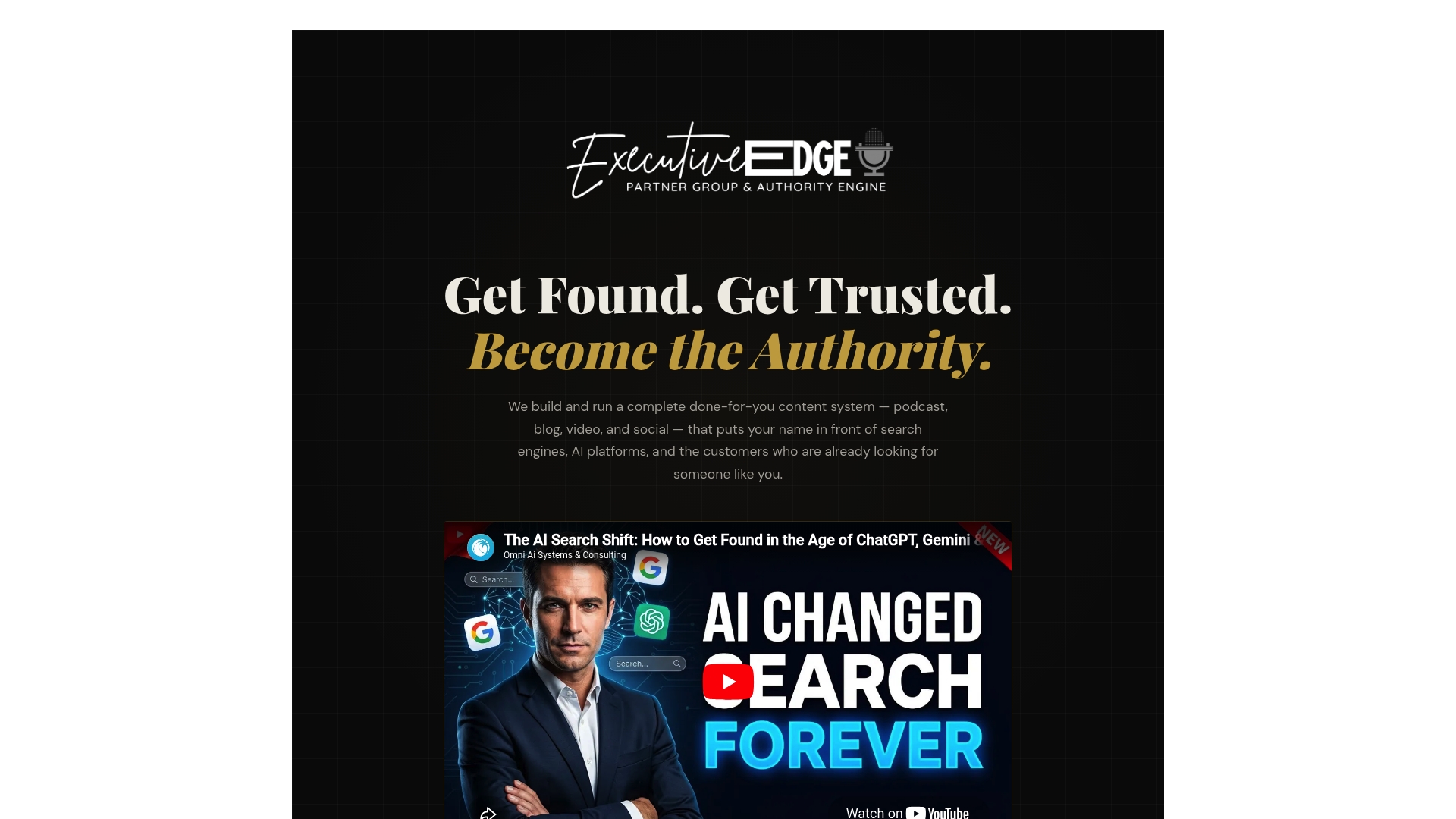
The system handles SEO, GEO (Generative Engine Optimization), and AEO (Answer Engine Optimization) so your content surfaces across Google, YouTube, and AI-driven search platforms, not just the channels you already know. For service-based businesses, consultants, attorneys, medical professionals, and executives who want to build lasting authority without rebuilding their schedule around content production, this is the practical path forward.
Start building your authority with Executive Edge Partner Group and put your expertise to work across every format that matters.
FAQ
What type of content works best for thought leadership?
The most effective thought leadership content combines original research, concrete case studies, and practical guidance, according to the Edelman-LinkedIn B2B Thought Leadership Impact Report. Interactive formats, including explainer videos, also rank among the highest-performing vehicles for engagement.
What are the four types of thought leadership?
A widely referenced framework identifies four types: Perspective Leadership (sharing a distinct point of view), Philosophical Leadership (articulating core beliefs and values), Strategic Leadership (providing direction and frameworks), and Transformational Leadership (driving change within an industry or organization).
What are the different types of thought leadership content formats?
The main categories are short-form content (blog posts, social media, newsletters), long-form and research-driven content (white papers, case studies, research reports), live and conversational formats (podcasts, webinars, interviews), multimedia formats (video, interactive infographics, data visualization), and authority-building formats (books, op-eds, media profiles, speeches).
How do you choose the right thought leadership format for your audience?
Match format to where your audience spends time, what stage of the buyer journey you are targeting, and your own production capacity. The Ascend2 Thought Leadership 2026 Report recommends a multi-channel approach that spans search, social, and live events rather than relying on a single format.
How does Executive Edge Partner Group help with thought leadership content?
Executive Edge Partner Group's Authority Engine is a done-for-you system that converts your expertise into strategic content across multiple formats, including podcasts, video, long-form articles, and social media, optimized for SEO, GEO, and AEO so your content reaches audiences across Google, YouTube, and AI search platforms.