

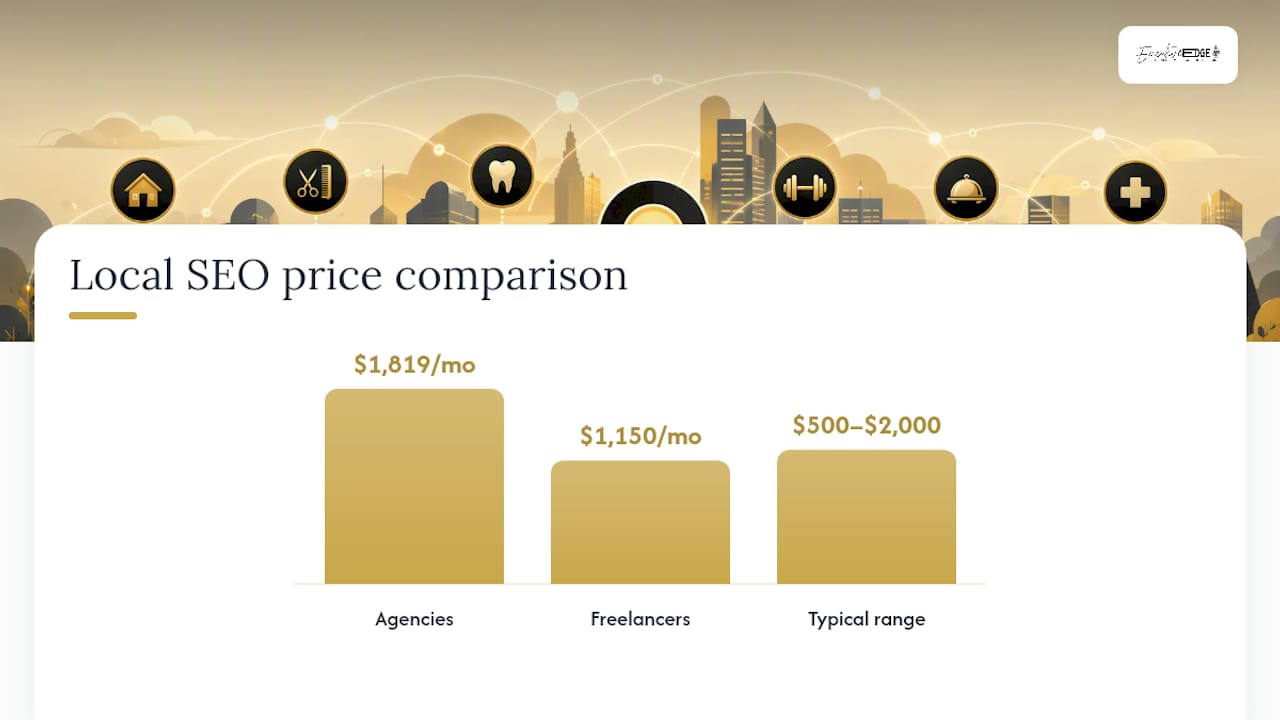
Most single-location businesses should budget between $500 and $2,000 a month for local SEO, with a monthly retainer as the common pricing model. That range lines up with industry survey averages showing US businesses spend $2,917 a month on SEO overall, while local-specific campaigns average $1,557 a month. Competitive fields like law or dentistry often need $2,000 to $4,000 or more to move the needle.
Table of Contents
- How Much Does Local SEO Pricing Actually Run?
- What Actually Drives the Price of Local SEO?
- Retainer, Hourly, Project, or Performance: Which Pricing Model Fits?
- What Should You Budget by Industry and Market Size?
- How Do You Evaluate a Local SEO Quote?
- What Red Flags Signal a Bad Local SEO Deal?
- How Long Until Local SEO Pays Off?
- Why Does Local SEO Cost More in Some Markets Than Others?
- A Real-World Look at Local SEO Budgeting Decisions
- How Executive Edge Partner Group Fits These Budgets
- Where These Local SEO Benchmarks Come From
- Sources
- FAQ
How Much Does Local SEO Pricing Actually Run?
Local SEO pricing breaks into three practical tiers, and knowing which one you're looking at matters more than the sticker price alone. A $600 package and a $2,500 package might both claim to "do local SEO," but they rarely deliver the same work.
The table below reflects what small businesses commonly pay across the three main pricing structures: monthly retainers, hourly consulting, and one-off project fees.
Hourly consulting runs around $111 an hour on average, though a lot of local-focused freelancers land in the $75 to $100 band. This model fits owners who have an in-house marketing person who just needs strategic direction rather than someone to execute every task.
Project-based pricing covers one-time work: a local SEO audit typically runs $750 to $3,000, and a Google Business Profile overhaul per location often falls between $300 and $800, according to Arc4's 2026 local SEO pricing breakdown. Landing page bundles for local service pages can cost $1,200 to $5,000 depending on how many pages and how much custom content is involved.
Here's the part that trips people up: a low monthly number doesn't always mean a bad deal, and a high one doesn't guarantee results. The basic tier makes sense for a business that already has clean citations and just needs someone watching the dashboard. The aggressive tier makes sense for a personal injury attorney competing against six other firms buying ads on the same ZIP code. Match the tier to the fight you're actually in, not the number that feels comfortable.
What Actually Drives the Price of Local SEO?
Two businesses in the same city, same industry, can get quotes that differ by $1,500 a month, and it usually comes down to five factors that have nothing to do with how "good" the vendor is.
Competition and city size set the floor. A pest control company in a mid-sized Texas market competes against maybe four or five serious rivals for map pack visibility. That same business type in Los Angeles or Dallas competes against dozens, and the content, link-building, and review volume needed to outrank them costs proportionally more.
Number of locations multiplies the work, not just the price. Each additional location needs its own Google Business Profile optimization, its own local landing page, its own citation set, and its own review response cadence. A five-location HVAC company isn't paying five times a single-location rate, but it's usually paying two and a half to three times as much, because reporting and strategy work don't scale linearly.
Scope of services is the biggest lever. A quote that only covers Google Business Profile management should cost far less than one that bundles in:
- Citation building and cleanup across data aggregators
- Local landing pages for each service area or neighborhood
- Ongoing blog or resource content tied to local search terms
- Link acquisition, including local PR and community backlinks
- Review generation and response management
Provider type changes the math too. Agencies average $1,819 a month for local SEO work, while freelancers average closer to $1,150. Agencies bring bench depth, project management, and specialized roles (a content writer, a link builder, a technical SEO). Freelancers bring lower overhead and, often, more direct access to the person doing the work. Neither is automatically the better buy.
Statistic worth sitting with: Most SEO providers bill through monthly retainers, not hourly or project fees. If you're getting quoted hourly for ongoing local SEO work, ask why. It's not necessarily a red flag, but it's outside the norm.
Retainer, Hourly, Project, or Performance: Which Pricing Model Fits?
Every local SEO provider charges one of four ways, and each model fits a different kind of need.
- Monthly retainer. This is the default for a reason: local SEO compounds over time, and a retainer lets a provider build citations, content, and links continuously instead of in disconnected bursts. It fits a business that wants ongoing, hands-off management and plans to stick with local search as a long-term channel.
- Hourly consulting. Best for a business with internal capacity that just needs direction: a marketing coordinator who can execute a GBP strategy but needs someone to design it. At $111 an hour on average, this only pencils out if you actually use the hours for strategy, not busywork.
- Project-based. Fits one-time fixes: an audit after a rankings drop, a full GBP overhaul before a rebrand, or a batch of local landing pages built once and maintained in-house afterward. Project pricing works when the problem has a clear endpoint.
- Hybrid or performance-based. Some providers blend a lower base retainer with bonuses tied to ranking or lead goals. This sounds appealing, but it creates a real incentive problem: providers can chase easy, low-value keyword rankings just to hit a bonus metric that doesn't translate into actual phone calls or bookings.
Pro Tip: Before signing anything, ask what happens to your Google Business Profile, citations, and content if you cancel. A retainer that quietly owns your assets is a bigger risk than the monthly price tag.
The choice usually comes down to how much internal marketing capacity you already have. A solo contractor with zero marketing staff needs a full retainer. A business with a marketing hire who's stretched thin might only need hourly strategic input. A business recovering from a website migration might just need one clean project engagement.
What Should You Budget by Industry and Market Size?
Local SEO pricing varies more by industry than most owners expect, mainly because customer lifetime value and competitive intensity differ so much from one vertical to the next.
Industry benchmark data shows a wide spread:
- Legal services: $2,500–$5,000/month. High case values and aggressive competitor spending push this tier up, especially for personal injury and family law attorneys in metro markets.
- Healthcare and dental: $1,500–$4,000/month. Patient acquisition value justifies mid-to-high spend, plus HIPAA-adjacent content requirements add complexity.
- Home services (HVAC, plumbing, roofing): $1,000–$2,500/month. Seasonal demand spikes and emergency-service searches make Google Business Profile visibility especially valuable.
- Restaurants: $500–$1,500/month. Lower average ticket size means the budget ceiling is naturally lower, though review management matters more here than almost any other category.
- Retail and creative services (photography, boutique studios): $300–$600/month on the low end, since local competition is often thinner and search volume is smaller.
Multi-location businesses scale differently than single-location ones. A three-location home services company might pay $1,800 to $3,500 a month total, not three separate full retainers, because a lot of the strategic and reporting work overlaps. A ten-location regional chain, though, often needs a dedicated account structure that pushes total spend well past $5,000 a month.
Real estate agents and other individual professionals sit in an interesting middle ground: personal brand content and geo-optimized local pages often matter more than raw citation volume, which shifts budget toward content production rather than technical SEO.
One budgeting heuristic worth using: most small businesses allocate 1% to 10% of total marketing spend to local SEO, scaling up toward 10% for businesses that depend almost entirely on local search for new customers.
How Do You Evaluate a Local SEO Quote?
A price without a scope attached is just a number. The real work happens when you compare what each dollar actually buys, and that means forcing every vendor into the same comparison format.
Start with a six-point checklist before you sign anything:
- Get a line-item deliverable list. Not "SEO management" but specific tasks: how many citations, how many pages, how many pieces of content per month, and what GBP work is included.
- Ask what KPIs they report on. Rankings alone mean nothing if calls and bookings aren't moving. Push for call tracking, form submissions, and direction requests, not just keyword position.
- Clarify reporting frequency and format. Monthly is standard; anything less frequent than that makes it hard to catch problems early.
- Find out who owns the content and assets. If you cancel, do the landing pages, blog posts, and citations stay live, or does the agency pull access?
- Ask which tools they use for tracking and reporting. A vendor using recognized platforms and giving you direct dashboard access is being transparent. One who only sends a PDF once a month usually isn't.
- Request a sample report from an existing client. Redacted is fine. If they can't produce one, that's a real gap in their process.
Beyond the checklist, pay attention to how a quote is structured. As one pricing analysis notes, a $600 retainer that only covers GBP maintenance isn't actually cheaper than a $2,000 retainer that includes content, citations, and link work. It just covers less. Compare cost per deliverable, not just the headline monthly figure.
If content production is part of the package, ask specifically whether it includes local landing pages tied to service areas, ongoing Google Business Profile posts, or just generic blog content that never mentions your city. Vendors that lean on local PR and community backlink placements as part of link building tend to produce more durable results than ones relying purely on directory submissions.
What Red Flags Signal a Bad Local SEO Deal?
Cheap SEO rarely stays cheap. It just moves the cost from your invoice to your rankings, your reputation, or both.
Watch for these warning signs before signing:
- Guaranteed rankings. No legitimate provider can guarantee a #1 spot on Google. Anyone promising it either doesn't understand the algorithm or is setting up an excuse for later.
- Vague, one-size-fits-all packages. If the same package is sold to a law firm and a taco truck with identical deliverables, it's templated, not strategic.
- Templated or thin content. Ask to see writing samples. Local content that never mentions actual neighborhoods, landmarks, or region-specific details is a sign of mass production.
- Fake or duplicate citations. Some cheaper providers pad citation counts with low-quality directories that can actually hurt local trust signals.
- Auto-renewal clauses with vague exit terms. Contracts that are easy to enter and hard to leave are a structural red flag, regardless of the monthly price.
Pro Tip: Ask any provider for two or three client references you can actually call, not just testimonials on their website. A vendor confident in their work will connect you.
How Long Until Local SEO Pays Off?
Quick wins show up fast. Google Business Profile fixes, citation corrections, and review response cleanup often produce visible movement within two to four weeks. That's the easy part.
Meaningful organic ranking movement, the kind that shows up in map pack position or organic traffic, usually takes 3 to 6 months. Content and link-building strategies compound over a longer arc, often 6 to 12 months or more, before they hit their full value.
ROI tracking should focus on a few concrete numbers:
- Cost per lead compared to your average customer value
- Call tracking data tied specifically to Google Business Profile and organic listings
- Booking or appointment lift compared to a pre-campaign baseline
- Breakeven point relative to your monthly spend tier
A business paying $1,000 a month generally needs just one or two additional closed jobs a month to break even, depending on ticket size. A business paying $4,000 a month in a competitive field needs a steadier lead flow to justify the spend, which is part of why higher-budget tiers tend to concentrate in higher-value industries like legal and healthcare.
Worth noting: Gartner projects meaningful shifts in search query volume as AI-driven search tools change how people find local businesses. That doesn't shrink the value of local SEO, but it does mean budgets increasingly need to account for how a business shows up in AI-generated answers, not just traditional blue links.
Why Does Local SEO Cost More in Some Markets Than Others?
Geography changes local SEO pricing more than most owners realize, and it's not just about labor costs.
Urban markets carry higher price tags because competition density is higher. A coffee shop in a city with 40 competing shops within a three-mile radius needs more aggressive content, review generation, and link-building to break into the map pack than a coffee shop in a town with three competitors total. The work is genuinely harder, so the price reflects that.

Rural and smaller-market businesses often see lower quotes, sometimes significantly so, because the competitive bar is lower and results can come faster with less volume of work. A basic $500 to $800 retainer might be enough to dominate local search in a town of 20,000 people, where that same budget wouldn't move a business in Houston or Chicago at all.
There's also a talent-cost factor. Agencies based in major metro areas often charge more simply because their overhead is higher, even for clients located elsewhere. A boutique agency or freelancer based in a smaller market can sometimes deliver comparable local SEO work at a lower rate, since remote service delivery means location rarely limits capability anymore.
International comparisons matter less for most US readers, but it's worth knowing that US local SEO pricing tends to run higher than in many other countries, largely due to higher average labor and marketing costs across the American service industry.
A Real-World Look at Local SEO Budgeting Decisions
Picture a single-location home services business: a roofer, a dentist, a boutique law practice. The owner has maybe $1,500 a month set aside for marketing and has to decide how much of that goes to local SEO versus paid ads or referral programs.
The honest answer depends on how much of that business already comes from repeat customers versus new search-driven leads. If new customer acquisition through Google is the growth engine, local SEO deserves the lion's share of that budget, probably $1,000 to $1,200 a month, with the rest held for testing paid ads.
For business owners in Tyler and East, Texas, this calculation often looks a little different than it does in a major metro. Competition for local search visibility is real but less saturated than in Dallas or Houston, which means a mid-tier budget tends to produce results faster in a regional market like this than the same spend would in a dense metro.
A managed subscription makes the most sense once an owner realizes they don't have the bandwidth to manage GBP posts, respond to reviews, track citations, and produce content every single month, on top of running the actual business. That's usually the tipping point.
— David Domm
How Executive Edge Partner Group Fits These Budgets
Everything above assumes you're either hiring an agency, bringing on a freelancer, or trying to piece the work together yourself with in-house staff. Some providers offer a fully managed subscription that combines local SEO fundamentals with broader authority-building content, including podcast production, blog articles, video, and short-form social content, so you're not stitching together three separate vendors to cover citations, content, and visibility.

This model fits best for business owners, consultants, and professionals who want the growth-tier or aggressive-tier results described earlier without managing multiple contractors or learning the technical side of Generative Engine Optimization and Answer Engine Optimization themselves. If you're comparing a $2,000 retainer that only covers traditional SEO against a done-for-you system that also builds your presence across YouTube, podcasts, and AI-driven search platforms, the math often favors the broader approach, especially as search behavior keeps shifting toward AI answer engines. Piecemeal hiring still works for businesses with strong internal marketing capacity. For everyone else, a single managed system tends to produce more consistent output.
If you want a clear picture of where your budget should land, request a line-item proposal from Executive Edge Partner Group and compare it directly against the ranges covered here.
Where These Local SEO Benchmarks Come From
The pricing ranges in this guide come from a handful of sources worth bookmarking if you're building a proposal comparison. GoodFirms' 2026 SEO pricing survey supplies the national average and spending distribution. Ahrefs' polling of 439 SEO providers breaks down local-specific averages, retainer prevalence, and hourly rates. Garrett Handley's small-business pricing guide offers practical budget floors and ceilings by competition level. Beancount's industry benchmark breakdown supplies the vertical-specific ranges used throughout this article.
Sources
- SEO pricing in USA 2026: What agencies, freelancers, charge?
- SEO Pricing: How Much Does SEO Cost? 439 People Polled
- Local SEO Cost in 2026: What Small Businesses Actually Pay | Garrett Handley
- Local SEO Budget Benchmarks by Industry: What Small Businesses Actually Pay in 2026
FAQ
How much do local SEO services cost?
Most single-location businesses pay $500 to $2,000 a month, with the national local SEO average landing at $1,557 monthly. Competitive industries like legal or healthcare often run $2,500 to $5,000 a month.
What is the 80/20 rule in SEO?
In practice, most local SEO gains come from a small share of the work: optimizing Google Business Profile, fixing citation inconsistencies, and generating reviews typically drive the majority of visibility improvement compared to lower-impact tasks.
Is local SEO worth it for a small business?
Yes, for most businesses that rely on nearby customers finding them through search, since 63% of US businesses spend between $500 and $5,000 monthly on SEO and treat it as a core acquisition channel rather than an optional expense. The return depends on matching your budget tier to your competition level rather than picking the cheapest available option.
How much should I charge for SEO?
Rates vary by role and model: hourly consultants average around $111 an hour, while monthly retainers for local SEO typically start at $500 and scale to $5,000 or more depending on scope, location count, and competitive intensity. Providers pricing far below these bands are usually cutting corners on deliverables, not offering a genuine discount.