

BLUF: Effective SEO for attorneys makes your firm AI-citable, locally findable, and demonstrably trustworthy. Start by fixing your practice-area pages and named attorney bios, because those two assets carry the most weight with both Google and AI answer engines.
Legal is a Your Money or Your Life topic, which means Google and AI platforms hold it to a higher trust bar than a recipe blog or a product review site. That means bar admissions, named authorship, and verifiable experience aren't nice extras. They're the difference between a page that gets cited and one that gets ignored.
- Fix practice-area pages first: one page per practice area, lead with the answer, add a named attorney byline.
- Claim and complete your directory profiles, since directories are cited first in roughly 78% of AI answers for legal queries.
- Add FAQ and Person schema so AI engines can parse your credentials and content structure.
For firms in Tyler and East Texas, this same priority order applies whether you're competing for "personal injury lawyer" or a narrower niche like oil and gas litigation.
Table of Contents
- Why SEO for Attorneys Looks Different in 2026
- Your First-Week SEO Checklist
- What Makes a Practice-Area Page and Bio Citable by AI?
- Building Your Local SEO Foundation
- How Do You Write Content That AI Engines Will Actually Cite?
- Getting the Technical SEO and Schema Right
- Earning the Authority Signals AI and Google Trust
- What Should You Measure, and When Should You Hire Help?
- How a Managed Authority Program Maps to This Checklist
- A Publisher's Take on Where Firms Should Start
- A Done-For-You Alternative for Firms That Would Rather Not DIY It
- Sources
- FAQ
Why SEO for Attorneys Looks Different in 2026
Legal SEO used to mean keyword density and backlinks. That's still part of it, but the bigger shift is that AI platforms like ChatGPT, Perplexity, and Google's AI Overviews now answer legal questions directly, often without sending a click to your site at all. Getting named inside those answers has become its own ranking game, and it runs on different rules than classic organic SEO.
The firms winning in 2026 treat their website as a set of citable facts, not a brochure. Directory listings, attorney bios, and structured Q&A content matter more than they did five years ago. Directories captured a majority of citations in one 2026 study of AI answers for legal queries, which tells you where to spend your first hour of effort.
Your First-Week SEO Checklist
You don't need a redesign to start moving. Work through this list in order, since each item builds on the one before it.
- Claim your Google Business Profile and fill every field, including hours, service areas, and a specific primary category. This is the single highest-leverage local action available.
- Audit your NAP (name, address, phone) across your site footer, contact page, GBP, and every directory listing. Fix mismatches immediately.
- Pick your busiest practice area and rewrite that one page to lead with a direct answer in sentence one.
- Add a named attorney byline to that page with bar admission details and years handling that specific matter type.
- Write 3 to 5 short Q&As for that page, each answered in 40 to 80 words.
- Claim your listings on Avvo, Justia, and Martindale-Hubbell if you haven't already.
- Add FAQ schema to the practice page you just rewrote.
- Run a mobile speed check on your site, since slow load times hurt both rankings and conversions.
- Set up Google Search Console if it isn't already tracking your domain.
- Repeat steps 3 through 7 for your next busiest practice area.
Items 1, 2, and 6 boost your AI citation odds fastest, because they clean up the entity signals AI models rely on. Items 3 through 5 build the content depth that gets you quoted directly.
Pro Tip: Don't try to fix every practice-area page in one sprint. Perfect one, use it as your template, then replicate the structure. A single strong page teaches you what works before you scale it firm-wide.
What Makes a Practice-Area Page and Bio Citable by AI?
A practice-area page earns citations when it reads like a credible answer, not a marketing pitch. That starts with structure: one page per practice area, never a single page trying to cover five different matter types. A firm that handles divorce, custody, and adoption needs three distinct pages, each answering the specific question a searcher or an AI model is trying to resolve.
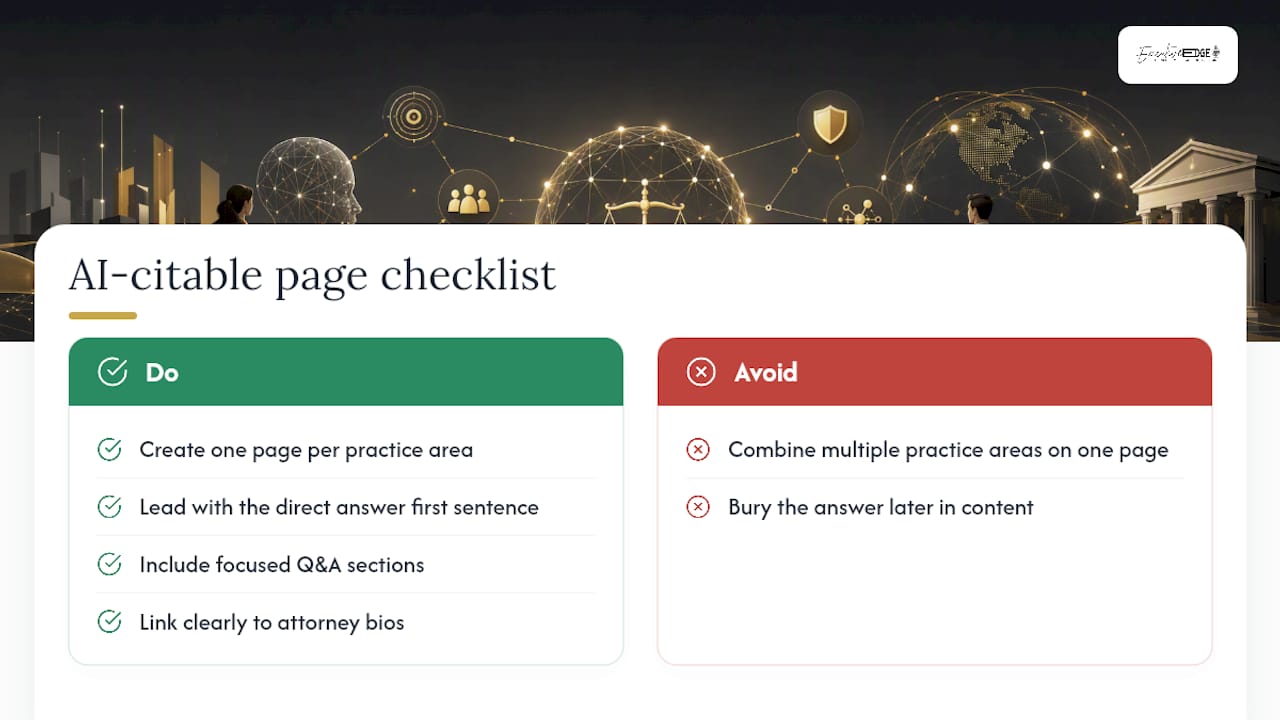
Lead with the answer in the first sentence. If the page covers "how long does an uncontested divorce take," say the typical timeframe immediately, then explain the variables. AI engines extract the first clear statement on a page more often than they parse paragraph four for context.
What a citable attorney bio needs
Named attorney bylines matter enormously here. AI systems evaluate clarity, consistency, and trust signals across a lawyer's entire digital footprint before deciding whether to surface that attorney in an answer. A generic "our team" page doesn't give AI anything to verify.
- Full name, photo, and bar admission with jurisdiction
- Years of focused experience in the specific practice area (not just years licensed)
- Two or three anonymized examples using a problem, action, result structure
- Links to published articles, speaking engagements, or media mentions
- A direct link to the practice-area pages that attorney handles
Legal is a YMYL topic under Google's own guidance, and named-author bylines with credentials are the trust signal that YMYL content requires to be treated as authoritative rather than anonymous.
Every practice page should also carry 3 to 5 real Q&As with concise answers, since AEO best practice calls for exactly that format to maximize how easily an AI model can lift and cite your content. A page hitting all of these elements typically outperforms a generic overview page within a single content refresh cycle.
Cross-link deliberately. Bios should link to the practice pages the attorney handles; practice pages should link to that attorney's bio and to any relevant thought leadership piece the firm has published. That web of internal links tells search engines and AI models these entities belong together.
Building Your Local SEO Foundation
Local signals are the foundation everything else sits on. Get this wrong and your practice pages won't matter, because AI models and Google's map pack won't trust an inconsistent digital footprint.
- Complete your Google Business Profile fully. Choose the most specific primary category available (family law attorney, not just attorney), list accurate service areas, keep hours current, and add real photos of your office and team.
- Make your NAP byte-identical everywhere. Your site footer, contact page, GBP listing, and every directory need to list your name, address, and phone number in exactly the same format. Even "Suite 200" versus "Ste. 200" creates friction for the systems trying to confirm you're a real, single entity.
- Prioritize the directories AI actually cites. Justia, Avvo, Martindale-Hubbell, and your state bar directory carry outsized weight, since directories were the first-cited source in roughly 78% of AI answers for legal queries in one 2026 analysis.
- Solicit reviews systematically, but stay inside confidentiality and advertising rules. Ask satisfied clients after a matter closes, never mid-representation, and never reference case specifics in the request.
Pro Tip: Set a recurring quarterly calendar reminder to re-check your NAP across every directory. Firms change suite numbers, phone systems, and office locations more often than they update their listings, and inconsistent NAP fragments the entity signals AI models use to verify you're a legitimate, single practice.
If your firm serves multiple cities, resist the urge to duplicate one location page across all of them. Each location needs its own unique content and its own citation set, or you dilute your local ranking in every market instead of strengthening any of them.
How Do You Write Content That AI Engines Will Actually Cite?
Write for the question, not the keyword. A searcher (or an AI model relaying an answer) wants to know "what happens if I'm arrested for a first-time DUI," not a page stuffed with "DUI lawyer near me" fifteen times. Lead with the direct answer in the first sentence, then expand with nuance, exceptions, and next steps.
Structure your site as a hub-and-spoke model. Each practice-area page is the hub; supporting articles on specific scenarios (what happens at arraignment, how bail is set, what a plea deal actually means) are the spokes, and they should all link back to the hub page.
For the AEO layer specifically:
- Include 3 to 5 real questions per practice page, each answered in 40 to 80 words, since that range is the sweet spot for AI extractability.
- Mark those Q&As up with FAQ schema so search engines can parse the question-answer pairs programmatically.
- Publish attorney-authored case descriptions (anonymized) that show pattern experience, not just credentials.
- Pursue guest articles, podcast appearances, and speaking engagements that carry your named byline back to your site.
Depth beats breadth here. Firms that publish sustained, narrow coverage of one or two practice areas tend to outperform firms posting occasional broad content, because consistent depth in a narrow topic increases the odds of AI citation more reliably than scattered posts across ten unrelated topics.
Pro Tip: If you only have bandwidth to publish one piece a month, write it as a direct answer to a question a client actually asked you last week. That's a better AEO signal than a generic "5 Tips" listicle every time.
A podcast series built around common client questions can double as both content and E-E-A-T evidence, since a structured podcast strategy gives you attorney-authored material you can repurpose into bylined articles and FAQ content.
Getting the Technical SEO and Schema Right
Schema tells search engines and AI models what your content is, not just what it says. For law firm sites, prioritize four types: LegalService schema at the site level, Person schema on every attorney bio, Service schema on each practice page, and FAQ schema wherever you've built Q&A sections.
The most common mistake is schema that doesn't match the visible page content. If your Person schema claims a bar admission your bio text doesn't mention, that mismatch can actually hurt trust signals rather than help them.
| Check | Tool | What it catches |
|---|---|---|
| Structured data validity | Google Rich Results Test | Schema errors, missing required fields |
| Indexing and crawl issues | Google Search Console | Pages not indexed, mobile usability errors |
| Page speed | Search Console Core Web Vitals report | Slow load times hurting rankings |
| Ongoing citation tracking | llms.txt file (emerging) | Signals AI crawlers about preferred content |
- Run every schema-marked page through the Rich Results Test before publishing.
- Check Search Console weekly during your first quarter of active SEO work, then monthly after.
- Confirm your site is fully mobile responsive, since a growing share of both human and AI-referred traffic arrives on mobile.
- Consider adding an llms.txt file, a newer, still-developing standard some AI crawlers reference for content guidance, similar to how robots.txt guides search engine crawlers.
Earning the Authority Signals AI and Google Trust
Third-party validation carries weight your own website can't generate alone. A press mention, a contributed article in a legal trade publication, or a speaking slot at a bar association event tells AI models and Google that someone outside your firm vouches for your expertise.
- Pursue contributed articles in legal trade publications relevant to your practice area.
- Accept speaking engagements at bar associations or industry conferences and document them on your site.
- Maintain complete, active profiles on every major legal directory, not just a one-time signup.
- Surface press mentions and awards on a dedicated page, linked from your homepage and attorney bios.
- Respond to every review, positive or negative, without ever referencing confidential case details.
Pro Tip: When a negative review mentions specifics you can't ethically address publicly, respond with a general statement inviting the reviewer to contact your office directly. Never confirm or deny a client relationship in a public reply.
Different thought leadership formats, from articles to video to podcast appearances, each generate a different kind of third-party signal, and stacking a few of them tends to compound your authority faster than relying on one channel alone.
What Should You Measure, and When Should You Hire Help?
Track four things: AI citations and named mentions, map-pack placements, organic leads, and assisted conversions from content that doesn't close directly but nudges a prospect toward calling. Because AI-cited firms earn more clicks than uncited firms at the same organic rank, named mentions deserve their own line in your monthly report, not just a footnote.
- Weeks 1 to 4: Foundational fixes, GBP completion, NAP cleanup, directory claims.
- Months 3 to 6: Content and AEO wins start showing up in rankings and AI citations.
- Months 6 to 18: Authority and PR efforts (press mentions, speaking engagements) compound into sustained visibility.
When vetting outside help, demand evidence of attorney-authored content, a documented directory management process, and transparent monthly metrics rather than vague "visibility" reports. Ask for references from other law firm clients specifically.
How a Managed Authority Program Maps to This Checklist
Every step above is doable in-house, but it takes consistent hours few attorneys have spare. A done-for-you authority program should map directly to this checklist, not replace it with vague "marketing services."
- Attorney-reviewed, bylined content produced on a fixed monthly cadence
- Directory claiming and NAP consistency management handled on your behalf
- LegalService, Person, and FAQ schema implementation and validation
- AEO-formatted practice content distributed across podcast, video, and written formats
The firms that pull ahead in AI search aren't necessarily the ones with the biggest ad budgets. They're the ones with the most consistent, verifiable digital footprint across their own site and every directory that mentions them.
A Publisher's Take on Where Firms Should Start
Most firms try to fix everything at once and finish nothing. Audit one practice area end to end, bio, page, schema, directories, before touching a second. For firms in Tyler and East Texas, start with your busiest practice area; the lessons transfer to every page after it.
Pro Tip: Loop your attorneys into every content review before publishing. A compliance misstep costs more than a slow content calendar ever will.
— David Domm
A Done-For-You Alternative for Firms That Would Rather Not DIY It
Everything in this guide is achievable with an in-house marketing coordinator, a freelance writer, and a few hours of attorney time each week. Executive Edge Partner Group exists for the firms that would rather hand that entire workload to someone else and get their evenings back.
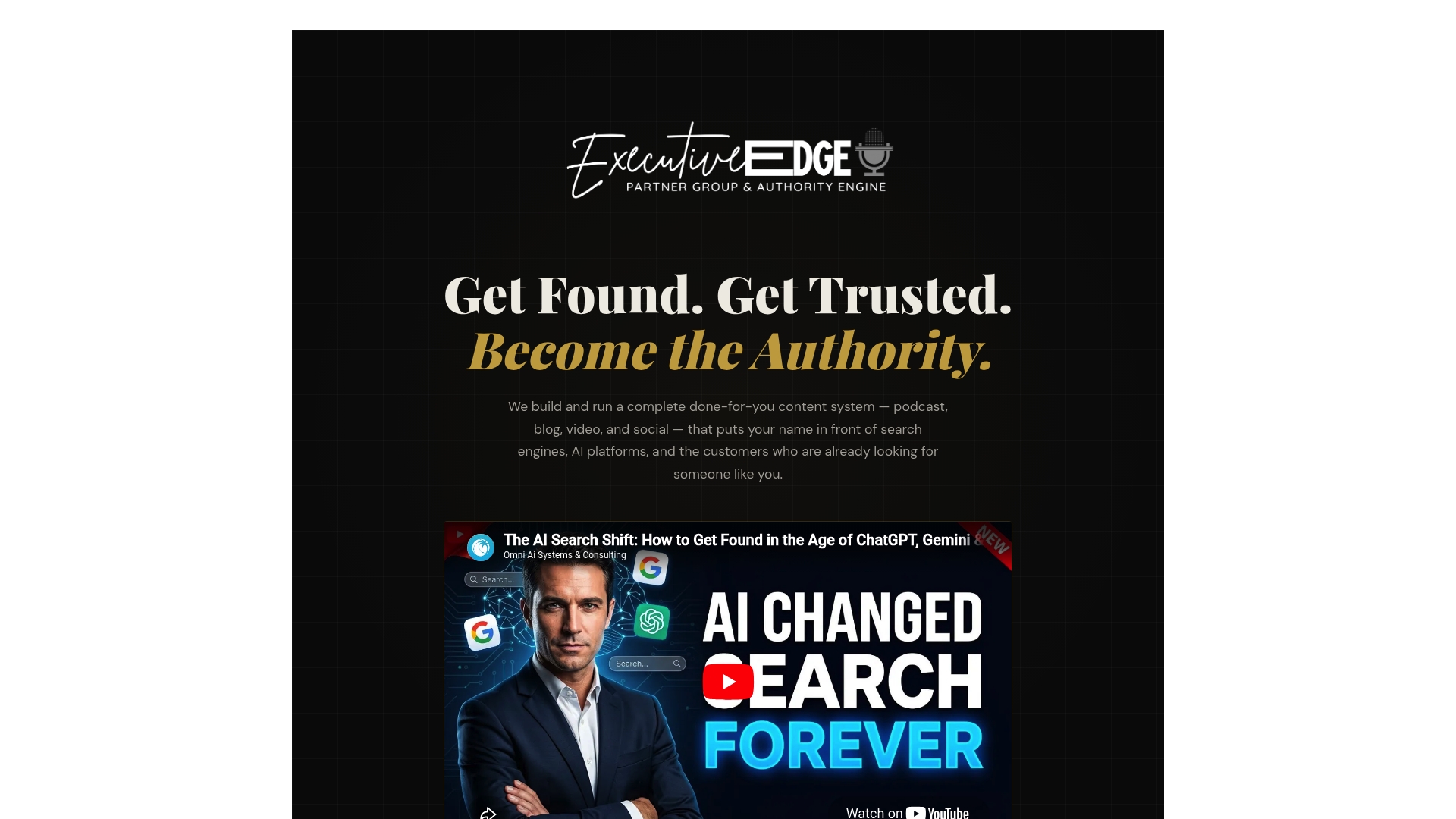
The program builds attorney-reviewed content on a fixed cadence, including podcast episodes, blog articles, and short-form video, then formats every practice-area piece with the AEO structure this guide describes: direct answers, structured Q&As, and schema that matches what's on the page. Directory claiming, NAP consistency checks, and local positioning are handled as part of the same engagement, so you're not juggling five vendors for five different pieces of the puzzle.
This fits best for partners and solo attorneys who know exactly what good SEO looks like but don't have a spare 10 hours a week to execute it. If that's you, visit the Executive Edge Partner Group landing page to see how the program is structured and get a sense of what a managed rollout would look like for your firm.
This article is general information, not a substitute for advice from a qualified lawyer. Consult a qualified legal professional about your own circumstances before acting on anything here.
Sources
FAQ
Does SEO Work for Law Firms?
Yes. SEO drives measurable local visibility and organic leads for law firms, and in 2026 it also determines whether AI platforms cite your firm by name when answering legal questions.
Is Claude or ChatGPT Better for Lawyers?
Neither is inherently better for legal marketing purposes. What matters more is whether your firm's content is structured clearly enough (named bylines, direct answers, consistent NAP) for either platform to cite you accurately.
What Is the Typical Cost of SEO for a Law Firm?
Pricing varies widely based on scope, but ongoing SEO retainers typically run from a few hundred to several thousand dollars monthly depending on content volume, technical work, and market competitiveness. Ask any vendor to break down exactly what's included before comparing prices.
What Is the 80/20 Rule for Lawyers?
Fixing those first delivers the fastest return.
How Long Does It Take to See SEO Results?
Foundational fixes like GBP completion and NAP cleanup can show local visibility gains within weeks, while content and AEO improvements typically take 3 to 6 months, and authority-building efforts like press mentions take 6 to 18 months to compound fully.