

The fastest, highest-return real estate agent SEO approach is an AEO-first local system: a fully optimized Google Business Profile + 10 hyperlocal neighborhood pages + machine-readable schema + consistent review velocity. That combination outperforms scattershot tactics because each element reinforces the others: schema makes your pages machine-readable, reviews signal freshness, and GBP puts you in the map pack and AI overviews simultaneously.
Here is your immediate 90-day priority stack:
- Weeks 1–2: Complete a full GBP audit, correct your NAP (name, address, phone) across all directories, and activate a review request workflow.
- Weeks 3–6: Publish five hyperlocal neighborhood pages with original data, schema markup, and internal links to your IDX listings.
- Weeks 7–10: Fix technical issues (site speed, canonical tags, XML sitemap, mobile responsiveness) and publish five more neighborhood or process pages.
- Weeks 11–12: Set up Google Search Console and GA4 dashboards, review keyword rankings for your priority pages, and plan the next content batch.
Timeline expectations: GBP gains and long-tail page rankings often appear within 4–8 weeks. Measurable organic traffic lifts typically arrive in the 3–6 month window. Head-term rankings (e.g., "Austin real estate agent") take longer, often 6–12 months of consistent effort.
Cost range: DIY costs mostly your time, roughly 8–12 hours per month once the foundation is built. A freelancer or small vendor runs $500–$1,500/month. A full-service managed retainer typically starts around $1,500–$3,500/month depending on market size and content volume.
Your single best next step right now: open your GBP listing and audit it against the checklist in Section 4 of this guide. If you do not have five neighborhood pages live yet, that is your second move.
Table of Contents
- Why real estate agent SEO beats paid ads for long-term lead generation
- How to build your real estate SEO checklist, step by step
- What does local SEO for realtors actually require?
- How should your website handle IDX listings and schema markup?
- How do you find the right keywords and build a content plan?
- What technical SEO issues hurt real estate websites most?
- Which tools should you use to track real estate SEO performance?
- What does a realistic 90-day SEO plan look like for agents?
- How do you scale content with AI without losing local authenticity?
- What we see working for agents — and the mistakes that hold them back
- How Executive Edge Partner Group helps agents build authority at scale
- Sources
- FAQ
Why real estate agent SEO beats paid ads for long-term lead generation
Real estate SEO is the practice of making your website, GBP, and content easy to find when buyers and sellers search for neighborhoods, prices, or agents. Done consistently, it builds visibility and trust that compounds over time. That compounding effect is the core reason it outperforms paid ads for most agents over a 12-month horizon.
Paid ads on Google or Zillow deliver traffic the moment you fund them and stop the moment you don't. Portal dependency (Zillow Premier Agent, Realtor.com leads) is even riskier: you are renting visibility on someone else's platform, competing against every other agent in your ZIP code, and paying per lead regardless of quality. SEO, by contrast, produces leads that arrive because a buyer or seller searched for something specific and found you as the answer. Those leads tend to convert at a higher rate because the intent is already there.
Answer Engine Optimization (AEO) is the newer layer on top of traditional SEO. As AI assistants and Google's AI Overviews handle more searches, a growing share of queries end without a click to any website. AEO means structuring your content, schema, and profiles so that AI systems cite you as the answer, even when no click happens. For local real estate queries ("best neighborhoods in [city] for families"), an agent with well-structured neighborhood pages and schema can outrank national portals in AI-generated answers.
The practical split: use paid ads for immediate pipeline when you need it, use portals selectively for volume, and build SEO/AEO as the long-term engine that reduces your cost per lead every year with help from an AI Ad Generator for Real Estate that tests creatives before you spend.
Pro Tip: Review velocity is the single fastest lever you can pull today. An agent with 40 Google reviews and a 4.8 rating outperforms one with 200 reviews and a 4.1 in both map pack placement and AI citation likelihood. Ask for reviews within 24 hours of a positive client interaction, every time.
How to build your real estate SEO checklist, step by step
This is the prioritized sequence. Do not skip ahead to content before fixing your GBP and NAP consistency, because those signals underpin everything else.
-
GBP audit (Week 1, 2–3 hours): Verify your business name, address, phone, website URL, and primary/secondary categories. "Real Estate Agent" should be your primary category. Add service areas for every neighborhood you actively work.
-
NAP consistency sweep (Week 1–2, 2 hours): Check your name, address, and phone number on Yelp, Bing Places, Apple Maps, and any local directories. Inconsistencies suppress local rankings.
-
Review request workflow (Week 2, 1 hour to set up): Create a short, direct review request message with your GBP review link. Send it within 24 hours of closing or a positive client moment. Aim for at least two new reviews per month.
-
Five initial hyperlocal neighborhood pages (Weeks 3–6, 3–4 hours each): Each page should cover median prices, school ratings, walkability, commute notes, and what makes the neighborhood distinct. Link each page to relevant IDX search results. Hyperlocal neighborhood pages are one of the strongest opportunities for individual agents to win AI citations and long-tail traffic that converts.
-
Site architecture and IDX hygiene (Week 5–6, 2–4 hours with developer): Confirm your IDX listing pages are indexable (not blocked by robots.txt), canonical tags point correctly, and your sitemap is submitted to Google Search Console.
-
Schema markup (Week 6–7, 1–2 hours with developer): Add
RealEstateAgent,LocalBusiness,FAQPage, andReviewschema to your agent bio, neighborhood pages, and listing detail pages. -
Content cadence (Month 2 onward, 4–6 hours/month): Publish two pieces per month minimum: one neighborhood or market update page, one process/FAQ page (buyer guide, seller checklist, school-zone explainer).
-
Local link building (Month 2–3, ongoing): Reach out to local press, neighborhood associations, school district sites, and business groups for contextual mentions and links. Local backlinks from contextual sources carry more weight than generic directory submissions.
-
Measurement setup (Week 12): Connect Google Search Console and GA4. Tag your contact forms and click-to-call buttons as conversion events. Set a monthly review date.
Pro Tip: Batch your neighborhood page production. Record a 10-minute walkthrough video of a neighborhood, then use that footage as the source for a written page, a GBP post, and a short social clip. One hour of original content becomes three assets. See how real estate agents use content to win more clients for a practical breakdown of this approach.
What does local SEO for realtors actually require?
Local SEO for realtors is primarily a GBP and citation game in the first 60 days. Here is the operational breakdown.
Optimizing your Google Business Profile
Your GBP listing is the highest-leverage, lowest-cost local asset you have. Beyond the basics (name, address, phone), these fields move the needle:
- Primary category: "Real Estate Agent" (not "Real Estate Agency" unless you are a brokerage).
- Service areas: List every neighborhood and ZIP code you actively serve. Do not leave this blank.
- Description: 750 characters, lead with your market and specialization, include neighborhood names naturally.
- Photos: Add at least 10 photos: headshot, recent listings, neighborhood shots, and a team photo if applicable. Update monthly.
- Weekly posts: One GBP post per week: a new listing, a market stat, a neighborhood tip. Posts signal active management to Google's algorithm.
- Booking/phone: Enable the call button and, if your CRM supports it, a booking link.
Citation sources and NAP consistency
Beyond GBP, the citations that matter most for real estate are Yelp, Bing Places, Apple Maps, Realtor.com profile, Zillow agent profile, and your state's real estate association directory. NAP must match exactly across all of them, including suite numbers and abbreviations (St. vs. Street).
Review request workflow
A simple, repeatable system beats a complex one. After closing or a strong client moment, send this message: "It was a pleasure working with you. If you have a moment, a Google review would mean a lot — here's the direct link: [your GBP review link]." That is it. Respond to every review within 48 hours, positive or negative. A one-line response template for positive reviews: "Thank you, [first name] — it was a pleasure helping you find your home in [neighborhood]. Wishing you all the best!"
Service-area vs. office-based settings
If you work from a home office or prefer not to show your address publicly, switch your GBP to a service-area business. This hides the address but keeps your map pack eligibility. If you have a physical brokerage office, show the address AND list service areas. Covering multiple neighborhoods? Add them all as service areas rather than creating separate GBP listings, which Google penalizes as duplicate entries.
Pro Tip: Agents who publish one GBP post per week and maintain a review velocity of two or more new reviews per month consistently outperform those who set up GBP once and leave it. Treat your GBP like a social channel, not a directory listing.
How should your website handle IDX listings and schema markup?
Site architecture and technical structure are where most agents lose ground to portals without realizing it. Here is what the right setup looks like.
Recommended site architecture
Build your site in content clusters, not flat pages:
- Home page (brand + market authority)
- Market pillar pages (e.g., "Austin Real Estate" or "Dallas Homes for Sale")
- Neighborhood cluster pages (e.g., "Homes in Mueller Austin," "East Austin Condos")
- Process/FAQ pages (buyer guide, seller checklist, mortgage FAQ)
- Agent bio page (with schema, license number, transaction count, and reviews)
Each neighborhood page links to relevant IDX search results and to your process pages. This internal linking structure tells Google which pages are most important.
IDX and MLS considerations
IDX feeds create a duplicate-content risk because the same listing data appears on hundreds of agent sites. The fix:
- Set IDX listing pages to
noindexif they are purely feed-generated with no original content. - Create original neighborhood pages that link to IDX searches rather than relying on IDX pages to rank.
- For high-value listings, write an original property description page with unique content, then use a canonical tag pointing to it from the IDX version.
- Check that your IDX provider does not block Googlebot in its robots.txt. Some platforms do this by default.
Schema markup that makes you machine-readable
Schema provides the structured data types that make your content readable by AI systems and search engines. The types that matter most for agents:
RealEstateAgenton your bio page: include name, license number, telephone, address, service area, and aggregate review rating.LocalBusiness/Organizationon your home page or brokerage page.Placeon neighborhood pages: include geo-coordinates, neighborhood name, and containedInPlace.FAQPageon any page with Q&A content: this is the primary driver of AI Overview citations.Review/AggregateRatingon your bio and testimonial pages.BreadcrumbListsite-wide: helps Google understand your site hierarchy.
Pro Tip: Place FAQPage schema on every neighborhood page, not just your main FAQ. A neighborhood page that answers "What are the best schools in [neighborhood]?" with structured FAQ schema has a measurably higher chance of appearing in AI Overviews for that query.
How do you find the right keywords and build a content plan?
Keyword research for real estate is less about search volume and more about intent. A query like "homes for sale in Mueller Austin" has clear transactional intent and a buyer ready to act. "Is Mueller Austin a good neighborhood?" is informational, but the person asking it is often three weeks from calling an agent.
Segmenting by intent
- Transactional: "homes for sale in [neighborhood]," "buy a house in [city]," "[city] condos under $400k" — these go on IDX-linked neighborhood pages and market pillar pages.
- Informational: "best neighborhoods in [city] for families," "how long does it take to buy a house in [state]," "what is the average home price in [neighborhood]" — these go on neighborhood guides and process pages.
- Navigational: "[Agent name] reviews," "[Brokerage] [city]" — these are handled by your GBP, bio page, and review profiles.
Long-tail neighborhood + intent combinations convert best because the searcher has already narrowed their geography. "3-bedroom homes in [specific neighborhood] under $500k" gets fewer searches than "homes for sale in [city]," but the person searching it is far closer to a transaction.
Keyword mapping
| Topic cluster | Sample search phrase | Page type | Conversion goal |
|---|---|---|---|
| Neighborhood living | "Best neighborhoods in [city] for young families" | Neighborhood guide | Email opt-in / contact |
| Buyer process | "How to buy a house in [state] first time" | Buyer guide / FAQ page | Consultation request |
| Seller intent | "How much is my home worth in [neighborhood]" | Seller landing page | Home valuation form |
| School zone | "Homes near [school name] [city]" | School-zone page | IDX search + contact |
| Market data | "[City] housing market update [month]" | Market report page | Newsletter sign-up |
Content calendar example
A sustainable monthly cadence for a solo agent:
- Week 1: Publish or update one neighborhood guide (1,000–1,500 words, with schema).
- Week 2: Publish one process/FAQ page or market update.
- Week 3: Record a short neighborhood walkthrough video; post it to YouTube and embed it in the relevant neighborhood page.
- Week 4: Publish one GBP post per week (ongoing), and send a market update email to your list.
Publishing structured FAQs aligned with real buyer and seller questions is one of the most direct paths to AI Overview citations. Aim for 50 or more market-specific Q&As across your site over time, as AEO research for real estate agents consistently points to FAQ depth as a citation driver.
Pro Tip: Your monthly market report is the most reusable asset you produce. Turn it into a neighborhood page update, a GBP post, a short video script, and a social caption. One piece of original research, four distribution channels. For a deeper look at geo-optimized content structures that work for local professionals, that guide covers nine proven formats.
What technical SEO issues hurt real estate websites most?
Technical SEO is the foundation. Content and links do not perform well on a slow, poorly structured site. Technical hygiene — site speed, mobile responsiveness, XML sitemaps, canonical tags — remains a core ranking requirement for real estate sites in 2026.
Diagnostic tools to run first
Run these before touching anything else:
- Google Search Console: Check for crawl errors, manual actions, and which pages are indexed. Look at the Coverage report for "Excluded" pages — IDX pages blocked by noindex or robots.txt show up here.
- PageSpeed Insights: Run your home page, one neighborhood page, and one IDX listing page. A score below 70 on mobile is a ranking liability.
- Google's Mobile-Friendly Test: Most modern themes pass, but IDX-heavy pages sometimes fail due to third-party scripts.
- Sitemap check: Confirm your XML sitemap is submitted in Search Console and includes your neighborhood pages, bio page, and process pages — not just IDX feed URLs.
Top fixes by impact
Page speed is the most common issue on agent sites. Oversized listing photos, unoptimized hero images, and heavy IDX scripts are the usual culprits. Compress images to WebP format, lazy-load below-the-fold content, and ask your IDX provider whether their widget loads asynchronously.
Canonical tags matter most on IDX pages. Without them, Google sees dozens of near-identical listing pages and may devalue all of them. Set a canonical on each IDX listing page pointing to either the original content version or itself (self-referencing canonical), and confirm your IDX platform supports this.
Robots.txt and noindex: Audit which pages are blocked. A common mistake is blocking IDX subdirectories that contain original neighborhood content. Check the robots.txt file directly at yourdomain.com/robots.txt.
Redirects: If you have migrated platforms or changed URL structures, run a crawl with Screaming Frog (free up to 500 URLs) to find broken internal links and missing 301 redirects.
A practical note: some CMS and IDX platforms (like Sierra Interactive or kvCORE) handle automatic schema generation, canonical management, and fast hosting out of the box. If you are evaluating platforms, these technical features reduce the developer work required significantly.
Stat to know: Google's own data shows that pages loading in under 2.5 seconds (Core Web Vitals "Good" threshold for Largest Contentful Paint) rank measurably better on mobile than slower pages. Run PageSpeed Insights on your site today and address any "Poor" or "Needs Improvement" flags before publishing new content.
Which tools should you use to track real estate SEO performance?
You do not need a dozen tools. You need four that you actually check.
Google Search Console is non-negotiable and free. It shows which queries drive impressions and clicks to your pages, which pages are indexed, and whether Google has flagged any technical issues. Check it weekly during your first 90 days, then monthly once things stabilize.

GA4 (Google Analytics 4) tracks what visitors do after they arrive. Set up conversion events for contact form submissions, click-to-call actions, and home valuation form completions. Without these events tagged, you cannot tell whether your SEO traffic is actually generating leads.
PageSpeed Insights is a free diagnostic you run on demand. Bookmark it and check your key pages after any major site update.
A keyword tracking tool rounds out the set. Ahrefs and Semrush are the industry standards; both start around $100–$130/month. If budget is tight, Ubersuggest or Google Search Console's own Performance report covers the basics for free.
For local citation management, BrightLocal ($39/month) is the most practical tool for agents: it audits your NAP consistency across directories, tracks local rankings, and monitors review velocity across platforms.
Core KPIs to track monthly
- Organic leads: Contact form submissions and click-to-call events attributed to organic search in GA4.
- Conversion rate on key pages: What percentage of visitors to your neighborhood pages or seller landing pages take a conversion action?
- Branded search impressions: Rising branded impressions in Search Console mean your offline reputation is driving online searches. That is a healthy signal.
- Review velocity: New Google reviews per month. Two or more is the minimum; four or more accelerates map pack gains.
- Keyword rank movement: Track 10–15 priority phrases (your top neighborhood + intent combos) monthly.
Pro Tip: AI-driven discovery (ChatGPT, Perplexity, Google AI Overviews) does not always show up as organic traffic in GA4 — it often appears as direct traffic or is unattributed. To get a rough read on AI citation impact, watch for spikes in branded search impressions in Search Console alongside direct traffic increases. Those two moving together usually signal AI-driven awareness. For a deeper look at how AI search discovery works, that guide covers the attribution mechanics in detail.
What does a realistic 90-day SEO plan look like for agents?
Here is the week-by-week breakdown, with owner assignments and cost expectations.
30/60/90-day milestones
Days 1–30 (Foundation):
- Complete GBP audit and update all fields (Agent, 2–3 hours).
- Sweep NAP consistency across top 10 directories (Agent or VA, 2 hours).
- Set up review request workflow and send first batch to past clients (Agent, 1 hour).
- Submit XML sitemap to Google Search Console (Developer or platform, 30 minutes).
- Run PageSpeed Insights and fix top 3 speed issues (Developer, 2–4 hours).
- Publish first two neighborhood pages with schema (Agent + writer, or vendor).
Days 31–60 (Content build):
- Publish three more neighborhood pages (total: five live).
- Add
RealEstateAgentandFAQPageschema to bio and neighborhood pages. - Identify 10–15 priority keyword phrases in Search Console.
- Publish one buyer or seller process page with FAQ schema.
- Begin local link outreach: one contextual mention per week (local blog, neighborhood association).
Days 61–90 (Measurement and scale):
- Review Search Console: which neighborhood pages are gaining impressions?
- Set up GA4 conversion events for contact forms and click-to-call.
- Publish five more pages (total: 10 neighborhood or process pages live).
- Review review velocity: are you hitting two or more new reviews per month?
- Plan next quarter's content calendar based on keyword data.
Expected results: Long-tail neighborhood pages often begin ranking within 4–8 weeks of publication. Measurable organic traffic gains typically arrive in the 3–6 month window. GBP map pack improvements from review velocity and post frequency can appear faster, sometimes within 30 days.
Cost ranges
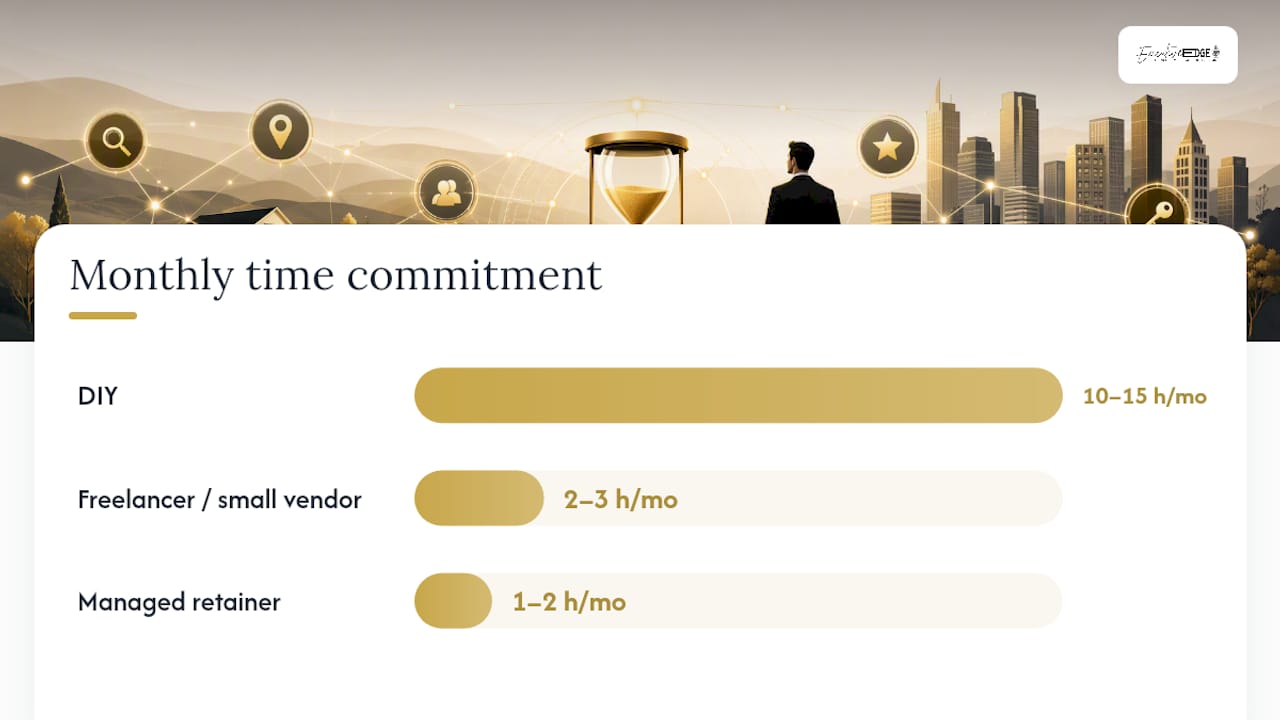
| Approach | Monthly cost | Time commitment |
|---|---|---|
| DIY | $0 (tools) | 10–15 hours/month |
| Freelancer / small vendor | $500–$1,500 | 2–3 hours/month (oversight) |
| Full-service managed retainer | $1,500–$3,500+ | 1–2 hours/month (review/approve) |
If budget is limited, outsource content writing first. Writing 1,000-word neighborhood pages consistently is the task most agents drop when life gets busy. Technical fixes (schema, canonicals, speed) are a one-time investment; content is ongoing.
How do you scale content with AI without losing local authenticity?
AI writing tools can cut your content production time significantly. The risk is generic output that reads like it could describe any neighborhood in any city, which Google and AI systems are increasingly good at filtering out.
A practical AI-assisted workflow
- AI draft: Use ChatGPT, Claude, or a real estate-specific AI tool to generate a first draft of a neighborhood page using a structured prompt (neighborhood name, median price, school names, walkability score, commute time).
- Human editing for local color: Add one or two details only a local agent would know: the coffee shop everyone meets at before showings, the street that floods in heavy rain, the school feeder pattern that surprises buyers from out of state.
- Schema insertion: Add
FAQPageandPlaceschema before publishing. - Publish and distribute: Post the page, then create a GBP post linking to it.
- Request a review: If the page covers a neighborhood where you recently closed, send the client a review request the same week.
An agent working in Tyler, Texas, for example, might use AI to draft the bones of a Rose Heights neighborhood page, then add firsthand notes about the historic bungalow stock, the proximity to UT Tyler, and the specific streets where buyers compete hardest. That local layer is what AI cannot replicate and what makes the page worth citing.
Do / don't list for AI content
Do use AI for: First drafts, outlines, FAQ generation, meta description writing, repurposing market reports into page content.
Do not use AI for: Publishing unedited generic content, fabricating local statistics, or replacing the agent's actual market knowledge and voice.
Pro Tip: Keep your author bio current with your license number, transaction count, and years in the market. These EEAT signals (Expertise, Experience, Authoritativeness, Trustworthiness) are visible to both Google's quality raters and AI systems evaluating whether to cite your content. An agent bio that reads like a real professional's profile outperforms a generic "passionate about real estate" paragraph every time. For ideas on how speaking content becomes SEO, that guide covers the repurposing workflow in detail.
What we see working for agents — and the mistakes that hold them back
The agents who gain the most ground from SEO share a few consistent habits: they treat their GBP like a live channel, they publish neighborhood pages before they feel "ready," and they ask for reviews without apology. The agents who stall almost always share the same three mistakes.
Thin neighborhood pages. A 200-word page with a headline, two sentences about the neighborhood, and an IDX widget is not a neighborhood page. It is a placeholder. Google treats it as thin content, and AI systems will not cite it. A real neighborhood page has original data, a FAQ section, school information, and a clear reason for a buyer or seller to trust the agent writing it.
Inconsistent citations. An agent listed as "Jane Smith Realty" on Google, "Jane Smith Real Estate" on Yelp, and "J. Smith, Realtor" on their brokerage site is sending conflicting signals to every local ranking algorithm. Run a citation audit in BrightLocal or Moz Local and fix every mismatch before building new content.
Overreliance on portals. Zillow and Redfin are useful for exposure, but they are not a substitute for owning your own search presence. An agent whose only online footprint is a Zillow profile has no compounding asset. Every dollar spent on portal leads disappears when the subscription ends. Every neighborhood page you publish keeps working.
The corrective actions are straightforward: audit your GBP this week, fix your citations, and publish one real neighborhood page before the end of the month. Those three moves alone put you ahead of most agents in your market.
How Executive Edge Partner Group helps agents build authority at scale
Most agents know what they should be doing for SEO. The gap is execution: writing neighborhood pages consistently, maintaining GBP posts, managing review workflows, and keeping schema current while running a full-time sales business.

Executive Edge Partner Group's Authority Engine is built for exactly that gap. The done-for-you system handles weekly content production (neighborhood pages, buyer/seller guides, market updates), GBP management, schema implementation, AEO/GEO optimization, and review workflow setup. It also includes podcast production, YouTube video content, and short-form social distribution, so your authority compounds across every channel where buyers and sellers are searching, not just Google.
The fit is straightforward: if you are an agent or broker who wants to own your local search presence without becoming a part-time content marketer, a managed retainer delivers faster results than DIY because the execution never stalls. If you prefer to handle content yourself and just need the technical foundation set up once, that is a conversation worth having too.
The honest guidance: DIY works if you will actually do it every month. Most agents start strong and drop off by month three. A managed system removes that variable entirely.
Ready to see where your current SEO stands? Request an audit with Executive Edge Partner Group and get a clear picture of your GBP, citation health, and content gaps before your next competitor publishes their tenth neighborhood page.
Sources
These are the primary references used throughout this guide, along with what each one is most useful for:
- Schema
- AI SEO for Real Estate Agents: The 2026 Playbook for Hyperlocal Visibility
- Answer Engine Optimization for Real Estate Agents 2026
- Real Estate SEO Guide for Agents & Brokers (2026)
FAQ
What is SEO for realtors?
SEO for realtors is the process of optimizing your website, Google Business Profile, and content so buyers and sellers find you through organic search. It focuses on local signals, neighborhood-specific content, and schema markup that make your pages easy for both search engines and AI systems to understand and cite.
Is SEO still worth it for real estate agents in 2026?
Yes, and the case is stronger than it was two years ago. AI Overviews and answer engines now cite individual agent pages for hyperlocal queries, meaning a well-optimized neighborhood page can outperform a national portal for specific searches. The agents who built their SEO foundation early are compounding those gains now.
What is the 80/20 rule for real estate SEO?
Focus your effort on those pages first: original content, FAQ schema, strong internal links, and regular updates. Everything else is secondary until those pages are performing.
How long does real estate SEO take to show results?
Long-tail neighborhood pages often begin ranking within 4–8 weeks. Meaningful organic traffic gains typically arrive in the 3–6 month window. GBP improvements from review velocity and weekly posts can appear faster, sometimes within 30 days of consistent activity.
Is SEO being replaced by AI search?
No, but it is evolving. AI Overviews and chat assistants pull from indexed, well-structured web content, which means traditional SEO signals (quality content, schema, authority, reviews) still drive what gets cited. AEO adds a layer on top: structuring your content so AI systems can extract and quote it directly. Agents who ignore either layer leave visibility on the table.