

Start with a 90-day content-first local SEO plan that prioritizes Google Business Profile optimization, one location or service pillar page, LocalBusiness schema, and a review and citation campaign. That single sentence is the whole strategy. Everything else is execution.
A very high percentage of consumers search online for local businesses, which means that your visibility in Google Search, Maps, and AI Overviews is no longer optional. The businesses that show up consistently in the Map Pack are not outspending competitors on ads. They are out-publishing them with structured, location-specific content.
30/60/90 Expectations:
- Day 1–30: GBP audit complete, one pillar page live, LocalBusiness schema deployed, first review requests sent. Expect early GBP engagement signals (views, direction clicks) within two to three weeks.
- Day 31–60: Citation cleanup underway, two to three supporting blog posts published, GBP posts running weekly. Expect early keyword movement on long-tail service+city queries.
- Day 61–90: Local backlink outreach active, content repurposed into GBP posts and social clips, review count growing. Expect measurable organic traffic to location pages and a Map Pack appearance for at least one target keyword.
48-Hour Quick-Start Checklist:
- Audit your Google Business Profile: verify categories, hours, photos, and NAP match your website exactly.
- Draft your first location or service pillar page using the template in Section 5.
- Write a review-request email template and send it to your last 10 customers.
- Add basic LocalBusiness JSON-LD schema to your homepage and contact page.
- Run a free NAP audit using Google Search or a citation tool to find inconsistencies.
Realistic KPIs at 90 days: a significant increase in GBP views and achieving a notable top local keyword ranking, and a measurable uptick in click-to-call or form fills from organic traffic. Iterate monthly after that.
Table of Contents
- What is local SEO and how does it differ from national SEO?
- Why does local SEO matter for small businesses?
- How do you build a local SEO content strategy step by step?
- What local content formats drive the most results?
- What does on-page local SEO look like in practice?
- How do reviews, citations, and local links work together?
- Which KPIs and tools should you track for local SEO?
- What does a 90-day local SEO implementation look like?
- How does schema and E-E-A-T future-proof your local presence?
- How Executive Edge approaches local content strategy for clients
- What Executive Edge Partner Group does for local businesses
- Useful sources and further reading
- FAQ
What is local SEO and how does it differ from national SEO?
Local SEO is the practice of optimizing your online presence so your business appears when someone nearby searches for what you offer. That means showing up in Google Search results, the Map Pack (the three-business cluster with a map at the top of results), and increasingly in AI Overviews that pull structured answers from local listings.
The difference from national SEO comes down to intent, signals, and KPIs. A national campaign chases broad keyword volume and domain authority. Local SEO targets specific geographic intent ("plumber in Austin," "Tyler TX dentist near me") and wins on proximity, Google Business Profile completeness, citation consistency, and review signals. The ranking triad Google uses for the Map Pack is relevance, distance, and prominence. None of those three factors are primarily about backlinks or domain rating.
"Local SEO helps you appear in search results when someone nearby searches for what you offer. A strong local SEO strategy attracts high-intent local leads, drives foot traffic and phone calls, and builds brand visibility in the communities you serve." — Backlinko Local SEO Guide
KPIs shift accordingly. National SEO tracks organic sessions and keyword rankings across broad terms. Local SEO tracks GBP calls, direction requests, Map Pack appearances, and conversions from location-specific landing pages. The content you create, the pages you build, and the citations you manage all serve a tighter geographic radius.
Why does local SEO matter for small businesses?
The Map Pack converts differently than standard organic listings. Someone searching "emergency HVAC repair Dallas" and clicking a Map Pack result is ready to call. That intent gap between a local search and a generic informational query is where local SEO earns its keep for service businesses, retailers, and professional practices.
"The businesses that win in the map pack are the ones that stay active — consistently applying local SEO best practices like updating info, earning reviews, and building their presence over time." — Backlinko
Google's ranking triad of relevance, distance, and prominence maps directly to content actions. Relevance comes from your GBP categories and page copy. Distance is fixed by your address or service area. Prominence is built through reviews, citations, backlinks, and content authority. A law firm, a roofing contractor, or a physical therapy clinic can all move the prominence needle within 60–90 days through consistent content and review activity.
AI Overviews add a new dimension. Google's AI-generated answers increasingly pull from structured data and short, explicit facts on local pages. A business with complete LocalBusiness schema and a well-structured location page has a real advantage over a competitor whose site is a generic template with no geographic signals.
For a retail shop or service business in a mid-size market, local SEO is often the highest-ROI marketing channel available. Paid search costs per click in competitive service categories can run well above $20. A well-ranked location page earns those clicks for free, month after month.
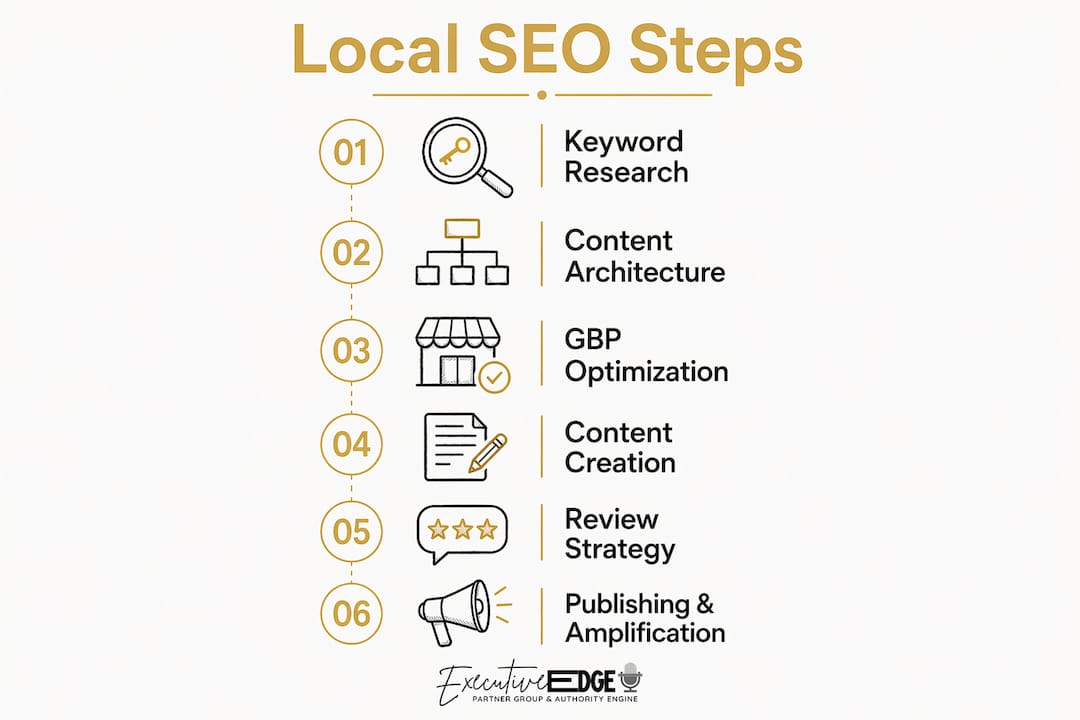
How do you build a local SEO content strategy step by step?
Step 1: Keyword research
Start with service+location combinations: "roof repair [city]," "family dentist [neighborhood]," "estate attorney [county]." Then layer in near-me variants and question-based queries ("how much does a roof repair cost in [city]"). Tools like Ahrefs surface local keyword volume and difficulty alongside SERP features. Google's autocomplete and "People Also Ask" boxes are free and often more locally specific than any paid tool.

Map every keyword to a single canonical page. A keyword-to-page map prevents cannibalization and keeps your content architecture clean. One keyword cluster, one page.
Step 2: Content architecture
Use a hub-and-spoke model: a pillar page for each core service or location, supported by topical blog posts that link back to it. A plumbing company serving three cities builds three location pillar pages, each supported by posts like "How to prevent frozen pipes in [city]" or "What to do when your water heater fails in [neighborhood]." Internal links flow from spokes to hub.
Step 3: Google Business Profile optimization
GBP completeness and activity are the single most important immediate fix for most local businesses. Work through this checklist:
- Choose the most specific primary category available, then add relevant secondary categories.
- Write a business description that includes your top service keyword and city in the first two sentences.
- Upload several photos including exterior, interior, team, and work examples.
- Add every service you offer with a description and price range where applicable.
- Publish a GBP post every week. Reuse your latest blog content within 48 hours of publishing it.
- Answer every question in the Q&A section before a stranger does.
- Keep hours current, including holiday closures.
Weekly GBP posts and photo uploads measurably differentiate otherwise similar listings. This is one of the few local SEO levers that produces visible results within 30 days.
Step 4: Content creation

A service page needs: an H1 that includes the service and city, a first paragraph that mentions the location within the first 100 words, a service description with local proof (years served, neighborhoods covered), an FAQ section targeting question-based queries, and a clear call to action. A location page follows the same structure but leads with the geography.
Pro Tip: Write your FAQ section by pulling directly from Google's "People Also Ask" results for your target keyword. Those questions are what real searchers type, and answering them explicitly improves your chances of appearing in featured snippets and AI Overviews.
Step 5: Review and citation strategy
Ask for reviews immediately after a positive experience. A simple email template:
"Hi [Name], thank you for choosing [Business]. If you have a moment, we'd love a quick Google review — it helps other [city] residents find us. [Direct link]"
SMS works even better for service businesses. Keep it under two sentences and include the direct link. Respond to every review within 24 hours, positive or negative.
Step 6: Publishing and amplification
Publish the blog post, then repurpose it: a GBP post within 48 hours, a social clip for Facebook or Instagram, and a short FAQ snippet for your website. One piece of content, four placements, four location signals. For local social content types that drive engagement, the formats that consistently outperform are before/after photos, short how-to videos, and community event coverage.
What local content formats drive the most results?
Hyperlocal content earns local backlinks more reliably than generic service pages. A neighborhood guide, a local event recap, or a "best of [city]" list attracts links from local blogs and news sites that would never link to a standard service page.
High-impact local content types:
- Location pages: One per city or neighborhood you serve, with unique content for each.
- Localized service pages: Service+city combinations ("kitchen remodeling in [city]").
- Neighborhood guides: Hyperlocal content that signals genuine community presence.
- Event pages: Local events you host, sponsor, or attend.
- FAQ pages: Targeting question-based local queries.
- Case studies: Real client outcomes with location references (anonymized if needed).
- Short-form video: Walk-throughs, before/after, and how-to clips for YouTube and GBP. See why YouTube helps local businesses for channel strategy.
For geo-optimized page examples with proven structures, the pattern that works is: location-specific headline, 100-word location lead, service bullets, local proof, schema, CTA.
Keyword-to-content mapping table:
| Keyword Example | Page Type | Primary CTA |
|---|---|---|
| "roof repair [city]" | Localized service page | Call / quote request |
| "best plumber near [neighborhood]" | Location page | Book appointment |
| "how much does [service] cost in [city]" | Blog post / FAQ | Contact form |
| "[city] [service] reviews" | Case study / testimonial page | Read more / call |
| "[neighborhood] guide for [service]" | Neighborhood guide | Internal link to service page |
| "[service] near me" | GBP post + location page | Direction click / call |
Cadence guidance: Build location and service pages first. They are permanent assets that compound over time. Blog posts and GBP posts fill the gaps weekly. Choose a location page over a blog post when the keyword has clear commercial intent. Choose a blog post when the query is informational and the searcher is researching, not buying yet.
What does on-page local SEO look like in practice?
On-page checklist
- NAP (name, address, phone) matches exactly across your website, GBP, and all directories.
- H1 includes the primary service and city or neighborhood.
- Title tag format: "[Service] in [City] | [Business Name]" (under 60 characters).
- Meta description includes city and a benefit phrase (under 155 characters).
- Location mentioned in the first 100 words of body copy.
- Internal links from blog posts to the relevant location or service pillar page.
- Mobile-first layout: tap-to-call button visible above the fold.
- Embedded Google Map on contact and location pages.
For city-specific landing page structure, each page needs 100% unique content. Duplicate location pages with only the city name swapped are a known ranking liability.
LocalBusiness schema: the JSON-LD you need
Structured data is how you communicate directly with search engines and AI Overviews in a language they parse without ambiguity. Place this JSON-LD in the <head> of your homepage, contact page, and each location page.
{
  "@context": "https://schema.org",
  "@type": "LocalBusiness",
  "name": "Your Business Name",
  "url": "https://yourbusiness.com",
  "telephone": "+1-555-000-0000",
  "address": {
    "@type": "PostalAddress",
    "streetAddress": "123 Main Street",
    "addressLocality": "Your City",
    "addressRegion": "TX",
    "postalCode": "75701",
    "addressCountry": "US"
  },
  "openingHours": ["Mo-Fr 08:00-18:00", "Sa 09:00-14:00"],
  "serviceArea": {
    "@type": "GeoCircle",
    "geoMidpoint": {
      "@type": "GeoCoordinates",
      "latitude": 32.3513,
      "longitude": -95.3011
    },
    "geoRadius": "50000"
  },
  "areaServed": ["Your City", "Neighboring City", "County Name"],
  "aggregateRating": {
    "@type": "AggregateRating",
    "ratingValue": "4.8",
    "reviewCount": "127"
  },
  "priceRange": "$$",
  "sameAs": [
    "https://www.facebook.com/yourbusiness",
    "https://www.yelp.com/biz/yourbusiness"
  ]
}
"AI Overviews increasingly read structured data rather than narrative paragraphs — structured schema and short, explicit facts on pages improve odds of being the zero-click answer." — Navoto Local Content Marketing Guide
LocalBusiness schema with serviceArea, areaServed, and aggregateRating significantly improves visibility in AI Overviews and Map Packs by giving search engines structured geographic and reputation signals. After deploying, validate using Google's Rich Results Test at search.google.com/test/rich-results and the Schema.org validator at validator.schema.org.
Pro Tip: Service-area businesses without a public storefront should set serviceArea and areaServed in schema and suppress the physical address in GBP. Showing a home address publicly is both a privacy risk and a ranking liability if your service model is mobile.
How do reviews, citations, and local links work together?
Citation and NAP workflow
Fixing NAP inconsistencies across directories reduces ranking volatility caused by mismatched signals. Start here:
- Run a NAP audit: search your business name in Google and note every listing that appears.
- Claim and correct the top-priority directories: Google Business Profile, Yelp, Bing Places, Apple Maps, Facebook, and your industry-specific directories.
- Fix address format, phone number format, and business name spelling to match your GBP exactly.
- Add new citation opportunities: local chamber of commerce, city business directories, and niche directories for your industry.
Review request templates
Email: "Hi [Name], we loved working with you on [project/service]. If you have two minutes, a Google review helps other [city] residents find us and means a lot to our small team. [Direct link]"
SMS: "[Business name] here — thanks for choosing us! Mind leaving a quick Google review? [Link]"
In-person: "We'd really appreciate a Google review if you have a moment. I can text you the link right now."
Respond to every review. For negative reviews, acknowledge the issue, offer to resolve it offline, and keep the response under three sentences. Never argue publicly.
Local link-building
Community partnerships produce the most durable local backlinks. Sponsor a local event and request a link from the event page. Join your local chamber of commerce and get listed in their member directory. Pitch a guest post or expert quote to a local news blog or neighborhood publication. These links carry geographic relevance that a generic directory link cannot replicate.
Pro Tip: Convert your best reviews into content assets. Pull a specific quote (with permission), add it to your location page with the reviewer's first name and city, and mark it up with Review schema. That single action reinforces E-E-A-T and adds structured reputation signals to the page simultaneously.
For local influencer partnerships that generate both links and social proof, micro-influencers with 1,000–10,000 local followers consistently outperform larger accounts on engagement and conversion.
Which KPIs and tools should you track for local SEO?
KPIs tied to business outcomes
Track these, not vanity metrics:
- GBP views and search impressions: Available in GBP Insights; shows whether your listing is gaining visibility.
- GBP calls and direction requests: Direct revenue signals from your listing.
- Organic sessions to location pages: Tracked in Google Analytics 4 (GA4) by filtering for your location page URLs.
- Local keyword rank movement: Track service+city keywords weekly using a rank-tracking tool.
- Form fills and booked appointments: Tag these as conversion events in GA4.
- Click-to-call rate: Set up call tracking (a tracked phone number on your website) to attribute calls to organic traffic.
Use UTM parameters on every GBP post link so GA4 can separate GBP-driven traffic from direct or organic visits. Format: ?utm_source=google&utm_medium=gbp&utm_campaign=post-[date].
Recommended tool stack
| Tool | Cost | Primary Use |
|---|---|---|
| Google Business Profile Insights | Free | GBP views, calls, direction clicks |
| Google Search Console | Free | Organic impressions, click-through rates, indexed pages |
| GA4 | Free | Traffic, conversions, location page performance |
| Ahrefs (or similar rank tracker) | Paid | Local keyword rankings, backlink monitoring |
| BrightLocal or Whitespark | Paid | Citation audit, NAP consistency, review tracking |
| Google Rich Results Test | Free | Schema validation |
Reporting cadence
| Frequency | What to Review |
|---|---|
| Weekly | GBP posts published, new reviews received and responded to, GBP call/view trend |
| Monthly | Keyword rank movement, organic traffic to location pages, new citations added, conversion rate |
| Quarterly | Full content audit, schema re-validation, citation cleanup pass, content refresh for top pages |
For converting local traffic into revenue, the measurement gap most small businesses miss is attribution. Without call tracking and UTM-tagged GBP links, you cannot prove which content is driving calls.
What does a 90-day local SEO implementation look like?
30-day sprint: foundation
- Complete GBP audit and fix all fields (categories, hours, photos, NAP). Owner or marketer, 3–4 hours.
- Publish one location or service pillar page with schema, local proof, and a clear CTA. Contractor or marketer, 6–8 hours.
- Deploy LocalBusiness JSON-LD on homepage, contact page, and the new pillar page. Developer or marketer, 2–3 hours.
- Send review requests to the last 20–30 customers. Owner, 1–2 hours.
- Run NAP audit and fix top-priority directory inconsistencies. Marketer or contractor, 3–5 hours.
Estimated cost (DIY): $0–$200 in tools. With a contractor: $500–$1,500 for content and technical setup.
60-day sprint: content and citations
- Publish two to three supporting blog posts targeting long-tail service+city keywords.
- Repurpose each post into a GBP post within 48 hours of publishing.
- Claim and correct 10–15 additional directory listings.
- Begin local outreach: chamber of commerce listing, one partnership link request.
Estimated additional cost: $300–$800 for content if outsourced.
90-day sprint: amplification and iteration
- Launch local link-building outreach to three to five community partners or local publications.
- Repurpose top-performing content into short video clips for YouTube or social. See video content for local marketing for format guidance.
- Review keyword rankings and double down on pages showing early movement.
- Run first quarterly content audit: update stats, refresh CTAs, add new FAQ items.
Pro Tip: When time is limited, prioritize in this order: GBP optimization first, one pillar page second, schema third. Citations and link-building compound over time, but GBP and a single strong location page can move the needle within 30 days.
Sample weekly publishing cadence:
- Week 1: Pillar page live, GBP post published.
- Week 2: First blog post live, repurposed to GBP post, review requests sent.
- Week 3: Second blog post live, social clip created, one citation fixed.
- Week 4: GBP Q&A updated, outreach email sent to one local partner, monthly report pulled.
How does schema and E-E-A-T future-proof your local presence?
The shift toward AI Overviews changes what "ranking" means for local businesses. Google's AI-generated answers pull from structured data, short explicit facts, and authoritative local signals. A business with complete LocalBusiness schema, consistent citations, and a track record of reviews is structurally better positioned for AI Overview inclusion than one relying on narrative content alone.
"Repurposing one long-form location article into short GBP posts, social clips, and FAQ snippets multiplies local signals without a linear increase in production hours." — Executive Edge Partner Group
Advanced schema fields worth adding:
| Field | Why It Matters |
|---|---|
serviceArea | Tells AI and Maps exactly where you operate |
areaServed | Reinforces geographic relevance for multi-city businesses |
aggregateRating | Pulls review signals into structured form for AI parsing |
openingHours | Enables "open now" filter in Maps and voice search |
sameAs | Links your GBP, Yelp, and social profiles for entity disambiguation |
priceRange | Surfaces in Maps and AI Overviews for commercial queries |
After deploying advanced schema fields, run three checks: Google's Rich Results Test, the Schema.org validator, and a manual Google search for your business name to confirm the knowledge panel reflects updated information.
Authority-building for E-E-A-T: Earned media mentions, local press coverage, and community partnerships all contribute to prominence. The Executive Edge Authority Engine approach treats content amplification as a systematic process: publish, repurpose, distribute, and earn links through community presence rather than cold outreach. For a deeper look at how AI search discovery works and what signals it prioritizes, the 2026 AI search guide covers the mechanics in detail.
Futureproofing: Monitor your AI Overview appearances by searching your target keywords in an incognito window monthly. When an AI Overview appears for a local query you are not in, examine the structured data and content format of the business that is. That gap analysis tells you exactly what to add.
Pro Tip: Set up a Google Alert for your business name and your top competitors' names. When a competitor earns a local press mention or community link, that is your signal to pursue the same outlet.
How Executive Edge approaches local content strategy for clients
The process starts with an audit: GBP completeness, existing content gaps, NAP consistency, and schema status. From there, the work moves into strategic pillar creation. One location or service page per priority market, built to the geo-optimized structure that consistently earns local rankings. GBP and content are synchronized from day one. Every blog post feeds a GBP post within 48 hours. Every location page gets schema on launch day.
The Executive Edge Authority Engine handles the amplification layer: repurposing long-form content into short-form social clips, GBP posts, and FAQ snippets without a linear increase in production time. For single-location businesses, that means one content sprint per month produces four to six distinct local signals. For multi-location businesses, the same system scales across markets by templating the pillar structure and localizing the proof elements.
The businesses that see the fastest results are typically service-area businesses that have never touched their GBP beyond the initial setup. A complete GBP audit and one strong pillar page, done right, can produce measurable ranking movement within 30 days. This is something we see consistently with businesses across East Texas and beyond. The fundamentals are the same whether you are a solo contractor or a 10-location regional brand.
What Executive Edge Partner Group does for local businesses
Executive Edge Partner Group is the done-for-you alternative to building a local SEO content operation from scratch. The service covers the full stack: GBP audit and optimization, location and service pillar page creation, LocalBusiness schema deployment, citation cleanup, review strategy, and multi-platform content amplification through the Executive Edge Authority Engine.

For local business owners who want to compete in the Map Pack and AI Overviews without becoming full-time content creators, this is the practical path. Packages include a full audit, strategic content plan, and ongoing publishing and amplification. Onboarding typically takes one to two weeks from first contact to active content production.
The next step is straightforward: request a local SEO audit at eepartnergroup.com. You will get a clear picture of where your current presence stands and what a 90-day sprint would look like for your specific market and service area.
Useful sources and further reading
The sources below were used throughout this guide and are worth bookmarking for ongoing reference:
- Backlinko Local SEO Guide: The most comprehensive free resource on local ranking factors, GBP optimization, and citation strategy.
- Ahrefs Local SEO Guide: Practical keyword research and link-building tactics with tool-specific walkthroughs.
- Moz Local Business Content Guide: Hub-and-spoke content architecture and pillar page strategy for local businesses.
- Moz Local SEO Content Planning: NAP consistency, citation workflow, and content planning frameworks.
- Navoto Local Content Marketing Guide: Schema recommendations and AI Overview optimization for local content.
- Schema.org LocalBusiness: The authoritative reference for every LocalBusiness schema field and its accepted values.
- Coursera: How to Make a Local SEO Strategy: Beginner-friendly overview of local SEO strategy components.
Tool categories to investigate:
- Rank trackers: Tools that monitor local keyword positions and Map Pack appearances weekly.
- Citation managers: Platforms that audit NAP consistency and push updates across directories.
- Schema validators: Google's Rich Results Test and Schema.org validator for deployment checks.
"For service-area businesses without a public storefront, set a clear serviceArea in schema and focus on location pages and review-rich content anchored to service regions rather than a single address." — Moz Local SEO Content Planning
Run a quarterly content audit using the reporting cadence in the measurement section above. Pages that ranked and then slipped usually need a content refresh, a new FAQ item, or an updated schema field. Evergreen content strategy guidance is covered in depth at What Is Evergreen Content.
FAQ
What is the most important first step in local SEO?
Optimize your Google Business Profile completely: verify it, choose specific categories, add photos, and publish weekly posts. GBP completeness is the single highest-impact action for Map Pack visibility and produces results faster than any other local SEO tactic.
How long does local SEO take to show results?
Most businesses see early GBP engagement signals within two to four weeks and measurable keyword movement within 60–90 days of consistent content and citation work. Competitive markets may take four to six months for significant Map Pack movement.
What is LocalBusiness schema and why does it matter?
LocalBusiness schema is structured JSON-LD code added to your website that tells search engines your name, address, hours, service area, and ratings in a machine-readable format. Including serviceArea, areaServed, and aggregateRating fields improves your chances of appearing in AI Overviews and Map Pack results.
How many reviews do I need to rank in the Map Pack?
Google does not publish a minimum review count, but review quantity, recency, and rating all factor into prominence. Aim for a steady cadence of new reviews rather than a one-time burst.
Can Executive Edge Partner Group manage my local SEO content?
Yes. Executive Edge Partner Group offers done-for-you local SEO content services covering GBP optimization, pillar page creation, schema deployment, citation cleanup, and ongoing content amplification. Visit eepartnergroup.com to request an audit and get a 90-day plan built for your market.