

AI Overviews are Google's generative summaries that pull from indexed web pages and display above the standard organic results, and they now touch a meaningful share of search queries. Winning a spot inside one has less to do with your rank and everything to do with whether Google's system can lift a clean, self-contained answer straight off your page. That reframes the job: rank still matters, but citation-worthiness now decides who gets seen.
Three moves determine whether you show up:
- Eligibility first. Your page has to be indexed, crawlable, and snippet-eligible. If Google can't legally quote you, nothing else matters.
- Extractability second. Your content needs an answer-first passage, ideally 40 to 60 words, that makes sense with zero surrounding context.
- Measurement and protection third. Track citations through the Generative AI performance report in Google Search Console, and decide deliberately which pages you want quoted versus shielded.
Quick stat: When an AI Overview appears above a page that used to hold the top organic spot, that page's click-through rate can drop between 38% and 61% — but brands that get cited inside the overview itself often see a 12% to 18% CTR bump over listings that never make the cut. The traffic pie is shrinking for some pages and growing for others, and the split comes down to extractability, rather than domain authority.
Table of Contents
- What Is AI Overviews SEO and When Do They Appear?
- How Does Google Generate AI Overviews?
- How to Optimize for AI Overviews: A Prioritized Checklist
- What Technical Requirements Must a Page Meet to Appear in AI Overviews?
- What Do the Numbers Say About AI Overviews' Impact on Traffic?
- How Do You Measure AI Overview Performance?
- How Do You Prevent Your Content From Appearing in AI Overviews?
- Why Isn't My Content Showing Up Correctly in AI Overviews?
- What Tools Help You Track AI Overview Citations?
- What Should SEO Teams Prioritize First?
- How Executive Edge Partner Group Fits Into Your AI Overview Strategy
- Where to Go for Primary Sources on AI Overviews
- Sources
- FAQ
What Is AI Overviews SEO and When Do They Appear?
AI Overviews are Google's AI-generated answer boxes that synthesize information from multiple web pages into a single summary block, usually positioned above the traditional blue links. They differ from featured snippets in one crucial way: a featured snippet quotes one page verbatim, while an AI Overview blends passages from several sources into a new, generated paragraph, then links out to the sources it drew from.
Google tends to trigger AI Overviews most often for:
- Informational queries where the answer requires synthesizing multiple sources ("how does compound interest work")
- Certain commercial-investigation queries where comparison or explanation adds value ("best types of business insurance for contractors")
- Multi-part questions that benefit from a structured breakdown rather than a single link
They show up far less consistently for hyper-local, transactional queries like "plumber near me," where map-pack and local-service results still dominate the layout.
Prevalence check: seoClarity's Research Grid found AI Overviews appearing on roughly 30% of tracked U.S. desktop keywords at one measured point, and the same analysis found these overviews almost always source from the existing top 20 organic results. That second fact matters more than the first. It means you don't need a brand-new AI strategy so much as you need your existing top-ranking pages restructured for extraction.
How Does Google Generate AI Overviews?
AI Overviews run on retrieval-augmented generation, or RAG. Instead of the model inventing an answer from memory, it retrieves relevant passages from Google's search index in real time, then generates a summary grounded in those retrieved passages. This is why ranking still matters: if your page never enters the retrieval pool, it can't be cited, no matter how well-written it is.
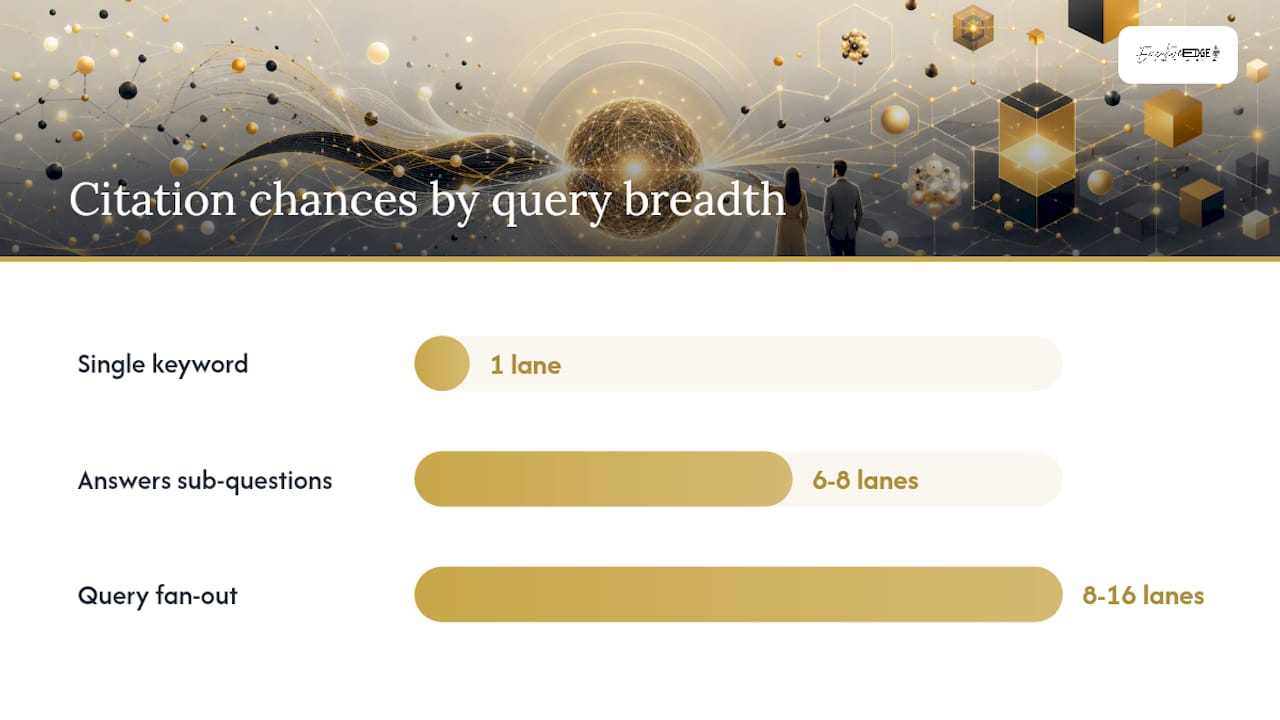
Before retrieval happens, though, Google typically runs query fan-out. The original search term gets decomposed into multiple related sub-queries, sometimes eight to sixteen of them, each one hunting for a different angle of the answer. A search for "how to reduce business insurance costs" might silently fan out into sub-queries about bundling policies, raising deductibles, industry-specific discounts, and claims history. Each sub-query pulls its own candidate pages, which widens the pool of pages that could get cited far beyond what a single-keyword ranking check would suggest.
Once the candidate pool is assembled, the system favors passages that are self-contained and easy to lift cleanly. Semrush's coverage of Google's own generative AI guidance confirms that RAG and query fan-out are the core mechanics behind how these features ground their answers in the live index, and that foundational SEO practices remain the primary lever for visibility.
A page that answers only its exact target keyword is competing for one lane. A page that also answers the six or eight natural sub-questions around that topic is competing for eight lanes at once, and each lane is a separate chance at citation.
What that means for how you structure content:
- Break topics into distinct, answerable sub-questions rather than one long undifferentiated block of prose.
- Put the most direct answer immediately under each heading, not buried three sentences in.
- Assume any paragraph might get lifted in isolation, so write it to survive without its neighbors.
How to Optimize for AI Overviews: A Prioritized Checklist
Start with the pages that already convert. Retrofitting your best-performing service page or highest-margin blog post for extractability pays off faster than chasing pages that get traffic but never generate a lead.
- Confirm indexability and snippet eligibility first. Nothing downstream matters if Google can't index or quote the page.
- Add an answer-first H2 with a 40 to 60 word extractable block underneath it. Write the heading as the question a person would actually type, then answer it completely in the next paragraph without leaning on prior context.
- Apply the Fan-Out Coverage Model. Identify six to eight natural sub-questions tied to your core topic and answer each with its own heading, either on the same page or across a tightly interlinked cluster. This mirrors how the query fan-out process searches for candidates in the first place.
- Chase featured snippet ownership as a proxy metric. Pages that already hold a featured snippet tend to have the exact structure AI Overviews look for, so snippet rank is a useful early signal even where it isn't a perfect predictor.
- Layer in entity and E-E-A-T signals. Named author bylines with real credentials, original research or first-hand case data, and third-party mentions on platforms like YouTube, Reddit, or Wikipedia all strengthen the trust signal Google's systems weigh during selection.
A few tactics genuinely help extraction and are worth building into your content templates:
- Native HTML tables for comparison data, since they're easier for retrieval systems to parse cleanly than an image or a PDF.
- A recurring freshness cadence, roughly every 30 to 60 days, for category and pillar pages.
- Original data or a first-hand case study that no competitor page can replicate.
And a short do-not-do list, because a lot of AI-SEO advice floating around right now is either wasted effort or actively risky:
- Don't build an
llms.txtfile expecting it to boost citations. Google has no such requirement. - Don't chop content into unnaturally short chunks purely to game passage extraction. It reads badly and doesn't reliably help.
- Don't run full-page AI rewrites with no human editing pass. Thin, generic phrasing is easy for both readers and ranking systems to spot.
- Don't manufacture inauthentic brand mentions on forums or review sites. Google's systems increasingly discount coordinated, low-quality mentions.
Pro Tip: Run your own extractability test before publishing anything. Copy the heading and the next 40 to 60 words into a blank document with zero surrounding context. If a stranger could read that snippet alone and fully understand the answer, it's citation-ready. If it references "this" or "the above" or assumes the reader already read three paragraphs of setup, rewrite it. Do this across your top 20 pages in one afternoon and you'll find your highest-leverage fixes fast. For teams building this into their process, our answer engine optimization playbook walks through the extractability workflow in more depth.
What Technical Requirements Must a Page Meet to Appear in AI Overviews?
A page has to clear the same indexing and crawlability bar that governs regular search visibility before it can be considered for generative features. Google's own documentation is direct about this: there's no special file format, no separate submission process, and no dedicated markup required specifically for AI Overview eligibility.
Run through this before troubleshooting anything more exotic:
- Confirm the page is indexed in Google Search Console and returns a clean 200 status.
- Check
robots.txtisn't blocking Googlebot from the page or its key resources. - Verify your CDN or firewall isn't silently serving a different response to Googlebot than to human visitors, which happens more often than teams expect.
- Audit for accidental
noindexornosnippettags left over from a staging environment or a CMS default. - Make sure the core answer text renders in the raw HTML rather than depending entirely on client-side JavaScript that crawlers may not fully execute.
Structured data deserves a specific caution here. Schema markup helps search engines understand your content's structure and can support rich results, but it is not a guaranteed AI Overview booster. Treat it as good hygiene, not a shortcut.
Common errors worth a quick numbered pass:
- Content locked behind a login wall or a lead-gen form, invisible to crawlers.
- Metadata or title tags stripped out during a site migration and never restored.
- Key answer content loaded only after a user interaction (a tab click, an accordion expand) that crawlers don't trigger.
- Canonical tags pointing to the wrong URL, which can confuse which version of a page gets indexed.
Our guide on getting found on AI search covers a deeper technical audit sequence if you're working through a larger site.
What Do the Numbers Say About AI Overviews' Impact on Traffic?
The CTR data is the headline, but the citation-length data is what actually tells you how to write. Analysis of thousands of AI Overview answers found a median citation length of about 67 words, which lines up almost exactly with the 40 to 60 word extractable-answer rule. Pages that front-load a tight, self-contained answer in that range get cited more often than pages that bury the point in longer paragraphs.
Pew Research found that people are less likely to click on any link at all once an AI-generated summary is present on the page. That's a real shift in searcher behavior, not just a Google-specific quirk, and it means fewer casual, low-intent clicks are reaching your site regardless of how well you optimize.
| Metric | Finding |
|---|---|
| CTR drop for former top organic result when AIO appears | 38% to 61% |
| CTR lift for brands cited inside the AI Overview | 12% to 18% |
| Median AI Overview citation length | ~67 words |
| Share of tracked U.S. desktop keywords showing AIOs | ~30% |
The practical takeaway isn't to panic about shrinking sessions. It's to stop treating every page as equally worth the optimization effort. Prioritize pages with real conversion potential, service pages, comparison guides, high-intent buying content, and put your extractability work there first. A blog post that drives brand awareness but never converts can wait.
How Do You Measure AI Overview Performance?
Google Search Console's Generative AI performance report is the primary place to see whether your pages are actually getting cited. It breaks out impressions and clicks specifically tied to appearances inside AI-generated features, separate from your standard organic performance data.
Set up your measurement approach in this order:
- Filter the Generative AI report by page and query to identify which of your assets are already earning citations.
- Cross-reference those pages against your conversion data in GA4 or your CRM to see whether cited traffic converts at a different rate than standard organic traffic.
- Build a recurring report, monthly is usually sufficient, tracking citation appearances, AIO-referred CTR, and conversion rate for cited pages side by side.
- Segment your top pages into two buckets: acquisition pages you want cited more, and proprietary or high-value pages you may want to protect from full extraction.
- Re-run your extractability test quarterly on pages that lost citations, since Google's retrieval selection shifts as competitors update their own content.
Core KPIs worth putting on a dashboard:
- Citation appearances by page and query
- AIO-referred click-through rate versus non-AIO CTR for the same query
- Conversion rate specifically for pages earning citations
- Change in total informational sessions over time (context, not a panic metric)
- Revenue per session, since fewer but higher-intent visitors can outperform a larger volume of casual traffic
Our piece on AI-driven content scaling has a fuller breakdown of building a measurement workflow that ties citation tracking to actual revenue attribution.
How Do You Prevent Your Content From Appearing in AI Overviews?
Sometimes you don't want a page cited. Proprietary research, gated reports, or content you monetize directly through the click itself might be better protected than exposed.
Google gives you a few specific controls:
nosnippet: prevents any text or video snippet from being shown for a page, which also blocks AI Overview extraction.data-nosnippet: an HTML attribute you can apply to a specific section of a page, letting you protect one paragraph while leaving the rest eligible.max-snippet: lets you cap snippet length to a specific character count, limiting how much text can be lifted.noindex: removes the page from search entirely, which is the most extreme option and comes at the cost of all organic visibility, not just AI citations.
| Control | Blocks AI citation | Blocks regular search visibility | Best use case |
|---|---|---|---|
nosnippet | Yes | No | Pages you want ranked but not quoted |
data-nosnippet | Partial (section only) | No | Protecting one proprietary paragraph on an otherwise open page |
max-snippet | Partial (length limited) | No | Limiting how much text can be lifted |
noindex | Yes | Yes | Content you want fully removed from search |
The tradeoff is real: blocking a page from AI Overview extraction also means it forfeits the citation-driven CTR lift that comes with being quoted. For most businesses, gating the truly proprietary sections with data-nosnippet while leaving the rest of the page open for extraction is a better middle path than an all-or-nothing noindex. Content gating and paywalls remain a legitimate alternative for genuinely premium material, and Google's own guidance treats these as acceptable as long as they don't attempt to cloak content differently for crawlers than for users.
Why Isn't My Content Showing Up Correctly in AI Overviews?
Start with Search Console. Check the Coverage report for the affected URL and confirm it's indexed without warnings. Then run a live URL inspection to see exactly what Google's renderer sees when it crawls the page right now, which often surfaces a JavaScript rendering issue you'd otherwise miss.
Quick diagnostic sequence:
- Confirm the page is indexed and free of
noindexornosnippettags you didn't intend to apply. - Run the URL Inspection tool's live test and compare the rendered HTML against what you expect to see.
- Check whether your answer content sits high enough in the page structure, buried content past several screens of unrelated text is less likely to get lifted.
- Verify structured data with Google's Rich Results Test to rule out markup errors that might confuse crawlers.
- If a citation is factually wrong or misattributes your content, use Google's feedback mechanism within the AI Overview itself to report it.
Common fixes:
- If indexing dropped after a redesign, check for leftover staging-environment
noindextags that migrated into production. - If structured data throws errors, fix the schema before assuming the content itself is the problem.
- If extractable content sits below the fold or after several paragraphs of introduction, move the direct answer higher and let the context follow.
Requesting a re-crawl through Search Console's URL Inspection tool after a fix typically speeds up reconsideration, though there's no guaranteed timeline for re-inclusion.
What Tools Help You Track AI Overview Citations?
The Generative AI performance report inside Google Search Console remains the only first-party source for citation tracking, and it should be the anchor of any monitoring workflow. It shows you directly which queries and pages are earning AI Overview impressions, which is data no third-party tool can fully replicate since it comes straight from Google.
Beyond Search Console, a few platforms add competitive and discovery layers:
- Semrush tracks AI Overview presence across tracked keywords and lets you see which competitors are getting cited for terms you rank for, useful for competitive gap analysis.
- seoClarity runs large-scale AI Overview research through its Research Grid and offers citation tracking at scale for enterprise sites managing thousands of pages.
- General rank-tracking platforms with AIO-specific modules can flag when a query you monitor triggers an overview, even before you dig into Search Console data.
Practical first steps: pull your top 50 converting pages, check which already have a Generative AI report presence in Search Console, then use Semrush or seoClarity to see whether competitors are winning citations for the same queries you're missing. That gap list becomes your content roadmap for the next quarter.
What Should SEO Teams Prioritize First?
The temptation right now is to treat every page like it needs an AI Overview strategy. It doesn't. The businesses that get this right are the ones willing to accept fewer total clicks on some pages in exchange for higher-quality clicks on the pages that actually drive revenue. That's an uncomfortable tradeoff for anyone whose job historically got measured in raw session counts, but it's the honest read of where the data points.
E-E-A-T signals matter more here than in classic keyword-rank SEO, not less. A named author with real credentials, a case study built on your own client data, a mention on a platform Google's systems already trust, these carry more weight in a system that's trying to decide whether your passage is safe to quote. Our breakdown of how AI search favors expert signals goes deeper on why anonymous, unattributed content is losing ground fastest.
If you're planning the next 90 days, here's the sequence that works:
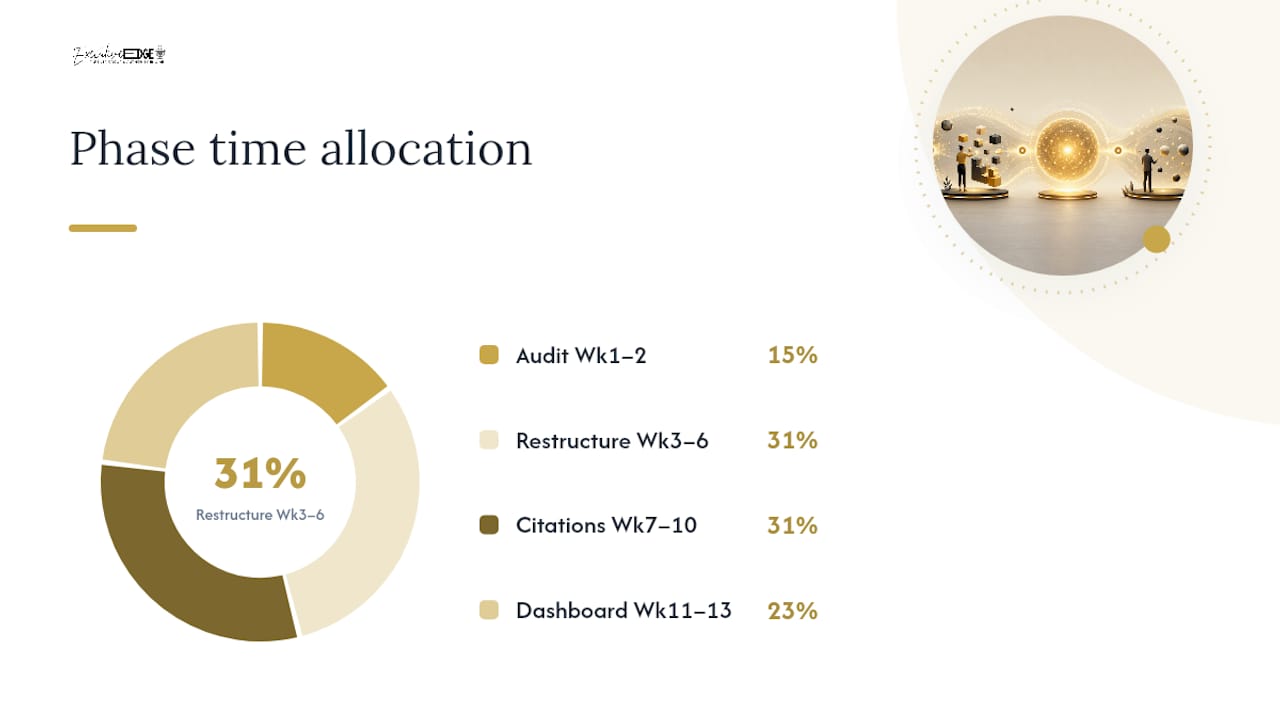
- Weeks 1 to 2: Audit your top 20 assets by conversion value, not traffic volume, and score each against the extractability test.
- Weeks 3 to 6: Apply answer-first restructuring and Fan-Out Coverage Model sub-questions to the highest-priority pages first.
- Weeks 7 to 10: Run citation experiments, republish a batch, track which structural changes actually moved the needle in the Generative AI report.
- Weeks 11 to 13: Build a permanent measurement dashboard combining Search Console, GA4, and conversion attribution, then set a recurring review cadence.
This is something we see consistently with business owners in Tyler and East Texas: the shift toward AI Overviews often means fewer low-intent informational visits, but the leads that do arrive from cited pages tend to convert at a noticeably better rate. Track conversions, not just sessions, and the picture usually looks a lot healthier than a raw traffic graph suggests.
How Executive Edge Partner Group Fits Into Your AI Overview Strategy
Building extractable, citation-worthy content on a consistent schedule is exactly the kind of work that gets deprioritized when your team is already stretched across client work, technical fixes, and everything else on the SEO backlog. Executive Edge Partner Group runs this as a done-for-you system: weekly podcast production, blog articles, YouTube content, and short-form social pieces, all built around the same eligibility, extractability, and measurement priorities laid out in this guide.
The Authority Engine's GEO and AEO workflows are built specifically to produce answer-first content structured for citation, paired with monitoring that tracks whether your pages are actually earning AI Overview visibility over time rather than just publishing and hoping. For business owners who don't have the bandwidth to run extractability audits and citation experiments in-house, this is the path that gets it handled without adding another task to your own plate. Visit Executive Edge Partner Group to see how the system maps to your current content and get a plan for what to fix first.
Where to Go for Primary Sources on AI Overviews
Google's own documentation should be your first stop for anything policy-related, since third-party guides sometimes lag behind actual product changes.
- Google Search Central's AI features guidance covers eligibility requirements and what Google explicitly does and doesn't require for generative feature inclusion.
- Semrush's coverage of Google's generative AI search guide is useful for understanding RAG and query fan-out mechanics in plain language.
For empirical data on how these features actually perform in the wild:
- seoClarity's Research Grid tracks prevalence trends and citation-sourcing behavior at scale.
- Search Engine Journal's CTR analysis is the best source for citation-length data and click-through impact figures.
- Pew Research's study on AI summary click behavior gives the clearest public-opinion read on how searcher behavior is shifting overall.
Sources
- Google CTRs drop 32% for top result after AI Overview rollout | Search Engine Journal
- AI features and your website | Google Search Central
- AI Overviews impact | seoClarity
- Google users are less likely to click on links when an AI summary appears in the results | Pew Research Center
FAQ
Is there an AI tool for SEO?
Yes, platforms like Semrush and seoClarity now include AI Overview tracking features, and Google Search Console's Generative AI performance report is the primary first-party tool for monitoring citations.
What is the 80/20 rule in SEO for AI Overviews?
How do you do SEO for AI search?
Confirm your pages are indexed and snippet-eligible, restructure key content with answer-first headings and 40 to 60 word extractable answers, cover the natural sub-questions around your topic using the Fan-Out Coverage Model, and track citations through the Generative AI report in Google Search Console.
What is AI SEO called now?
The terms Generative Engine Optimization (GEO) and Answer Engine Optimization (AEO) are the standard industry names for optimizing content specifically for AI-generated search features like AI Overviews, and they sit alongside, not instead of, traditional SEO.
Does losing top organic rank hurt AI Overview citations?
Not necessarily, since AI Overviews draw from roughly the top 20 organic results rather than only position one, but pages ranking higher still enter the retrieval pool more reliably and tend to get cited more often.