

Answer engine optimization (AEO) is the practice of structuring content so AI-powered tools can understand, synthesize, and cite your brand as an authoritative answer. The fastest way to start: open every major H2 with a one-sentence direct answer, add FAQ schema to your top ten pages, and make sure each section can stand alone as a self-contained response.
Here are the five actions to take this week:
- Audit your top pages. Identify which pages already rank for question-based queries — those are your highest-probability AEO candidates.
- Add FAQ schema. Implement JSON-LD FAQ markup on any page that answers a discrete question.
- Rewrite H2 openings. The first sentence under each heading should answer the question the heading poses, not build toward an answer.
- Claim and verify your entity. Make sure your brand name, author bios, and linked credentials appear consistently across your site and authoritative third-party sources.
- Test manually. Ask ChatGPT, Perplexity, and Google AI Overviews the questions your content answers. Note whether your brand appears.
Editorial rule: Every section of every page should be able to answer one specific question, completely, in 120–180 words, without requiring the reader to scroll anywhere else.
Table of Contents
- What is answer engine optimization and how does it work?
- How does AEO differ from traditional SEO?
- Key AEO strategies that actually increase citation probability
- How to structure pages and implement schema for AI extraction
- Technical prerequisites that determine whether AI engines can find you
- How do you measure AEO success?
- Step-by-step AEO implementation checklist for your team
- Common pitfalls and challenges in AEO
- How digital PR and brand authority amplify AEO results
- The practitioner's view: what a done-for-you AEO workflow actually looks like
- Authority-building without the full-time content team
- Sources
- FAQ
What is answer engine optimization and how does it work?
AEO is a content discipline that sits inside the broader category sometimes called Generative Engine Optimization (GEO) or AI-driven discoverability. Where traditional SEO earns ranked positions in a results list, AEO earns inclusion in the synthesized answer an AI engine generates. The distinction matters because a user who gets a direct answer from ChatGPT or Google AI Overviews may never click a blue link at all.
AI answer engines operate in two modes. Retrieval pulls from indexed sources at query time — Perplexity does this explicitly, surfacing citations alongside its answers. Generation synthesizes knowledge baked into the model during training, supplemented by retrieval in real time. Most modern engines blend both. Understanding how AI search discovery works at a mechanical level helps you decide where to invest first.
The platforms you need to prioritize
- ChatGPT (OpenAI): Favors credible sources with clear entity signals — named authors, linked bios, consistent brand mentions across trusted outlets. With 800 million weekly active users reported, the referral opportunity is substantial.
- Perplexity: Explicitly retrieval-based. It favors well-cited, data-driven sources and surfaces inline citations. Pages that already rank well and carry structured data perform better here.
- Gemini / Google AI Overviews (SGE): Strongly correlated with organic ranking. Pages that perform well in traditional search are more likely to appear in AI Overviews. Schema markup and E-E-A-T signals carry extra weight.
- Voice assistants (Alexa, Siri, Google Assistant): Pull from featured snippets and structured knowledge graphs. Concise, direct answers in the 40–60 word range tend to win these placements.
Different engines have subtly different behaviors, so testing across multiple platforms — not just one — is the only reliable way to know where your content wins and where it needs structural change.
How does AEO differ from traditional SEO?
The goals are related but not identical. SEO optimizes a page to rank in a results list and generate clicks. AEO optimizes a page to be extracted and cited by an AI engine, often without a click ever occurring. AEO and SEO overlap significantly, but AEO requires structural changes that ranking-focused workflows rarely make.
| Dimension | Ranking-focused (SEO) | Citation-focused (AEO) |
|---|---|---|
| Primary goal | Top-3 position in SERPs | Inclusion in AI-generated answer |
| Key signals | Backlinks, keyword relevance, CTR | Entity clarity, structured data, answer-first structure |
| Content shape | Long-form, keyword-rich | Self-contained sections, 120–180 words each |
| Success metric | Organic clicks, impressions | AI citations, branded search lift |
| Schema priority | Optional enhancement | Near-mandatory for FAQ, HowTo, Article |
| Author signals | Helpful but not required | Bylines and linked bios are critical |
The overlap is real and worth protecting. Technical SEO — clean indexing, fast servers, canonical tags, solid domain authority — remains a prerequisite because most AI engines pull from content that search crawlers have already indexed and ranked. You cannot skip the SEO foundation and expect AEO to work.
Quick AEO readiness checklist for existing pages:
- Does the page answer a specific question in the first 50 words?
- Does each H2/H3 open with a direct answer sentence?
- Is there FAQ schema or Article schema implemented?
- Does the author have a linked bio with verifiable credentials?
- Is the page indexed and crawlable (no noindex, no login wall)?
- Does the page cite named, verifiable sources?
- Is the content updated with a visible
dateModifiedtimestamp?
If you answered "no" to three or more, that page needs structural work before it will earn AI citations reliably. For a deeper look at how AI search favors experts, the E-E-A-T checklist there maps directly onto AEO readiness.
Key AEO strategies that actually increase citation probability
The core principle is simple: write for extraction, not just for reading. An AI engine does not read your page the way a human does. It looks for discrete, self-contained passages that answer a specific question. Every structural decision you make should serve that goal.
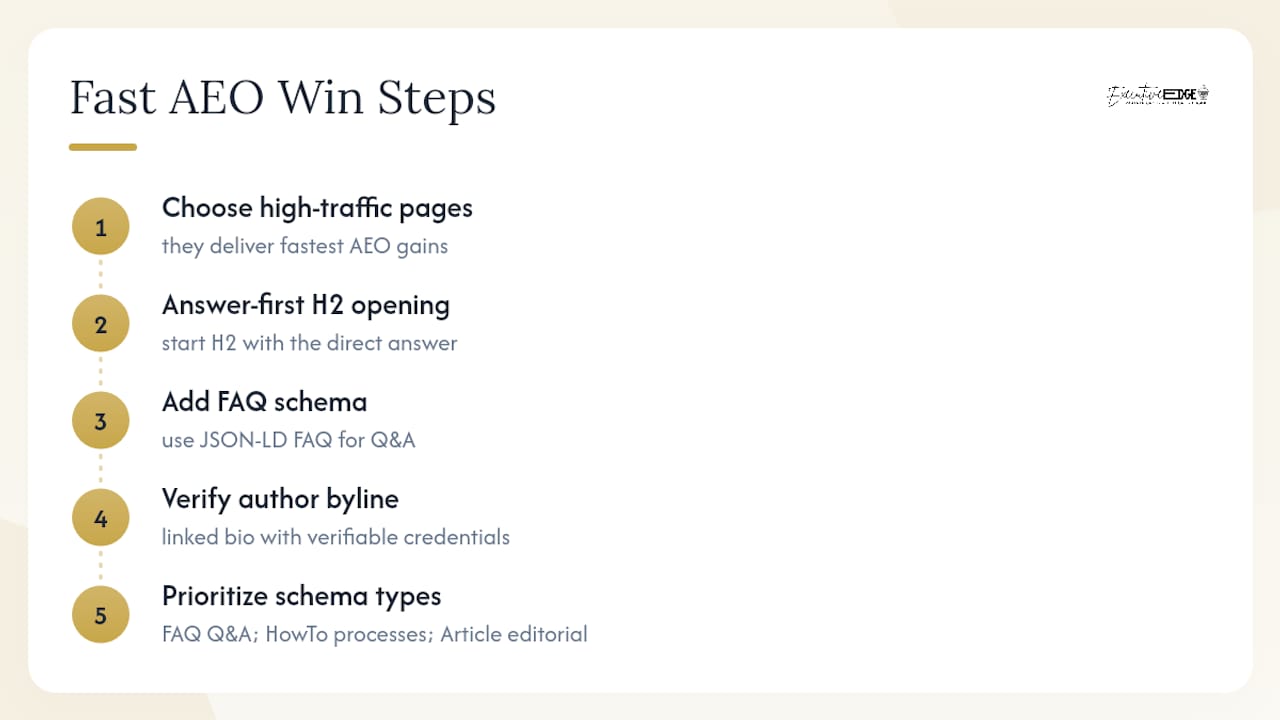
Answer-first content. The first sentence under any heading should state the answer, not introduce it. "FAQ schema is a type of structured data that tells AI engines which questions a page answers and what the answers are" is an answer. "In this section, we'll explore FAQ schema" is not. Sections written in the 120–180 word range, each answering one question completely, are the format most likely to be extracted and cited.
Natural-language headings. Write headings the way a person would type a question into ChatGPT. "What is FAQ schema?" outperforms "FAQ Schema Overview" because it matches the query pattern AI engines are trained to respond to.
Structured data and schema priorities. Structured data — particularly JSON-LD FAQ, HowTo, and Article schema — is a critical signal that helps AI systems interpret page structure. Prioritize FAQ schema for Q&A content, HowTo for process content, and Article schema with author and dateModified fields for editorial content.
Entity clarity and E-E-A-T signals. Every page should have a named author with a linked bio. The bio should reference verifiable credentials, publications, or professional affiliations. AI engines treat named, credible authors as a trust signal when deciding whether to cite a source.
Off-site signals: branded mentions and digital PR. Consistent, authoritative mentions across trusted outlets increase the probability that AI models reference your brand when synthesizing answers. A single press mention in a niche trade publication can do more for AEO than ten internally published blog posts.
Pro Tip: Your highest-traffic existing pages are your fastest AEO wins. They already have domain authority and indexed history. Rewrite the opening sentence of each H2 to answer the heading's question directly, add FAQ schema, and verify the author byline. That sequence — on pages already getting traffic — typically produces measurable citation gains faster than publishing new content.
For a broader view of AI search visibility tactics that complement these structural changes, the SemDash guide covers original content signals worth reviewing.
How to structure pages and implement schema for AI extraction
Each H2 and H3 on your page should function as an independent extraction point. That means: the heading poses a question, the first sentence answers it, and the following sentences add supporting detail. A reader who lands mid-page should be able to understand the answer without reading anything above it.
JSON-LD schema implementation
Place your schema in the <head> of the page or immediately before the closing </body> tag. Most CMS platforms (WordPress via Yoast or Rank Math, Webflow via custom code blocks) support this without developer intervention.
FAQ schema — minimum required fields:
{
  "@context": "https://schema.org",
  "@type": "FAQPage",
  "mainEntity": [{
    "@type": "Question",
    "name": "What is answer engine optimization?",
    "acceptedAnswer": {
      "@type": "Answer",
      "text": "Answer engine optimization (AEO) is the practice of structuring content so AI-powered tools can understand, synthesize, and cite your brand as an authoritative answer."
    }
  }]
}
Article schema — minimum required fields:
{
  "@context": "https://schema.org",
  "@type": "Article",
  "headline": "Your Article Title",
  "author": {
    "@type": "Person",
    "name": "Author Name",
    "url": "https://yoursite.com/author/name"
  },
  "datePublished": "2026-01-15",
  "dateModified": "2026-06-01"
}
The dateModified field matters more than most editors realize. AI engines that favor fresh content use it to assess recency. Update it every time you make a substantive edit.
Validation workflow
- Paste your page URL into Google's Rich Results Test and confirm schema is detected without errors.
- Check that FAQ items render correctly in the structured data preview.
- Manually query ChatGPT and Perplexity with the exact question your page answers. Note whether your content appears, and if not, whether a competitor's does.
- Repeat the manual check monthly. Citation patterns shift as models update.
Schema is the canonical vocabulary for all structured-data markup. Use it as your reference when editors ask which fields are required versus optional.
Implementation rule: Schema without answer-first prose is wasted effort. The markup tells the engine what to look for; the prose has to deliver the answer when the engine looks. Both have to work together.
| Schema type | Best for | Critical fields |
|---|---|---|
| FAQPage | Q&A content, support pages | name, acceptedAnswer.text |
| HowTo | Process and tutorial content | step, name, text |
| Article | Editorial and blog content | author, dateModified, headline |
Technical prerequisites that determine whether AI engines can find you
No amount of structural optimization matters if AI crawlers cannot access your content. The technical layer is unglamorous, but it is the prerequisite everything else depends on.
Essential technical checklist:
- Indexable HTML: Content must render in the page's HTML source, not only via JavaScript after load. Server-side rendering or static generation is safer than client-side-only rendering for AI crawlers.
- XML sitemap: Submit a current sitemap to Google Search Console and keep it updated. Several AI retrieval systems use Google's index as their source of truth.
- robots.txt: Confirm you are not accidentally blocking AI crawlers. Check for
Disallow: /rules that apply broadly. - Canonical tags: Every page should declare its canonical URL to prevent duplicate-content confusion.
- Server performance: Pages that load slowly or return intermittent errors get crawled less frequently. A page that is unreliable is a page that gets deprioritized.
- No login walls or paywalls on target content: Gated content cannot be extracted. If a page requires authentication, it will not appear in AI-generated answers.
- Avoid PDF-only content: PDFs are harder for AI agents to parse reliably. Publish the same content as HTML.
What to avoid. Google explicitly advises against manipulative AEO tactics — spammy AI-chunked pages, unnecessary llms.txt files used as manipulation tools, and thin content padded to look comprehensive. These approaches tend to trigger quality filters rather than earn citations.
The llms.txt file is a legitimate tool for communicating with AI agents about your site's structure, but misusing it to stuff keywords or claim false authority is counterproductive. Use it to clarify, not to game.
Gartner projects a meaningful decline in traditional search-engine volume as AI chatbots and virtual agents take a greater share of queries. That shift makes technical accessibility to AI crawlers a business-critical investment, not an optional enhancement.
How do you measure AEO success?
AEO success is not measured in clicks. The KPIs that matter are citation frequency, brand mention lift, and the downstream effect on branded search volume and assisted conversions.
Core KPIs to track:
- AI citation count: How often does your brand or content appear when you query target questions across ChatGPT, Perplexity, Gemini, and Google AI Overviews?
- Excerpt share: When your content is cited, is the excerpt accurate and favorable?
- Branded search volume: Rising branded search often correlates with increased AI visibility. Track this in Google Search Console.
- Assisted conversions: Users who encounter your brand in an AI answer and then visit your site directly. Segment direct traffic by landing page to identify this pattern.
- PR-driven mentions: Track new backlinks and brand mentions from authoritative outlets using tools like Ahrefs or Moz.
Sample monthly tracking workflow
| Step | Action | Tool |
|---|---|---|
| 1 | Run 30 target queries | ChatGPT, Perplexity, Gemini, Google AI Overviews |
| 2 | Log citation appearances | Spreadsheet (brand, page cited, excerpt) |
| 3 | Check branded search trend | Google Search Console |
| 4 | Review new backlinks/mentions | Ahrefs, Moz, or Google Alerts |
| 5 | Correlate changes with content updates | Internal content calendar |
For teams that want tool-assisted monitoring, AI visibility tools for marketing teams can automate parts of the citation-tracking workflow that manual spot checks miss.
Pro Tip: Combine manual spot checks with programmatic monitoring. Manual checks catch nuance — whether the excerpt is accurate, whether a competitor displaced you. Programmatic tools catch volume and trend. Neither alone gives you the full picture.
Step-by-step AEO implementation checklist for your team
This is the production sequence for converting an existing page to AEO-ready status. Apply it to your highest-traffic, question-based pages first.
- Identify the primary question the page answers. Write it as a plain-language sentence. If you cannot state it in one sentence, the page is trying to answer too many questions.
- Rewrite the opening paragraph to answer that question in 40–60 words. No preamble, no context-setting — the answer first.
- Audit every H2 and H3. Each heading should pose a question or make a claim. The first sentence below it should answer or support that claim directly.
- Add a FAQ block at the bottom of the page with 3–5 questions the page's content can answer. Write each answer in 40–80 words.
- Implement FAQ schema using JSON-LD. Validate with Google Rich Results Test before publishing.
- Add or update the author byline. Link it to a bio page that includes verifiable credentials and professional context.
- Add named, verifiable citations to any factual claims. Link to primary sources, government data, or recognized industry research.
- Set
dateModifiedin your Article schema and update it with every substantive revision. - Check indexability. Confirm the page is not blocked by robots.txt, has a canonical tag, and appears in your XML sitemap.
- Run a manual citation test. Query ChatGPT, Perplexity, and Google AI Overviews with the page's primary question. Document the result.
Priority audit scoring
For scaling this process across a full content library, the scalable content creation guide covers the operational workflow in detail.
Common pitfalls and challenges in AEO
AEO is not a set-and-forget tactic. The platforms change, model behaviors shift, and content that earns citations today can lose them after a model update. Understanding the failure modes upfront saves significant rework.
Risks to watch:
- Over-optimization and factual drift. Writing content specifically to match AI extraction patterns can push editors toward oversimplification. Answers that are too short or too generic may be technically extractable but factually incomplete — which creates liability if the AI cites them out of context.
- Citation misattribution. AI engines sometimes attribute a claim to the wrong source, or combine claims from multiple sources in ways that misrepresent any one of them. You cannot fully control this, but you can reduce the risk by writing precise, bounded claims rather than broad generalizations.
- Reliance on ephemeral platform behavior. Google AI Overviews, Perplexity, and ChatGPT all change their citation logic regularly. A tactic that works in one model version may not survive the next update. Build for durable content quality, not for a specific platform's current behavior.
- Spammy AI-generated content. Publishing large volumes of thin, AI-generated pages to capture more citation surface area tends to backfire. Google's quality systems and AI engines' own quality filters both penalize this approach.
Mitigations:
- Add "as of [date]" timestamps to any time-sensitive claims.
- Maintain a versioning log for pages that cover regulatory, pricing, or technical information that changes.
- Establish an editorial review policy that requires a named human editor to approve any page before publication.
- Follow Google's guidance: unique, expert-led content that demonstrates genuine experience and expertise is the only durable AEO strategy.
Ethical considerations. Do not attempt to manipulate AI engines into citing your brand through paid placement schemes, fake reviews, or manufactured mentions. Beyond the ethical problems, these tactics are increasingly detectable and tend to produce the opposite of the intended effect.
How digital PR and brand authority amplify AEO results
Off-site signals are where many AEO strategies stall. Brands that optimize their own pages but neglect their external presence often find that AI engines cite competitors with weaker on-page structure but stronger brand recognition across trusted outlets. Consistent, authoritative mentions across trusted outlets increase the probability that AI models reference your brand when synthesizing answers.
Digital PR tactics that earn AI-favorable mentions:
- Publish original data or research that journalists and bloggers will cite. A single data-driven study can generate dozens of authoritative backlinks and brand mentions.
- Offer expert commentary to trade publications and industry newsletters. A named quote in a recognized outlet is a strong entity signal.
- Pursue podcast appearances and video interviews. Transcripts from these often get indexed and carry the same entity signals as written content.
- Issue press releases for genuine news events — product launches, partnerships, awards — through distribution services that reach indexed news outlets.
Amplification checklist:
- Syndicate long-form content to LinkedIn Articles, Medium, and industry-specific platforms with canonical links back to the original.
- Embed structured data in video descriptions and podcast show notes where platforms support it.
- Build a consistent author presence across multiple platforms so AI engines can triangulate your brand's expertise across sources.
- Pursue local media coverage in niche publications relevant to your industry.
For business owners in Tyler and East Texas, local media and regional trade publications are often underutilized. A mention in a respected East Texas business journal or a local chamber of commerce feature carries genuine entity weight for AI engines that factor geographic relevance into their source selection. Local content that converts covers the amplification tactics that work specifically for regional brands.
The practitioner's view: what a done-for-you AEO workflow actually looks like
Most brands approach AEO the same way they approached SEO in 2012: they read a guide, update a few pages, and then wonder why nothing changed six months later. The gap is almost never strategy. It is execution consistency.
A production-grade AEO workflow runs in five phases. First, a content audit that maps existing pages to specific questions and scores them for extraction readiness. Second, content transformation — rewriting openings, restructuring sections, adding FAQ blocks, and implementing schema — applied systematically to the highest-priority pages. Third, schema implementation and validation across the full site, not just the pages that got rewritten. Fourth, PR amplification: identifying the outlets and formats that will generate the kind of authoritative mentions AI engines favor, then executing a consistent outreach cadence. Fifth, monitoring: monthly manual citation checks across ChatGPT, Perplexity, Gemini, and Google AI Overviews, correlated with branded search volume trends and assisted conversion data.
Realistic timelines: brands that execute this workflow consistently typically see measurable citation appearances within 60–90 days on their highest-priority pages. Branded search lift tends to follow 30–60 days after that. Assisted conversions are the last metric to move, usually appearing in the data at the 90–120 day mark.
The measurement integration matters as much as the execution. AEO results should appear in the same reporting dashboard as organic traffic, branded search, and PR metrics — not in a separate "AI report" that nobody reads. When citation changes correlate with branded search volume shifts, that correlation is the business case for continued investment.
Authority-building without the full-time content team
Most businesses that want to compete for AI citations face the same constraint: the content production required is real, the schema implementation is technical, and the PR outreach is time-consuming. Doing all three consistently, while running an actual business, is where most AEO efforts break down.
Executive Edge Partner Group's Authority Engine is built for exactly this situation. It is a done-for-you system that handles the full AEO production stack: weekly long-form content written for extraction, FAQ and Article schema implemented on every piece, author bylines and bio pages built to E-E-A-T standards, and a PR amplification cadence that generates the branded mentions AI engines favor. The service is designed for service-based businesses, consultants, attorneys, medical professionals, and executives who need consistent authority-building output without adding headcount.
The workflow is fully managed. Clients bring their expertise; the Authority Engine transforms it into indexed, schema-marked, citation-ready content distributed across the channels where AI engines look. For businesses that want to stop losing AI citations to competitors with weaker expertise but stronger content operations, the next step is straightforward: visit Executive Edge Partner Group to see how the Authority Engine fits your category and get a clear picture of what a managed AEO program looks like in practice.
Sources
- Answer Engine Optimization (AEO) — HubSpot
- Schema
- Gartner press release — search engine volume projection
FAQ
What is answer engine optimization?
Answer engine optimization (AEO) is the practice of structuring content so AI-powered tools — including ChatGPT, Perplexity, Gemini, and Google AI Overviews — can extract and cite your brand as an authoritative answer. Unlike traditional SEO, which targets ranked positions in a results list, AEO targets inclusion in the AI-generated answer itself.
What is the difference between AEO and SEO?
SEO optimizes pages to rank in search results and generate clicks; AEO optimizes content to be extracted and cited by AI engines, often without a click occurring. Strong SEO remains a prerequisite for AEO because most AI engines pull from content that search crawlers have already indexed and ranked.
What is the difference between AEO and generative engine optimization?
AEO focuses specifically on earning citations in AI-generated answers, while Generative Engine Optimization (GEO) is a broader term covering all tactics that improve visibility across AI-driven discovery platforms, including image generation, code assistants, and multimodal search. AEO is best understood as a subset of GEO focused on text-based answer citation.
What is the best approach for answer engine optimization?
The highest-impact combination is answer-first content structure (each H2 opens with a direct answer), FAQ and Article schema implemented via JSON-LD, named author bylines with verifiable credentials, and consistent branded mentions across authoritative third-party outlets. Executive Edge Partner Group's Authority Engine manages this full stack for businesses that need consistent execution without building an in-house content team.
How do I know if my content is being cited by AI engines?
Run manual spot checks monthly: query ChatGPT, Perplexity, Gemini, and Google AI Overviews with the specific questions your content answers, and log whether your brand or page appears. Pair this with Google Search Console branded search volume trends — rising branded search often signals growing AI visibility even when direct citation tracking is incomplete.