

A local PR backlink is a link earned through media coverage, sponsorships, or community partnerships tied to a specific city or region rather than a generic guest post. The single best approach is targeted local digital PR: hyperlocal stories, data assets, and community partnerships that local outlets have real reason to link to. Done consistently, this earns roughly 2 to 8 backlinks per campaign, with visible ranking movement in weeks to a few months.
Table of Contents
- What Makes a Backlink "Local," and Why It Beats Chasing National Links
- Priority Shortlist: Where to Focus First
- How to Pitch Local Story Angles Journalists Will Actually Cover
- Events, Sponsorships, and Community Partnerships as Link Machines
- Content That Local Publishers Actually Want to Cite
- Directories, Chambers, and Associations Worth Your Time
- HARO, Podcasts, and Guest Spots: Editorial Mentions at Scale
- Turning Unlinked Mentions Into Live Backlinks
- Tracking Results: KPIs, Tools, Timelines, and Costs
- Author and Agency Perspective, With Proof From the Field
- Why We Prioritize Local PR Over General Link-Chasing
- A Managed Path if You'd Rather Not Build This Yourself
- Sources
- FAQ
What Makes a Backlink "Local," and Why It Beats Chasing National Links
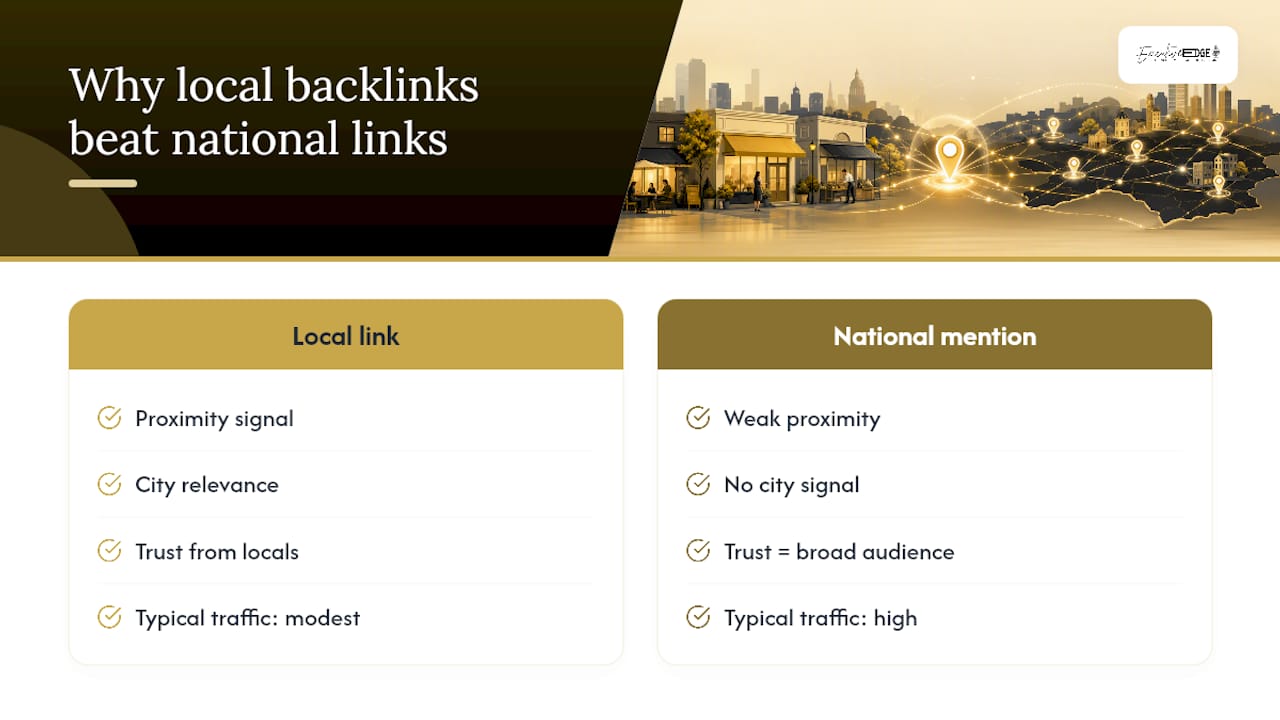
Google weights proximity, relevance, and trust when ranking businesses for local searches, and a link from your city's newspaper carries more of that signal than a mention on a national outlet with ten times the traffic. This is the core finding behind Press Ranger's analysis of local media links, and it flips a lot of conventional SEO advice on its head. Marketers trained to chase high domain authority often skip the neighborhood blog with 4,000 monthly readers in favor of a national roundup that never mentions their city by name.
That's backwards for local SEO. A link from a regional outlet, even one with modest traffic, tells Google something a national mention can't: that real people in your actual service area recognize and reference your business. Verlua's ranking-factor research puts backlinks at roughly 15% to 19% of the total local ranking weight, which makes link-focused local PR one of the higher-leverage channels available to a small business, right alongside review volume and citation consistency.
The standard term for this work is "local link building" or "local digital PR." If you've seen "local PR backlinks" used elsewhere, know that it describes the same practice: earning inbound links through public relations activity anchored in a specific community rather than broad, untargeted outreach.
Priority Shortlist: Where to Focus First
Not every tactic delivers the same return for the same effort. Here's how to rank them if you're starting from zero:
- Local media pitches with a data or news angle. Highest impact, moderate effort. Result example: one seasonal data story pitched to three outlets can land two placements with links. First step: pull one interesting number from your own business data today.
- Sponsorships and community events. High impact, low to moderate cost. Result example: sponsoring a 5K often earns a sponsor-page link plus a local news mention. First step: call one event organizer this week.
- Data assets and localized content (maps, calculators, guides). High impact, higher upfront effort, long payoff. Result example: a neighborhood cost calculator can attract links for years. First step: outline one asset idea tied to your industry.
- Unlinked mention reclamation. Low effort, fast wins. Result example: converting a text-only mention into a live link often takes one email. First step: search your business name in Google News today.
- Directories and chamber listings. Low effort, foundational value. Result example: a completed chamber profile with a live link. First step: check whether your chamber membership listing is current.
Pick one or two of these to start. Trying to run all five at once is how local PR campaigns stall out in month one.
How to Pitch Local Story Angles Journalists Will Actually Cover
Local reporters get pitched constantly, and most pitches die because they're written for a national audience wearing a local disguise. What works instead is an angle built from three ingredients: local data, timeliness, and a human element specific to your city or neighborhood.
Here's a workflow that consistently earns coverage:
- Research the beat, not just the outlet. Find the specific reporter who covers small business, local economy, or your industry vertical. A general "info@" pitch almost never gets read.
- Build a one-page press kit. Include a clear headline, three supporting data points, a suggested URL for your source page, and one usable image. Reporters on tight deadlines grab whatever is easiest to use.
- Personalize the first line. Reference a story the reporter actually wrote. This single sentence often determines whether the email gets opened past the subject line.
- Follow up once, politely, after four to five business days. Reporters juggle dozens of pitches; a single follow-up is expected, not pushy.
- Request the link only after publication. Reporters are under no obligation to add one, and pushing for a link before the story runs can sour the relationship. Press Gazette's reporting on link requests makes clear that the polite ask, with the exact URL and suggested placement, works far better than a demand.
Pro Tip: Send your press kit as a plain text email with the one-pager attached, not a slick PDF brochure. Reporters copy and paste text into their CMS; they don't want to reformat your design.
Events, Sponsorships, and Community Partnerships as Link Machines
A single sponsored event can generate several linkable touchpoints at once: an event page on the organizer's site, a press mention from local media covering the event, a social recap, and sometimes a "past sponsors" archive page that stays live for years. That compounding effect is one reason local PR outperforms one-off link requests.
Not every sponsorship publishes a sponsor page with a link, so ask before you write the check. Youth sports leagues, school fundraisers, and chamber-run events are generally reliable about listing sponsors online, while smaller informal gatherings may only offer a social media shoutout.
If a large annual sponsorship is out of budget, smaller, cheaper options still work:
- Host a free workshop or "lunch and learn" at your location and invite a local reporter to cover it.
- Sponsor a single category prize at an existing community event instead of the whole event.
- Co-host a pop-up or open house with a complementary local business, splitting outreach effort and doubling the coverage odds.
- Donate services or products to a local nonprofit auction in exchange for a listing on their sponsor page.
When negotiating placement, always ask for an in-content or homepage mention rather than a buried footer credit. A footer link technically counts, but a mention in the event description or "thank you to our sponsors" paragraph tends to carry more contextual weight and gets seen by more visitors. It costs nothing extra to ask; most organizers just default to whatever's easiest unless you request otherwise.
Content That Local Publishers Actually Want to Cite
Local journalists and neighborhood bloggers gravitate toward a narrow set of content formats because these formats do their job for them: a data story with a clear number, an interactive map, a cost calculator, or a genuinely useful neighborhood guide. The Stacc's guide to local digital PR points to seasonal data stories and cost calculators as repeatable assets that produce measurable backlink counts campaign after campaign.
The production checklist is short but non-negotiable:
- Localize the data down to the neighborhood or zip code level, not just the city.
- Build one clear visual (a simple chart or map beats a wall of numbers every time).
- Make the asset downloadable or embeddable so bloggers can pull it into their own posts.
- Write a two-sentence summary journalists can paste directly into a story.
- Pitch the asset to five to ten local outlets and bloggers within the first week of publishing.
Pro Tip: Build your data asset around a comparison, not just a raw statistic. "Which East Texas neighborhoods have the highest home insurance rates" earns more coverage than "the average home insurance rate in our region," because comparisons give reporters a built-in headline.
Directories, Chambers, and Associations Worth Your Time
Not all directory links are equal, and chasing every free listing site wastes hours for negligible return. Prioritize in this order:
- Local chamber of commerce membership. A paid membership typically earns a permanent member-directory link plus eligibility for chamber-run events, making it one of the better ROI plays on this list.
- Trusted general directories like the Better Business Bureau. BBB accreditation signals credibility to both consumers and search engines, and the listing link is durable.
- Industry-specific associations. A contractor's trade association or a medical board directory carries topical relevance that a generic directory can't match.
- Municipal and economic development lists. Many cities maintain a "shop local" business directory that's free to join and rarely optimized by competitors.
For each listing, run through a short optimization checklist: confirm your name, address, and phone number (NAP) match exactly across every profile, link to a specific landing page rather than just your homepage, and add local business schema markup where the directory allows custom fields. A membership fee is worth paying when the directory has real local search visibility of its own; a free listing is worth claiming regardless.
HARO, Podcasts, and Guest Spots: Editorial Mentions at Scale
Journalist query services like HARO (now Connectively) let you respond to reporters actively looking for sources, which flips the outreach dynamic in your favor. Check queries daily if you can, since the useful ones get dozens of responses within hours.
- Filter for local and industry-relevant queries rather than replying to everything.
- Answer in the first two sentences; reporters skim, and a buried answer gets ignored.
- Include your name, title, city, and one sentence of relevant credibility, nothing more.
- Track your win rate so you know which query types actually convert for your niche.
Podcast guest spots work on a similar logic. Most shows link back to guests in the episode show notes, so treat each appearance as a backlink opportunity and always confirm the host includes a link before you record.
Turning Unlinked Mentions Into Live Backlinks
Businesses get mentioned by name without a link far more often than owners realize, and these are the fastest wins available.
- Set up Google Alerts for your business name and check monthly for name-only mentions in local coverage.
- Search Google News and your city's outlet sites directly, since alerts miss some coverage.
- Email the author or editor with the exact URL of the article and the exact anchor text you'd suggest, making the ask as low-effort as possible for them.
- Wait one to two weeks before a single polite follow-up.
Reporters are not obligated to add a link after the fact, so keep the tone appreciative rather than demanding. Press Gazette's guidance on post-publication link requests notes that clear, specific asks convert far better than vague ones, and accepting a "no" gracefully keeps the relationship open for next time.
Pro Tip: Keep a running spreadsheet of every unlinked mention you find, even ones you've already requested a link for. Editors change, sites get redesigned, and a mention that got ignored in March sometimes gets picked up in September.
Tracking Results: KPIs, Tools, Timelines, and Costs
Track new referring domains, local organic sessions, Map Pack position changes, and branded search volume. Google Search Console shows referral traffic and query trends for free, while tools like Ahrefs, Semrush, and BrightLocal track new backlinks and local rank tracking specifically.
- DIY effort: little to no cash cost, but expect 5 to 10 hours per month and a 6 to 12 week lag before ranking movement shows up.
- Small local agency: a modest monthly fee, faster execution, results typically visible in 6 to 10 weeks.
- Full-service retainer: higher monthly investment, but consistent output and compounding results over 3 to 6 months.
A repeatable quarterly campaign, paired with focused outreach, tends to land 2 to 8 backlinks per push, and that pace holds steady whether you run it yourself or hand it to a managed program.
Author and Agency Perspective, With Proof From the Field
This guide draws on the local digital PR playbook David Domm has refined through Executive Edge Authority Engine's campaign work with service-based businesses. In one anonymized engagement, a regional client saw referring domains climb by double digits over a single quarter after shifting spend from generic outreach to hyperlocal data stories and sponsorships, an approach Executive Edge Authority Engine now builds directly into its managed content and PR distribution work for clients.
Why We Prioritize Local PR Over General Link-Chasing
General link-chasing wastes time on links Google barely weighs for local intent. A single local news mention or chamber sponsorship page tends to outperform five generic guest posts, because it carries the geographic relevance that national links simply can't fake.
If you do one thing this quarter, make it this: pitch one hyperlocal data story to three local outlets before you touch anything else on this list. This is something we see work consistently with East Texas businesses that finally stop competing for national attention and start competing for their own zip code.
— David Domm
A Managed Path if You'd Rather Not Build This Yourself
Everything above works, but it takes real hours: research, pitch writing, follow-up, and tracking, month after month. Executive Edge Partner Group runs this entire system as a done-for-you service, building data assets, running press outreach, and distributing content across search and AI platforms so you're not the one drafting pitches at 9 PM.

This approach fits best for service-based local businesses, consultants, and professionals who know local PR matters but don't have a marketing team to execute it week after week. Executive Edge Authority Engine handles the data story production, the outreach cadence, and the reporting so the backlinks and referral traffic show up without you learning journalist etiquette from scratch. If you want to see what a managed local authority campaign looks like for your business, visit the Executive Edge Partner Group landing page and get a look at how the system runs for businesses like yours.
Sources
For deeper tactical detail, see Press Ranger's local media analysis, The Stacc's local digital PR guide, and Mettevo's three-category link building framework. Internally, pair this with our guide on local SEO content strategy and our breakdown of proximity as a ranking signal.
- Digital PR Is the New Local SEO: How Local Media Beats National Headlines for Rankings - Press Ranger
- Local Link Building in 2026: Backlinks That Rank | Verlua
- Reach reporters warned over unauthorised links to outside sites - Press Gazette
FAQ
Are Backlinks Still Relevant for Local SEO in 2026?
Yes. Backlinks still account for roughly 15% to 19% of local ranking weight, and local, relevant links matter more for local search than raw domain authority.
How Do I Get Local Backlinks If I'm Starting From Zero?
Start with one hyperlocal data story pitched to three local outlets, then claim your chamber of commerce and BBB listings the same week; both are low-effort, high-reliability first moves.
Is Link Building Illegal?
No, earning links through legitimate PR, sponsorships, and outreach is standard SEO practice; what crosses the line is buying links purely to manipulate rankings, which violates Google's guidelines and risks a penalty.
How Much Should I Pay for Local SEO or PR Link Building?
Costs range from a few hours of your own time for DIY outreach to a monthly retainer for a full-service program, with most small businesses landing somewhere between a modest agency fee and a managed retainer depending on how much execution they want handled for them.