

Hyperlocal marketing is the practice of targeting customers within a very small geographic radius, often a single neighborhood or a few blocks, to drive an immediate visit, call, or purchase. It's a sharper, more focused cousin of local marketing, and when it's set up correctly, it changes what a business owner should expect from their marketing dollars. Here's what tends to happen once a hyperlocal campaign is running well:
- More "near me" visibility in Google search and Maps results
- Higher conversion rates, since you're reaching people who are close enough to act now
- More efficient ad spend, because you're not paying to reach anyone outside your realistic service area
- Stronger local brand trust, built through consistent visibility on Google Business Profile, Google Ads, and neighborhood-level content
Tools like Google Business Profile and Google Ads make this approach accessible to almost any small business, and a done-for-you partner like Executive Edge Partner Group can help scale it further. This is something we see play out consistently with business owners across Tyler and East Texas who are competing against bigger regional chains with bigger budgets.
Table of Contents
- What Is Hyperlocal Marketing, Exactly?
- Why Does Hyperlocal Marketing Work So Well?
- What Are the Core Hyperlocal Marketing Tactics by Channel?
- How Do You Set Up a Hyperlocal Marketing Campaign?
- How Do You Measure Hyperlocal Marketing Success?
- What Do Real Hyperlocal Marketing Campaigns Look Like?
- What Mistakes Should You Avoid in Hyperlocal Campaigns?
- What Tools and Platforms Support Hyperlocal Marketing?
- What Should You Prioritize in Your First 90 Days?
- How Does Authority Content Amplify Hyperlocal Marketing?
- A Publisher's Take on Hyperlocal Marketing
- Build Your Local Authority Beyond a Single Campaign
- Sources
- FAQ
What Is Hyperlocal Marketing, Exactly?
Hyperlocal marketing means targeting a very specific slice of geography, often a single neighborhood, a few blocks, or a tight radius of roughly 1 to 2 miles. Local marketing, by contrast, usually covers an entire city or metro area. Both aim to reach nearby customers, but the scale and precision are different.
Think of it this way. A pizza shop running "local" ads might target all of Tyler. A hyperlocal version of that same campaign would target only the zip codes within a 10-minute drive of the storefront, because that's the realistic delivery zone.
Radius examples that map to real businesses:
- Walkable range (0.1 to 0.5 miles): coffee shops, bakeries, dry cleaners
- Short drive (1 to 2 miles): salons, gyms, restaurants, urgent care clinics
- Service radius (up to 5 to 10 miles): plumbers, HVAC techs, mobile pet groomers
The difference isn't just distance. Hyperlocal campaigns use tighter creative (street names, neighborhood nicknames, landmark references), and they're measured differently too. A city-wide campaign tracks reach and brand awareness. A hyperlocal one tracks calls, direction requests, and walk-ins. It's a related concept but a different discipline, and confusing the two is a common reason local ad budgets underperform. Worth noting: hyperlocal marketing is a targeting strategy, not a delivery model. It's distinct from quick-commerce fulfillment, which is about how fast a product gets delivered, not how narrowly a business targets its audience.
Why Does Hyperlocal Marketing Work So Well?
Hyperlocal marketing works because it matches your message to people who are already close enough, and often ready enough, to act. That combination of proximity and intent is what separates it from generic advertising.
Search behavior backs this up. Mobile usage has made location-based search a daily habit for most people, and that behavior makes location-targeted marketing close to essential for any business trying to capture nearby customers before a competitor does. Someone typing "plumber near me" at 11 p.m. isn't researching. They're deciding.
The core benefits break down into four categories:
- Higher-intent traffic: you're reaching people actively searching nearby, not casually browsing
- More foot traffic: geo-targeted promotions convert online attention into in-person visits
- Better ROI: ad spend gets restricted to a high-intent radius instead of leaking budget across an entire metro area
- Stronger community trust: consistent local visibility builds a reputation that outlasts any single ad campaign
Not every business benefits equally, though. Hyperlocal marketing is the clear priority for cafés, salons, home service providers, and quick-delivery merchants, basically anyone whose customers live or work within a short drive. A regional B2B software company selling nationwide has less use for a two-mile radius strategy. If your customer base is defined by geography more than by demographic or niche, hyperlocal should be near the top of your marketing plan.
What Are the Core Hyperlocal Marketing Tactics by Channel?
A working hyperlocal strategy stacks several channels together rather than relying on just one. Here's how the major channels break down, with specific first steps for each.
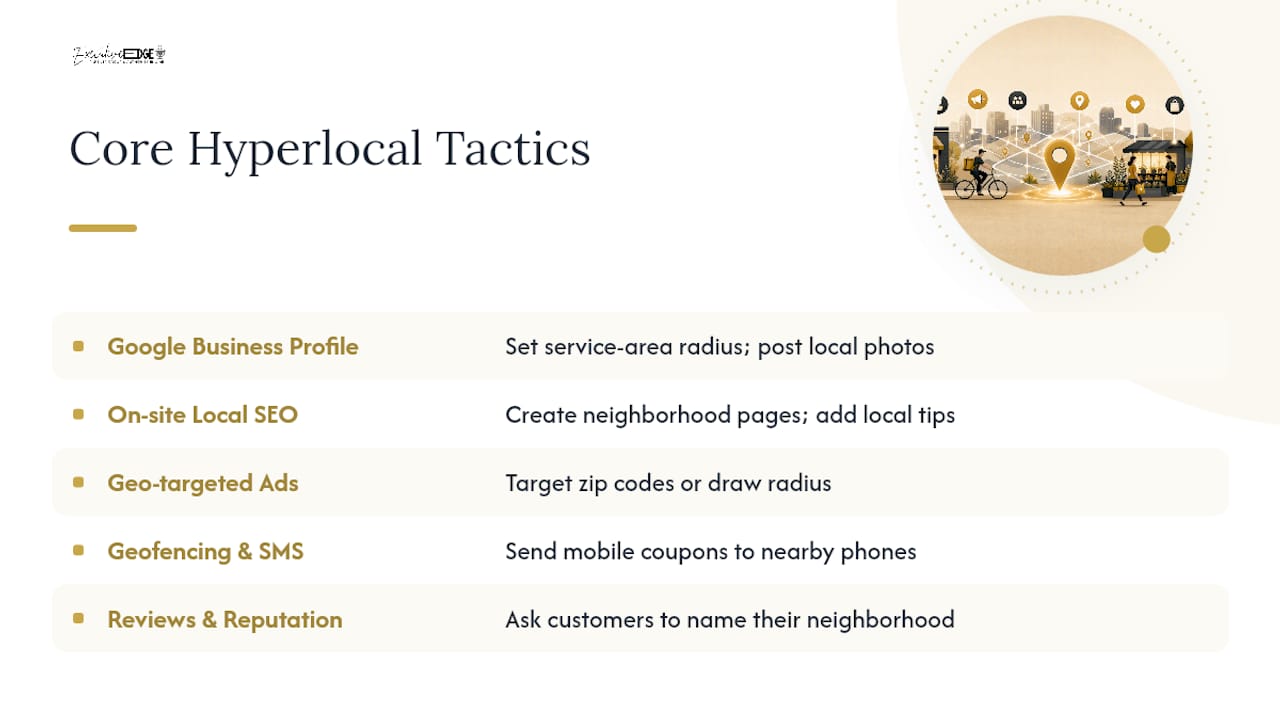
Google Business Profile and local listings. This is the foundation. Set your service-area radius accurately, add neighborhood keywords to your services section, and post local photos weekly (your storefront, your team, your street). An unclaimed or half-filled profile is the single most common missed opportunity for small businesses.
On-site local SEO. Build content around your specific area, not just your city. A landscaper serving three neighborhoods should have pages or sections addressing each one by name, plus practical content like seasonal soil tips or weather-related advice that only makes sense for that specific area.
Geo-targeted search and social ads. Both Google Ads and Meta/Facebook Ads let you draw a radius or target specific zip codes. A boutique running Instagram ads limited to a few zip codes around an event date will typically outperform a broad city-wide version of the same ad, dollar for dollar.
Geofencing and SMS/push. A coffee shop can trigger a mobile coupon to anyone within two blocks during the morning rush, a tactic that turns foot traffic near your door into foot traffic through it.

Local content and partnerships. Cross-promote with complementary nearby businesses, referencing local landmarks in your content to build both relevance and trust.
Reviews and reputation. Ask happy customers to mention their neighborhood in their review. "Best coffee in the Azalea District" does far more for local search relevance than a generic five-star rating.
Pro Tip: When you ask for reviews, prompt customers with a specific question like "What part of town are you visiting us from?" Reviews that naturally mention neighborhood names carry real weight with local search algorithms, and you can't fake that language convincingly on your own.
How Do You Set Up a Hyperlocal Marketing Campaign?
Launching your first hyperlocal campaign works best as a sequence, not a scramble. Follow this order:
- Define your goal and KPI. More calls? More walk-ins? More bookings? Pick one primary metric before you touch any ad platform.
- Pick your target zone. Draw your radius based on where your actual customers come from, not where you wish they came from. Check your existing customer zip codes if you have them.
- Set up Google Business Profile and local listings. Confirm your service-area radius matches your real capacity, and audit your listings on other directories for consistency.
- Build geo-specific creative. Reference the actual neighborhood, street, or landmark in your ad copy and images. Generic stock photography undercuts everything else you're doing.
- Configure geo-targeted ad settings and budgets. Start narrow. You can always widen a radius that's underperforming; you can't easily recover wasted spend from one that was too broad.
- Schedule your launch. Time-limited local promotions (a weekend, a specific event) tend to outperform always-on campaigns for a first test.
- Soft-launch and monitor daily for the first two weeks.
A realistic 30/60/90-day timeline looks like this:
- Days 1 to 30: Listings cleanup, local SEO basics, one geo-targeted ad test running
- Days 31 to 60: Expand content, add community partnerships, test SMS or push if available
- Days 61 to 90: Scale whatever worked, refine your audience radius, add authority content
Copy-and-use checklist before you launch anything:
- Target radius defined in miles or zip codes
- Primary KPI documented
- Creative specs finalized (images, copy, local references)
- Budget set with a hard cap for the test period
- Tracking tags and call-tracking numbers installed
How Do You Measure Hyperlocal Marketing Success?
The right KPIs depend on what "success" means for your business, but most hyperlocal campaigns should track a consistent set of numbers regardless of industry.
Watch these primary metrics:
- Foot traffic (if you can measure it through point-of-sale counts or store-visit conversions)
- Phone calls generated from ads or listings
- Direction requests from Google Business Profile
- Website visits originating from your target area
- "Near me" search impressions and clicks
- Appointment bookings or reservations
- Local conversion rate (visits or calls divided by impressions in your target zone)
For attribution, use UTM parameters on every geo-targeted link, set up location-based segments in your analytics platform, and use dedicated call-tracking numbers for each channel you run. If your ad platform supports store-visit conversion tracking, turn it on. It's imperfect, but it's the closest thing to a direct line between an ad and a walk-in.
For offline outcomes that don't show up in any dashboard, a simple point-of-sale survey question ("How did you hear about us?") or a trackable promo code does the job without needing extra software.
What Do Real Hyperlocal Marketing Campaigns Look Like?
Café patio promo. Objective: fill slow morning hours. Tactic: geofenced push notification offering a coupon within a two-block radius, active 7 to 9 a.m. Expected outcome: a meaningful bump in morning foot traffic within the first two weeks.

Salon weekday bookings. Objective: fill Tuesday and Wednesday appointment gaps. Tactic: geo-targeted Meta/Facebook Ads promoting a weekday-only discount to a 3-mile radius. Expected outcome: a measurable rise in weekday bookings compared to the prior month.
Emergency plumber. Objective: capture urgent "near me" searches. Tactic: Google Ads campaign targeting emergency-related keywords within a 10-mile service area, paired with a fully optimized Google Business Profile. Expected outcome: more inbound calls converting to same-day jobs.
Retail pop-up or event. Objective: drive attendance to a one-time event. Tactic: zip-code targeted social ads combined with local partnership cross-promotion. Expected outcome: higher event attendance than a comparable non-targeted post.
What Mistakes Should You Avoid in Hyperlocal Campaigns?
Most hyperlocal campaigns don't fail because the strategy is wrong. They fail because of small, avoidable execution mistakes.
- Over-targeting. A radius that's too narrow starves your ad platform of enough audience to optimize. Widen it incrementally instead of guessing at the right number upfront.
- Inconsistent NAP data. Your name, address, and phone number need to match exactly across every directory. Run a citation audit at least twice a year.
- Poor review management. Generic reviews don't help local search relevance. Request location-specific language when you ask for feedback.
- Weak local creative. Stock photos and generic copy undercut the entire point of going hyperlocal. Use real photos of your actual location.
- Privacy and consent errors. Mobile geofencing and location-based targeting carry real consent requirements. Use opt-in practices and stay current with your ad platform's location-data policies rather than assuming broad implied consent.
What Tools and Platforms Support Hyperlocal Marketing?
You don't need a huge stack to run this well. A handful of tools, used consistently, cover most of what a hyperlocal program needs.
- Google Business Profile: your core listing and local search presence. Post weekly, keep hours accurate, and respond to every review.
- Google Ads: best for capturing high-intent search queries. Set your radius under campaign location settings and layer in "near me" style keywords.
- Meta/Facebook Ads: best for geo-targeted social reach and event promotion, especially for visually driven businesses like salons, restaurants, and retail.
- Geofencing vendors: useful once you want to trigger offers based on real-time proximity rather than just ad targeting.
- SMS/push providers: good for repeat-customer retention within your existing radius.
- Local SEO tools: citation and listing management platforms help keep your NAP data consistent across directories.
- Analytics and call-tracking tools: the backbone of any measurement plan described above.
Running all of this consistently takes real time, which is exactly where a done-for-you authority service earns its place. A managed program can handle setup, content, and amplification across these tools so a business owner isn't learning seven platforms at once.
What Should You Prioritize in Your First 90 Days?
- Days 1 to 30 (high priority): Claim and optimize your Google Business Profile, fix NAP inconsistencies, launch one geo-targeted ad test, start a review-request process.
- Days 31 to 60 (medium priority): Expand local content, establish one or two community partnerships, trial SMS or push messaging, review early performance signals.
- Days 61 to 90 (medium to low priority): Scale whatever channel performed best, refine your audience radius based on real data, layer in authority content built around GEO and AEO principles.
Treat the 30-day items as non-negotiable. Everything after that depends on what the first month's data actually shows you.
How Does Authority Content Amplify Hyperlocal Marketing?
Search engines and AI answer platforms increasingly reward content that demonstrates real, specific local knowledge, not generic marketing copy. A blog post that references an actual neighborhood problem, a local landmark, or a customer's real question tends to match search and AI-driven "answer engine" intent far better than boilerplate content.
Three content formats do this well:
- A neighborhood how-to (for example, "How Tyler homeowners should winterize outdoor pipes")
- A local case study describing a real customer outcome
- Q&A pages built around the exact questions local customers ask
Pro Tip: Blend formats. A short podcast episode or local video segment that mentions specific neighborhoods by name tends to outperform text-only content for local visibility, because it gives search and AI platforms more context signals to match against.
This is exactly the mechanism behind Executive Edge Authority Engine: building and distributing authority content that keeps feeding your hyperlocal presence long after a single ad campaign ends.
A Publisher's Take on Hyperlocal Marketing
Most small businesses treat hyperlocal marketing as a task instead of a discipline, running one geofenced promo and calling it done. The businesses that actually win in a specific neighborhood are the ones who keep showing up there, in reviews, in content, in local partnerships, month after month. We've watched that exact pattern play out with clients across East Texas: the ones who stack tactics consistently outperform the ones chasing a single quick win.
Build Your Local Authority Beyond a Single Campaign
Running geo-targeted ads and cleaning up your Google Business Profile gets you real results, but it takes ongoing attention most owners don't have hours in the week for. Executive Edge Partner Group exists for exactly that gap: a done-for-you system that builds podcast episodes, blog content, video, and local authority positioning around your business, then optimizes and distributes it for both traditional search and AI-driven answer platforms.
Instead of managing seven tools and hoping the content adds up to something, you get a managed program that handles content creation, GEO and AEO optimization, distribution, and performance tracking end-to-end. If you want a clear picture of what that looks like for your specific market, request a consultation with Executive Edge Partner Group and see how a fully managed authority program fits your hyperlocal goals.
Sources
- Hyperlocal Marketing: How it Works, Strategies & Examples (2026) - Shopify
- 8 Hyperlocal Marketing Strategies to Grow Your Business
- Hyperlocal Marketing: Examples, Ideas & Tactics - WordStream
- Engage with Hyperlocal Marketing - Mailchimp
FAQ
What Is Hyperlocal Marketing in Simple Terms?
Hyperlocal marketing means targeting customers in a very small area, often a neighborhood or a 1 to 2 mile radius, to drive an immediate visit, call, or purchase.
How Is Hyperlocal Marketing Different From Local Marketing?
Local marketing typically targets an entire city or metro area, while hyperlocal marketing narrows that down to specific neighborhoods, zip codes, or blocks with tighter creative and measurement.
Which Businesses Benefit Most From Hyperlocal Marketing?
Cafés, salons, home service providers, and quick-delivery merchants benefit most, since their customers typically live or work within a short drive of the business.
What Tools Do I Need to Start a Hyperlocal Campaign?
At minimum, an optimized Google Business Profile, a geo-targeted Google Ads or Meta/Facebook Ads campaign, and a call-tracking or analytics setup to measure results.
Can a Small Business Manage Hyperlocal Marketing Without an Agency?
Yes, though it takes ongoing time across listings, content, and ads. Many businesses eventually turn to a done-for-you service like Executive Edge Partner Group to sustain it without adding staff.