

AI-driven content scaling is the systematic use of AI tools and workflows to produce, repurpose, and distribute content at a volume and speed no human team could sustain alone, while keeping brand quality and pipeline impact intact. Done right, it shifts your content operation from a publishing bottleneck to a measurable revenue driver. Done wrong, it floods your site with low-quality pages that trigger scaled-content abuse penalties and erode the brand voice you spent years building.
Table of Contents
- What does AI-driven content scaling actually look like?
- What are the core components of a scaling system?
- How do you govern AI content without slowing everything down?
- How do you implement AI-driven content scaling in 90 days?
- What metrics actually matter for AI-scaled content?
- Which tool categories do you actually need?
- What are the most common ways AI content scaling fails?
- A 7-step checklist to start scaling safely this month
- The gap most teams miss
- Authority-building content, done for you
- FAQ
What does AI-driven content scaling actually look like?
Scaling is not "AI writes everything and you hit publish." It looks like a 40-page topic cluster built from one expert interview, 12 localized service pages generated from a single master template, or a long-form podcast episode repurposed into a blog post, three social clips, and a newsletter section, all in the time it used to take to write the blog post alone.
What scaling does not solve: judgment calls, proprietary data, original expert opinion, or the strategic question of which content actually moves a deal forward. AI excels at drafting, repurposing, and metadata generation but cannot supply first-hand experience. That gap is where humans stay irreplaceable.
| Task | AI handles reliably | Humans must own |
|---|---|---|
| Topic research & clustering | ✓ | |
| First-draft generation | ✓ | |
| Metadata & schema markup | ✓ | |
| Repurposing across formats | ✓ | |
| Fact-checking & accuracy | ✓ | |
| Proprietary insight & opinion | ✓ | |
| Brand voice judgment | ✓ | |
| Funnel-stage strategy | ✓ | |
| Final approval & compliance | ✓ |
Pro Tip: Start your pilot with repurposing existing high-performing content, not greenfield mass publishing. You get faster wins, lower risk, and a cleaner signal on what AI actually improves in your workflow.
What are the core components of a scaling system?
Scaling is an operational and architectural challenge first, a tool-selection problem second. Before you add another AI writing app, you need a connected pipeline. Here are the layers:
- Product truth / first-party data: The source of record for facts, claims, and differentiators. Without this, AI drafts commodity content.
- Topic intelligence: Keyword and intent research that maps content to buyer stages. Tools like Semrush, Clearscope, or dedicated topic intelligence platforms feed this layer.
- Content layer: Structured briefs that constrain AI output, followed by AI-generated drafts.
- Governance and review: Human editorial gates before anything publishes. This is where most programs break.
- Channel adaptation: Format variants for blog, social, email, video, and AI discovery surfaces (GEO/AEO).
- Measurement and feedback: Attribution data that flows back into topic selection and brief quality.
Content moves through the pipeline like this: intent signal → brief → AI draft → SME review → editorial approval → channel adaptation → publish → measure → feed signal back to brief. Every handoff needs a named owner and a defined SLA, or the pipeline stalls. For a deeper look at how scalable content creation fits into a broader marketing strategy, the architecture principles are the same.
Tooling categories to cover: topic research (Semrush, Ahrefs, SparkToro), draft generation (Claude, ChatGPT, Jasper), orchestration and workflow management (your CMS plus tools like Valiz for content operations), GEO/AEO optimization (structured data, schema markup, answer-optimized formatting), and analytics/attribution (GA4, your CRM's attribution model).

How do you govern AI content without slowing everything down?
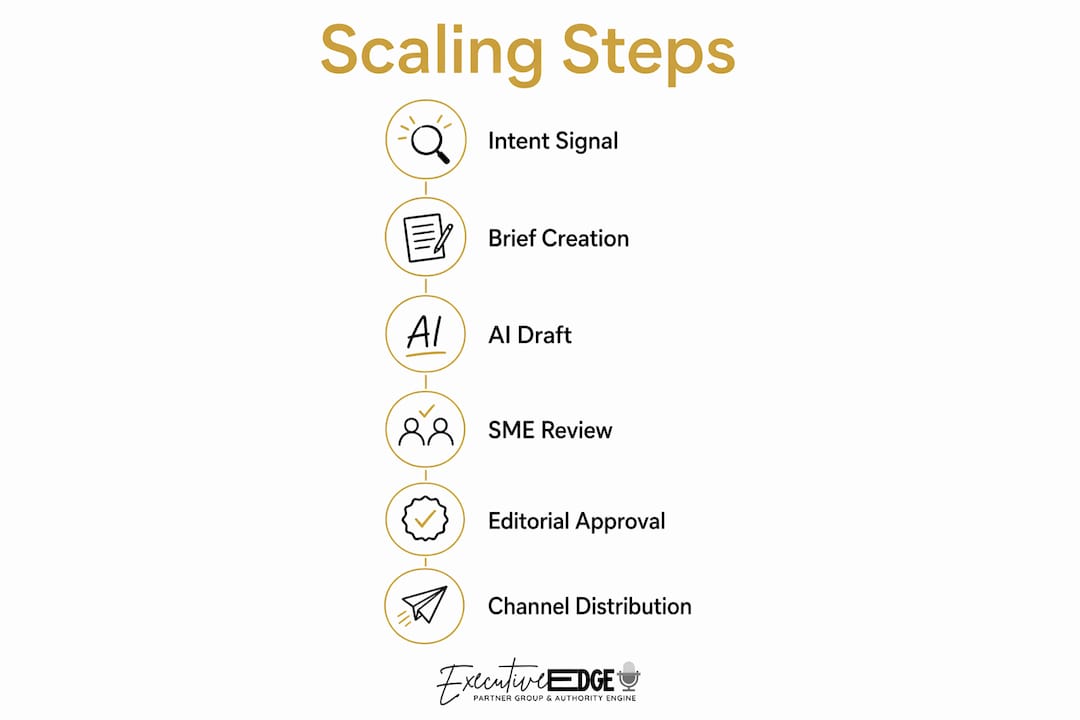
Governance is the operating requirement that separates a scaling program from a liability. Publishing AI-generated content without a human review layer risks Google's scaled-content abuse policies, brand-voice drift, and factual errors that are expensive to correct at volume.
Roles that must be explicitly assigned:
- AI: Drafting, repurposing, metadata generation, format variants
- Editor: Brand voice, structure, readability, on-page SEO
- Subject-matter expert (SME): Fact accuracy, proprietary insight, claims verification
- Compliance / legal (where applicable): Regulated industries, disclaimers
- Distribution ops: Channel formatting, scheduling, GEO/AEO tagging
Before any asset publishes, run it through this checklist:
- Facts verified against a primary source
- Proprietary insight or SME perspective added (not just AI-generated opinion)
- Brand voice consistent with guidelines
- Metadata, schema, and structured data complete
- Funnel stage and CTA aligned
- GEO/AEO signals present (direct answers, FAQ schema, cited sources)
Pro Tip: Rewire one broken workflow first. Pick the highest-friction approval step in your current process, fix it with AI and a clear SLA, and use that as your proof-of-concept before rolling governance across every content type.
How do you implement AI-driven content scaling in 90 days?
The pilot objective is simple: prove a measurable pipeline lift from two optimized assets in 90 days. Here is the playbook:
- Week 1–2 (Discovery): Audit existing content. Identify two high-intent, mid-funnel topics with existing traffic but low conversion. Assign an editor, an SME, and a measurement owner.
- Week 3–4 (Mapping): Map each asset to a funnel stage and a specific pipeline outcome (influenced opportunity, MQL, demo request). Define success thresholds before you write a word.
- Week 5–6 (Brief and draft): Build structured briefs. Run AI drafts. SME adds proprietary data and first-hand perspective. Editor applies brand voice and GEO/AEO formatting.
- Week 7–8 (Review and publish): Run the editorial checklist. Publish. Set up tracking in GA4 and your CRM for influenced pipeline.
- Week 9–12 (Measure and iterate): Track influenced opportunities, MQLs, and time-to-publish versus your baseline. If the signal is positive, expand to the next workflow. If not, adjust the brief quality or SME involvement before scaling further.
The human-in-the-loop framework is not optional at any stage. AI handles ideation and drafting; humans own strategy mapping and final approval.
What metrics actually matter for AI-scaled content?
Pageviews and publish counts are vanity metrics in 2026. Measuring content by revenue impact means tracking influenced opportunities, SQLs, and closed-won deals attributed to content touches, alongside AI-visibility signals like GEO citations and AEO presence.
94% of enterprise organizations plan to increase AEO/GEO investment in 2026, making AI-answer visibility the top marketing priority of the year.
| Metric | Owner | Frequency | Success threshold |
|---|---|---|---|
| Influenced opportunities | Revenue / marketing ops | Weekly | Positive trend vs. baseline |
| SQLs from content | Sales + marketing | Weekly | MQL-to-SQL rate improves |
| Closed-won (content-assisted) | CRM / attribution | Monthly | Measurable content-touch contribution |
| AI citations / GEO presence | SEO / content team | Monthly | Appears in AI answers for target queries |
| Time-to-publish | Content ops | Per sprint | Reduction vs. pre-AI baseline |
| Organic sessions (qualified) | SEO | Monthly | Traffic quality, not raw volume |
Understanding how AI search discovery works is increasingly necessary to interpret GEO presence data correctly.
Which tool categories do you actually need?
Start with orchestration and governance integrations before adding another draft generator. Most teams already have two or three AI writing tools and zero workflow infrastructure, which is exactly backwards.
- Topic intelligence: Semrush, Ahrefs, SparkToro, or a dedicated intent platform. Must integrate with your brief templates.
- Draft generation: Claude, ChatGPT, Jasper. Feature to prioritize: prompt templating and first-party data injection.
- Orchestration / CMS: Your CMS plus a workflow layer. Look for approval gates, role-based access, and channel adapters. Valiz is one option built specifically for AI-augmented content operations.
- GEO/AEO optimization: Schema markup tools, structured data validators, answer-optimized formatting guidelines.
- Analytics / attribution: GA4 plus CRM-level attribution. The goal is account-level pipeline influence, not session counts.
Pro Tip: Choose tools that connect to your CMS and product information management system. If your AI draft tool cannot pull from your product truth source, every draft starts from scratch and brand consistency breaks down fast.
What are the most common ways AI content scaling fails?
The biggest failure mode is the demand-cost paradox: lower cost per asset increases demand for more assets, which increases governance burden faster than the team can absorb it. Volume alone hides operational debt, and that debt compounds.
Watch for these red flags:
- Publish counts rising while conversion rates fall
- Repeated factual corrections across multiple assets
- Brand voice inconsistency between pieces published the same week
- Orphan pages with no internal links and no funnel connection
- Keyword cannibalization from near-duplicate AI-generated pages
When you see any of these signals, pause publishing immediately. Run a content audit to identify duplicates and thin pages. Add SME review to every brief before the next draft runs. Scaling faster on a broken foundation does not fix the foundation.
A 7-step checklist to start scaling safely this month
- Audit your existing content (Week 1, content lead): Identify what to repurpose, refresh, or retire before creating anything new.
- Map two assets to funnel stages (Week 1–2, marketing strategist): Pick mid-funnel, high-intent topics with a clear pipeline outcome.
- Build a structured brief template (Week 2, editor + SME): Include brand voice guidelines, required proprietary data points, and GEO/AEO formatting requirements.
- Assign an SME to every brief (Week 2, content manager): No brief ships without a named expert responsible for fact accuracy.
- Set up governance gates (Week 3, content ops): Define the approval sequence: AI draft → SME review → editorial → publish. Document it in one page.
- Wire measurement before you publish (Week 3, marketing ops): Configure GA4 events and CRM attribution for influenced pipeline before the first asset goes live.
- Publish a small batch and measure (Week 4–6, full team): Two to four assets maximum. Measure time-to-publish, influenced opportunities, and MQL rate versus baseline before expanding.
The gap most teams miss
The conversation around AI content scaling almost always starts with tools. Which LLM? Which CMS plugin? That framing gets teams into trouble fast. The real question is which workflow is creating the most friction and the least pipeline impact right now. Fix that one thing first, with AI and a clear governance model, and you have a repeatable pattern. Add the next workflow only after you can prove the first one works.
For business owners in Tyler and East Texas, this is especially relevant: the competitive advantage is not publishing more than the next business, it is publishing content that actually answers the questions your buyers are asking in AI search results. That requires strategy and human expertise, not just a faster content machine. How executives are using AI content tools in 2026 reflects exactly this shift: governance and measurement first, volume second.
Authority-building content, done for you
Most business owners and consultants do not have the bandwidth to build a governance model, hire an SME reviewer, wire attribution, and publish consistently, all while running their business. That is the gap Executive Edge Partner Group fills.

The Executive Edge Authority Engine is a fully managed system that handles the entire pipeline: strategic content planning, AI-assisted production, GEO and AEO optimization, multi-platform distribution, and detailed performance tracking. Every asset goes through editorial review before it publishes. Every campaign is mapped to visibility and pipeline outcomes, not just publish counts. It is built for service-based businesses, consultants, attorneys, medical professionals, and local brands that need authority-driven content working for them consistently.
If you want to see how a done-for-you content system maps to the framework in this guide, start with a consultation at Executive Edge Partner Group.
FAQ
What is AI-driven content scaling in simple terms?
AI-driven content scaling is using AI tools within a structured workflow to produce, repurpose, and distribute content at higher volume and speed than a human team alone could manage, while maintaining brand quality and measurable pipeline impact.
Does AI-generated content get penalized by Google?
AI-generated content published without human review risks Google's scaled-content abuse policies. Google's March 2024 core update reduced low-quality content in search results by 45%, so human editorial oversight and original expert input are non-negotiable for safe scaling.
What KPIs should I track for AI-scaled content?
Track influenced opportunities, SQLs, and closed-won deals attributed to content, alongside AI-citation presence (GEO/AEO). Pageviews and publish counts are unreliable indicators of content value in 2026.
How long does it take to see results from a content scaling pilot?
Most teams see measurable time-to-publish improvements within four to six weeks of a structured pilot. Pipeline influence metrics typically show a trend within 90 days, depending on your sales cycle length.
Can a small business use AI-driven content scaling?
Yes. The same governance principles apply at any size: map content to funnel stages, assign a subject-matter expert, and measure pipeline impact. Executive Edge Partner Group's done-for-you system is specifically designed for small and mid-size businesses that want these results without building the infrastructure themselves.