

Generative engine optimization (GEO) structures your content and online presence so AI answer engines like ChatGPT, Perplexity, and Google's AI Overviews cite you directly. The fastest path to visibility is restructuring your highest-value pages first: open with a direct answer, add cited statistics and quotes, and mark up FAQs with schema. Start there, then expand outward.
Table of Contents
- What Is Generative Engine Optimization?
- Why Does GEO Matter for Marketers Right Now?
- What Are the Core Signals GEO Audits Should Check?
- What Tactics Actually Move the Needle?
- How Do You Measure GEO Success?
- What Does a 30/60/90-Day GEO Rollout Look Like?
- How Executive Edge Authority Engine Puts GEO Into Practice
- Why Governance Matters More Than Tactics
- Get Your Content Working Across Every AI Platform
- Sources
- FAQ
What Is Generative Engine Optimization?
GEO is the practice of structuring content so AI systems can extract, trust, and cite it when answering a user's question. It builds directly on SEO rather than replacing it. Google's own developer guidance confirms that optimizing for generative AI features remains a subset of foundational SEO, built on crawlability, structured data, and clear provenance, not secret tricks.
The mechanical difference lies in how these systems retrieve information. Generative engines rely on retrieval-augmented generation (RAG), breaking pages into passages or "chunks" and pulling the specific paragraph that best answers a query, according to Wikipedia's overview of the discipline. A page can rank on page one of Google and still get skipped by an AI engine if the answer is buried in paragraph six instead of stated up front.
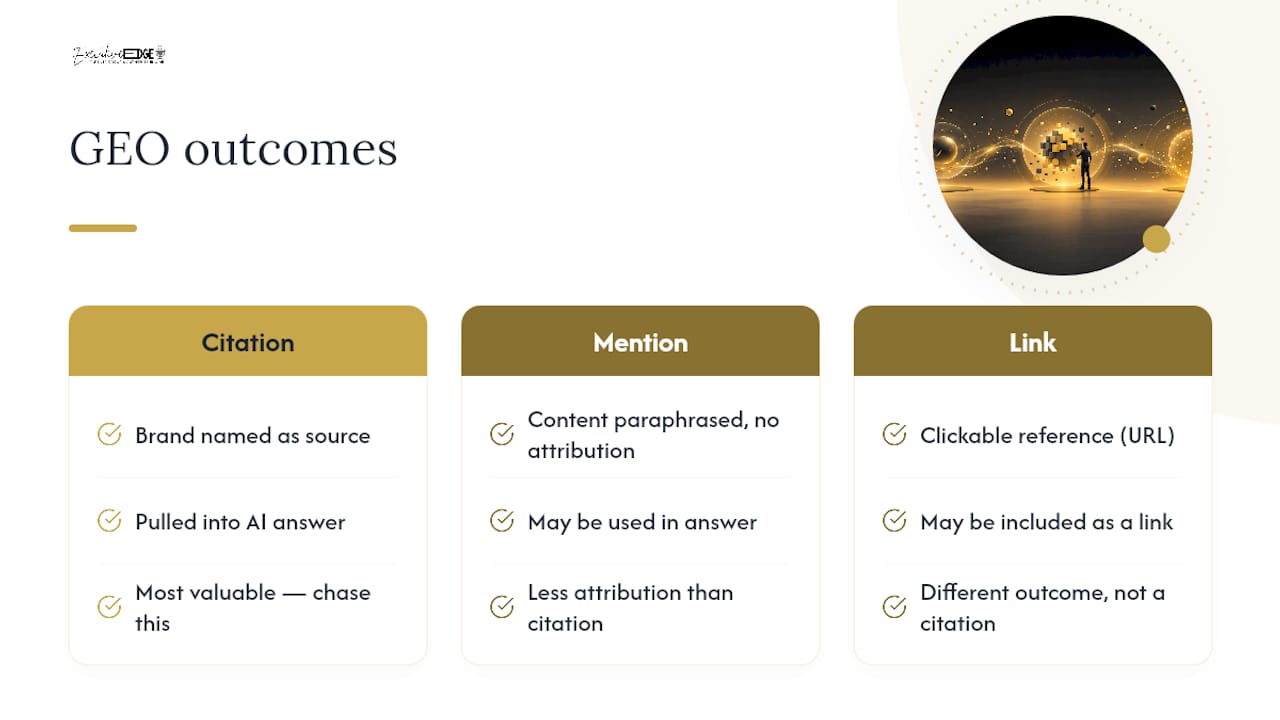
This changes what "success" looks like. Traditional SEO measures rank and clicks. GEO measures whether a specific claim, statistic, or sentence from your page gets pulled into an AI-generated answer. A citation (your brand named as the source), a mention (your content paraphrased with no attribution), and a link (a clickable reference) are three different outcomes, and citation is the one worth chasing.
Why Does GEO Matter for Marketers Right Now?
Being cited by an AI engine shapes buyer consideration before a prospect ever visits your site. When ChatGPT or Perplexity names your brand while answering "best options for X," that mention often arrives earlier in the buying journey than a traditional search result, and it carries an implied endorsement a blue link doesn't.
HubSpot's reporting on marketer outcomes found that earning AI citations tends to improve brand inclusion in generative answers and correlates with higher-quality leads compared to visitors arriving through generic organic search. The controlled testing behind the original GEO research backs this up mechanically: adding citations, statistics, and quotations to a page produced measurable visibility gains inside generative engine responses.
There's also a compounding effect worth understanding. Once one AI platform starts citing you as an authority on a topic, that citation often becomes training or retrieval signal that other platforms pick up on. Visibility in one engine rarely stays isolated. It tends to bleed into the others over a few months, which is exactly why early movers in a niche end up with a durable head start.
What Are the Core Signals GEO Audits Should Check?
Four signals determine whether an AI engine treats your content as a credible source, according to the GEO Wiki's practitioner framework. Score your top pages against each one before writing a single new word.
- Extractability: Does the page open with a direct answer (BLUF), broken into short, self-contained paragraphs and clear headings a retrieval system can chunk cleanly?
- Factual density: Does the page contain specific statistics, cited external sources, and direct quotations, or is it mostly opinion and generic advice?
- Entity clarity: Is your brand, author, and organization identified consistently, with schema markup and a presence in knowledge graphs like Wikidata, so machines know who is speaking?
- Corroboration: Do other sites, reviews, or publications independently confirm the same facts your page states, or is your claim the only place it appears online?
Run this checklist against your ten highest-traffic pages first. A page that's strong on extractability but weak on corroboration is a different fix than one that's information-dense but buried under three paragraphs of throat-clearing before the actual answer.
What Tactics Actually Move the Needle?
Prioritize by effort versus impact. Some of these tactics take fifteen minutes per page; others take a quarter to build out properly.
- Rewrite openings as BLUF. Every priority page should answer the core question in the first one to two sentences, before any context or backstory.
- Add statistics, citations, and direct quotes. This is the single most effective lever tested in controlled GEO research. Pages with cited external sources and quantified claims saw the largest visibility increases in generative engine responses, and it's a low-effort edit compared to a full content rewrite.
- Mark up FAQPage, Article, and Organization schema with JSON-LD. This gives AI crawlers explicit, machine-readable signals about what your content is and who published it.
- Check AI crawler access. Confirm your robots.txt and sitemap don't accidentally block GPTBot, PerplexityBot, or Google-Extended, and consider publishing an llm.txt file for platforms that support it.
- Improve first contentful paint. Slow-loading pages get skipped during retrieval more often, a pattern Digiday's coverage of AI-visibility struggles has flagged repeatedly among marketing teams chasing AI citations.
- Build off-site corroboration. Earn press mentions, respond to reviews on platforms like G2 or Trustpilot, and pursue a Wikidata or Wikipedia entry. Structured markup paired with off-site corroboration materially affects whether an engine treats a claim as trustworthy enough to cite.
Pro Tip: Don't start with new content. Audit your five best-performing existing pages first. HubSpot's practitioner data shows AI engines disproportionately cite pages that already rank well in organic search once those pages also carry extractable claims, so a rewrite beats a blank page almost every time.
For a deeper technical breakdown of crawler access and machine-readable structure, see how AI search discovery mechanics actually work behind the scenes.
How Do You Measure GEO Success?
Four metrics matter, and none of them are pageviews. Citation rate tracks how often your brand gets named as a source across a fixed set of prompts. AI share of voice tracks how you rank against competitors when the same prompts get run repeatedly. Source quality tracks whether AI engines are pulling from your best pages or your weakest ones. Conversion-from-AI tracks whether traffic tagged as arriving from an AI referral actually converts.
Build a fixed prompt set of 20 to 50 realistic buyer questions and run them against ChatGPT, Perplexity, and Google's AI Overviews on a recurring schedule, ideally monthly. Consistency in the prompt list matters more than volume.
- Google Search Console's AI features reports now surface some visibility data directly.
- Bing Webmaster Tools includes an AI Performance report built specifically for tracking entity authority across AI surfaces.
- GA4 can tag referral traffic from AI platforms once you set up the right UTM conventions.
- A bespoke sampling script running your prompt set on a schedule is often the only way to catch citation changes before a client or boss asks why traffic looks different.
One number to watch closely: most teams find AI share of voice moves in smaller, choppier increments than organic rank does. Don't panic over week-to-week noise. Track the monthly trend line instead.
What Does a 30/60/90-Day GEO Rollout Look Like?
Treat this as a rolling calendar, not a one-time project.
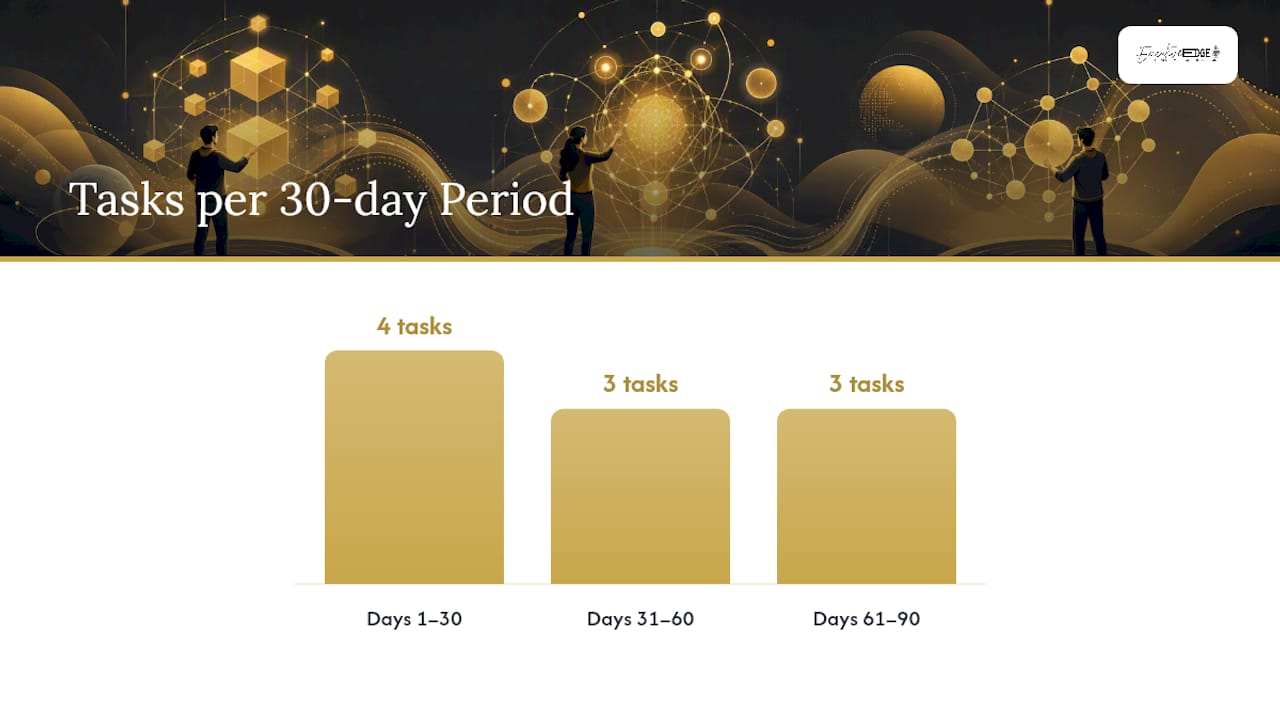
- Days 1 to 30: Audit your top 10 to 20 pages against the four core signals. Rewrite openings into BLUF format. Add one or two cited statistics per priority page. Implement FAQ schema on pages that already answer common questions.
- Days 31 to 60: Roll out Article and Organization JSON-LD sitewide. Build dedicated entity pages for your brand, key team members, and core services. Begin outreach for corroboration, press mentions, review requests, industry directory listings.
- Days 61 to 90: Start systematic prompt sampling on a monthly cadence. Fold GEO checks into your standard content workflow so every new piece launches with BLUF structure and citations built in from the start. Begin connecting AI-referral traffic to actual pipeline, not just visibility.
Three pitfalls trip up almost every team attempting this. First, over-optimizing wording specifically for bots produces stiff, robotic copy that reads poorly to actual humans; write for people first, structure for machines second. Second, teams build technical schema perfectly and skip corroboration entirely, then wonder why citations don't follow, since AI engines cross-reference claims against other sources before trusting a single site. Third, relying on one single statistic or source for a big claim is fragile. If that source updates or disappears, your credibility signal disappears with it.
For teams building this into an ongoing content operation, a step-by-step AEO and SEO alignment framework can help sequence the work without duplicating effort across departments.
How Executive Edge Authority Engine Puts GEO Into Practice
Executive Edge Authority Engine operationalizes this entire playbook for service-based businesses that don't have a content team to run it internally. The system handles weekly podcast production, blog articles, video, and short-form content, all built around the same extractability and entity-clarity signals covered above, then distributes it across platforms with AI-aware structuring baked in. For business owners in Tyler and East Texas, this looks like consistent authority content that compounds across Google, YouTube, and AI answer engines simultaneously, without the owner becoming a full-time content creator.
Why Governance Matters More Than Tactics
Here's what most GEO guides skip: the tactics are the easy part. Governance is the hard part. Every statistic you cite needs a source check before publishing, not after an AI engine repeats a stale number back to a prospect as current fact. Set an update cadence for entity pages and cited data, because a claim that was accurate eighteen months ago can quietly become a liability once it's baked into a machine's retrieval index.
The bigger risk isn't hallucination on your own site. It's an AI engine paraphrasing your content inaccurately and attributing the error to your brand. Editorial review before publishing is the cheapest insurance against that. Invest steadily, measure monthly, and resist the urge to chase every algorithm shift.
— David Domm
Get Your Content Working Across Every AI Platform
Most businesses trying to tackle GEO in-house run into the same wall: the audits, schema work, and citation building described above take real hours every single week, and marketing teams at service businesses rarely have that bandwidth to spare. This process can be handled as a done-for-you system, turning your existing expertise into podcast episodes, blog articles, video, and short-form content built with extractability and entity clarity in place from day one.

The advantage isn't just the content itself. It's the consistency. GEO rewards brands that show up the same way across dozens of pages and platforms over months, and that's exactly what a managed AI-enhanced content system is built to sustain without burning out an internal team. If you're a business owner, consultant, or executive who wants AI search engines citing your name instead of a competitor's, visit Executive Edge Partner Group to see how the program fits your industry and get a plan started.
Sources
- GEO: Generative Engine Optimization (Princeton / GEO-bench paper)
- 6 generative engine optimization benefits every marketer should know — HubSpot
FAQ
What Is Generative Engine Optimization in Simple Terms?
GEO is the practice of structuring your content and online presence so AI answer engines like ChatGPT and Perplexity cite you when generating responses, rather than just ranking your page in a search results list.
How Is GEO Different From Traditional SEO?
SEO optimizes for page rank and clicks, while GEO optimizes for whether a specific passage on your page gets extracted and cited inside an AI-generated answer. Google treats GEO as a subset of the same SEO fundamentals, not a separate discipline.
What Is the Fastest Way to Improve GEO Performance?
Rewrite your highest-traffic pages with a direct answer in the first sentence, add cited statistics and quotes, and implement FAQ schema. These are the tactics the Princeton GEO-bench research found produced the largest visibility gains.
How Do You Track Whether GEO Efforts Are Working?
Build a fixed set of buyer questions, run them monthly against major AI platforms, and track your citation rate and AI share of voice over time rather than reacting to single-week fluctuations.
Can a Done-for-You Service Handle GEO for a Small Business?
Yes. Programs like Executive Edge Authority Engine build extractability, entity clarity, and off-site corroboration into every piece of content they produce, which removes the need for an internal team to manage GEO audits and schema work manually.