

Topic clusters are a pillar page plus tightly linked cluster pages that concentrate topical authority on one subject area, and building one increases your odds of ranking for head and long-tail queries while getting cited by AI answer engines. If you're auditing your site, start now: pick one high-traffic page, list every related page you already have, and check whether they link to it. That single exercise tells you whether a real cluster exists or just a pile of loosely related posts.
Table of Contents
- What Are Topic Clusters in SEO?
- Why Do Topic Clusters Still Matter for SEO and AI Search?
- How Do You Create a Topic Cluster?
- How Should You Structure Internal Links Between Cluster Pages?
- How Do You Measure and Maintain a Topic Cluster?
- How Do Topic Clusters Help With AI Search and Query Fan-Out?
- What Does a Cluster Audit Checklist Look Like in Practice?
- What Should Your 30/60/90-Day Cluster Rollout Look Like?
- How Do You Avoid Keyword Cannibalization Across Clusters?
- What the Cluster Model Gets Wrong (And Right)
- Build Your Cluster Without Building a Content Team
- Sources
- FAQ
What Are Topic Clusters in SEO?
A topic cluster is a group of web pages organized around one broad subject, anchored by a single comprehensive page and supported by narrower pages that each cover a specific subtopic. The broad page is the pillar. The narrower pages are cluster pages, sometimes called spokes. Every spoke links back to the pillar, and the pillar links out to each spoke, forming what's commonly called a hub-and-spoke content model.
This structure exists because search engines and AI models both reward depth over scatter. Topic clusters organize related pages around a pillar page and internal links, and that structure improves crawlability and topical authority. A single 2,000-word article trying to cover an entire subject usually ranks worse than a pillar page supported by five focused spokes, because the spokes each target specific intent and the internal links tell search engines exactly how the pages relate.
Key vocabulary worth locking down before you start mapping anything:
- Pillar page: the broad, comprehensive page targeting the core topic and its highest-volume keyword.
- Cluster page (spoke): a narrower page targeting one subtopic, question, or long-tail variant.
- Hub-and-spoke model: the linking pattern connecting spokes to the pillar and to each other.
- Content hub: the full set of pillar plus spokes, often reflected in a subfolder URL structure like /topic/subtopic.
- Content pillar strategy: the planning process of deciding which topics deserve a pillar versus a standalone post.
Isolated keyword posts compete with each other for the same ranking signals instead of reinforcing one another. A cluster does the opposite: every spoke feeds authority upward.
Why Do Topic Clusters Still Matter for SEO and AI Search?
Clusters matter because they solve two problems at once: search engine crawl efficiency and answer engine extractability. Google's crawlers follow links to discover and prioritize pages, and a tightly linked cluster gives them a clear map of what your site knows deeply versus what it merely mentions in passing.
The user-experience case is just as strong. A visitor who lands on a pillar page about, say, local SEO content strategy and finds direct links to the exact subtopic they need (schema markup, review generation, Google Business Profile optimization) stays on the site longer and visits more pages per session. That behavior signal reinforces the ranking benefit you already got from the linking structure itself.
The newer piece is AI and Answer Engine Optimization. Large language models answering a query don't crawl the web live for most queries; they lean on indexed content that's structured to be lifted cleanly. Clustered content that's consolidated and well-linked outperforms scattered one-off posts, driving more organic traffic and holding rankings longer than standalone pages covering the same ground.
Query fan-out is the mechanism behind this. When someone asks an AI system a broad question, the system internally breaks it into several related sub-questions and searches for answers to each. A well-built cluster already has an answer for every one of those sub-questions sitting on its own extractable page or subheading, which raises the odds that your site provides the passage the AI system chooses to cite. A site with three disconnected posts on the same broad subject simply doesn't offer that same coverage, no matter how good each individual post is.
How Do You Create a Topic Cluster?
Building a cluster is a five-stage process, and skipping the research stage is the single most common reason clusters underperform. The repeatable creation process runs: choose a core topic, research subtopics, identify pillar and subpages, create the content, then measure cluster performance. Here's how to actually execute each stage.
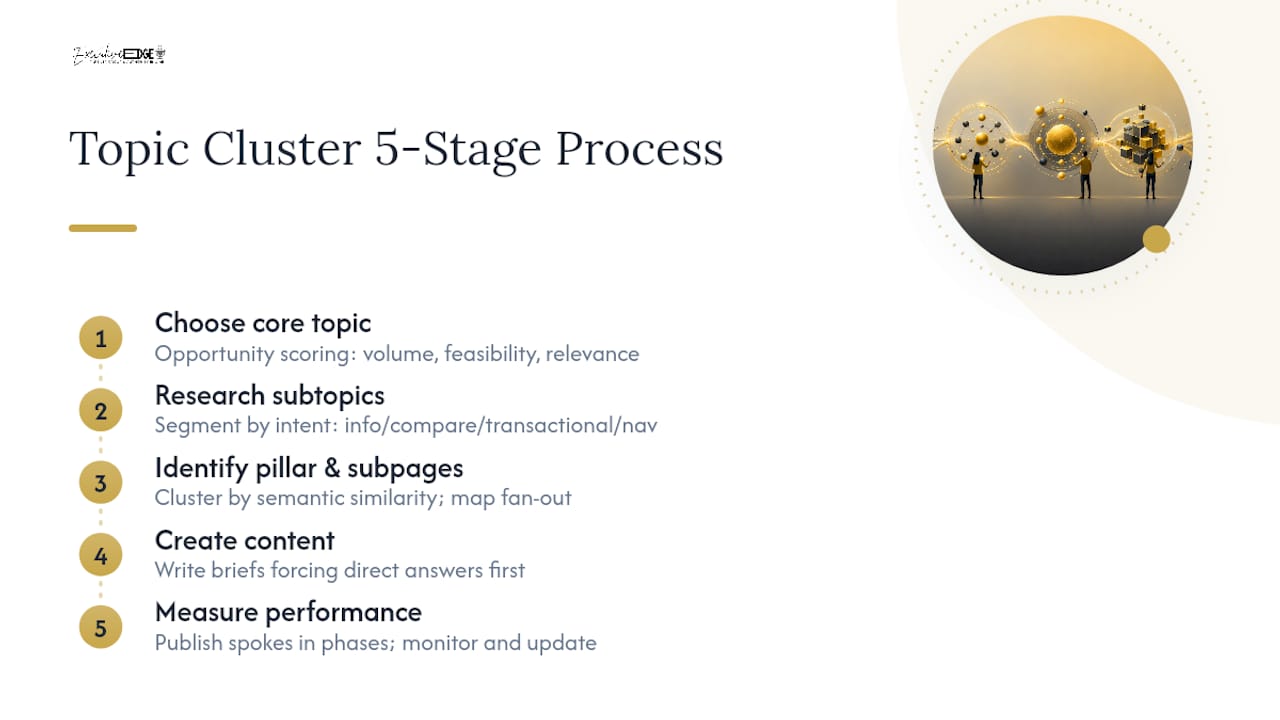
1. Choose the core topic using opportunity scoring. Don't pick a pillar topic because it sounds important. Pick it because it scores well on three factors: search volume for the head term, competitive feasibility (can you realistically rank against what's currently on page one), and business relevance (does ranking for it actually bring in the right kind of visitor). A consulting firm choosing between "business coaching" and "executive leadership coaching for manufacturing CEOs" should usually pick the narrower one first. Broad pillars are tempting but slow to rank; narrower ones with clear commercial intent convert faster and build momentum.
2. Research and segment by intent, not just keyword volume. Pull every keyword variant related to your core topic, then sort them by what the searcher actually wants: informational ("what is X"), comparative ("X vs Y"), transactional ("hire X"), or navigational. Tools like Ahrefs, Semrush, or Google Search Console's existing query data all work for this. A tool like affiliate-style keyword research focused on buyer intent is worth studying even outside affiliate contexts, because the underlying discipline, filtering for intent rather than raw volume, applies directly to pillar and spoke selection.
3. Cluster by semantic similarity and map the fan-out. Group your keyword list into buckets where the searcher's underlying question overlaps. "How much does X cost" and "X pricing breakdown" belong in the same spoke; "how does X work" belongs in a different one. This is where you're effectively predrafting the query fan-out an AI system would generate for your core topic, and deciding which sub-questions get their own page versus a subheading on the pillar.
4. Write briefs that force extractability. Every content brief, pillar or spoke, should specify the exact subheading that answers the target question, instruct the writer to lead that section with the direct answer, and only then add supporting detail. This isn't optional formatting advice; it's the difference between a page an AI system can lift a clean passage from and one it skips.
5. Publish and roll out links in phases. Don't launch all five spokes and the pillar simultaneously if you're resource constrained. Publish the pillar first with placeholder mentions of upcoming spokes, then release spokes over two to four weeks, updating the pillar's internal links as each one goes live. This also gives you time to see early ranking signals on the first spokes before committing to the rest.
Pro Tip: Before writing a single word, draft the pillar's outline as a list of every subheading question you plan to answer, then check whether five or six of those questions are substantial enough to become standalone spoke pages. If they're not, you don't have a cluster; you have one long article with headers.
Real-world examples worth studying: HubSpot, Semrush, and Ahrefs all publish visible pillar-and-spoke structures you can reverse-engineer by checking their sitemap subfolders and internal link patterns.
How Should You Structure Internal Links Between Cluster Pages?
Internal linking is where most cluster strategies quietly fail, because teams treat it as an afterthought instead of the mechanism that actually carries the authority signal. Internal linking architecture should include vertical, horizontal, and selective cross-cluster links, with anchor-text variety and in-body placement improving signal clarity.
Three link types, each doing a different job:
- Vertical links run from spoke to pillar. Every spoke page must link up to its pillar, ideally within the first two or three paragraphs, not buried in a footer list.
- Horizontal links run between spokes that share topical overlap. If two spokes both touch on pricing, they should reference each other directly rather than both linking only upward.
- Cross-cluster links connect one cluster to a different, related cluster on your site. Use these sparingly and only where genuine topical relevance exists.
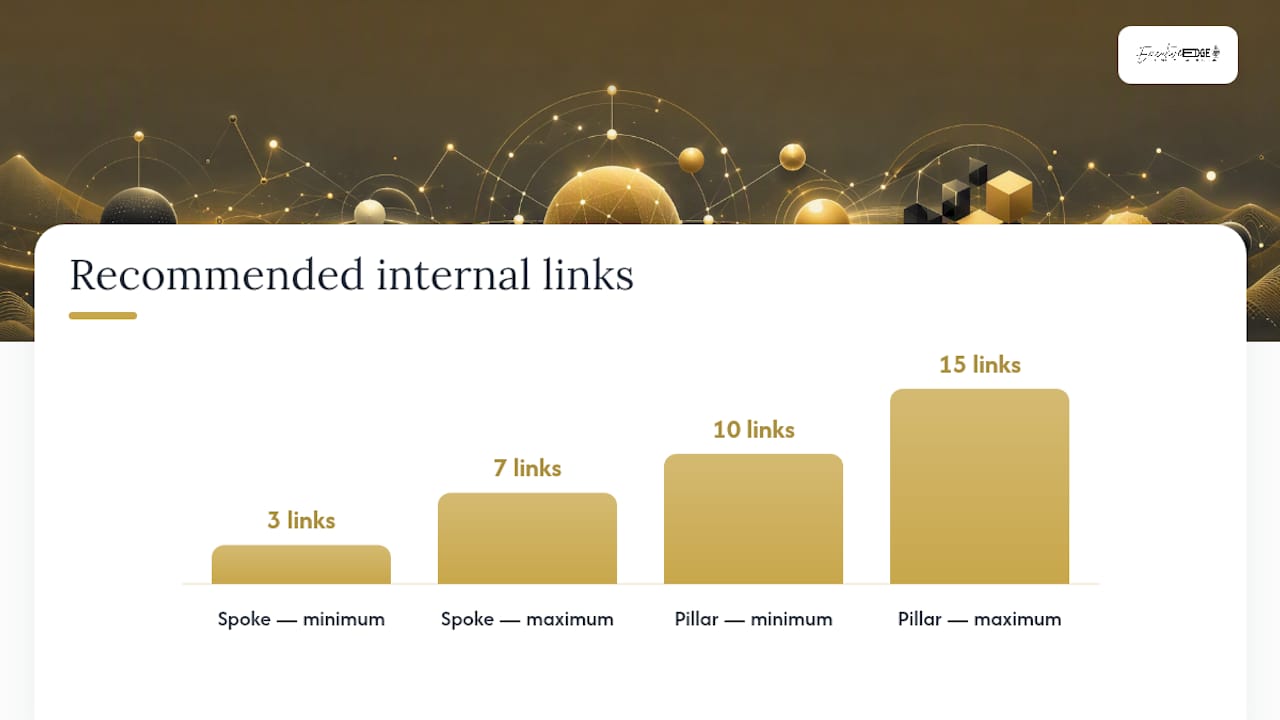
On anchor text, vary your phrasing across exact-match, partial-match, and descriptive anchors rather than repeating the identical keyword phrase in every link. Practitioners commonly work with a benchmark of roughly 3 to 7 internal links per standard spoke post, scaling up to 10 to 15 for the pillar page itself, though the right number always depends on content length and how many genuinely relevant pages exist.
Click depth matters more than most teams realize. A spoke page buried four or five clicks from your homepage sends a weaker relevance signal than one reachable in two clicks through the pillar. Keep every spoke within two clicks of its pillar, and keep the pillar itself reachable from primary navigation or a hub landing page.
Legacy content is the retrofit problem nobody wants to deal with, but retroactively linking from high-traffic older pages to new cluster content speeds indexation and prevents the new pages from becoming orphaned. Run a quarterly audit of your highest-traffic pages and check whether any of them belong in a cluster they're not currently linked into.
Pro Tip: Treat your internal links as a graph, not a checklist. Allow spoke-to-spoke connections wherever real topical overlap exists instead of forcing every link back to the pillar. A rigid hub-only model actually weakens the topical signal AI systems and search engines are trying to read.
Keep total visible internal and external links on a pillar page reasonable. Pages that link out dozens of times in the main body dilute the authority each individual link passes, so prioritize the links that matter most and trim decorative ones.
How Do You Measure and Maintain a Topic Cluster?
Cluster performance isn't a single metric; it's a small dashboard. Track these at the cluster level, not just per page:
- Aggregate organic traffic across the pillar and all spokes combined, tracked monthly.
- Ranking position spread for the full keyword set the cluster targets, not just the head term.
- Pages per session for visitors who land on any cluster page, which tells you whether internal links are actually getting clicked.
- Click share to the pillar from each spoke, visible in Google Analytics as an internal traffic flow.
- Assisted conversions where a spoke page contributes to a lead or sale that completes on a different page.
Run small experiments rather than guessing. Test moving a key internal link from the bottom of a spoke to the second paragraph and watch click-through over two to four weeks. Test rewriting a title tag on an underperforming spoke to match the actual query intent more precisely. A framework built for creative performance testing and measurement applies just as well here: isolate one variable, measure over a fixed window, and don't change two things at once.
Audit each cluster quarterly. Signals that a cluster needs consolidation include two spokes ranking for nearly identical queries, or a spoke that's dropped to page three and shows no recovery after a link and content refresh. Signals it needs expansion include a spoke consistently pulling featured snippets, which usually means the surrounding subtopic deserves its own additional page rather than a paragraph.
How Do Topic Clusters Help With AI Search and Query Fan-Out?
AI answer engines don't rank pages the way Google's classic algorithm does. They generate an answer, often pulling from several sources, and the sources that get pulled are the ones offering a clean, self-contained passage that directly answers a sub-question.
The tactical steps that make a cluster AI-ready:
- Map tiered fan-out queries to subheadings. Take your core topic and list every sub-question a person or an AI system would ask about it, then sort them into tiers by specificity. Tier one goes on the pillar as major subheadings; tier two and three become spoke pages.
- Structure each chunk to stand alone. Every subheading's first sentence should answer the question directly, with supporting context following after, not before.
- Choose liftable formats deliberately. Use tables for anything comparative, numbered lists for any process with sequential steps, and short definition boxes for terminology.
Designing each content chunk to be extractable, starting subheadings with the question and leading with the answer before adding detail, is what lets AI engines lift the passage cleanly.
E-E-A-T signals matter inside this structure too, not just as a separate trust exercise. Include a visible author byline with relevant credentials near the top of pillar content, cite primary data with a source link wherever you reference a statistic, and update publish dates when you meaningfully revise a page. AI systems weighing which source to cite tend to favor pages that look maintained and attributably written over anonymous, undated content.
What Does a Cluster Audit Checklist Look Like in Practice?
Executive Edge Partner Group runs cluster audits for service-based clients constantly, and the pattern that separates a working cluster from a struggling one is almost always the same short list:
- Inventory every page touching the topic, including old blog posts nobody remembers writing.
- Priority score each page by current traffic, ranking position, and business relevance.
- Flag consolidation candidates: pages targeting near-identical queries that should merge into one.
- Flag orphan pages: content with zero inbound internal links from anywhere else on the site.
- Build the linking plan before writing a single new page, not after.
The most common pitfall is overlap: three pages quietly competing for the same query because nobody checked before publishing the third one. The fix is straightforward once you see it. Merge the weakest two into the strongest, redirect the URLs, and rebuild the links pointing at the survivor.
What Should Your 30/60/90-Day Cluster Rollout Look Like?
Days one through 30: audit existing content, score every candidate page, and choose one pillar topic to build first. Days 31 through 60: write and publish the pillar plus three to five spokes, rolling out internal links as each page goes live. Days 61 through 90: measure ranking movement, run one anchor-text or link-placement test, and decide whether to expand or consolidate. For business owners in Tyler and East Texas, this 90-day rhythm tends to line up naturally with quarterly content planning cycles many local firms already run.
How Do You Avoid Keyword Cannibalization Across Clusters?
Cannibalization happens when two or more pages on your own site compete for the same search query, and it's the most common failure mode in a cluster that's grown past its original plan. Search engines end up splitting ranking signal between the competing pages instead of concentrating it on one, which usually means both rank worse than a single consolidated page would.
The fix starts with an audit, not a rewrite. Pull your Google Search Console query data and check whether multiple URLs are showing impressions for the same or near-identical search terms. Where you find real overlap, pick the stronger performing page (higher traffic, better backlink profile, more internal links pointing to it) and merge the weaker page's unique content into it. Redirect the old URL with a 301 so any existing authority transfers rather than getting lost.
Prevention is cheaper than cleanup. Before publishing any new spoke, check it against your existing content inventory for query overlap. A shared spreadsheet mapping every published URL to its primary target query, updated every time you publish, catches this before it becomes a ranking problem instead of after.
Not every overlap needs consolidation. Two pages can legitimately target the same broad topic from genuinely different intents, a "what is X" informational page and a "hire X" transactional page rarely cannibalize each other even though they share keywords, because the searcher's underlying need differs. The test is whether the pages would satisfy the same searcher at the same moment. If yes, merge them. If no, keep both but link them to each other so users and search engines understand the distinction.
What the Cluster Model Gets Wrong (And Right)
Most cluster advice treats linking as a checklist item, something you do once after the content's written. That's backwards. The architecture decisions, which spokes link to which, where the pillar sits in navigation, deserve as much planning time as the content briefs themselves, because a brilliantly written spoke with no path back to its pillar contributes almost nothing to topical authority.
The bigger blind spot in conventional advice is treating AI citation as a separate initiative from SEO. It isn't. The same structural discipline that makes Google trust a cluster, clear hierarchy, unambiguous internal links, no orphaned pages, is exactly what makes an AI system able to extract and cite a passage confidently. Chasing AEO with a different content strategy than your SEO strategy is wasted effort.
If you're prioritizing one thing first, prioritize the linking architecture over adding more spokes. A cluster with four well-linked pages consistently outperforms one with ten pages loosely connected by footer links nobody clicks. Volume without structure just adds maintenance burden.
— David Domm
Build Your Cluster Without Building a Content Team
Everything above works, but it assumes you have the bandwidth to run keyword research, write briefs, publish on schedule, and audit quarterly, on top of running your actual business. Executive Edge Partner Group exists for the business owner who understands exactly why topic clusters matter and has zero interest in becoming a part-time content strategist to execute one.

Executive Edge Partner Group builds the full pillar-and-spoke structure for you: weekly podcast production, blog articles written to the extractability standards AI answer engines favor, YouTube content, and the internal linking architecture connecting all of it, without you hiring a writer, an SEO strategist, and a video editor separately. The system layers in Generative Engine Optimization and Answer Engine Optimization from the start rather than bolting it on later, so the content built today is already positioned for how people search now.
If you run a professional practice, a local service business, or a consulting firm and want to see what a done-for-you cluster looks like for your specific field, visit Executive Edge Partner Group and request a review of your current content against a proper pillar-and-spoke model.
Sources
- Topic Clusters: The Next Evolution of SEO - HubSpot Blog
- How to build topic clusters that AI will cite: A step-by-step guide - Search Engine Land
- Topic Clusters for SEO: What They Are & How to Create Them - Semrush
- Topicalmap
FAQ
Are Topic Clusters Still Relevant?
Yes. Search engines still crawl and rank based on internal link structure, and AI answer engines lean even more heavily on well-organized, extractable content when deciding what to cite, which makes clusters more relevant now than when the model first emerged.
What Is the Difference Between a Keyword Cluster and a Topic Cluster?
A keyword cluster is a grouping of related search terms used to plan content, while a topic cluster is the actual published structure, the pillar page and its linked spoke pages, built from that keyword research.
What Is an Example of a Content Cluster?
A pillar page on "local SEO content strategy" linked to spoke pages on Google Business Profile optimization, review generation, and local link building is a typical content hub example, with every spoke linking back to the pillar and to each other where topics overlap.
How Do You Create a Topic Cluster?
Choose a core topic using opportunity scoring, research and segment supporting keywords by intent, map them into a pillar and several spokes based on semantic similarity, write briefs that lead each section with a direct answer, then publish and link the pages in phases while measuring performance.
Does Executive Edge Partner Group Build Topic Clusters for Clients?
Yes. Executive Edge Partner Group's authority-building system includes pillar and spoke content planning, writing, and internal linking as part of its done-for-you SEO, GEO, and AEO services for service-based businesses and professionals.