

A content repurposing strategy takes one piece of long-form work, pulls its core insights into an extraction document, and rebuilds those insights into platform-native assets on a fixed schedule. Done well, this extract-produce-schedule loop turns a single podcast episode or blog post into 8 to 15 derivative assets without a proportional increase in staff time. A done-for-you option exists for businesses that want the output without building the pipeline themselves.
Table of Contents
- What Is Content Repurposing, and Why Does It Matter?
- How Do You Choose Which Content to Repurpose First?
- What Does a Repeatable Repurposing Workflow Look Like?
- Which Formats Should One Long-Form Asset Become?
- What Tools and Templates Actually Speed This Up?
- How Do You Measure Whether Repurposing Is Working?
- What Do Practitioners Get Wrong About This Process?
- What Legal and Copyright Issues Come Up in Repurposing?
- What Do Successful Repurposing Programs Actually Look Like?
- How Do You Tailor Repurposed Content for Different Audience Segments?
- How Do You Build a Repurposing Calendar That Supports Broader Marketing Goals?
- The Real Bottleneck Isn't Ideas, It's Structure
- A Managed Path to Running This System Without Building It Yourself
- Sources
- FAQ
What Is Content Repurposing, and Why Does It Matter?
Content repurposing is not the same as crossposting. Crossposting takes one finished piece and drops it, unchanged, onto five different platforms. Repurposing extracts the ideas inside that piece and rebuilds each one into a format native to where it lands. A 40-minute podcast interview becomes a LinkedIn carousel, a newsletter blurb, three short video clips, and a blog post, each shaped for how people actually consume that platform.
The payoff shows up in three places. Reach expands because you are meeting audiences on the channels they already use instead of hoping they find your primary format. SEO and topical authority build faster because repurposed assets can target multiple keywords and search intents instead of competing for one. And your team spends far less time starting from a blank page for every new asset.
The efficiency case has academic backing, too. Structured reuse of content is linked to better resource efficiency and broader audience reach in practitioner and academic literature alike. Industry framing echoes this: publishers like NYT Licensing describe repurposing as converting one high-quality asset into multiple formats for different platforms, audiences, and stages of the buyer journey.
The core benefits break down like this:
- Reach: one source feeds many channels instead of one channel absorbing all your production time.
- SEO and topical authority: derivative assets target distinct keywords and intents, compounding your footprint in search.
- Resource efficiency: less time spent ideating from scratch, more time spent refining what already works.
- Message consistency: every asset traces back to the same core thesis, so your positioning does not drift across platforms.
How Do You Choose Which Content to Repurpose First?
Not every asset deserves a second life. Repurposing a thin blog post or an outdated webinar just multiplies mediocre content across more channels, which wastes effort rather than saving it. Run a quick filter before committing production time to anything.
- Check for evergreen relevance. If the core claim will still be true in 12 months, it is a repurposing candidate. If it is tied to a dated event or a stat that will expire, skip it or update it first.
- Confirm depth. A strong source piece contains at least three standalone insights that could each stand on their own as a post, clip, or email. If you can only pull one idea out, the piece is too thin to fan out.
- Look at past performance. Traffic, watch time, downloads, or shares on the original piece tell you where audience interest already exists. Repurpose what already worked before betting on something untested.
- Match it to audience fit. A niche technical explainer built for one segment will not translate cleanly into a broad social hook. Confirm the underlying idea travels before you invest in reformatting it.
- Weigh conversion potential. Content that already nudges readers toward a decision, a demo, a call, a purchase, is worth more in derivative form than pure top-of-funnel education.
Score each candidate 1 to 5 on these five criteria. Anything scoring 20 or above out of 25 goes to the top of your queue. A 10 to 20 minute audit using this rubric, run monthly against your existing content library, usually surfaces two or three strong candidates you had forgotten about.
Skip repurposing when the source material is thin, factually outdated, or built around a product or offer you no longer sell. Rebuilding a stack of assets on a shaky foundation just means rebuilding them again in three months.
What Does a Repeatable Repurposing Workflow Look Like?
Every scalable system runs on the same three-step loop: extract, produce, schedule. Teams that formalize this sequence report higher output consistency than teams that repurpose ad hoc, piece by piece, whenever someone remembers to.
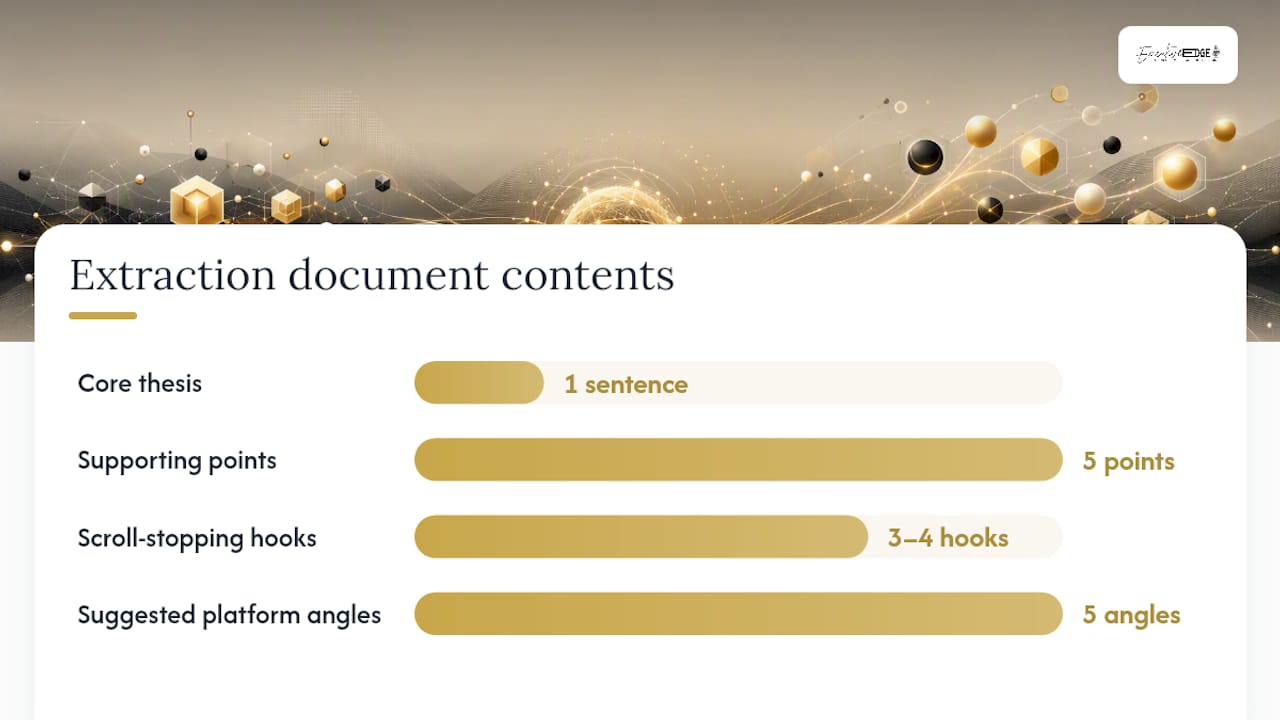
Step 1: Build the extraction document. This is the single source of truth every derivative asset gets built from. A solid extraction document contains the core thesis in one sentence, five supporting points pulled straight from the source, the best quotes and statistics, any visual assets worth reusing, three or four scroll-stopping hooks, and a suggested angle for each target platform. Building this document once, instead of re-reading the source material for every new asset, is what actually saves the time repurposing promises.
- Pull the core thesis and five supporting points from the source asset.
- List every strong quote, statistic, and visual worth reusing.
- Draft three to four hooks that could open a social post, email, or video.
- Assign a suggested platform angle to each supporting point.
- Store the document somewhere the whole team can access it before production starts.
Step 2: Produce platform-native drafts. Map each extracted element to a template built for where it is going, a LinkedIn carousel template for a supporting point with a strong visual, a short-video script for a quotable moment, a newsletter blurb for the thesis statement. AI tools work well for the first-pass draft here, but human editorial review remains necessary to catch tone drift, factual slips, and anything that reads like it came from a machine. Batch this work: draft all five LinkedIn posts from one extraction document in a single sitting rather than switching contexts between platforms all week.
Step 3: Schedule and distribute. A workable cadence rule is one asset per channel per day, spread across a rolling calendar rather than dumped all at once. Map each asset to a publish date, then check platform-specific distribution habits: native video uploads generally outperform link posts on LinkedIn and Instagram, while a well-tagged link post still works fine for blog traffic on X or Facebook.
Role assignments shift with team size. A solo operator runs all three steps but should timebox each one so extraction does not bleed into production time. A small team typically splits extraction and editorial review between two people, with a third handling scheduling and distribution. Larger teams or agencies assign platform owners, one person responsible for LinkedIn output, another for short-form video, each pulling from the same shared extraction document so messaging stays aligned.
Pro Tip: Do not scale platform count before you scale process. Start with two or three platforms where your audience actually shows up, prove the workflow works, then add channels one at a time.
Which Formats Should One Long-Form Asset Become?
A single source asset can realistically become a dozen different outputs if you map formats to platforms before you start producing. Here is how one long-form piece typically fans out:
- Blog post to short-form: two or three how-to posts on LinkedIn or Instagram, each built around one supporting point.
- Podcast episode to video: three short vertical clips pulled from the strongest moments, native-uploaded to TikTok, Reels, and YouTube Shorts.
- White paper to email: a four-to-six part email series, each installment covering one section of the original argument.
- Webinar to multi-channel: slide decks turned into carousels, Q&A moments turned into FAQ posts, and the full recording repackaged into a landing-page asset.
- Long interview to newsletter: a condensed summary with the best quotes, linking back to the full piece for readers who want the detail.
A 30-day plan built from one long-form source might include: 4 LinkedIn posts, 3 short video clips, 1 carousel, 2 email newsletter sends, 1 X thread, 1 Instagram Reel, 1 YouTube Short, and 1 blog roundup that links back to the original.
On nativity: upload video directly to each platform instead of sharing a link to YouTube. Native uploads get algorithmic preference on nearly every major platform, and a link post competes with the platform's own interest in keeping viewers on-site. If you are working from a recorded webinar specifically, a focused repurposing sprint can turn one session into 30 days of content in an afternoon.
What Tools and Templates Actually Speed This Up?
Five tool categories cover most of what a repurposing workflow needs, and you do not need more than one tool per category to run this well.
- Extraction document: Notion or Google Docs, whichever your team already lives in, works fine as the shared source of truth.
- AI drafting: ChatGPT or Claude for first-pass drafts of social posts, email copy, and video scripts built from the extraction document.
- Design: Canva for carousels, quote graphics, and any visual asset that needs a consistent brand look.
- Video clipping and editing: tools like Descript or Opus Clip cut manual editing time significantly by automatically surfacing shareable moments from longer recordings.
- Scheduler: Buffer or Later for queuing assets against your calendar so publishing does not depend on someone remembering to hit post.
A small template library removes most of the guesswork from production. Keep a spec for each: a LinkedIn long post (150 to 300 words, hook in the first line, one core idea), a LinkedIn carousel (6 to 8 slides, one point per slide), a short-video script (under 60 seconds, hook in the first three), a newsletter blurb (75 to 100 words with one link), and a tweet or X thread (5 to 8 posts, one insight per post).
AI speeds up drafting, but it needs guardrails. Before anything publishes, run it through a short editorial checklist: does the fact-check hold up, does the tone match your brand voice, does the CTA align with the platform, does the format actually fit where it is going, and do all links work. Pairing AI drafts with a partner platform built for marketing workflows can help formalize this checklist across a team instead of leaving it to memory.
Pro Tip: Build your prompt library once, then treat it like a template, not a one-off. A well-written prompt for "turn this quote into a LinkedIn hook" works the same way every time you feed it a new extraction document.
How Do You Measure Whether Repurposing Is Working?
The clearest signal that a repurposing system is working is your assets-per-source ratio. If one long-form piece is only producing three or four derivative assets, something in the extraction or production step is bottlenecked. Tracking output against a target multiplier, commonly 8 to 15x, reveals exactly where that bottleneck sits.
Track these core metrics on a recurring basis:
- Assets-per-source ratio: total derivative assets divided by source pieces published.
- Reach and engagement rate: per platform, per asset type, so you can see which formats actually land.
- Conversion events: demo requests, email sign-ups, or purchases attributed specifically to repurposed assets, not just the original.
- Cost-per-asset: total production time or spend divided by assets produced, tracked over time to confirm the system is getting more efficient, not less.
Attribution works best with UTM parameters on every link, consistent content tagging by source piece, and a simple rule that every derivative asset links back to its original. A basic dashboard pulling these together, reviewed monthly, is usually enough to see which templates and platforms are earning their keep. A structured performance review run quarterly can also catch when it is time to retire an underperforming template rather than keep producing more of what is not working. Use what the metrics show to change your selection criteria going forward, not just to report on what already happened.
What Do Practitioners Get Wrong About This Process?
The single biggest failure point in most repurposing efforts is skipping the extraction document and going straight from source material to platform draft. That shortcut feels faster in the moment. It is not. Every time someone has to re-read or re-watch the original to pull a quote or find a stat, you are paying the research cost again, asset by asset, instead of once.
Building a documented extraction document containing the core insights, proof points, visual frameworks, and hooks lets a team construct every derivative asset from a single source. It saves meaningful time and, just as important, keeps the message consistent across every platform the content touches.
Small teams that run this well usually split three roles cleanly: one person owns extraction and builds the document within 24 hours of the source publishing, a second person drafts and edits the platform-native versions, and a third schedules and monitors distribution. Batching by role, rather than by asset, keeps context-switching low and output consistent.
This operational discipline can be run on behalf of clients who do not have the internal bandwidth to build and staff this pipeline themselves, tracking asset-per-source multipliers and cadence targets so the system produces predictable output rather than sporadic bursts of content whenever someone finds time.
What Legal and Copyright Issues Come Up in Repurposing?
Repurposing your own original content, blog posts, podcasts, webinars you produced, carries minimal legal risk since you own the underlying rights. The exposure grows when your source material includes third-party elements: licensed stock footage, guest interview audio, quoted statistics from a paid research report, or music in a podcast recording.
Before repurposing a piece that includes a guest, confirm what usage rights your original agreement covers. Many podcast guest releases only cover the original episode, not derivative clips repurposed across social platforms, so check the release language rather than assuming broader clips are automatically covered. The same caution applies to licensed images or stock footage: a license covering use in one blog post does not automatically extend to a video clip or a paid social ad built from that same asset.
Quoting statistics or findings from third-party research is generally fine under fair use principles when you attribute the source and do not reproduce the entire report, but reproducing large portions of someone else's proprietary data set as your own repurposed content crosses into a gray area. When in doubt on a specific piece, a quick legal review before wide distribution is cheaper than a takedown notice after the fact. This is not a substitute for legal advice on your specific content library, just a reminder to check licensing terms before multiplying an asset across a dozen new placements.
What Do Successful Repurposing Programs Actually Look Like?
The pattern across teams that get real return from repurposing is consistency, not cleverness. A single well-extracted webinar, run through a documented workflow, routinely produces 12 to 15 downstream assets over a 30-day window: social posts, email segments, short clips, and a blog recap, all traceable back to the original recording through consistent tagging.
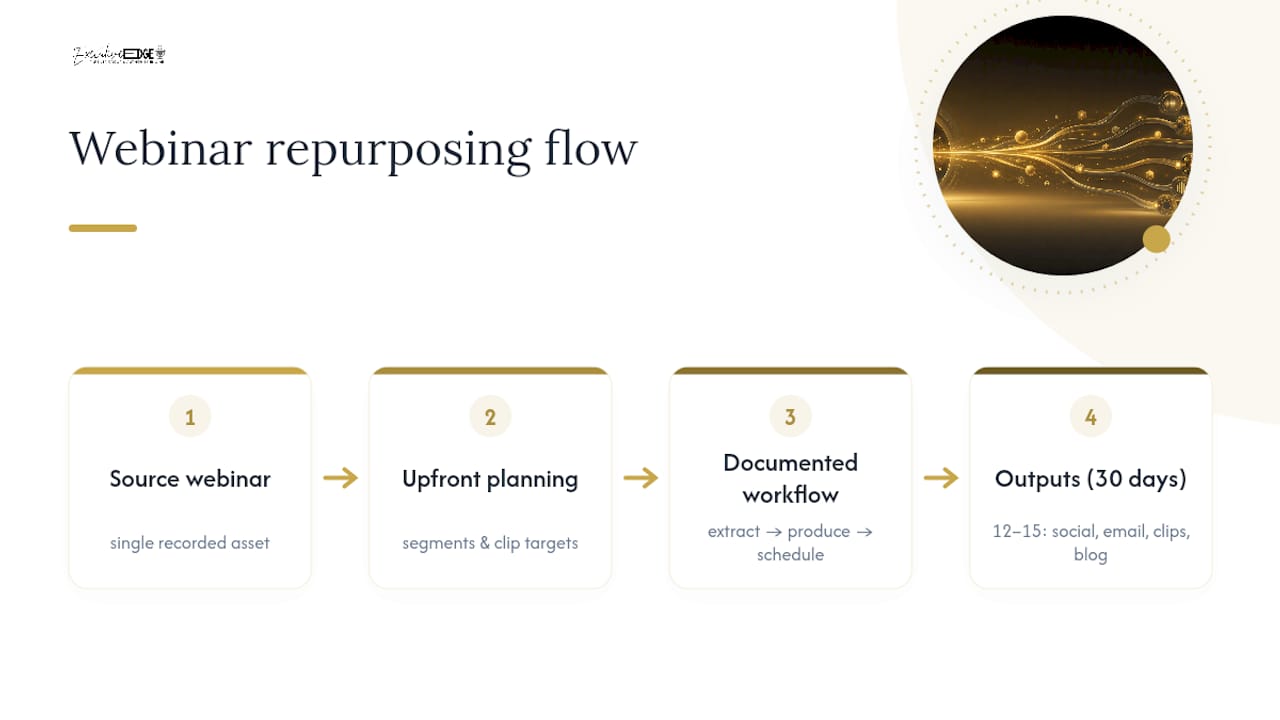
The common thread in these programs is that content isn't treated as a one-time event. A podcast episode is planned from the start as a source asset, with a producer already thinking about which segments will clip well and which sound bites will carry a graphic before the episode even airs. That upfront framing cuts the extraction time down significantly compared to reverse-engineering assets from a piece that was never planned with repurposing in mind.
Smaller operations see the same pattern at a lower volume. A consultant who converts one long client case study into a LinkedIn carousel, three short posts, and a newsletter feature is running the identical extract-produce-schedule loop as a larger team, just with fewer hands on it.
How Do You Tailor Repurposed Content for Different Audience Segments?
The same core insight can land completely differently depending on who is reading it, so a single extraction document should feed segment-specific variations, not identical copy pasted across every channel. A supporting point aimed at C-suite executives might emphasize ROI and time savings, while the same point reworked for a practitioner audience leans into the specific tactical steps.
Platform context shapes this too. LinkedIn audiences generally respond to a professional framing with a clear takeaway in the first two lines, while an Instagram audience responds better to a visual hook and a more conversational tone on the same underlying idea. Pulling the same supporting point from your extraction document and rewriting the hook for each platform's expected register is the difference between an asset that performs and one that gets scrolled past.
For buyer-journey stage, top-of-funnel audiences generally respond to educational framing, the "what" and "why" of an idea, while bottom-of-funnel audiences respond better to proof points, case examples, and a direct next step. If your extraction document already tags supporting points by funnel stage, matching a given point to the right segment becomes a fast lookup instead of a fresh strategic decision every time.
How Do You Build a Repurposing Calendar That Supports Broader Marketing Goals?
A repurposing calendar only works when it is built backward from your existing marketing goals rather than as a standalone content exercise. If your quarterly priority is a product launch, your extraction and production schedule should weight toward source content that supports that launch, not toward whatever piece happens to be sitting in the queue.
Start by mapping your source content calendar, new podcast episodes, webinars, long-form articles, against your marketing team's quarterly themes. Each source piece then gets a repurposing plan built at the same time it's greenlit, not after it publishes. This keeps the derivative assets released while the source content is still fresh and relevant to whatever campaign it supports.
A practical cadence for most small teams: one new source asset every one to two weeks, each generating its full run of derivative content over the following 30 days on a rolling schedule so the output calendar never runs dry between source pieces. Reviewing this calendar monthly against your broader marketing goals, not just against publishing volume, keeps the whole system pointed at outcomes instead of just activity.
The Real Bottleneck Isn't Ideas, It's Structure
Most teams don't fail at repurposing because they run out of ideas. They fail because they never build the one document that would let them stop reinventing the wheel for every new post. The conventional advice, "just repurpose more," misses the actual constraint, which is process discipline, not creative supply.
What gets overrated in most guides on this topic is tool selection. Swapping Buffer for Later, or one AI drafting tool for another, changes almost nothing if there is no extraction document underneath the workflow. What gets underrated is the boring administrative habit of building that document within a day of publishing the source, before momentum fades and someone has to re-watch a 40-minute recording to remember what the third supporting point was.
If you take one thing from this and act on it this week, build the extraction document template first, before you touch a scheduler or a new AI tool. Everything downstream, the carousels, the clips, the email series, gets faster and more consistent once that single source of truth exists. Businesses in Tyler and East Texas that have tried to run this in-house usually hit the same wall: the system works fine for a month, then quietly falls apart the first time the person who "just knows how to do it" gets busy with something else.
— David Domm
A Managed Path to Running This System Without Building It Yourself
An alternative to building this entire pipeline in-house is a done-for-you system that handles extraction, production, and scheduling for business owners, consultants, and professionals who want the authority-building output without hiring a content team to run it.

Building this in-house makes sense once you have a dedicated person whose job is extraction and production, plus the editorial time to review everything AI drafts before it publishes. Most solo operators and small businesses don't have that spare capacity, which is exactly the gap this service fills. A managed service can handle the weekly production cycle, podcast episodes, blog articles, short-form social content, and AI-driven distribution, built around the same extract-produce-schedule discipline covered here, so a business owner gets the output without owning the workflow. If you would rather hand this off than staff it, visit Executive Edge Partner Group and schedule a consult to see what a managed repurposing calendar would look like for your business.
Sources
- Content Repurposing Workflow: 1 Post to 15+ Assets
- How to Build an AI-Powered Content Repurposing Workflow
- Files
- Repurposing Content: A 101 Guide | NYTLicensing
FAQ
What Is a Content Repurposing Strategy?
A content repurposing strategy is a repeatable system for extracting the core insights from one long-form asset and rebuilding them into multiple platform-native formats, typically producing 8 to 15 derivative assets per source.
How Is Repurposing Different From Crossposting?
Crossposting shares the identical piece across multiple platforms unchanged, while repurposing reshapes the underlying ideas into formats built for each platform's audience and norms.
How Many Assets Should One Piece of Content Produce?
Most documented workflows target an 8 to 15x asset multiplier per source piece, tracked against actual output to catch bottlenecks early.
Do I Need AI Tools to Repurpose Content Effectively?
AI speeds up first-pass drafting significantly, but human editorial review remains necessary to catch tone drift and factual errors before anything publishes.
Is a Done-for-You Repurposing Service Worth It?
If your team lacks dedicated time for extraction and editorial review, a managed system like Executive Edge Authority Engine can run the full workflow without requiring you to hire and train an internal content team.