

Executive content underutilization is defined as the gap between an executive's actual expertise and the authority-building content they publish. Most executives possess deep knowledge that buyers, partners, and prospects would value, yet they produce far less content than their expertise warrants. The reasons are not laziness or lack of ideas. Fear of visibility, cognitive workflow mismatches, and organizational dysfunction are the three primary drivers behind this gap. For business owners and executives in Tyler, Texas and across East Texas, this gap is especially costly in competitive local markets where trust and name recognition drive decisions. Executive Edge Partner Group identifies visibility by design as the foundation of long-term authority, and the research is clear: executives who avoid content lose ground to those who do not.
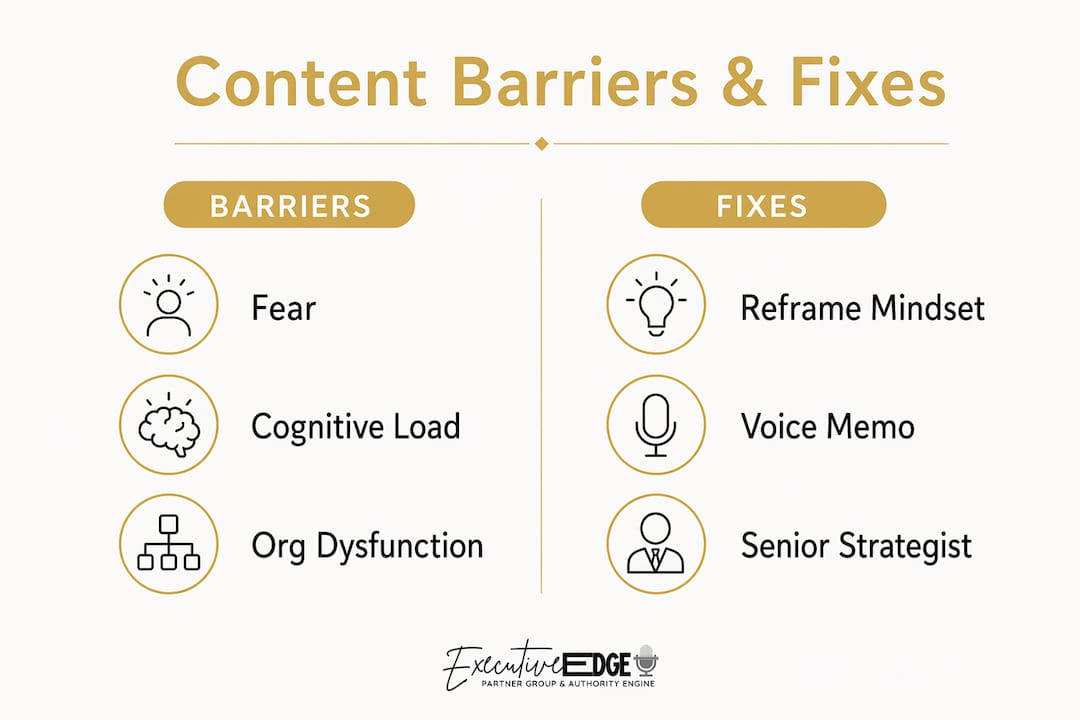
Why executives underutilize content: the core barriers
The three barriers to executive content use are psychological fear, cognitive friction, and organizational failure. Each one operates independently, but they compound each other. An executive who fears public scrutiny will also resist the cognitive effort of writing, and an organization without a content system will never resolve either problem. Understanding all three is the first step toward fixing them.
What psychological fears stop executives from publishing?
Fear is the primary barrier to executive content creation, not skill. Fear of being challenged or proved wrong leads executives to default to safe, generic content that fails to build genuine authority. The result is a feed full of industry platitudes and recycled statistics that no one remembers and no buyer trusts.
The fear operates on two levels. First, executives worry about public scrutiny. A bold opinion published on LinkedIn or in a long-form article is a target. Critics can respond, competitors can counter, and journalists can quote it out of context. Second, executives fear reputational risk. A single poorly worded post can circulate for years. These fears are rational, but they produce an irrational outcome: fear of exposure consistently outweighs the actual lack of content skill, meaning the barrier is emotional, not technical.
The cost of this fear is measurable in missed opportunity. Opinionated, insightful content generates higher-quality leads than safe, definition-style posts, even when it attracts fewer clicks. Executives who play it safe optimize for vanity metrics and sacrifice the buyer relationships that actually drive revenue.
Key fears that suppress executive content output:
- Fear of public criticism or being proved wrong on a stated position
- Concern about reputational damage from a misquoted or misread post
- Worry that bold opinions will alienate clients, partners, or board members
- Discomfort with the permanence of written content versus spoken conversation
- Anxiety about appearing self-promotional rather than genuinely helpful
Pro Tip: Reframe content creation as a service to your audience, not a performance for critics. Ask yourself: "What do my best clients wish they understood better?" That question produces content worth publishing and eliminates the self-consciousness that triggers fear.
Understanding thought leadership strategy helps executives see that bold, specific content is not arrogance. It is the mechanism by which buyers decide who to trust before they ever make contact.
How does the writing process itself block executive content?
The cognitive load of writing differs fundamentally from verbal explanation, and this mismatch is a major reason executives produce less content than they should. An executive can talk through ideas in 20 minutes but writing the same ideas takes hours. The brain processes speaking and writing through different pathways. Speaking is fluid, contextual, and conversational. Writing demands structure, precision, and revision at every sentence.

Most executives are trained to speak. They present to boards, lead client meetings, and conduct interviews with ease. When they sit down to write, the fluency disappears. The blank page creates a cognitive bottleneck that does not exist in conversation. This is not a weakness. It is a structural mismatch between how executives think and how traditional content creation works.
The solution is extraction, not writing. Capturing speaking transcripts and working with content partners to structure those ideas for publication removes the bottleneck entirely. Voice memos, recorded conversations, and structured interviews all produce raw material that a skilled content strategist can shape into publishable content without distorting the executive's voice.
"Thought leadership writing success stems from treating content as a translation of verbal expertise, not traditional essay writing. Executives who succeed capture their spoken thinking first and let a structured partner shape it for publication."
The numbered process that works in practice:
- Record a 15-to-20-minute voice memo or structured interview on a single topic
- Transcribe the recording using a transcription tool
- Hand the transcript to a senior content strategist for structure and editing
- Review the draft for voice accuracy, not for grammar
- Publish with your name and your perspective intact
This process preserves authenticity. It also scales. An executive who records two voice memos per week can produce eight to ten pieces of content per month without sitting at a keyboard for hours. That volume compounds authority over time in a way that one carefully written post per quarter never will.
Pro Tip: Use your commute or travel time for voice memos. A 20-minute drive is enough to capture the raw material for a full article. The key is speaking as if you are explaining the idea to a trusted colleague, not writing a formal document.
What organizational problems dilute executive content impact?
Organizational dysfunction is the third barrier to executive content use, and it is the least discussed. Content approval by diverse teams produces watered-down messaging that loses sharp opinions and unique phrasing. By the time legal, marketing, HR, and the executive's assistant have reviewed a post, the original voice is gone and the content reads like a press release.
Separate executive campaigns without coordination create disconnected messaging that reduces overall effectiveness. When a CEO, CFO, and Chief Revenue Officer each publish independently without a unified content strategy, the organization speaks in three different voices. Buyers notice the inconsistency and trust erodes.
The CEO bottleneck is a specific and common failure mode. The CEO's intellectual input is most valuable at strategic points, not in daily content execution. When the CEO must approve every post, content production slows to a crawl. The fix is governance design, not harder work.
| Content production model | Voice authenticity | Publication speed | Scalability |
|---|---|---|---|
| Executive writes alone | High | Slow | Low |
| Multi-stakeholder approval | Low | Very slow | Very low |
| Senior strategist with extraction | High | Fast | High |
| Uncoordinated multi-executive | Mixed | Variable | Low |
Senior content strategists play a vital role in orchestrating and scaling executive content production. They maintain coherence across multiple executive voices, protect the original phrasing that makes content distinctive, and manage the approval process so the executive's time is spent on input, not administration. Organizations that assign content management to junior staff or general marketing coordinators consistently produce diluted, generic content that fails to build authority.
Strategies to increase executive content output and authority
The most effective fix for low executive content output is building a system, not relying on individual discipline. Deliberate content systems produce predictable and scalable authority for multiple executives. Without a system, content production depends on motivation, and motivation is unreliable under executive workloads.
Practical strategies that produce results:
- Adopt spoken-word extraction as the primary content input method. Record, transcribe, and structure rather than write from scratch.
- Assign a senior content strategist, not a junior coordinator, to manage executive content flow and voice consistency.
- Build a unified content calendar that coordinates messaging across all executive voices in the organization.
- Publish opinionated, specific content rather than safe, general statements. Buyers engage with positions, not summaries.
- Align content metrics with executive priorities. Track trust indicators like direct messages, speaking invitations, and inbound inquiries, not just page views.
- Integrate content input sessions into existing executive schedules. A 20-minute weekly recording session is more sustainable than a monthly writing marathon.
Pro Tip: Set a single content theme per quarter and let every executive speak to it from their own perspective. This creates coordinated messaging without forcing uniformity, and it gives your content strategist a clear framework to work within.
The executive content strategy guide from Executive Edge Partner Group outlines how to build this kind of system from the ground up. The core principle is that content should reflect the executive's actual thinking, captured efficiently and published consistently. Volume and authenticity together build the authority that generic content never can.
Metrics matter here. Executives who track content performance through a business lens, measuring inbound leads, partnership inquiries, and speaking requests, stay motivated because they see direct business results. Executives who track only likes and impressions lose interest quickly because those numbers rarely connect to revenue.
What I've learned watching executives avoid their own authority
I have worked with executives who had more insight in a single conversation than most content creators produce in a year. The problem was never the ideas. The problem was always the system, or the absence of one. Every executive who told me they "didn't have time for content" was actually saying they didn't have a process that fit how they think and work.
The shift I've seen work consistently is when an executive stops trying to write and starts treating content as a conversation that gets captured. The moment that reframe happens, the volume increases and the quality improves. The fear doesn't disappear, but it becomes manageable when the executive realizes that publishing a specific opinion is what separates them from the noise, not what exposes them to it.
Buyer expectations have shifted. Professionals now research the people behind a business before they engage with the business itself. An executive with no content presence is invisible to that research process. Visibility compounds. An executive who publishes consistently for 12 months builds a body of work that generates trust and inbound interest long after each individual post is forgotten.
The executives I've seen build the most authority are not the ones with the most polished content. They are the ones who show up consistently with real opinions and real experience. That is a system problem, not a talent problem. Build the system and the authority follows.
— David Domm
How Executive Edge Partner Group supports executive content authority

Executive Edge Partner Group builds the content systems that executives need but rarely have time to construct themselves. The Authority Engine extracts your spoken expertise through structured interviews and voice capture, then transforms that raw thinking into long-form and short-form content published across the platforms where your buyers and partners are looking. The system handles coordination across multiple executive voices, maintains voice authenticity through senior-level content strategy, and aligns every piece of content with your authority and visibility goals. Executives gain a consistent content presence without adding hours to their week. If you are ready to turn your expertise into a body of work that builds trust and attracts opportunity, Executive Edge Partner Group is the place to start.
FAQ
Why do executives underutilize content even when they have expertise?
Fear of public scrutiny and reputational risk causes executives to avoid publishing bold, specific content. The primary barrier is emotional, not a lack of skill or ideas.
What is the fastest way to fix executive content underutilization?
Switching from writing to spoken-word extraction is the fastest fix. Recording a 20-minute voice memo and working with a senior content strategist to structure it removes the cognitive bottleneck that slows most executives down.
How does organizational structure contribute to content marketing neglect?
Multi-stakeholder approval processes dilute executive voice and slow publication speed. Assigning a senior content strategist to manage content flow and governance resolves the bottleneck without removing executive oversight.
What content metrics should executives track?
Executives should track trust-based metrics like inbound inquiries, speaking invitations, and direct messages from prospects. These connect content output to business results more directly than page views or social media impressions.
Does opinionated content really outperform safe content?
Opinionated, specific executive content generates higher-quality leads than generic, definition-style posts, even when it attracts fewer total clicks. The trade-off favors revenue over reach.