

Yes, structured data helps AI search, but only as identity infrastructure, not as a content substitute. If you do nothing else this quarter, wire up sitewide Organization schema with sameAs links plus a linked Person node for every author, delivered as JSON-LD. Indexing and early signals show up within weeks. Measurable citation lifts on established sites usually take 4 to 12 weeks, and schema never rescues thin or low-authority content.
Table of Contents
- What Structured Data Means for AI Search Optimization
- Which Schema Types Actually Matter for AI Citations
- How Do You Implement JSON-LD and Entity Graphs Correctly?
- Why Does Structured Data Get Ignored by AI Systems?
- A 2 to 4 Week Schema Audit and Rollout Plan
- How to Measure Whether Structured Data Is Working
- What Practitioners Get Wrong About Schema and AI Search
- A Managed Path for Teams That Don't Want to DIY Schema
- Sources
- FAQ
What Structured Data Means for AI Search Optimization
Structured data is a standardized way to describe what's on a page so machines don't have to guess. Google defines it as a labeling system that tells search systems what a page is about and how its pieces relate, and JSON-LD is the format Google recommends for writing it. That's the technical backbone of AEO, or Answer Engine Optimization: the practice of shaping content so AI systems can extract, verify, and cite it confidently.
Here's the part most SEO teams misunderstand. AI search optimization doesn't work through one pipeline. Google's AI Overviews and Bing's Copilot pull directly from indexed, schema-tagged content and have confirmed they use it for grounding answers. ChatGPT and Perplexity work differently. They rely more on crawled web data, third-party indexes, and their own retrieval layers, so schema's benefit there is indirect. It helps by making your entity identity unambiguous wherever your content gets scraped or referenced.
Schema amplifies clarity. It doesn't manufacture authority.
- It labels what already exists; it can't fix vague or duplicate content.
- It disambiguates who wrote something and who published it.
- It has zero effect if your visible page content contradicts what the markup claims.
Think of it less as decoration and more as a translation layer between your content and the machine reading it.
Which Schema Types Actually Matter for AI Citations
Three schema types form the non-negotiable floor for any site chasing AI visibility: Article (or BlogPosting), Organization, and Person. Schema maintains the canonical vocabulary for all of these, and skipping any one of the three leaves a gap in how AI systems verify who made the content and whether the source is credible.
Beyond the floor, prioritize by page function:
- FAQPage for question-and-answer content, since it maps directly to how conversational AI systems phrase their own answers.
- HowTo for procedural or step-based content, particularly guides with sequential actions.
- Dataset for original data, statistics, or research you've published. Data-focused engines like Perplexity have shown a stronger pull toward pages carrying Dataset markup for data queries.
- Product or LocalBusiness for commercial and transactional pages, where price, availability, and service area need to be machine-readable.
Required fields matter more than most checklists admit. Article needs a headline, author, datePublished, and publisher. Person needs a name and, ideally, sameAs links to verifiable profiles. FAQPage needs each Question paired with an acceptedAnswer that mirrors the visible text exactly. If your JSON-LD headline doesn't match your on-page H1, or your FAQ answer text differs from what's rendered on the page, you've created a mismatch that erodes trust in the whole markup block.
How Do You Implement JSON-LD and Entity Graphs Correctly?
Use JSON-LD exclusively. It's the format Google recommends, and the JSON-LD specification makes it easier to maintain across templates than microdata or RDFa, both of which carry higher error rates in practice. Here's the sequence that works:
- Pick your placement. Drop the JSON-LD script tag in the
<head>or just before</body>. Confirm your site renders it server-side, since client-side rendering can leave AI crawlers with nothing to parse. - Design a permanent
@idscheme. Something likeyoursite.com/#organizationfor your Organization node andyoursite.com/#author-jane-doefor each Person node. These IDs never change, even if URLs do. - Connect the graph. Use
@graphto bundle related entities on one page, and reference your author@idthroughmainEntityOfPageandauthorproperties so the relationship between page and person is explicit, not implied. - Populate
sameAsdeliberately. Link to LinkedIn profiles, Wikipedia or Wikidata entries where they exist, and any verified professional directory. Entity linking through@idandsameAsis one of the highest-leverage moves for AI disambiguation, according to Search Engine Land's analysis of how AI search systems resolve identity. - Match schema to LocalBusiness listings. For location pages, keep your NAP data (name, address, phone) identical across schema, your Google Business Profile, and directory listings. Inconsistency here confuses knowledge graph matching.
- Audit for parity. Every value in your JSON-LD should exist somewhere in the visible page content. No exceptions.
Pro Tip: Build your Person schema once per author, host it as a reusable @id, and reference it across every article they write. This turns a one-time setup into a sitewide authority signal instead of a page-by-page chore, and it's exactly the kind of entity graph work that pays off as your content library grows.
Why Does Structured Data Get Ignored by AI Systems?
Bad schema is often worse than no schema, because it signals inconsistency rather than clarity. Run every implementation through two tools: Validator for structural correctness, and Google's Rich Results Test for search-specific eligibility. Schedule revalidation quarterly, not once at launch, since CMS updates and template changes break markup more often than teams expect.
The recurring failure points, in order of frequency:
- Missing required fields, especially
datePublishedandauthoron Article schema. - A
headlinevalue that doesn't match the visible H1. - Raw HTML tags inside FAQPage answer text, which breaks parsing.
- Inconsistent
@idvalues for the same entity across different pages. - Auto-generated
dateModifiedtimestamps that update on every deploy, even with no content change, which erodes trust signals over time.
Validation gaps are also the most common reason schema fails to deliver, since it's the step most teams skip once markup ships. For scale, build schema checks into your CI pipeline or CMS template layer instead of auditing page by page after the fact.
A 2 to 4 Week Schema Audit and Rollout Plan
Weeks 0 to 2: Inventory every page type sitewide and fix the floor. Confirm Organization schema exists once, sitewide, with sameAs links populated. Build stable @id values for your Organization and every Person entity, then apply Article schema across all published content.
Weeks 2 to 4: Layer in FAQPage and HowTo on your highest-traffic informational pages, add Dataset markup to any original research or data you've published, then run both validators across the full set.
- Run indexing checks to confirm pages with new schema are crawled and indexed.
- Probe citation behavior manually in Perplexity and ChatGPT for target queries.
- Track referral traffic from AI sources in your analytics dashboard.
- Log baseline impressions for pages before and after adding FAQ/HowTo markup.
Pro Tip: If a 2 to 4 week sprint sounds reasonable in theory but unrealistic given everything else on your plate, that's the exact gap a managed system like the Authority Content System is built to close, handling the schema, author entity work, and content production together instead of leaving it as a side project.
How to Measure Whether Structured Data Is Working
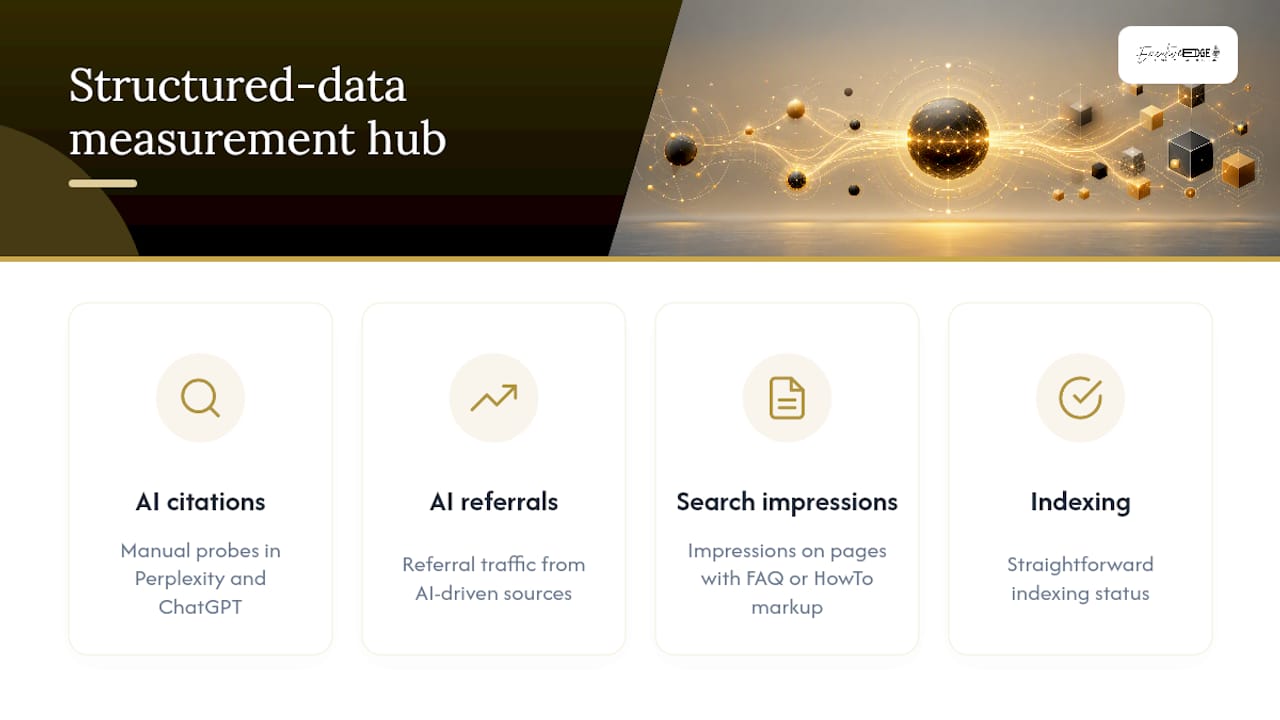
Track four things: manual citation probes in Perplexity and ChatGPT for your target queries, referral traffic from AI-driven sources in your analytics, search impressions on pages carrying FAQ or HowTo markup, and straightforward indexing status.
Structure a simple experiment: take a random sample of pages, add full schema to half, leave the rest untouched, then compare citation and referral behavior over 4 to 12 weeks. Be honest about confounding factors. Page speed, server-side rendering, and crawlability all correlate with citation probability independent of schema, so an uplift you see might be partly technical SEO catching up, not markup alone.
What Practitioners Get Wrong About Schema and AI Search
Schema isn't a hack. It's infrastructure that compounds with content quality and brand signals over time, and treating it as a one-time technical task misses the point entirely. The sites that see real citation gains are the ones that pair clean entity graphs with content that's actually worth citing.
For local business owners, including the ones we work with across Tyler and East Texas, the identity piece matters more than most people realize — this is crucial for AI in marketing: personalization, automation, and customer insights. If your Organization schema, Google Business Profile, and directory listings don't match, AI systems can attribute your expertise to the wrong entity or skip you entirely in favor of a competitor with cleaner signals. Validate first. Measure honestly. Iterate on identity before you chase volume.
— David Domm
A Managed Path for Teams That Don't Want to DIY Schema
If everything above sounds like the right approach but not something your team has bandwidth to execute and maintain, that's a legitimate constraint, not a failure. Schema work compounds, but only if someone keeps validating it, updating author entities as your team grows, and connecting it to content that's actually getting published on a schedule.

Executive Edge Partner Group built the Authority Content System around exactly that gap. It's a done-for-you approach: a single recording session and a guided intake enable the system to produce weekly podcast episodes, video, blog content, and social posts, while handling technical tasks like schema and author entity work as part of the production pipeline. For a deeper look at how AI search discovery actually works before you commit to any approach, this guide breaks down the mechanics. If you'd rather have identity signals, distribution, and measurement running in the background while you run your business, visit the Authority Content System to see how it fits your situation.
Sources
- Introduction to structured data markup in Google Search
- Schema
- How schema markup fits into AI search — without the hype
- Schema.org validator
FAQ
What Is Structured Data in AI Search?
Structured data is a labeled, machine-readable description of a page's content, most commonly written in JSON-LD, that tells AI systems what an entity is and how it relates to other entities. Google's documentation frames it as a standardized way to classify page content for search systems, and that same classification helps AI models resolve who created something and whether it's trustworthy.
Does AI Search Require Structured Data?
No engine strictly requires it, but skipping it puts you at a disadvantage for identity resolution and disambiguation. Google's AI Overviews and Bing Copilot draw directly from schema-tagged, indexed content, while engines like ChatGPT and Perplexity benefit more indirectly through cleaner entity signals wherever your content is referenced.
Can You Give an Example of Structured Data?
A simple example is Article schema on a blog post: JSON-LD specifying the headline, author (linked to a Person node), datePublished, and publisher (linked to an Organization node). Schema.org's Article type defines the full property list, and each value should match what's visibly on the page.
How Do You Build AI Search Visibility From Scratch?
Start with the schema floor: sitewide Organization markup with sameAs links, Person schema for every author, and Article schema on every piece of content. From there, layer in FAQPage and HowTo on relevant pages, validate everything through validator.schema.org, and measure citation behavior over several weeks rather than expecting instant results.
What Does Executive Edge Partner Group Charge for the Authority Content System?
Pricing for the Authority Content System varies based on the content and distribution needs of each business; current details are available directly on the provider's website. Reach out through the site to get current details for your situation.